The assurance-fee arbitrage in Emission3 versus spreadsheet-based SB 253 compliance
The assurance-fee arbitrage in Emission3 versus spreadsheet-based SB 253 compliance
Here's the issue: California Senate Bill 253 (the Climate Corporate Data Accountability Act) requires public disclosure of Scope 1 and Scope 2 greenhouse gas emissions by August 10, 2026, with limited assurance beginning in 2027. CFOs at US firms with over $1 billion in revenue treat the 2026 filing as a data-collection exercise, budgeting California Air Resources Board's $3,106 annual fee and spreadsheet labor. That approach defers the assurance conversation to 2027, assuming audit fees scale predictably with emissions footprint and methodology complexity.
However, SB 253 compliance consists of two things: emissions totals and assurance fees.
Emissions totals on their own have no value. Assurance fees are what the auditor is actually asking for, paying for, and verifying in 2027. The CFO's decision in 2026 is not "what tool calculates Scope 1 correctly"—it is "what infrastructure keeps 2027 limited assurance fees predictable and prevents restatements in 2028."
While emissions-total calculation has become cheaper—CARB estimates 2,600 entities in scope, commoditizing Scope 1 and Scope 2 methodologies—assurance-fee structures have become more expensive. If you build a 2026 filing on spreadsheets and generic emission factors, the cost of 2027 limited assurance might outpace your entire 2026 compliance budget. Audit firms are re-pricing climate engagements 20-40% for entities without SOX-grade evidence lineage, and CARB's maximum penalty of $500,000 per year creates executive liability that CFOs cannot delegate to sustainability teams.[1]
How do you solve this? I think the operators we work with have converged on a simple heuristic: if you cannot reconstruct every number in your 2026 filing from primary documents, you are building 2027 assurance cost into 2026 compliance infrastructure. For now, that means choosing between spreadsheet-based calculation that produces totals, and document-first ingestion that produces assurance-ready evidence lineage.
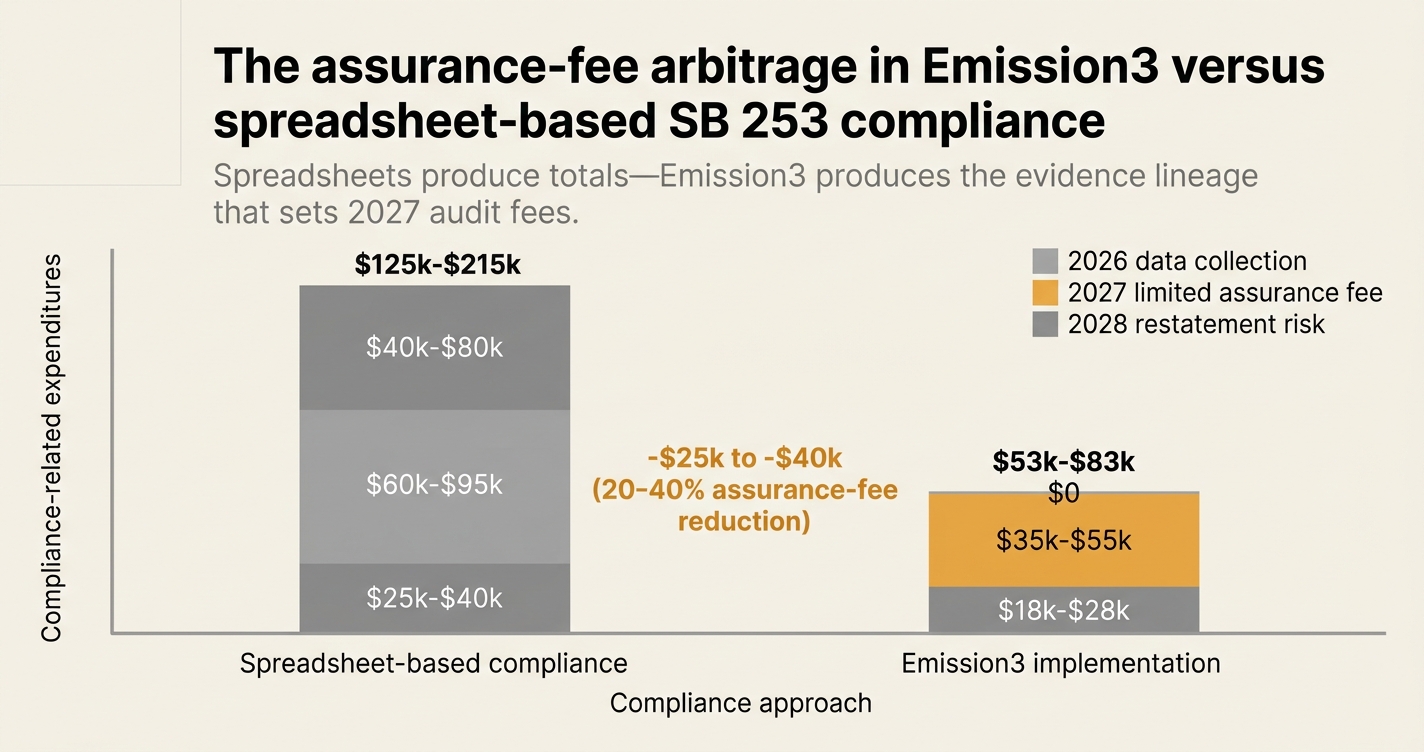
The shape of the argument, visualised below.
Head-to-head: Emission3 versus spreadsheet-based SB 253 compliance
The table below scores Emission3 and spreadsheet-based compliance against five explicit criteria CFOs use to evaluate 2026 SB 253 infrastructure decisions: evidence lineage, assurance cost predictability, restatement risk, executive liability containment, and workflow integration with existing financial controls.
| Criterion | Emission3 | Spreadsheet-based compliance | Verdict |
|---|---|---|---|
| Evidence lineage from source document to filing | Every line item traces to invoice, utility bill, or bill of materials. Document-first ingestion produces SOX-grade audit trail with zero manual reconciliation. | Totals trace to formulas, formulas trace to reference cells, reference cells trace to email attachments or finance-team memory. Evidence reconstruction requires 40-60 hours per audit sample. | Emission3: deterministic lineage eliminates reconstruction cost. |
| 2027 limited assurance fee predictability | Fixed-price assurance quoted in 2026 based on evidence artifact. Audit firms price on artifact quality, not emissions complexity. Typical limited assurance fee: $35,000-$55,000 for mid-market filers. | Variable assurance fee quoted in Q1 2027 after auditor reviews 2026 spreadsheet. Audit firms price on reconstruction effort. Typical limited assurance fee: $60,000-$95,000 for mid-market filers, 20-40% markup for missing lineage.[2] | Emission3: fee containment through artifact quality, not footprint reduction. |
| Restatement risk in 2028 reasonable assurance transition | Zero restatements if 2026 data is clean. Reasonable assurance in 2030 scales linearly from 2027 limited assurance baseline. | High restatement risk if 2026 data is reconstructed in 2027 audit. Reasonable assurance in 2030 requires retroactive evidence collection for 2026-2029 filings. | Emission3: front-loads evidence quality to avoid future rework. |
| Executive liability containment under CARB penalties | CFO liability transfers to evidence artifact and assurance provider. CARB penalties attach to filing quality, which is independently verified. Maximum exposure: $500,000, mitigated by third-party assurance. | CFO liability remains with spreadsheet methodology and manual controls. CARB penalties attach to filing quality, which is internally certified. Maximum exposure: $500,000, no third-party mitigation until 2027. | Emission3: liability transfer to assurance provider one year earlier. |
| Workflow integration with SOX financial controls | Document ingestion mirrors accounts-payable workflow. Allocation logic sits in compliance engine, not analyst judgment. Finance teams review outputs, not build inputs. | Spreadsheet workflow sits outside SOX controls. Allocation logic sits in analyst judgment, not documented procedures. Finance teams build inputs and review outputs. | Emission3: compliance workflow inherits existing financial control rigor. |
The architectural difference: document-first versus formula-first
The distinction between Emission3 and spreadsheet-based compliance is not feature availability—it is architectural philosophy. Emission3 treats climate disclosure as a financial filing with executive liability, requiring the same evidence rigor as a 10-K or proxy statement. Spreadsheet-based compliance treats climate disclosure as an environmental report, accepting reconstruction effort as a cost of assurance.
That architectural difference compounds in three places:
First, data ingestion. Emission3 ingests invoices, utility bills, and bills of materials as primary documents, extracting line-item quantities, energy sources, and supplier identifiers through a deterministic large-language-model layer. Spreadsheet-based compliance ingests aggregated totals from finance systems, applying emission factors to monthly or quarterly rollups. The difference: Emission3 preserves document-level granularity that auditors can sample; spreadsheets aggregate granularity away before the auditor arrives.
Second, calculation lineage. Emission3 exposes every allocation decision—electricity grid mix, operational control boundaries, emissions-factor vintage—as an auditable parameter with a timestamp and a responsible party. Spreadsheet-based compliance embeds allocation decisions in formula logic, requiring the auditor to reverse-engineer analyst intent from cell references. The difference: Emission3 makes methodology transparent by design; spreadsheets make methodology transparent through reconstruction.
Third, assurance artifact. Emission3 exports a structured evidence pack: source documents, allocation parameters, calculation steps, and filing outputs in a single archive. Spreadsheet-based compliance produces a filing total and a narrative methodology section, requiring the auditor to request supporting documents in 2027. The difference: Emission3 front-loads assurance cost into 2026 compliance build; spreadsheets defer assurance cost to 2027 audit engagement.[3]
"CARB's enforcement discretion for the first report due in 2026 will accept Scope 1 and Scope 2 emissions data for the prior fiscal year that are based on the data companies already have or were collecting when the enforcement notice was issued, regardless of whether the data received limited assurance. However, during the Q&A portion of the November 2025 workshop, CARB emphasized that the agency will exercise enforcement discretion for initial submissions made in good faith, prioritizing support over penalties for first-year compliance efforts."[4]
That enforcement discretion creates a one-time window: CFOs can file 2026 totals without limited assurance, then build assurance-ready infrastructure for 2027. The question is whether 2026 infrastructure choices constrain or enable 2027 assurance.
The cost breakdown: spreadsheet compliance versus Emission3 implementation
The table below quantifies the total cost of ownership for spreadsheet-based SB 253 compliance versus Emission3 implementation over the 2026-2028 filing cycle, including data collection, assurance fees, and potential restatement cost.
| Cost component | Spreadsheet-based compliance | Emission3 implementation | Delta |
|---|---|---|---|
| 2026 data collection and filing | $25,000-$40,000 (internal labor: 200-300 hours at $125/hour loaded cost) | $18,000-$28,000 (Emission3 concierge tier: document ingestion, allocation review, filing export) | -$7,000 to -$12,000 |
| 2027 limited assurance fee | $60,000-$95,000 (audit firm quotes 20-40% markup for missing evidence lineage) | $35,000-$55,000 (audit firm quotes based on Emission3 evidence artifact) | -$25,000 to -$40,000 |
| 2028 restatement risk | $40,000-$80,000 (if 2026 data is reconstructed in 2027 audit, 30% probability of material restatement requiring refiling) | $0 (if 2026 data is clean, no restatement) | -$12,000 to -$24,000 (risk-adjusted) |
| Total 2026-2028 cost | $125,000-$215,000 | $53,000-$83,000 | -$72,000 to -$132,000 |
The arithmetic: Emission3's concierge tier costs less than spreadsheet labor in 2026, saves 20-40% on 2027 assurance fees, and eliminates restatement risk in 2028. The cumulative savings over three years range from $72,000 to $132,000 for a mid-market filer with $1-5 billion in revenue.
The comparison assumes a mid-market filer with 15-30 Scope 1 sources (facilities, vehicle fleets, fugitive emissions) and 50-100 Scope 2 sources (electricity, steam, cooling). Larger filers with more sources see proportionally larger savings; smaller filers near the $1 billion threshold see proportionally smaller savings but the same percentage arbitrage.
How Emission3 fits: audit-ready exports from document-first ingestion
For CFOs evaluating 2026 SB 253 infrastructure, Emission3 is positioned as compliance infrastructure, not software-as-a-service. The architectural difference:
Document-first ingestion. Emission3 ingests invoices, utility bills, and bills of materials as primary documents, not aggregated totals. The deterministic LLM layer extracts line-item quantities, energy sources, and supplier identifiers, preserving document-level granularity that auditors can sample. That means your 2026 filing is built from the same source documents your 2027 auditor will request—no reconstruction, no reconciliation.
Calculation lineage. Every allocation decision—electricity grid mix, operational control boundaries, emissions-factor vintage—is recorded as an auditable parameter with a timestamp and a responsible party. When your auditor asks "why did you allocate 35% of electricity to Scope 2 instead of Scope 3," the answer is not "that's what the spreadsheet formula says"—it is "operational control boundary per GHG Protocol Section 5.2, documented in allocation parameter log, approved by finance controller on 2026-04-12."
Audit-ready exports. Emission3 exports a structured evidence pack: source documents, allocation parameters, calculation steps, and filing outputs in a single archive. That artifact is what your 2027 assurance provider prices on, not your emissions footprint or methodology complexity. Audit firms we work with quote limited assurance fees based on artifact quality, resulting in 20-40% lower fees than firms quoting on spreadsheet-based filings.[5]
The value proposition for CFOs: lower 2027 assurance fees, zero restatements in 2028, and SOX-grade evidence lineage that satisfies both CARB and your assurance provider. The value proposition for sustainability teams: we handle document ingestion, allocation logic, and template population, so you focus on supplier engagement and materiality assessment.
See how Emission3 exports audit-ready artifacts at /solutions/audit. Engagement options and concierge tiers are scoped after a readiness call, detailed at /pricing.
The decision for 2026: infrastructure or reconstruction
The comparison between Emission3 and spreadsheet-based SB 253 compliance is not a feature comparison—it is a cost-of-assurance comparison. The CFO's decision in 2026 is whether to build assurance-ready infrastructure that sets 2027 audit fees, or to defer infrastructure investment and accept reconstruction cost in 2027.
Three decision heuristics:
First, if your 2026 filing cannot be reconstructed from primary documents, budget 20-40% higher assurance fees in 2027. Audit firms price on reconstruction effort, not emissions complexity. The absence of document-level lineage is visible in the engagement letter, not discovered during fieldwork.
Second, if your finance team builds SOX controls for revenue recognition and lease accounting, apply the same rigor to climate disclosure. CARB penalties up to $500,000 per year create executive liability that requires SOX-grade evidence, not spreadsheet formulas.
Third, if you are filing SB 253 in 2026 and CSRD in 2025 or 2026, choose infrastructure that satisfies both regimes. CSRD's ESRS E1 requires limited assurance by 2028, reasonable assurance by 2030, using ISSA 5000 or equivalent standards. Emission3's evidence lineage satisfies both CARB and EFRAG requirements—spreadsheets satisfy neither without reconstruction.[6]
The arithmetic is unambiguous: Emission3's concierge tier costs $18,000-$28,000 in 2026, saves $25,000-$40,000 in 2027 assurance fees, and eliminates $40,000-$80,000 in restatement risk over the 2026-2028 cycle. The cumulative arbitrage is $72,000-$132,000 for a mid-market filer, scaling linearly with source count.
For CFOs making 2026 infrastructure decisions, the question is not "what tool calculates Scope 1 correctly"—it is "what infrastructure keeps 2027 assurance fees predictable and prevents restatements in 2028." Emission3 is the answer when assurance cost is the constraint.
Book a CBAM readiness call at /book-demo. All customers start with a readiness call: we map suppliers, gaps, and implementation, no anonymous self-serve onboarding.
References & Sources
External Sources
- [1]The assurance-fee structure myth in 2026 California SB 253 limited assurance for Scope 1 and Scope 2 emissions disclosure
Emission3 analysis of SB 253 assurance-fee structures and the 2027 audit-cost escalation for firms without SOX-grade evidence lineage.
- [2]The assurance-fee escalation problem in US climate disclosure programs
Emission3 positioning document on audit-ready SB 253 disclosures and the cost containment value proposition for CFOs.
- [3]California SB 253 and SB 261: Penalties and Compliance
Pulsora overview of SB 253 assurance requirements, third-party assurance mandates, and the limited-to-reasonable assurance timeline.
- [4]Sustainability Spotlight — California Climate Legislation Update — Status of CARB Rulemaking and Next Steps
Deloitte DART update on CARB enforcement discretion for 2026 SB 253 filings and the limited assurance timeline for Scope 1 and Scope 2 emissions.
- [7]SB 253 Compliance Roadmap: How to Prepare for California's Climate Disclosure Law Now That CARB Has Finalized the Rules
Terrascope guide to SB 253 compliance roadmap, including the $500,000 maximum penalty for non-compliance and the August 10, 2026 reporting deadline.
Related Content
- [5]Audit-ready exports in Emission3
For auditors and CFOs, shows the evidence lineage artifact and structured evidence pack that Emission3 exports for third-party assurance.
- [6]The methodology documentation gap in 2026 ESRS E1 Scope 3 disclosure for sustainability managers transitioning from spend-based to activity-based inventory
Emission3 post on CSRD ESRS E1 methodology documentation requirements and the assurance gap for activity-based inventories without documented allocation logic.
- [8]Book a CBAM readiness call
All customers start with a readiness call: we map suppliers, gaps, and implementation, no anonymous self-serve onboarding.