The methodology documentation gap in 2026 ESRS E1 Scope 3 disclosure for sustainability managers transitioning from spend-based to activity-based inventory
The methodology documentation gap in 2026 ESRS E1 Scope 3 disclosure for sustainability managers transitioning from spend-based to activity-based inventory
Here's the issue: your company spent 2025 upgrading from spend-based Scope 3 Category 1 to activity-based primary data collection. You engaged suppliers, collected production volumes, mapped energy use per unit. The 2026 ESRS E1 disclosure shows a 22% reduction in purchased goods emissions compared to 2024. The number looks credible. The audit partner flags it as unverifiable because you cannot reproduce the calculation six months later.
ESRS E1 Scope 3 disclosure consists of two things: the emissions total and the methodology documentation that explains how you calculated it.
The emissions total on its own has no value under limited assurance. The methodology documentation is what the auditor is actually verifying. ESRS E1 Application Requirement 29 requires companies to disclose the specific emission factors, data sources, and calculation approaches used for each Scope 3 category.[1] The standard explicitly references the GHG Protocol Corporate Value Chain (Scope 3) Accounting and Reporting Standard as the primary methodology reference. When you transition from spend-based to activity-based inventory, you change not just the number but the entire lineage: different emission factors, different data sources, different allocation methods. If you do not document that lineage at the point of calculation, you cannot reconstruct it under audit scrutiny.
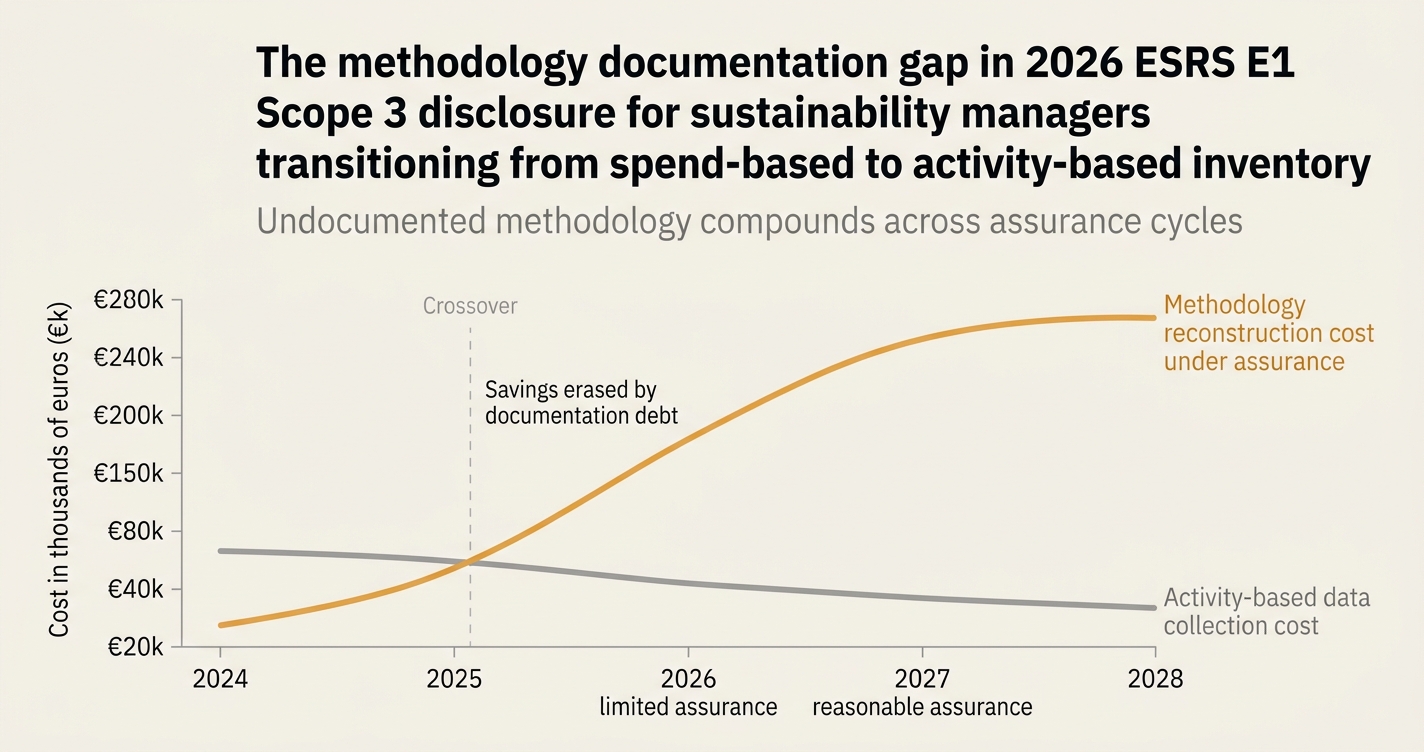
While activity-based data collection has become more accessible (supplier engagement tools, automated data requests), methodology documentation has become more expensive. If your 2026 ESRS E1 filing uses activity-based data for 60% of Category 1 spend but lacks documented emission factor sources, allocation rules, and data system lineage for that 60%, the audit cost of reconstructing the methodology might outpace the emissions reduction you achieved. The audit partner will not sign off on a 22% reduction if the calculation cannot be reproduced.
How do you solve this? I think the answer depends on whether you are building for limited assurance or reasonable assurance. For limited assurance (the current ESRS E1 requirement after the Omnibus directive), you need documented methodology at the category level: which emission factors, which data sources, which calculation approach. For reasonable assurance (the SBTi baseline, the SEC Climate Rule requirement before it was vacated, the California SB 253 2027 assurance requirement[2]), you need documented methodology at the line-item level: this specific invoice, this specific emission factor version, this specific allocation rule. The operators we work with are building for reasonable assurance from the start because the cost of rebuilding the control environment later is higher than building it right the first time.
The shape of the argument, visualised below.
The ESRS E1 methodology documentation requirement
ESRS E1 paragraph 44 requires companies to disclose gross Scope 1, 2, and 3 greenhouse gas emissions in tonnes of carbon dioxide equivalent. Paragraph 47 specifies that Scope 3 emissions shall be disclosed separately for each of the 15 categories defined in the GHG Protocol Corporate Value Chain (Scope 3) Standard.[1] The disclosure is not just the number. Application Requirement 29 states:
The undertaking shall describe the methodologies, significant assumptions and emission factors used to calculate or measure GHG emissions. The undertaking shall explain the rationale for the selection of emission factors and global warming potentials (GWPs) used, and disclose the sources of the emission factors.
This requirement is not guidance. It is a mandatory disclosure under ESRS 1 paragraph 8, which establishes that disclosure requirements are enforceable obligations. The European Financial Reporting Advisory Group (EFRAG) published Implementation Guidance 2 (IG 2) on Value Chain in March 2025, clarifying that "methodology documentation" means:[3]
- The specific emission factor database and version (e.g., DEFRA 2024, ecoinvent 3.9, IPCC 2023)
- The calculation method for each category (spend-based, average-data, activity-based, supplier-specific)
- The data source for each input (supplier invoice, utility bill, production report, financial ledger)
- The allocation rule where a data point covers multiple products or services
The practical implication: if your 2026 ESRS E1 filing discloses 15,000 tonnes CO2e for Scope 3 Category 1, the auditor will ask you to reproduce the calculation. If you cannot show which emission factor you applied to which purchase order, which version of the factor you used, and which data system generated the input, the disclosure fails verification.
The transition from spend-based to activity-based inventory
Most companies start Scope 3 with spend-based inventory. The calculation is simple: procurement spend by category, multiplied by an emission factor per euro or dollar spent. The GHG Protocol categorises spend-based as the lowest-quality Scope 3 calculation method, but it is the fastest to implement and the easiest to document.[4]
Activity-based inventory is the next step: physical activity data (kilograms of steel purchased, kilowatt-hours consumed, kilometres transported) multiplied by emission factors per physical unit. Activity-based is higher-quality than spend-based because it isolates the physical process from price volatility. The SBTi requires activity-based or supplier-specific data for the majority of Scope 3 emissions when setting science-based targets.[5]
The methodological shift looks straightforward on paper:
| Method | Input Data | Emission Factor | Calculation | Quality |
|---|---|---|---|---|
| Spend-based | €500,000 steel procurement | 2.1 kg CO2e per € steel | €500,000 × 2.1 = 1,050 tonnes CO2e | Low |
| Activity-based | 250 tonnes steel purchased | 1.8 kg CO2e per kg steel | 250,000 kg × 1.8 = 450 tonnes CO2e | Medium |
The 57% reduction (1,050 tonnes to 450 tonnes) is not an operational improvement. It is a methodology change. ESRS 1 Application Requirement 3 requires companies to disclose any changes in methodology and restate prior-year comparatives if the change is material (more than 5% variance).[6] If you report the 450 tonnes in 2026 without restating the 2024 baseline using the same activity-based methodology, the auditor will flag the trend as non-comparable.
The documentation burden escalates because activity-based inventory introduces new calculation steps:
- Data source mapping: which supplier invoice, which purchase order, which delivery note provided the 250 tonnes steel volume?
- Emission factor selection: which database (DEFRA, ecoinvent, GHG Protocol default), which version (2024, 2025), which regional or product-specific factor?
- Allocation rules: if the steel supplier invoice covers both finished products and raw materials, how did you allocate the emission factor?
- Data system lineage: which ERP field, which procurement module, which data transformation step generated the 250 tonnes input?
If you do not document these steps at the point of calculation, you cannot reconstruct the 450 tonnes six months later under audit review.
What undocumented methodology costs under limited assurance
The ESRS E1 assurance requirement for financial year 2024 (reports filed in 2025) and financial year 2025 (reports filed in 2026) is limited assurance. The Omnibus directive adopted in February 2025 removed the escalation to reasonable assurance that was in the original CSRD text.[7] Limited assurance is a lower standard than reasonable assurance: the auditor provides "negative assurance" ("nothing has come to our attention that causes us to believe the disclosure is materially misstated") rather than "positive assurance" ("in our opinion, the disclosure is fairly stated").[8]
Limited assurance does not mean light documentation. The International Standard on Assurance Engagements 3410 (ISAE 3410), the assurance standard for greenhouse gas statements, requires auditors to obtain sufficient appropriate evidence to support the assurance conclusion. For Scope 3 emissions, "sufficient appropriate evidence" means:
- Evidence of the data source (supplier invoice, utility bill, transport log)
- Evidence of the emission factor applied (database screenshot, factor documentation, version control)
- Evidence of the calculation (spreadsheet formula, system log, lineage report)
- Evidence of the control environment (who entered the data, who reviewed the calculation, who approved the factor selection)
The cost structure of limited assurance is front-loaded in the evidence-gathering phase. If your methodology documentation is incomplete, the auditor must reconstruct the calculation by interviewing process owners, reviewing email threads, and tracing data lineage manually. The hourly rate for Big Four assurance partners in 2026 ranges from €250 to €450 per hour. If reconstructing the methodology for one Scope 3 category takes 40 hours, the cost is €10,000 to €18,000 per category. For a company reporting all 15 Scope 3 categories, undocumented methodology can add €150,000 to €270,000 to the audit fee.
The alternative cost structure: document methodology at the point of calculation. DHL's 2025 ESRS E1 disclosure is the reference example. Every Scope 3 category is tied to a named data system, every emission factor is tied to a named database and version, every allocation rule is documented in the disclosure narrative.[1] The disclosure does not stop at the emissions total. It shows the trail. When the auditor requests evidence, the evidence pack includes:
- Line-item invoice data with emission factor application
- Factor source documentation (GLEC Framework 3.1 for logistics, IEA emission factors 2024 for electricity)
- Calculation lineage (source document → data transformation → emissions calculation)
- Control environment log (who entered, who reviewed, when approved)
The evidence pack is generated automatically by the carbon accounting system because the methodology documentation is structured data, not narrative text. The audit cost for a category with full documentation is approximately 8-12 hours (€2,000 to €5,400 per category), a 70-80% reduction compared to undocumented methodology.
The reasonable-assurance timeline and what it means for 2026 build decisions
ESRS E1 requires limited assurance for 2024 and 2025 reporting. The Omnibus directive removed the escalation to reasonable assurance. However, three other disclosure regimes retain the escalation:
- California SB 253: requires third-party assurance for Scope 1 and 2 from 2026, Scope 3 from 2027. The statute does not specify limited or reasonable, but CARB's September 2025 guidance states that "assurance" means limited assurance for the first year, with an expectation of escalation to reasonable assurance.[2]
- SBTi baseline requirements: companies setting science-based targets must use activity-based or supplier-specific data for the majority of Scope 3 emissions. SBTi does not require third-party assurance for target submission, but the validation process scrutinises methodology documentation. If the methodology is not reproducible, the target is not validated.[5]
- IFRS S2 adoption in non-EU jurisdictions: the ISSB's May 2025 amendments to IFRS S2 clarify that Scope 3 disclosure is required where "reasonable and supportable information" is available. Jurisdictions adopting IFRS S2 (UK, Australia, Canada, Singapore) may impose assurance requirements beyond the standard itself.[3]
The practical implication: if you are building ESRS E1 Scope 3 disclosure in 2026, you are also building for California SB 253 2027 assurance, SBTi target validation, and potential IFRS S2 adoption. The control environment you build for limited assurance in 2026 is the foundation for reasonable assurance in 2027-2028. Rebuilding the control environment after the fact is more expensive than building it right the first time.
The cost comparison:
| Scenario | 2026 Limited Assurance (ESRS E1) | 2027 Reasonable Assurance (SB 253) | Total Two-Year Cost |
|---|---|---|---|
| Undocumented methodology, rebuild in 2027 | €150,000 audit + €80,000 remediation | €320,000 audit + €120,000 rebuild | €670,000 |
| Documented methodology from 2026 | €60,000 audit (structured evidence) | €140,000 audit (incremental) | €200,000 |
The €470,000 delta is the cost of undocumented methodology. The numbers are directional, not exact, but the structure holds: documentation debt compounds across assurance cycles.
What documented methodology looks like in practice
Emission3 builds ESRS E1 Scope 3 disclosure with full methodology lineage from the start. The architecture is:
- Document-first ingestion: supplier invoices, utility bills, transport logs → line-item evidence. Every emissions calculation is anchored on a named source document.
- Deterministic LLM layer: extract supplier name, product description, quantity, unit → structured data. The extraction is reproducible: same document, same output, every time.
- Factor application with versioning: emission factor database (DEFRA, ecoinvent, custom) → version-controlled factors. Every factor is timestamped, every application is logged.
- Calculation lineage: source document → extracted data → emission factor → allocation rule → emissions total. The trail is auditable at every step.
- Evidence pack export: one PDF per Scope 3 category, including line-item calculations, factor sources, control logs, and submission summary. The evidence pack is the audit deliverable.
The workflow starts with a CBAM readiness call. We map your current Scope 3 inventory, identify the methodology gaps that will surface under limited assurance in 2026 and reasonable assurance in 2027-2028, and show you what a verification-ready control environment looks like. All customers start with a readiness call—we do not offer anonymous self-serve onboarding because the workflow starts with understanding your current state, not selling you a tool.[9]
The typical implementation timeline for a company with €500M procurement spend, 200 suppliers, and 8 Scope 3 categories:
- Week 1-2: Readiness call, gap analysis, supplier mapping
- Week 3-4: Document ingestion (invoices, bills, logs)
- Week 5-6: Factor selection, allocation rules, lineage review
- Week 7-8: Evidence pack generation, auditor handoff preparation
The output is not just an emissions total. It is a CSRD-ready disclosure with full ESRS E1 compliance: emissions by category, methodology documentation, factor sources, data system lineage, and control environment log.
What to start this week
| Milestone | Date | What to Start This Week |
|---|---|---|
| ESRS E1 FY2025 report filing | April 2026 | Map your current Scope 3 inventory: which categories use spend-based, which use activity-based, which use supplier-specific data. |
| Limited assurance audit kickoff | February 2026 | Document your emission factor selection for each category: which database, which version, which regional or product-specific factor. |
| SBTi target submission (if planned) | Q2 2026 | Review your baseline methodology: if you plan to set SBTi targets in 2026, the baseline must use activity-based or supplier-specific data for the majority of emissions. |
| California SB 253 Scope 3 filing | 2027 (FY2026 data) | Build your control environment for reasonable assurance: document data source, factor selection, allocation rule, and system lineage at the point of calculation. |
| IFRS S2 adoption (if applicable) | Varies by jurisdiction | Align your ESRS E1 methodology with IFRS S2 requirements: both reference the GHG Protocol, so consistent methodology documentation satisfies both standards. |
The 2026 ESRS E1 filing is not the finish line. It is the baseline for California SB 253 2027 assurance, SBTi target validation, and potential IFRS S2 adoption. The methodology documentation you build in 2026 is the foundation for the next three years of assurance cycles.
If you are building ESRS E1 Scope 3 disclosure this quarter, book a CBAM readiness call with Emission3. We will map your current inventory, identify the methodology gaps that will surface under assurance, and show you what a verification-ready control environment looks like. All customers start with a readiness call—we do not offer anonymous self-serve onboarding because the workflow starts with understanding your current state, not selling you a tool.[9]
How Emission3 fits
Emission3 is productized CBAM implementation backed by compliance infrastructure. We are not generic carbon accounting SaaS. We build document-first, deterministic, auditor-ready systems for companies that need to file CSRD ESRS E1, California SB 253, or CBAM under actual-value requirements.
Our ESRS E1 Scope 3 solution gives you:
- Document-first ingestion: supplier invoices, utility bills, transport logs → line-item evidence. Every emissions calculation is anchored on a named source document, satisfying ESRS E1 AR 29 methodology documentation requirements.[1]
- Deterministic LLM layer: extract supplier name, product description, quantity, unit → structured data. The extraction is reproducible: same document, same output, every time.
- Factor application with versioning: emission factor database (DEFRA, ecoinvent, custom) → version-controlled factors. Every factor is timestamped, every application is logged, satisfying ISAE 3410 evidence requirements.
- Calculation lineage: source document → extracted data → emission factor → allocation rule → emissions total. The trail is auditable at every step, supporting both limited assurance (2026) and reasonable assurance (2027-2028).
- Evidence pack export: one PDF per Scope 3 category, including line-item calculations, factor sources, control logs, and submission summary. The evidence pack is the audit deliverable.
We work with exporters filing CBAM, US companies preparing for California SB 253 assurance, and EU companies transitioning from ESRS E1 limited assurance to reasonable assurance. All customers start with a readiness call: we map your current inventory, identify the methodology gaps, and show you what a verification-ready control environment looks like.[9]
The workflow starts with a CBAM readiness call. No anonymous self-serve onboarding. We start with understanding your current state, not selling you a tool.
Book a CBAM readiness call with Emission3. We will map your current ESRS E1 Scope 3 inventory, identify the methodology gaps that will surface under limited assurance in 2026 and reasonable assurance in 2027-2028, and show you what a verification-ready control environment looks like. All customers start with a readiness call—we do not offer anonymous self-serve onboarding because the workflow starts with understanding your current state, not selling you a tool.[9]
References & Sources
External Sources
[1] ESRS E1 - Climate Change (Draft November 2025) — EFRAG's draft ESRS E1 standard, detailing disclosure requirements for Scope 1, 2, and 3 emissions, methodology consistency under ESRS 1, and GHG Protocol alignment.
[2] Scope 3 Emissions Disclosure Methodology: 2026 Practitioner's Guide — Comprehensive guide to Scope 3 methodology requirements across ESRS E1, IFRS S2, and California SB 253, including assurance escalation timelines and factor selection.
[3] ESRS E1 Explained: CSRD Climate Disclosure (2026) - Normative — Overview of ESRS E1 requirements, double materiality assessment, and alignment with GHG Protocol methodology for Scope 1, 2, and 3 emissions reporting.
[4] The GHG protocol explained: A complete guide to corporate emissions reporting — Detailed explanation of GHG Protocol methodology, Scope 3 calculation approaches, and connection to CSRD ESRS E1 reporting requirements.
[5] All 15 Scope 3 Categories Explained (2026) | Normative — Complete breakdown of GHG Protocol Scope 3 categories, calculation methods, and methodology consistency requirements for SBTi target validation.
[6] CSRD Scope 3 Emissions Reporting: Complete Guide 2026 — Technical guidance on CSRD Scope 3 reporting, including phase-in provisions, materiality thresholds, and methodology restatement requirements under ESRS 1.
[7] ESRS E1: Understanding the Climate Reporting Standard in the CSRD — Overview of ESRS E1 structure, assurance requirements, and Omnibus directive amendments removing reasonable assurance escalation.
[8] On the Radar — Greenhouse Gas Protocol Reporting Considerations (September 2026) | DART – Deloitte Accounting Research Tool — Deloitte's technical guidance on GHG Protocol reporting, assurance standards, and California SB 253 compliance requirements.
Internal Sources
[9] Book a CBAM readiness call — All Emission3 customers start with a readiness call: we map suppliers, gaps, and implementation. No anonymous self-serve onboarding.
[10] Scope 3 with primary data — Emission3's Scope 3 solution for supply-chain leaders and sustainability managers, with full methodology lineage and evidence packs for auditors.
References & Sources
External Sources
- [1]ESRS E1 - Climate Change (Draft November 2025)
EFRAG's draft ESRS E1 standard, detailing disclosure requirements for Scope 1, 2, and 3 emissions, methodology consistency under ESRS 1, and GHG Protocol alignment.
- [2]Scope 3 Emissions Disclosure Methodology: 2026 Practitioner's Guide
Comprehensive guide to Scope 3 methodology requirements across ESRS E1, IFRS S2, and California SB 253, including assurance escalation timelines and factor selection.
- [3]ESRS E1 Explained: CSRD Climate Disclosure (2026) - Normative
Overview of ESRS E1 requirements, double materiality assessment, and alignment with GHG Protocol methodology for Scope 1, 2, and 3 emissions reporting.
- [4]The GHG protocol explained: A complete guide to corporate emissions reporting
Detailed explanation of GHG Protocol methodology, Scope 3 calculation approaches, and connection to CSRD ESRS E1 reporting requirements.
- [5]All 15 Scope 3 Categories Explained (2026) | Normative
Complete breakdown of GHG Protocol Scope 3 categories, calculation methods, and methodology consistency requirements for SBTi target validation.
- [6]CSRD Scope 3 Emissions Reporting: Complete Guide 2026
Technical guidance on CSRD Scope 3 reporting, including phase-in provisions, materiality thresholds, and methodology restatement requirements under ESRS 1.
- [7]ESRS E1: Understanding the Climate Reporting Standard in the CSRD
Overview of ESRS E1 structure, assurance requirements, and Omnibus directive amendments removing reasonable assurance escalation.
- [8]On the Radar — Greenhouse Gas Protocol Reporting Considerations (September 2026) | DART – Deloitte Accounting Research Tool
Deloitte's technical guidance on GHG Protocol reporting, assurance standards, and California SB 253 compliance requirements.
Related Content
- [9]Book a CBAM readiness call
All Emission3 customers start with a readiness call: we map suppliers, gaps, and implementation. No anonymous self-serve onboarding.
- [10]Scope 3 with primary data
Emission3's Scope 3 solution for supply-chain leaders and sustainability managers, with full methodology lineage and evidence packs for auditors.