The assurance-fee structure myth in 2026 California SB 253 limited assurance for Scope 1 and Scope 2 emissions disclosure
The assurance-fee structure myth in 2026 California SB 253 limited assurance for Scope 1 and Scope 2 emissions disclosure
Here's the issue: California SB 253 requires public disclosure of Scope 1 and Scope 2 greenhouse gas emissions by November 10, 2026, with limited assurance beginning in 2027. CFOs treat the 2026 filing as a data-collection exercise, budgeting CARB's $3,106 annual fee and spreadsheet labor. That approach defers the assurance conversation to 2027, assuming audit fees scale predictably with emissions footprint.
However, California SB 253 disclosure consists of two things: emissions totals and assurance fees.
Emissions totals on their own have no value. Assurance fees are what the auditor is actually asking for, paying for, and verifying in 2027.
While emissions-total calculation has become cheaper—CARB estimates 2,600 entities in scope, commoditizing Scope 1 and Scope 2 methodologies—assurance-fee structures have become more expensive. If you build a 2026 filing on spreadsheets and generic emission factors, the cost of 2027 limited assurance might outpace your entire 2026 compliance budget. Audit firms are re-pricing climate engagements 20-40% for entities without SOX-grade evidence lineage, and CARB's maximum penalty of $500,000 per year creates executive liability that CFOs cannot delegate to sustainability teams.
How do you solve this? I think you treat the 2026 filing as assurance infrastructure, not emissions accounting. The operators we work with anchor 2026 workflows to the 2027 audit brief: every utility bill, every invoice, every allocation becomes a line-item evidence artifact. For now, that means document-first ingestion and deterministic calculation lineage, so limited assurance in 2027 becomes a review exercise, not a reconstruction project.
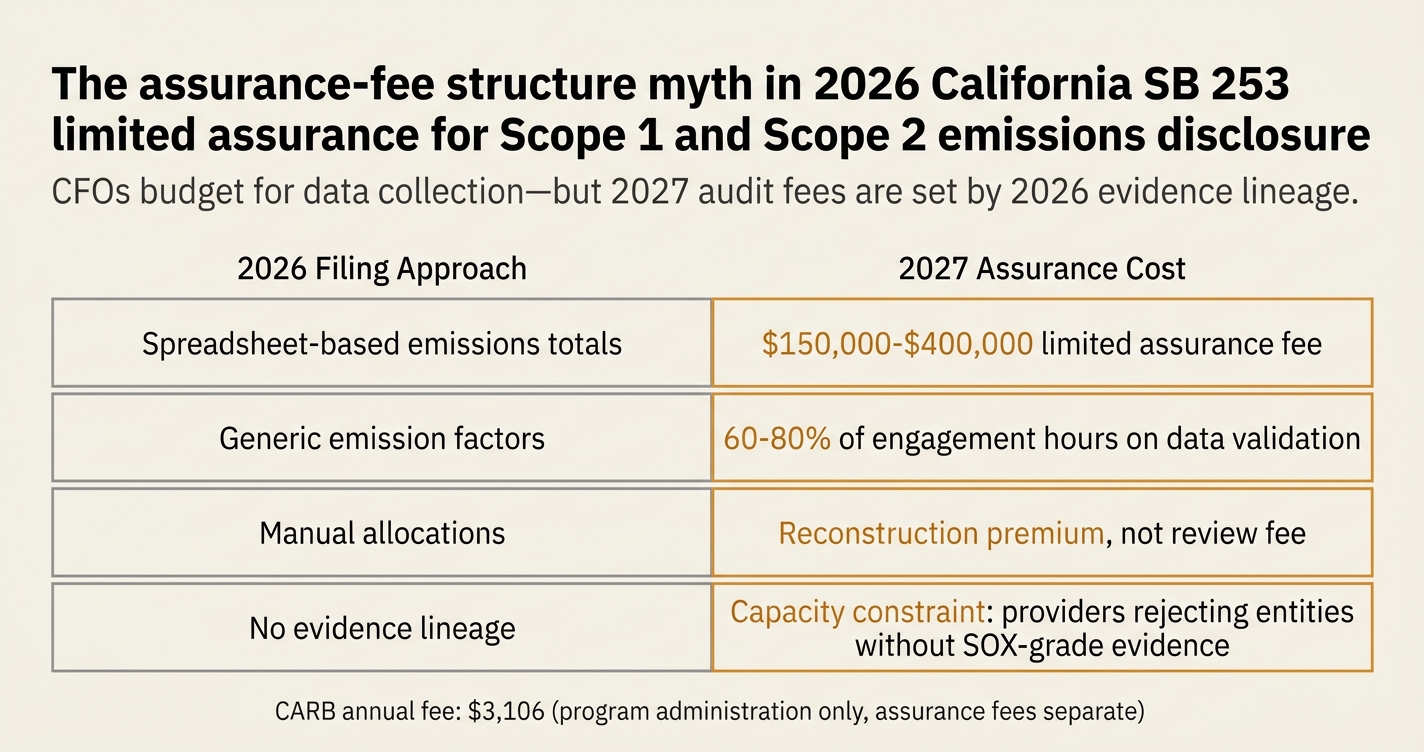
The shape of the argument, visualized below.
Myth 1: "Limited assurance in 2027 will cost the same as our 2026 data-collection budget"
Reality: Limited assurance is not scaled data collection—it is an independent audit of your evidence lineage and calculation methodology. Audit firms price assurance engagements by the number of hours required to trace every number back to source documents. If your 2026 filing is built on spreadsheets, generic emission factors, and manual allocations, your 2027 audit will require full reconstruction. CARB's February 26, 2026 regulations set annual fees at $3,106 per entity for SB 253 program administration, but assurance provider fees are separate, negotiated engagements. Market feedback from Big Four firms indicates limited assurance for a mid-sized entity without evidence lineage ranges from $150,000 to $400,000 for the first cycle.[1]
The cost delta is not linear. Audit firms are not re-pricing by emissions volume—they are re-pricing by audit trail complexity. If you defer evidence-lineage design to 2027, your assurance provider will spend 60-80% of engagement hours on data validation, not disclosure review.
Myth 2: "CARB's reporting template is the compliance artifact"
Reality: CARB's Scope 1 and Scope 2 reporting template is a submission format, not an evidence artifact. The template collects emissions totals by source category, but limited assurance in 2027 requires traceability from those totals back to utility bills, invoices, fuel receipts, and allocation methodologies. CARB released the draft template in September 2025, with public feedback accepted until October 27, 2025, and final adoption in February 2026. The template references the GHG Protocol Corporate Standard and the U.S. EPA Simplified GHG Emissions Calculator, but it does not specify evidence-lineage requirements. Those requirements are set by the assurance standard—ISAE 3410 for greenhouse gas statements, or ISSA 5000 for sustainability assurance starting December 15, 2026.[2]
Assurance providers do not audit the template—they audit the calculation logic and source documents that populate the template. If your 2026 submission is accurate but your evidence lineage is incomplete, your 2027 assurance engagement becomes a forensic review.
Myth 3: "We can reuse our CDP or TCFD disclosures for SB 253"
Reality: CDP and TCFD disclosures are voluntary frameworks with no statutory assurance requirements. California SB 253 is a financial filing with executive liability. CARB's maximum annual penalty is $500,000, and California Health and Safety Code Section 38532 places legal responsibility on the reporting entity's executive officers. CDP disclosures are typically built on estimated emissions factors and supplier surveys, which satisfy voluntary reporting but fail limited assurance. TCFD disclosures under SB 261 (currently paused by Ninth Circuit injunction as of November 18, 2025) require climate-risk narrative, not line-item emissions evidence.[3]
The reuse opportunity is methodological, not artifactual. If your CDP workflow already includes utility-bill ingestion and allocation logic, that infrastructure can support SB 253 compliance. If your CDP workflow is built on annual supplier questionnaires and industry-average factors, you are starting from zero.
Myth 4: "No assurance in 2026 means we can delay evidence-lineage design"
Reality: CARB's phased assurance timeline creates a 12-month window to build audit-ready infrastructure. The first Scope 1 and Scope 2 reports are due November 10, 2026 (or August 10, 2026 for entities with fiscal years ending before February 1, 2026), with no assurance requirement for that first filing. Limited assurance begins in 2027, covering fiscal year 2026 data. The delay is not a deferral—it is a design window. Assurance providers need at least six months to scope an engagement, and they will reject entities without evidence lineage. If you submit a spreadsheet-based 2026 filing and approach assurance providers in Q1 2027, you will either pay a reconstruction premium or miss the 2027 deadline.[4]
The infrastructure you build in 2026 determines your 2027 audit cost. Treat the 2026 filing as a pilot engagement with your future assurance provider, even if no formal assurance is required.
Myth 5: "Assurance providers are interchangeable"
Reality: California SB 253 requires assurance providers to be independent, systematic, and free of conflicts of interest. CARB proposed these criteria in its second public workshop in September 2025, but did not specify accreditation standards or a registry of qualified providers. In practice, limited assurance for greenhouse gas statements is provided by Big Four accounting firms, specialized sustainability auditors, and ISO-accredited verification bodies. Not all providers have capacity for 2,600 entities in 2027. Not all providers have experience with ISAE 3410 or ISSA 5000. Not all providers will accept engagements for entities without evidence lineage.[5]
Assurance capacity is a binding constraint. If you wait until 2027 to select a provider, you will be competing for the same limited pool as 2,600 other entities. The firms with ISSA 5000 expertise (the new standard replacing ISAE 3410 after December 15, 2026) are already booking 2027 engagements.
Myth 6: "Scope 3 is optional in 2027, so we can focus on Scope 1 and Scope 2 first"
Reality: Scope 3 reporting begins in 2027 (exact date to be determined by CARB), and early builds of Scope 3 evidence lineage reduce 2028 assurance costs. CARB's draft regulations propose reporting the most material Scope 3 categories first, with full Category 1-15 disclosure phased in over subsequent years. Scope 3 assurance is not required until 2030, but the infrastructure you build in 2027 determines whether 2030 assurance is a review or a reconstruction. Scope 3 data collection is more complex than Scope 1 and Scope 2—supplier engagement, invoice matching, and allocation logic require 6-12 months of baseline development.[6]
If you treat 2026-2027 as Scope 1 and Scope 2 only, you will face a second infrastructure build in 2028-2029 for Scope 3. The entities with the lowest assurance costs in 2030 are building Scope 3 evidence lineage in parallel with Scope 1 and Scope 2 in 2026-2027.
Myth 7: "SB 253 is a California-only requirement"
Reality: California SB 253 applies to any U.S.-organized entity with over $1 billion in annual revenue doing business in California. "Doing business in California" is defined broadly: CARB's preliminary covered-entity list includes companies headquartered outside California with California customers, California suppliers, or California employees. The revenue threshold is global, not California-specific. CARB estimates 2,600 entities in scope, including multinational corporations with no California headquarters. The regulation is not a California-only disclosure—it is a federal-reach climate reporting regime implemented at the state level.[7]
If your company has California revenue, California employees, or California suppliers, assume you are in scope. CARB opened a preliminary covered-entity list for public comment in 2025, and the final list will be published in 2026. Waiting for confirmation is a risk—if you are confirmed in scope in mid-2026, you will have less than six months to build evidence lineage for the November 2026 filing.
Summary: The assurance-fee structure at a glance
| Element | 2026 Reality | 2027 Consequence |
|---|---|---|
| CARB annual fee | $3,106 per entity (flat rate for program administration) | Same flat rate, plus separate assurance provider fees |
| Assurance requirement | None for first filing (November 10, 2026 deadline) | Limited assurance required for fiscal year 2026 data |
| Assurance provider fees | Not applicable in 2026 | $150,000-$400,000 for entities without evidence lineage |
| Evidence lineage | Not required for 2026 submission | Required for 2027 limited assurance engagement |
| Scope 3 reporting | Not required in 2026 | Required in 2027 (date TBD), assurance required in 2030 |
| Maximum penalty | $500,000 per year for non-compliance | Same penalty, plus reputational and capital-access risks |
| Capacity constraint | 2,600 entities in scope, no capacity constraint in 2026 | Limited assurance providers booking 2027 engagements now |
How Emission3 fits
Emission3 positions California SB 253 compliance as assurance-ready infrastructure, not emissions accounting. Our implementation starts with a CBAM readiness conversation (required for all customers, no anonymous self-serve onboarding), where we map your utility bills, invoices, and allocation logic to CARB's reporting template and your 2027 assurance brief. The platform ingests documents first—utility bills, fuel receipts, supplier invoices—and builds line-item evidence artifacts with full calculation lineage. Every number in your 2026 filing is reproducible from source documents, so your 2027 limited assurance engagement becomes a review, not a reconstruction.
Our compliance engine is deterministic: we use a structured LLM layer to extract line-item data from invoices and allocate emissions by facility, product, or reporting entity, but every allocation is human-reviewable and auditor-ready. Outputs include CARB-template submissions, evidence packs for assurance providers, and registry-oriented exports for ISSA 5000 or ISAE 3410 engagements. We also build Scope 3 evidence lineage in parallel with Scope 1 and Scope 2, so your 2027 Scope 3 filing and 2030 Scope 3 assurance are infrastructure extensions, not new projects.
For CFOs and finance teams, the value proposition is cost containment: lower 2027 assurance fees, zero restatements, and SOX-grade evidence lineage that satisfies both CARB and your assurance provider. For sustainability teams, the value proposition is workflow: we handle document ingestion, allocation logic, and template population, so you focus on supplier engagement and materiality assessment.
See how Emission3 exports audit-ready artifacts at /solutions/audit. Engagement options and concierge tiers are scoped after a readiness call, detailed at /pricing.
The decision for 2026: infrastructure or reconstruction
California SB 253 limited assurance in 2027 is not a compliance extension—it is an audit of the infrastructure you build in 2026. CFOs who treat the 2026 filing as a data-collection exercise will pay reconstruction premiums in 2027. CFOs who treat the 2026 filing as assurance infrastructure will pay review fees in 2027. The cost delta is 2-3x, and the capacity constraint is binding: assurance providers are already booking 2027 engagements, and entities without evidence lineage will compete for the same limited pool.
The operators we work with anchor 2026 workflows to the 2027 audit brief: every utility bill, every invoice, every allocation becomes a line-item evidence artifact. For now, that means document-first ingestion and deterministic calculation lineage, so limited assurance in 2027 becomes a review exercise, not a reconstruction project.
Book a CBAM readiness call at /book-demo to map your SB 253 workflow to your 2027 assurance brief. All customers start with a readiness call—we map suppliers, gaps, and implementation timelines before any engagement begins.
References & Sources
External Sources
- [1]California's climate disclosure laws: An overview of SB 253 & SB 261 (Updated November 2025) - Optera
Overview of California SB 253 and SB 261 requirements, including phased assurance timelines and reporting deadlines for Scope 1, 2, and 3 emissions.
- [2]SB 253 Compliance Roadmap: How to Prepare for California's Climate Disclosure Law Now That CARB Has Finalized the Rules
CARB's February 26, 2026 regulations implementing SB 253, including fee structures, reporting templates, and assurance requirements for Scope 1 and Scope 2 emissions.
- [3]The 9th Circuit and California's climate disclosure laws—what companies need to know – Watershed
Legal status of California SB 253 and SB 261, including Ninth Circuit injunction on SB 261 enforcement and implications for compliance timelines.
- [4]A guide to California's climate disclosure rules (SB 253, SB 261, SB 219) – Watershed
Comprehensive guide to California SB 253 requirements, including assurance timelines, Scope 3 reporting phases, and alignment with CSRD and TCFD frameworks.
- [5]Recapping CARB's Second Public Workshop for California's Climate Disclosure Laws | Thompson Hine LLP
CARB's second public workshop on SB 253 implementation, including proposed assurance provider criteria, reporting templates, and flat annual fee structure.
- [6]California's climate disclosure regulations: An update on SB 253 and SB 261 | Baker Tilly
Baker Tilly's analysis of SB 253 implementation, including Scope 3 reporting requirements, assurance timelines, and evidence-lineage best practices.
- [7]Nelson Mullins - Navigating California's Climate Disclosure Laws: Your Complete Guide to SB 253 and SB 261
Legal guide to SB 253 and SB 261 scope, including definitions of "doing business in California" and covered-entity criteria for U.S.-organized entities.
Related Content
- [8]Audit-ready exports in Emission3
For auditors and CFOs, shows the evidence lineage artifact: document-first ingestion, deterministic calculation logic, and registry-oriented outputs for ISSA 5000 or ISAE 3410 engagements.
- [9]Book a CBAM readiness call
All customers start with a readiness call: we map suppliers, gaps, and implementation timelines before any engagement begins. No anonymous self-serve onboarding.