The 2027 compliance-cost crossover for mid-market manufacturers
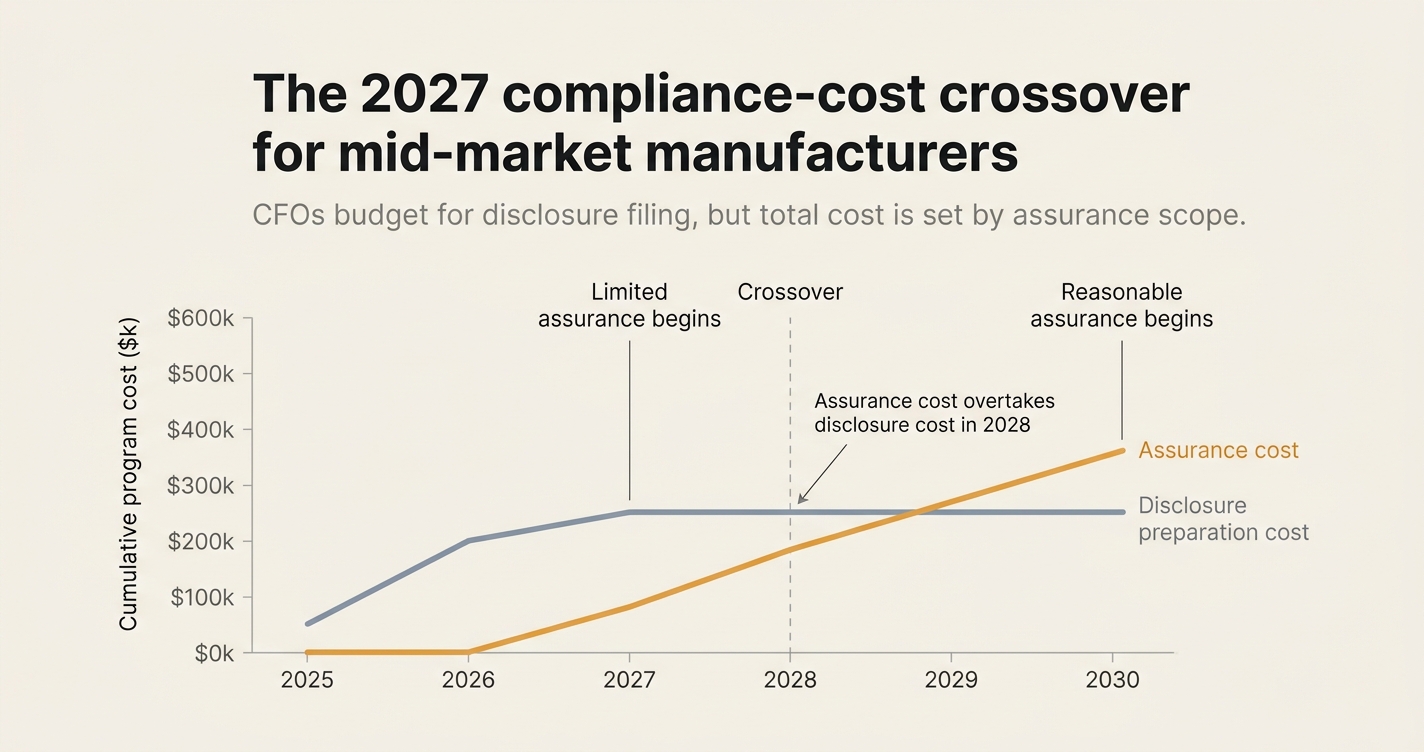
The 2027 compliance-cost crossover for mid-market manufacturers
Here's the issue: mid-market manufacturers with revenue between $500 million and $2 billion are budgeting for 2027 climate disclosure as a one-time filing exercise. They allocate headcount for data collection, engage consultants to build the inventory, and assume the cost curve flattens after year one. The internal estimate sits at $150,000 to $300,000 for the first cycle. That assumption breaks in 2027.
However, 2027 compliance consists of two things: disclosure filing and assurance cost. The filing is the inventory you submit—Scope 1, Scope 2, and in some cases Scope 3. The assurance cost is what you pay auditors to verify that inventory meets evidentiary standards for limited or reasonable assurance. CFOs budget for the first. But total program cost is set by the second.
The filing on its own has no value if the assurance engagement expands scope mid-cycle. The auditor is not verifying your totals—they are verifying the lineage from source document to reported emission factor to final filing. If your procurement system cannot reproduce Scope 3 spend by supplier, if your utility invoices are stored in email, if your emission-factor library does not cite a version-controlled source, the auditor will expand fieldwork. That expansion is billed hourly, and it is not capped.
While disclosure-preparation costs have stabilized at $200,000 to $400,000 for mid-market manufacturers, assurance fees are re-pricing upward by 20 to 40 percent for firms without evidence lineage. If your 2027 filing triggers a six-week assurance engagement instead of a two-week review, the incremental cost is $80,000 to $120,000. If the auditor flags three material estimation gaps in Scope 3 and you need to re-engage tier-1 suppliers mid-cycle, add another $40,000 in consultant fees. The total program cost crosses $500,000—not because the inventory is larger, but because the evidence trail is incomplete.
How do you solve this? I think the answer is to treat 2027 as a pre-audit year, not a filing year. The operators we work with are building evidence lineage in 2026—document-level trails from utility bills to Scope 2 totals, from purchase orders to Scope 3 supplier-specific factors, from production logs to Scope 1 process emissions. The goal is not to file early. The goal is to make the 2027 assurance engagement a verification exercise, not a data-reconstruction project. For now, that seems to be the only way to keep total program cost below $400,000.
The shape of the argument, visualised below.
The 2027 Compliance Timeline: What Hits When
The table below maps the five regulatory milestones between January 2027 and December 2027 that mid-market manufacturers need to track. Each row includes the specific date, the regulation triggering the requirement, who is in scope, and what the consequence is if you miss it.
| Date | Regulation | Requirement | In Scope | Consequence If Missed |
|---|---|---|---|---|
| January 1, 2027 | California SB 261 | Climate-related financial risk disclosure (biennial) | Entities doing business in California with >$500M global revenue | Civil penalties up to $50,000 per year; reputational risk with investors and customers [1] |
| August 10, 2027 | California SB 253 | Scope 3 emissions disclosure for fiscal year 2026 | Entities doing business in California with >$1B global revenue | Civil penalties up to $500,000 per year; inability to bid on California municipal contracts [2] |
| Q2 2027 | EU CSRD (ESRS E1) | Scope 1, 2, 3 with limited assurance for large non-EU companies with EU subsidiaries | Non-EU parent companies with EU subsidiaries >€150M revenue or 500 employees | Enforcement varies by member state; audit opinion qualification; delisting risk for listed entities [3] |
| November 2027 | California SB 253 | Scope 1 + 2 emissions disclosure with limited assurance for fiscal year 2026 | Entities doing business in California with >$1B global revenue | Same penalties as August deadline; assurance engagement cannot start without prior-year baseline [2] |
| December 31, 2027 | Internal deadline | Establish Scope 3 supplier engagement framework for 2028 reasonable assurance transition | All entities subject to SB 253 or CSRD reasonable assurance by 2030 | 2028 assurance fees escalate 40-60% if supplier data gaps are flagged during 2027 limited assurance cycle [4] |
Two milestones are already missed for many mid-market manufacturers. If your SB 261 disclosure was not filed by January 1, 2027, and the Ninth Circuit injunction is lifted, CARB will issue a compliance notice within 90 days. The second missed milestone is implicit: if you have not started Scope 3 supplier engagement by Q1 2027, your August filing will rely on spend-based estimation for 60 to 80 percent of Category 1 emissions. That estimation is acceptable for the first-year filing, but it becomes a material scope expansion for the 2028 assurance engagement.
"The assurance market is re-pricing. Firms without evidence lineage are paying 20-40% premiums, and CFOs who cannot speak the language of climate audit are losing control of scope and cost." — Big Four Assurance Partner, 2025 [5]
The cost driver is not the disclosure itself. The cost driver is the time your auditor spends reconstructing evidence trails during fieldwork. If your Scope 2 total is $12 million in purchased electricity and the auditor cannot match that number to utility invoices within two hours of sampling, they will expand the population test. If your Scope 3 Category 1 total is based on a supplier survey with a 30 percent response rate, the auditor will flag it as a limited-assurance qualification and recommend you re-engage non-responders. That re-engagement happens in Q3 2027, when your procurement team is already closing the fiscal year. The incremental cost is not in the filing—it is in the mid-cycle correction.
The Assurance-Cost Structure: What You Pay and Why
Limited assurance for Scope 1 and Scope 2 emissions in 2027 is priced at $60,000 to $150,000 for a mid-market manufacturer with 2 to 5 facilities and revenue between $500 million and $1.5 billion. That range assumes:
- Utility invoices are centralized and machine-readable.
- Emission factors are cited to a version-controlled library (EPA, IEA, or DEFRA).
- Scope 1 process emissions are calculated from metered inputs (natural gas, diesel, refrigerants).
- The client can produce a complete population of emission sources within one week of the auditor's request.
If any of those assumptions break, the assurance engagement moves from a two-week review to a four-to-six-week evidence-reconstruction exercise. The incremental cost is $400 to $600 per hour for senior assurance staff, and the typical scope expansion adds 80 to 120 billable hours. That moves the total assurance cost from $80,000 to $130,000—a 62 percent increase.
The table below shows the cost structure for a typical 2027 limited-assurance engagement, broken into preparation, fieldwork, and reporting phases:
| Phase | Activity | Hours (Standard Engagement) | Hours (Evidence Gap Scenario) | Cost at $500/hr |
|---|---|---|---|---|
| Preparation | Scoping call, data request, population definition | 12-16 | 24-32 | $12,000-$16,000 |
| Fieldwork | Sampling, invoice review, factor verification, calculation testing | 40-60 | 100-140 | $50,000-$70,000 |
| Reporting | Draft assurance statement, management letter, findings review | 16-24 | 32-48 | $16,000-$24,000 |
| Total | 68-100 hours | 156-220 hours | $78,000-$110,000 |
The difference between the two scenarios is not emissions complexity. It is evidence availability. If your facilities manager emails utility invoices to your consultant each month and the consultant transcribes them into a spreadsheet, your auditor will test the transcription process. If your Scope 1 refrigerant leak calculations are based on an assumed leak rate instead of quarterly inspection logs, your auditor will flag it as a departure from the GHG Protocol and recommend you re-calculate. Both corrections happen during fieldwork, and both are billed at the senior-manager rate.
The Scope 3 Penalty: What Happens If You Wait
Scope 3 emissions disclosure is required by August 10, 2027, for California SB 253 filers. Assurance is not required for Scope 3 in 2027, but CARB will make a decision on Scope 3 assurance by late 2026. If CARB mandates Scope 3 limited assurance starting in 2028, and you filed your 2027 Scope 3 inventory using spend-based estimation for 70 percent of Category 1 emissions, your 2028 assurance engagement will require a full supplier-data-collection program. That program costs $120,000 to $200,000 for a mid-market manufacturer with 200 to 400 tier-1 suppliers.
The penalty is not regulatory—it is economic. If you file a 2027 Scope 3 inventory that is 70 percent spend-based, and your 2028 assurance engagement reveals a 40 percent variance when you switch to supplier-specific factors, you will need to restate your 2027 baseline. That restatement triggers a second assurance cycle, because the auditor must verify both the 2027 restated inventory and the 2028 current-year inventory. The incremental cost is $60,000 to $100,000, and it compounds if your Scope 3 total is material to your overall emissions profile.
The alternative is to start Scope 3 supplier engagement in Q1 2027, even though assurance is not required until 2028. The engagement framework is straightforward:
- Identify your top 50 suppliers by procurement spend (these will represent 60 to 80 percent of Category 1 emissions).
- Send a data request asking for Scope 1 and Scope 2 emissions per unit of product or service delivered.
- Offer to pay for third-party verification if the supplier does not have an existing emissions inventory.
- Use supplier-specific factors for the top 50; use spend-based estimation for the tail.
This approach costs $40,000 to $80,000 in 2027 (consultant fees to design the request, manage responses, and verify supplier data). But it eliminates the restatement risk in 2028, and it reduces your 2028 assurance cost by $60,000 to $100,000. The net benefit is $20,000 to $60,000, and you avoid the executive-liability exposure of a material restatement.
The Reasonable-Assurance Transition: What 2030 Looks Like From Here
Reasonable assurance for Scope 1 and Scope 2 is required starting in 2030 for California SB 253 filers. Reasonable assurance is equivalent to a financial audit—the auditor must test the completeness of your emission-source population, verify the accuracy of your calculations, and confirm that your internal controls over data collection are designed and operating effectively. The cost is 2x to 3x the cost of limited assurance, and the preparation workload is 4x to 6x.
If you wait until 2029 to build SOX-grade controls for your emissions data, you will not be ready for the 2030 reasonable-assurance engagement. The control-design process takes 12 to 18 months, and it requires:
- Centralized document repositories for utility invoices, purchase orders, and production logs.
- Version-controlled emission-factor libraries with citation trails to EPA, IEA, or DEFRA.
- Segregation of duties between data collectors, calculators, and reviewers.
- Quarterly internal audits of high-risk emission sources (Scope 1 process emissions, Scope 3 Category 1 supplier data).
The cost to build these controls in 2027 is $80,000 to $150,000 (consultant fees plus internal FTE time). The cost to build them in 2029, under deadline pressure, is $200,000 to $350,000. The difference is not scope—it is urgency. If you start in 2027, you can pilot the controls at one facility, refine them, and roll them out across your footprint. If you start in 2029, you need to deploy them at all facilities simultaneously, and you will pay for rework.
How Emission3 Fits
Emission3 is designed for the 2027-to-2030 transition. We provide document-first carbon accounting with built-in evidence lineage—every emission factor is cited to a version-controlled source, every calculation is reproducible from source invoice to final total, and every export includes an audit-ready evidence pack.
For mid-market manufacturers preparing for 2027 SB 253 or CSRD filings, we offer:
- Utility-bill ingestion and reconciliation: Upload invoices as PDFs; Emission3 extracts meter reads, matches them to facilities, and calculates Scope 2 emissions with full lineage to the IEA or EPA factor library.
- Supplier-data collection framework: Pre-built templates for Scope 3 Category 1 data requests, with validation logic to flag incomplete or inconsistent supplier responses.
- Assurance-ready exports: Every filing includes a calculation lineage table, an emission-factor citation log, and a document index—the three artifacts your auditor will request in the first week of fieldwork.
We do not replace your auditor. We provide the evidence infrastructure your auditor needs to complete a limited-assurance engagement in two weeks instead of six.
Learn more about our audit-ready exports at /solutions/audit, or book a CBAM readiness call at /book-demo to map your 2027 compliance program.
What to Start This Week
If your first 2027 filing deadline is August 10, 2027, you have 226 days. The preparation sequence is:
- Week 1 (this week): Inventory your emission-source documents. Collect utility invoices for the past 12 months, production logs for Scope 1 process emissions, and procurement spend data for Scope 3 Category 1. Store them in a shared drive with folder structure:
YYYY-MM_Scope[1|2|3]_[FacilityName]_[SourceType].pdf. - Week 2-4: Engage an assurance provider. Request a scoping call and ask for a written fee estimate based on your facility count, revenue, and evidence-availability level. If the estimate exceeds $100,000 for limited assurance, ask what evidence gaps are driving the cost.
- Week 5-8: Build your emission-factor library. Cite every factor to EPA, IEA, or DEFRA, and document the version and publication date. If you are using supplier-specific factors for Scope 3, verify that the supplier has third-party assurance or a published sustainability report.
- Week 9-12: Pilot your Scope 3 supplier engagement. Send data requests to your top 20 suppliers by spend. Track response rates weekly. If you do not hit a 60 percent response rate by week 12, escalate to procurement leadership.
- Week 13-16: Run a pre-audit dry run. Export your Scope 1, 2, and 3 totals in the format your auditor will request (line-item detail with source-document references). Send it to your assurance provider and ask for a preliminary review. Flag any evidence gaps now, not during fieldwork.
The firms that complete this sequence by May 2027 will file on time and stay within budget. The firms that wait until June will pay the premium.
For a step-by-step guide to the Scope 3 supplier engagement framework, see The tier-2 visibility problem in Scope 3 Category 1 primary data collection. For a breakdown of the assurance-standard decision for SB 253, see The assurance-standard selection problem in California SB 253 compliance programs. For a comparison of limited versus reasonable assurance engagement costs, see The assurance-standard gap in 2026 CSRD filing programs.
The 2027 crossover is not a surprise. It is visible in the regulatory text, in the assurance-fee re-pricing, and in the enforcement guidance CARB published in December 2025. The only question is whether you build evidence lineage in 2026 or pay for evidence reconstruction in 2027. The cost difference is $120,000 to $200,000. The deadline to decide is this week.
Questions? Ask the founder directly at /contact.
References & Sources
External Sources
- [1]California's climate disclosure regulations: An update on SB 253 and SB 261
Baker Tilly summary of California SB 253 and SB 261 compliance timelines, fee structures, and assurance requirements through 2030, including CARB's flat-fee proposal and penalty provisions.
- [2]California Climate Disclosure Laws: CARB Draft Regulations Clarify Fees, Deadlines, and Applicability
Detailed analysis of CARB's final SB 253 regulations, including the August 10, 2026, Scope 1+2 deadline, Scope 3 timeline for 2027, and annual fee structure of $2,000-$7,000 per entity.
- [3]Sustainability Spotlight — California Climate Legislation Update
Deloitte DART resource summarizing SB 253 and SB 261 compliance roadmaps, including the limited-assurance requirement for Scope 1+2 starting in 2027 and reasonable-assurance transition in 2030.
- [4]The US Climate Disclosure Stack: 12 Terms Every CFO Must Know Before 2026 SB 253 Audits
Emission3 glossary of 12 assurance and audit terms for CFOs preparing for California SB 253 filings, including definitions of limited vs. reasonable assurance and evidence lineage requirements.
- [5]California's New Climate Disclosure Laws for Large Businesses
Clark Nuber overview of SB 253 and SB 261 requirements, noting that limited assurance is required 2026-2029 and reasonable assurance from 2030 onwards, with scope-3 assurance decision pending.
Related Content
- [6]The assurance-standard selection problem in California SB 253 compliance programs
How California SB 253 filers can navigate the limited-vs-reasonable assurance decision, with cost implications and preparation timelines for each standard.
- [7]The tier-2 visibility problem in Scope 3 Category 1 primary data collection
Step-by-step framework for engaging tier-1 suppliers and obtaining tier-2 visibility for Scope 3 Category 1 emissions, including response-rate benchmarks and cost estimates.
- [8]Audit-ready exports in Emission3
Emission3's document-first carbon accounting platform exports audit-ready evidence packs, calculation lineage tables, and emission-factor citation logs for assurance engagements.
- [9]Book a CBAM readiness call
All Emission3 engagements start with a readiness call to map suppliers, identify evidence gaps, and scope implementation timelines—no anonymous self-serve onboarding.