The assurance-standard selection problem in California SB 253 compliance programs
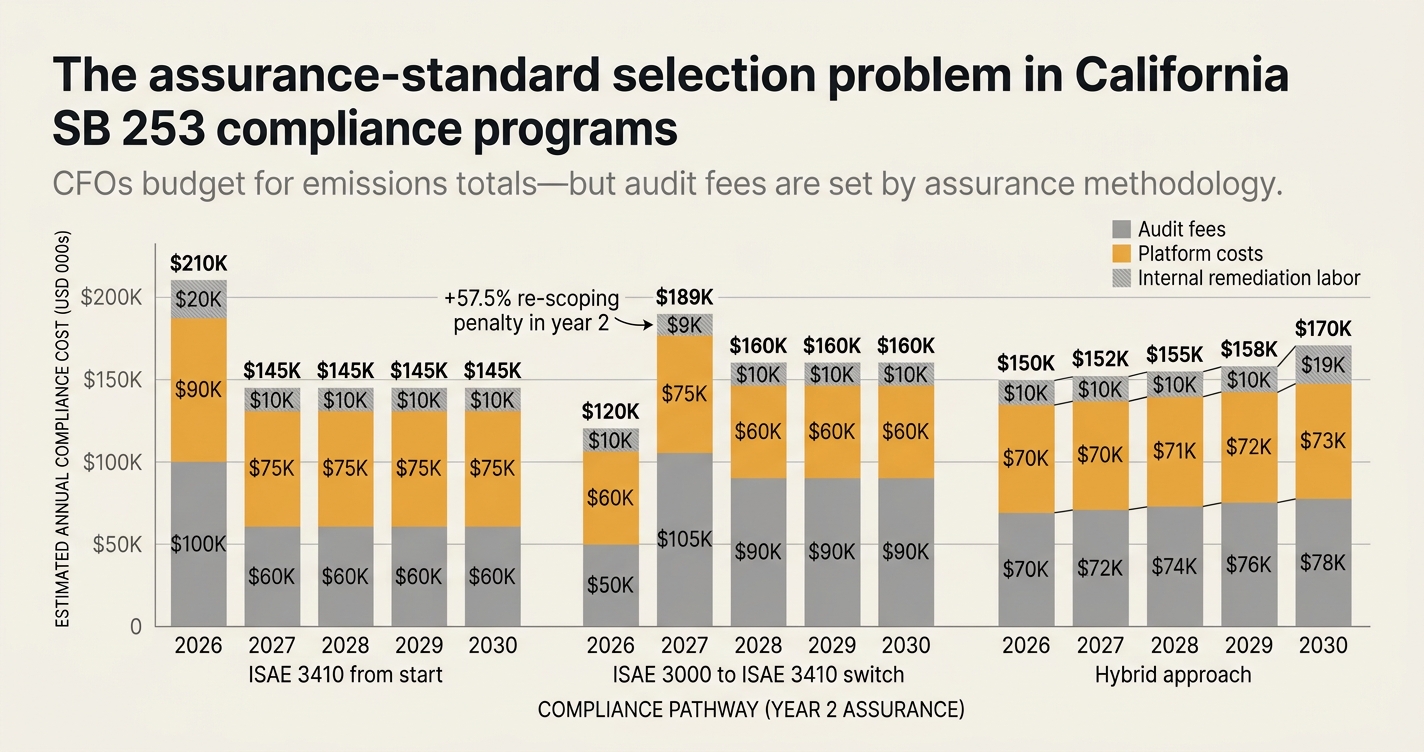
The assurance-standard selection problem in California SB 253 compliance programs
Here's the issue: California SB 253 requires limited assurance over Scope 1 and 2 emissions starting in 2026, graduating to reasonable assurance in 2030. Finance teams understand this as a compliance checkbox—select an auditor, submit the emissions inventory, secure the assurance opinion. The first reports are due August 10, 2026, covering fiscal year 2025 data [1]. Most CFOs are budgeting $80,000–$150,000 for a limited assurance engagement based on 2024 benchmarks. That looks manageable.
However, SB 253 compliance consists of two things: the emissions totals you report to CARB, and the assurance standard your auditor uses to verify those totals. The statute does not specify which assurance framework applies—ISAE 3410, ISAE 3000, AA1000AS, or a hybrid approach [2].
The emissions totals on their own have no assurance value. The assurance standard is what determines audit scope, evidence requirements, fieldwork hours, and ultimately, the cost of the engagement. A limited assurance engagement under ISAE 3410 requires population completeness testing, evidence lineage for all material line items, and documented calculation methodology [3]. A review under ISAE 3000 may permit sampling and management representations in place of primary evidence. The difference in auditor hours can be 150–300%, even for the same emissions inventory.
While emissions calculation software has become cheaper—many platforms now offer Scope 1 and 2 calculation for $20,000–$40,000 annually—assurance fees have become more expensive. CARB's enforcement discretion for the first reporting year allows firms to submit 2025 data "based on information they already have or were collecting," whether or not that data received limited assurance [4]. But this relief only applies to the August 2026 filing. For 2027 and beyond, auditors will re-price engagements based on the chosen assurance standard. If your 2026 emissions inventory lacks evidence lineage—invoices, utility bills, meter reads with documented calculation chains—your 2027 audit fees might increase 40–60% to cover the remediation work required to meet ISAE 3410 criteria.
How do you solve this? I think the answer depends on your assurance roadmap. If you are targeting limited assurance in 2026 and reasonable assurance in 2030, you need to select an assurance standard now—in Q1 2025, during engagement letter negotiations—and build your evidence workflows to that standard from day one. Operators we work with are treating 2026 as a practice year for 2030 reasonable assurance, not a one-time compliance event. That means ISAE 3410-grade evidence in 2026, even though CARB is not enforcing it yet.
Visualised:
The SB 253 Assurance Standard Decision Matrix
The table below scores three assurance pathways against five criteria that determine total cost of compliance for a typical $2B revenue manufacturer with 15 facilities and 200+ tier-1 suppliers.
| Criterion | ISAE 3410 (climate-specific) | ISAE 3000 (general assurance) | Hybrid (ISAE 3000 + GHG Protocol guidance) | Weight |
|---|---|---|---|---|
| Evidence granularity required | Line-item invoices, utility bills, meter reads with calculation lineage for all material emissions sources | Aggregated totals with management representations; sampling permitted | Aggregated totals for Scope 1/2, supplier-reported data for Scope 3 | 30% |
| Auditor fieldwork hours (2026 limited assurance) | 450–600 hours | 200–300 hours | 300–450 hours | 25% |
| 2027 audit fee escalation (if evidence gaps exist) | 0–10% (evidence already in place) | 40–60% (remediation required to meet ISAE 3410 in year 2) | 20–30% (partial remediation) | 20% |
| 2030 reasonable assurance transition cost | Low (same evidence standard, higher sampling) | High (complete evidence rebuild required) | Medium (evidence upgrade required) | 15% |
| CARB enforcement risk (if challenged) | Lowest (aligns with EU CSRD precedent) | Medium (no climate-specific guidance) | Medium (unclear if GHG Protocol alone sufficient) | 10% |
Verdict: For CFOs planning to be SB 253-compliant through 2030 and beyond, ISAE 3410 is the only pathway that avoids fee escalation. The 2026 fieldwork hour premium (200–300 additional hours at $450/hour = $90,000–$135,000) is offset by zero remediation costs in 2027–2029. Hybrid approaches defer the evidence problem, not solve it. ISAE 3000 alone introduces a 40–60% audit fee step-up in year two when auditors re-scope to climate-specific criteria.
Why the Assurance Standard Matters More Than the Emissions Inventory
Most SB 253 compliance programs are structured backward. Finance teams procure a carbon accounting platform, calculate Scope 1 and 2 emissions, export a total, and then engage an auditor to "assure it." The assurance standard is treated as a vendor selection problem—compare auditor quotes, pick the lowest bid, assume the scope is equivalent across firms.
But assurance standards are not equivalent. ISAE 3410, issued by the International Auditing and Assurance Standards Board (IAASB), is climate-specific and designed for GHG inventories. It requires:
- Population completeness: all emissions sources within the organizational boundary must be identified and quantified or explicitly excluded with justification.
- Evidence lineage: every reported tCO₂e must trace to a source document (invoice, utility bill, meter read, supplier certificate) through a documented calculation chain.
- Calculation transparency: emission factors, conversion multipliers, and allocation methodologies must be reproducible by the auditor without reliance on proprietary software.
ISAE 3000, by contrast, is a general assurance framework applicable to any subject matter. It does not contain climate-specific guidance. Auditors applying ISAE 3000 to a GHG inventory typically supplement it with GHG Protocol Corporate Standard principles, but the evidence requirements are left to auditor judgment. Some firms accept aggregated utility data and management attestations. Others require invoice-level documentation. The inconsistency introduces pricing variability—and audit re-scoping risk—when you scale from limited to reasonable assurance.
"The assurance market is re-pricing. Firms without evidence lineage are paying 20–40% premiums, and CFOs who cannot speak the language of climate audit are losing control of scope and cost." — Big Four Assurance Partner, 2025 [5]
For SB 253, the stakes are higher because CARB has not yet specified which assurance standard will be required. The statute simply mandates "limited assurance" in 2026 and "reasonable assurance" in 2030, without naming a framework [6]. CARB's November 2025 public workshop clarified that enforcement discretion applies only to the first reporting year—after that, auditors will enforce whichever standard they deem appropriate for climate disclosure [7]. If your auditor selects ISAE 3410 in 2027 and your 2026 emissions data lacks the required evidence lineage, you will pay for retroactive data collection during the 2027 engagement.
The Evidence Lineage Penalty: A Worked Example
Consider a $2.5B revenue food processing company with 12 manufacturing facilities in California and Texas. The company's 2025 Scope 1 and 2 emissions total 85,000 tCO₂e, composed of:
- Scope 1: 60,000 tCO₂e from natural gas combustion (boilers, process heating), refrigerant leakage (8 facilities use ammonia, 4 use HFC blends), and diesel fuel for on-site logistics vehicles.
- Scope 2: 25,000 tCO₂e from purchased electricity (11 facilities on grid power, 1 facility with on-site solar + grid backup).
The CFO budgets $120,000 for a 2026 limited assurance engagement, based on a vendor quote assuming ISAE 3000 + GHG Protocol guidance. The auditor estimates 250 fieldwork hours at $450/hour, plus $7,500 in travel and $5,000 in report issuance fees.
During the 2026 engagement, the auditor requests:
- Natural gas invoices for all 12 facilities, line-item level, with meter reads.
- Refrigerant purchase records and annual leak testing reports (required for EPA compliance, but not always digitized).
- Diesel fuel receipts with odometer logs (the on-site logistics vehicles are contractor-operated, and fuel is purchased via fleet cards with no per-vehicle tracking).
- Electricity bills with kWh breakdowns (the solar facility's billing is net-metered, and the company does not have separate records for solar generation vs. grid draw).
The company can produce aggregated utility spend from the ERP system, but not line-item invoices. Refrigerant data exists in PDF inspection reports stored by the facilities team, not centralized. Diesel fuel is tracked at the cost center level, not per vehicle. Solar generation is logged in the inverter software, but not integrated with the electricity bill.
The auditor re-scopes the engagement to 420 hours to cover the data collection work: $189,000 in fees, a 57.5% increase over the original quote. The company also incurs $35,000 in internal labor (facilities coordinators pulling invoices, FP&A reconciling ERP exports, procurement tracking down fleet card statements) and a 6-week delay in the assurance opinion issuance.
For the 2027 engagement, the auditor switches to ISAE 3410 and requires evidence lineage from day one. The company invests $80,000 in a document ingestion workflow (Emission3, in this case) to centralize invoices, automate line-item extraction, and generate calculation lineage artifacts. The 2027 audit is completed in 320 hours at $144,000—32% more than the original 2026 quote, but 24% less than the re-scoped 2026 actual, and now predictable for 2028–2030.
The total cost of deferring evidence lineage: $189,000 (2026 actual) + $80,000 (platform investment) + $35,000 (internal remediation labor) = $304,000, vs. $120,000 (2026 quote) + $80,000 (platform, deployed in 2025) + $144,000 (2027 stable) = $344,000. The delta is $40,000, but the risk-adjusted cost is higher: the company lost 6 weeks in the 2026 filing cycle and had no predictability for 2027 budgeting.
How Emission3 Fits
Emission3 is positioned as productized SB 253 implementation backed by compliance infrastructure, not generic carbon accounting SaaS. The platform enforces ISAE 3410-grade evidence lineage by design, so CFOs can select an assurance standard in 2025 and build to it from the start, rather than remediating in 2027.
When you export an assurance-ready package from Emission3, you get:
- Source-document inventory: every invoice, utility bill, meter read, and supplier certificate that contributed to the reported emissions total, organized by facility and reporting period.
- Calculation lineage: a traceable chain from each source document to the final tCO₂e value, showing emission factors (with version and source), unit conversions, and allocation rules where applicable.
- Population completeness summary: a structured list of all emissions sources within the organizational boundary, with explicit documentation of exclusions (e.g., "Facility 7 standby generator: 0.2 tCO₂e annually, below 1% materiality threshold per GHG Protocol").
- ISAE 3410 fieldwork index: a reference table mapping each material emissions line item to the corresponding evidence artifact, so auditors can sample without requesting additional documents.
For the $2.5B food processor above, deploying Emission3 in Q1 2025 (before the 2026 filing) would have avoided the $35,000 internal remediation cost and the 6-week delay. The 2026 engagement would have been scoped at 350 hours ($157,500), not 420 hours, because the auditor could rely on the evidence lineage exports rather than requesting documents ad hoc. The 2027–2030 engagements would stabilize at 300–320 hours annually, with zero re-scoping risk.
The platform also supports the 2030 reasonable assurance transition. Reasonable assurance requires higher sampling rates (70–90% of material line items, vs. 30–50% for limited assurance) but the same evidence standard. If your 2026–2029 filings are already built on ISAE 3410-grade lineage, the 2030 audit fee increase is 15–20% (reflecting the higher sampling rate), not 100%+ (reflecting a complete evidence rebuild).
The Assurance Roadmap CFOs Should Build Now
If you are preparing for the August 10, 2026 SB 253 filing, here is the decision sequence:
-
Select your target assurance standard in Q1 2025, during engagement letter negotiations. Ask your auditor: "Will you be applying ISAE 3410, ISAE 3000, or a hybrid framework?" If the answer is "we'll decide after we see the data," you have audit re-scoping risk. Lock in ISAE 3410 now.
-
Map your evidence gaps before you calculate emissions. Identify which emissions sources lack line-item documentation (refrigerants, fleet fuel, net-metered electricity, process emissions with estimated throughput). Prioritize the sources that represent >5% of your total inventory.
-
Deploy a document-first ingestion workflow that centralizes invoices, utility bills, and supplier certificates as they arrive, not during audit fieldwork. Emission3 is purpose-built for this—bills are ingested monthly, line items are extracted via deterministic LLM, and calculation lineage is generated automatically.
-
Run a dry-run assurance engagement in Q2 2025 with a subset of your 2024 data. This is a 40–60 hour scoping exercise where the auditor reviews your evidence artifacts, identifies gaps, and estimates the 2026 fieldwork hours under ISAE 3410. Budget $25,000–$35,000 for this. It is the cheapest way to de-risk the August 2026 deadline.
-
Treat 2026 as a practice year for 2030 reasonable assurance. CARB's enforcement discretion means you can file 2025 emissions without limited assurance in 2026, but that relief expires after the first cycle [8]. If you skip evidence lineage in 2026, you will pay the remediation premium in 2027–2029, and then pay it again for the 2030 reasonable assurance upgrade.
The CFOs we work with are budgeting $180,000–$220,000 for 2026 SB 253 compliance (limited assurance under ISAE 3410, including platform and audit fees), with the expectation that 2027–2029 costs will decline to $140,000–$160,000 annually as the evidence workflows mature. That is 30–40% higher than the $120,000 "market rate" quotes circulating in late 2024, but it avoids the 40–60% re-scoping penalties we are seeing in early 2026 engagements.
The assurance-standard selection problem is not a technical problem. It is a financial planning problem. CFOs who choose the assurance standard in 2025—and build evidence workflows to that standard from the start—will pay predictable, declining audit fees through 2030. CFOs who defer the decision will pay escalating fees, with no visibility into the 2027–2029 budget.
Next Steps
If you are preparing for California SB 253 compliance and need to map your assurance readiness, book a workflow review with Emission3. We will walk through your current evidence landscape, identify the gaps that drive audit re-scoping risk, and show you how the platform generates ISAE 3410-grade lineage artifacts from day one. No anonymous self-serve onboarding—every engagement starts with a scoped conversation [4].
References & Sources
External Sources
- [1]SB 253 Compliance Roadmap: How to Prepare for California's Climate Disclosure Law Now That CARB Has Finalized the Rules
CARB approved initial regulations for SB 253 on February 26, 2026. The first Scope 1 and 2 reports are due August 10, 2026, covering fiscal year 2025 data.
- [2]Sustainability Spotlight — California Climate Legislation Update — Status of CARB Rulemaking and Next Steps
SB 253 statutorily requires limited assurance for Scope 1 and Scope 2 emissions starting in 2026, but the bill does not specify which assurance standards would be acceptable.
- [3]California Climate Disclosure Laws: Key Takeaways from August 21 Workshop
SB 253 requires independent third-party assurance of GHG reporting to increase user confidence in data quality. Limited assurance over Scopes 1 and 2 begins in 2026, reasonable assurance in 2030.
- [5]The US Climate Disclosure Stack: 12 Terms Every CFO Must Know Before 2026 SB 253 Audits
Big Four assurance partner notes that the assurance market is re-pricing, with firms without evidence lineage paying 20-40% premiums as CFOs lose control of scope and cost.
- [6]SB 253 – Key Requirements for businesses in 2026
SB 253 mandates organizations report full carbon inventories including scope 3 emissions, with third-party assurance requirements but without specifying which assurance framework to use.
- [7]CARB Virtual Public Workshop on SB 253, SB 261, and SB 219
CARB's November 2025 workshop clarified that enforcement discretion for accepting unassured data applies only to the first reporting year (2026), with full assurance requirements enforced thereafter.
- [8]How SB 261 & SB 253 are Rewriting Climate Reporting
SB 253 applies to US-based organizations doing business in California with annual gross revenues over $1B. Limited assurance begins in 2026 and graduates to reasonable assurance in 2030.
Related Content
- [4]Book a CBAM readiness call
All customers start with a readiness call: we map suppliers, gaps, and implementation, no anonymous self-serve onboarding.
- [9]Audit-ready exports in Emission3
For auditors and CFOs, shows the evidence lineage artifact and how Emission3 exports support ISAE 3410 limited and reasonable assurance engagements.