The tier-2 visibility problem in Scope 3 Category 1 primary data collection
The tier-2 visibility problem in Scope 3 Category 1 primary data collection
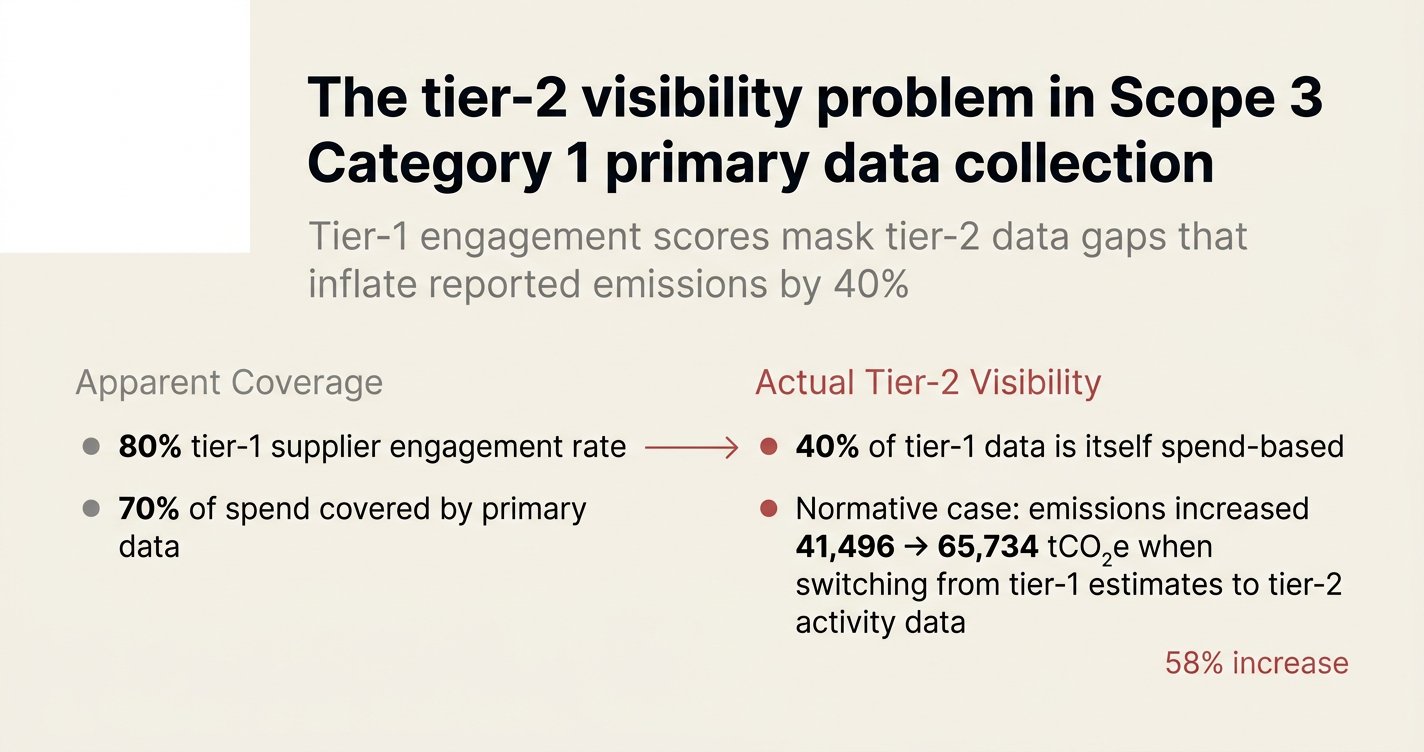
Here's the issue: procurement teams running Scope 3 Category 1 programs typically report 70-80% supplier engagement rates within 18 months. They replace spend-based estimates with supplier-specific data, integrate carbon into vendor scorecards, and deliver line-item emissions by purchase order. At first glance, this looks like comprehensive coverage. However, the disclosure consists of two things: tier-1 supplier engagement and tier-2 data availability. These are not the same thing.
Tier-1 engagement on its own has limited value. Tier-2 data availability is what the emissions total—and any assurance engagement—is actually built on. When a tier-1 supplier reports their Scope 3 emissions, they are passing through data from their own suppliers. If that data is missing, the tier-1 figure defaults to spend-based estimates, and the procurement team unknowingly imports industry averages dressed as primary data. This is the deception: engagement metrics look strong, but the underlying emissions calculation remains anchored in defaults.
While tier-1 engagement has become easier—standardized platforms, CDP Supply Chain, procurement portals—tier-2 visibility has become harder. According to Optera Climate, 40% of sustainability teams cite Scope 3 data gathering as their biggest challenge, rising to 55% for companies above $10 billion in revenue.[1] The larger the supply chain, the more tier-2 suppliers sit outside direct procurement relationships. If a tier-1 supplier cannot source primary data from their own upstream partners, the reported emissions revert to modelled estimates. The procurement team sees a submitted figure, but the calculation methodology is identical to the spend-based baseline they were trying to replace.
How do you solve this? I think the most defensible approach for now is to treat tier-2 visibility as a procurement-controlled workflow, not a sustainability side project. The operators we work with require tier-1 suppliers to document their own data sources: what percentage of their reported Scope 3 is primary data, what percentage is modelled, and which categories default to industry factors. This metadata becomes part of the vendor scorecard. If a tier-1 supplier cannot demonstrate tier-2 coverage, the procurement team either applies a conservative adjustment to the reported figure or escalates the supplier to a higher-touch engagement program. It is more work upfront, but it prevents the illusion of primary data coverage when the underlying calculation is still anchored in defaults.
The shape of the argument, visualised below.
Actionable checklist for procurement leaders: tier-2 visibility in Scope 3 Category 1 programs
This checklist organizes the tier-2 visibility workflow into 12 numbered steps. Each step includes (a) the action, (b) the owner, and (c) the evidence artifact produced. The goal is not to eliminate tier-2 gaps overnight, but to make them visible, quantify their impact on reported emissions, and route high-impact suppliers into higher-touch engagement.
1. Map tier-1 supplier coverage by spend category
Action: Generate a supplier roster by Scope 3 Category 1 spend. Group by product category (raw materials, components, packaging, services). Flag suppliers representing >2% of category spend.
Owner: Procurement operations, sustainability data lead.
✅ Done when: You have a table with columns: [Supplier Name | Category | Annual Spend | % of Category Total | Tier-1 Engagement Status]. Export as CSV, date-stamped.
2. Request tier-2 data source disclosure from tier-1 suppliers
Action: Add a metadata field to your supplier emissions request: "What percentage of your reported Scope 3 is based on primary data from your own suppliers?" Include a dropdown: [0-25% | 25-50% | 50-75% | 75-100% | Unknown].
Owner: Procurement sustainability lead, vendor management.
✅ Done when: The updated supplier questionnaire is live in your CDP Supply Chain portal, procurement system, or vendor engagement platform. Confirm with a test submission.
3. Score tier-1 submissions by tier-2 data quality
Action: For each tier-1 supplier submission, assign a tier-2 visibility score: A = >75% primary data, B = 50-75%, C = 25-50%, D = <25% or unknown. Cross-reference with the supplier's own sustainability report if available.
Owner: Sustainability analyst, procurement data quality team.
✅ Done when: The supplier roster from Step 1 now includes a [Tier-2 Visibility Score] column. You can filter by score and see which high-spend suppliers have low tier-2 coverage.
| Supplier | Category | Annual Spend (€) | % of Category | Tier-2 Score |
|---|---|---|---|---|
| Supplier A | Raw materials | 4.2M | 18% | A |
| Supplier B | Components | 3.8M | 22% | D |
| Supplier C | Packaging | 1.9M | 31% | C |
4. Calculate the emissions uncertainty introduced by tier-2 gaps
Action: For suppliers with tier-2 scores of C or D, apply a conservative adjustment factor. If a tier-1 supplier reports 1,000 tCO₂e but only 30% is primary data, treat the remaining 70% as spend-based. Recalculate using your baseline emission factors for that category.
Owner: Climate accounting lead, sustainability analyst.
✅ Done when: You have a comparison table: [Supplier | Reported Emissions (tCO₂e) | Tier-2-Adjusted Emissions (tCO₂e) | Delta (tCO₂e) | Delta (%)]. Sum the delta column to quantify total uncertainty.
"When one of our customers switched to more accurate supplier activity data for Category 1, total reported emissions increased from 41,496 to 65,734 tonnes of CO₂e. That is not a worsening performance; it is better accounting." — Normative, Scope 3 Supplier Engagement Guide[2]
5. Prioritize tier-1 suppliers for tier-2 engagement escalation
Action: Rank suppliers by [Annual Spend × Tier-2 Uncertainty Delta]. The top 10-15 suppliers on this list represent the highest-impact opportunities for tier-2 data improvement.
Owner: Procurement operations, sustainability program lead.
✅ Done when: You have a prioritized list with columns: [Supplier | Spend | Tier-2 Score | Uncertainty Delta (tCO₂e) | Escalation Priority]. Share with vendor management for quarterly business reviews.
6. Integrate tier-2 visibility into vendor scorecards
Action: Add tier-2 data quality as a weighted criterion in your vendor performance scorecard. For example: 10% of total score tied to tier-2 visibility, measured by the score from Step 3.
Owner: Procurement sustainability lead, vendor management.
✅ Done when: Vendor scorecards now display a tier-2 visibility metric alongside cost, quality, delivery performance. Confirm the weighting in your procurement system or manual scorecard template.
7. Offer tier-2 data collection support to high-priority tier-1 suppliers
Action: For suppliers flagged in Step 5, offer a supported engagement program: templates for requesting data from their own suppliers, calculation guidance, or access to a shared carbon accounting tool.
Owner: Sustainability program lead, procurement relationship manager.
✅ Done when: You have sent engagement offers to the top 10 suppliers from Step 5. Track responses in a status field: [Offer Sent | Engaged | Declined | No Response].
8. Document tier-2 methodology in supplier emissions submissions
Action: Require tier-1 suppliers to attach a short methodology note with their emissions submission: which categories are primary data, which are modelled, what emission factors were used for modelled categories.
Owner: Procurement sustainability lead, vendor data quality team.
✅ Done when: Your supplier portal or questionnaire includes a file upload field labeled "Methodology Note (PDF, max 2 pages)." Confirm with a test submission.
9. Audit a sample of tier-1 submissions for tier-2 lineage
Action: Select 3-5 high-spend suppliers with tier-2 scores of A or B. Request evidence of their own supplier engagement: data request emails, supplier responses, calculation worksheets.
Owner: Internal audit, sustainability assurance lead.
✅ Done when: You have reviewed the evidence for each sampled supplier and confirmed that their tier-2 data sources match their reported methodology. Document findings in an audit memo.
10. Flag tier-2 gaps in your Scope 3 disclosure narrative
Action: In your annual sustainability report or CDP disclosure, include a data quality statement: "X% of Category 1 emissions are based on tier-1 supplier data, of which Y% is supported by tier-2 primary data. The remainder uses industry average emission factors."
Owner: Sustainability reporting lead, external assurance partner.
✅ Done when: The data quality statement appears in your draft disclosure, with X and Y calculated from Steps 3-4. Confirm with your assurance provider that this level of transparency is acceptable.
11. Track tier-2 visibility improvement year-over-year
Action: Create a dashboard or spreadsheet tracking tier-2 visibility scores by supplier, by year. Calculate the percentage of total Category 1 emissions supported by tier-2 primary data in 2025, 2026, 2027.
Owner: Sustainability data lead, procurement analytics.
✅ Done when: You have a line chart showing [Year | % of Category 1 Emissions with Tier-2 Primary Data]. Set a target: reach 60% by 2027.
12. Revise procurement RFPs to include tier-2 visibility requirements
Action: For new supplier onboarding or RFP renewals, add a question: "What percentage of your own Scope 3 emissions is based on primary data from your suppliers?" Use the answer to inform vendor selection.
Owner: Procurement operations, RFP template owner.
✅ Done when: The updated RFP template includes the tier-2 visibility question, with a scoring rubric: [>75% primary = 10 points | 50-75% = 5 points | <50% = 0 points]. Confirm with procurement legal that this is compliant.
Why tier-2 visibility matters for CBAM and SB 253 compliance
The tier-2 problem is not hypothetical. Under CBAM, non-EU exporters must report embedded emissions using actual production data, not defaults, or face a tariff penalty.[3] If a steel exporter sources iron ore from a tier-2 supplier who cannot provide primary data, the reported emissions default to the highest available factor in the CBAM regulation—effectively a compliance penalty dressed as an estimate.
Similarly, California SB 253 requires limited assurance for Scope 3 emissions starting in 2026, escalating to reasonable assurance in 2030.[4] Assurance scope is set by evidence lineage, not just the emissions total. If a procurement team reports 80% supplier engagement but the underlying tier-2 data is modelled, the assurance fee escalates to cover the expanded evidence request. One sustainability manager at a mid-market manufacturer told us their assurance quote doubled when the auditor discovered that tier-1 supplier data was itself based on spend estimates, not activity data.
The checklist above does not eliminate tier-2 gaps, but it makes them visible and quantifiable. That visibility is what allows procurement teams to route high-impact suppliers into deeper engagement, document methodology for assurance, and avoid the illusion of primary data coverage when the underlying calculation is still anchored in defaults.
How Emission3 fits
Emission3 is built for procurement teams running Scope 3 Category 1 programs at scale. The platform ingests supplier submissions—invoices, sustainability reports, CDP responses—and classifies each line item by data quality tier. When a supplier reports Scope 3 emissions, Emission3 flags whether the underlying methodology is primary data, spend-based, or hybrid, and calculates the uncertainty delta introduced by tier-2 gaps.
The deterministic LLM layer reads supplier methodology notes, extracts tier-2 data source disclosures, and surfaces them in the vendor scorecard interface. If a tier-1 supplier reports 1,200 tCO₂e but only 40% is primary data, Emission3 applies a conservative adjustment using your baseline emission factors and documents the lineage in the assurance export. That adjustment becomes part of the evidence pack for your external auditor, not a manual reconciliation.
For procurement teams preparing for CBAM or SB 253 limited assurance, the platform exports supplier-level evidence lineage: which submissions are tier-2-supported, which default to modelled estimates, and what the uncertainty range is for each category. That export is what auditors and compliance teams are asking for when they review Scope 3 Category 1 programs, and it is the artifact that determines whether your reported emissions are assurance-ready or require expanded evidence collection.
What to do next
If you are running a Scope 3 Category 1 program and your tier-1 engagement rate is above 70%, the next bottleneck is tier-2 visibility. Start with Steps 1-3 above: map your supplier roster by spend, request tier-2 data source disclosure, and score submissions by tier-2 quality. That scoring exercise will tell you how much of your reported emissions is actually supported by primary data, and where the largest tier-2 gaps are.
For high-spend suppliers with tier-2 scores of C or D, route them into a higher-touch engagement program. Offer templates, calculation support, or access to a shared carbon accounting tool. The goal is not to eliminate tier-2 gaps overnight, but to make them visible, quantify their impact, and document the methodology for assurance.
If you are preparing for CBAM filings or California SB 253 compliance, treat tier-2 visibility as a procurement-controlled workflow, not a sustainability side project. The evidence lineage from tier-2 data sources is what determines whether your Scope 3 disclosure is assurance-ready, and whether your CBAM filings avoid the default-value penalty.
Emission3 helps procurement teams map tier-2 visibility at scale, flag methodology gaps in supplier submissions, and generate assurance-ready evidence lineage for Scope 3 Category 1 programs. The platform starts with a CBAM readiness call where we map your supplier roster, identify tier-2 coverage gaps, and scope the engagement program. Book a readiness call here.[5]
References & Sources
External Sources
- [1]Supplier Engagement: The Key to Scope 3 Emissions Data
Optera Climate research on Scope 3 data gathering challenges: 40% of teams cite data collection as the biggest bottleneck, rising to 55% for companies above $10B in revenue.
- [2]Scope 3 Supplier Engagement: Primary Carbon Data
Normative case study: switching from spend-based to supplier activity data increased reported Category 1 emissions from 41,496 to 65,734 tCO₂e, demonstrating the accuracy gap in tier-1 data without tier-2 lineage.
- [3]Supplier Engagement Strategies to Achieve Scope 3 Targets
Environmental Defense Fund guide on supplier engagement programs, including the role of tier-2 visibility in meeting Scope 3 targets and regulatory compliance requirements.
- [6]Supplier Engagement Explained: How Large Organisations Collect Carbon Data
Seedling case study on Colt's CDP Supply Chain program, including data quality criteria for incorporating supplier-specific emissions and the role of supplier capability development.
- [7]Creating a Supplier Engagement Strategy for Decarbonization
Sustain-Cert guide on building supplier engagement programs for Scope 3 reduction, with focus on value chain resilience and regulatory compliance drivers.
Related Content
- [4]The assurance-fee escalation problem in California SB 253 compliance
How limited assurance scope for Scope 3 emissions under California SB 253 is determined by evidence lineage, not just emissions totals, and why tier-2 data gaps drive audit cost escalation.
- [5]Book a CBAM readiness call
Start with a readiness call where we map your supplier roster, identify tier-2 coverage gaps, and scope the engagement program for CBAM or SB 253 compliance.
- [8]Scope 3 with primary data
How Emission3 helps procurement teams replace spend-based estimates with supplier-specific primary data, map tier-2 visibility gaps, and generate assurance-ready evidence lineage for Scope 3 Category 1 programs.