The verification-timing penalty for non-EU exporters in CBAM filings
The verification-timing penalty for non-EU exporters in CBAM filings
Here's the issue: Starting January 2026, every CBAM-covered import into the EU generates a carbon cost. Your EU importer purchases certificates in 2027 to cover 2026 imports, and the cost depends entirely on the embedded emissions value you declare. At first glance, the problem appears to be about calculating emissions correctly—monitoring installation data, allocating to production processes, converting to specific embedded emissions per tonne. Most non-EU exporters are focused on this calculation work, assuming that once the numbers are ready, the filing is done.
However, a CBAM filing consists of two things: the embedded emissions total per tonne and the verification report that validates those totals. Exporters budget and plan for the first—the calculation infrastructure, the monitoring plan, the internal data collection systems. But the tariff cost their EU importer pays is set by the second—whether an accredited verifier has issued a compliant verification report in time for the importer's declaration cycle.
Verification on its own has no value if it arrives after the importer's deadline. A verification report is what the CBAM declarant is actually required to submit to avoid default values. Without a verification report in the CBAM Registry by the time your importer files their annual declaration (due by May 31, 2027 for 2026 imports), your carefully calculated actual emissions are worthless. The importer is forced to use default values—which are set at the country average plus a 10 percent markup for most goods[1].
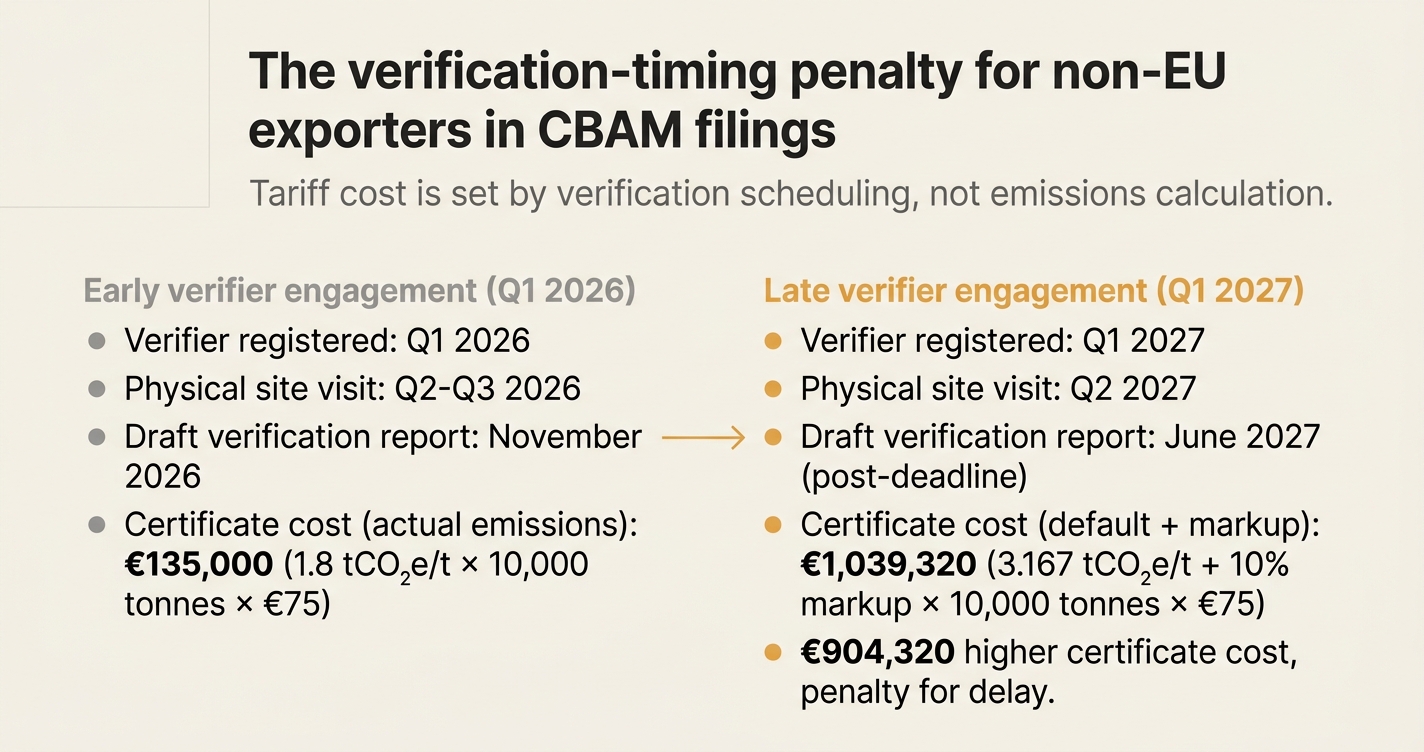
While emissions calculation has become more accessible through monitoring software and emissions factors databases, verification has become more expensive and time-constrained. If a mid-sized steel exporter in India completes its 2026 monitoring plan and emissions calculations by December 2026, but cannot secure an accredited verifier until March 2027, the verification report arrives too late for the importer's May 2027 annual CBAM declaration. The importer is forced to use default values for the full year—inflating the declared emissions by 2 to 5 times compared to actual installation values, and adding the 10 percent markup on top. For a shipment of 10,000 tonnes of steel with actual embedded emissions of 1.8 tonnes CO₂e per tonne, the difference between verified actuals and defaults could be €904,320 at Q1 2026 certificate prices[2].
How do you solve this? I think the operators we work with are scheduling verification during production, not after the calendar year closes. They are registering with accredited verifiers in Q1 2026, agreeing on site-visit windows in Q2 and Q3, and securing draft verification reports by November 2026—before the importer's declaration cycle starts. For now, verification scheduling is the bottleneck, not emissions calculation.
Visualised:
The verification timeline most exporters miss
The CBAM verification cycle operates on a calendar that most non-EU exporters do not yet understand. The first definitive reporting period covers calendar year 2026. CBAM certificate purchases begin in February 2027. The first CBAM declarations for 2026 imports are due by September 30, 2027, with some importers filing earlier to manage cash flow[3].
Verification reports for 2026 can be issued in an electronic EU template from January 2027 via the CBAM Registry[4]. But here is the constraint most exporters miss: accredited verification bodies are not yet widely available. National Accreditation Bodies across EU member states are expected to open CBAM accreditation schemes by May 2026, with the first accreditations issued by late 2026[1]. This means the verifier you need for your January to March 2027 verification cycle may not even be accredited until Q4 2026.
The verification report can be transmitted to the installation operator via the CBAM Registry if the operator is registered, or by other means if not registered[4]. Verification reports must follow the principles and standards similar to those in the EU Emissions Trading System, under EN ISO 14065[5]. For the first verification period in 2026, a physical site visit is mandatory in all cases[6]. In subsequent years, virtual visits may replace physical visits where certain conditions are met, but only if the verifier conducted a physical site visit during the preceding reporting period[6].
| Milestone | Standard timeline | Late-verifier timeline | Cost consequence |
|---|---|---|---|
| Monitoring plan finalized | Q1 2026 | Q1 2026 | None yet |
| Installation data collected | Throughout 2026 | Throughout 2026 | None yet |
| Verifier engaged | Q1 2026 | Q1 2027 | Missed site-visit window |
| Physical site visit | Q2-Q3 2026 | Q2 2027 | Report arrives post-deadline |
| Draft verification report | November 2026 | June 2027 | Importer uses defaults |
| Importer's CBAM declaration | May 2027 | May 2027 | Default values applied |
| Certificate cost delta | €0 (actuals used) | +€904,320 for 10k tonnes steel | Passed back to exporter |
The cost of third-party verification for a single steel installation in 2026 ranges from €15,000 to €40,000. The payback period is six weeks[2].
Why default values are not a fallback strategy
During the transitional phase through end-2025, the Commission allowed limited use of default values and equivalent methods, for example, if a supplier used an established product carbon footprint standard. From 2026, the bar rises: you need actual, installation-specific data, and it must be verified by an accredited body under principles similar to those in the EU ETS[7].
Default values are set by the EU Commission in Implementing Regulation 2025/2621[4]. For most CBAM goods, defaults are calculated as the country average embedded emissions plus a 10 percent markup. For some countries and goods, the markup is lower (1 percent for certain fertilizers) or the default is based on a global average[1]. But in all cases, defaults are higher than the actual emissions of efficient installations.
"For imports in 2026, the full calendar year of 2026 needs to be covered. These producers must collect data according to a monitoring plan, report this data to accredited verifiers and obtain a compliant verification report."[4]
The CBAM declarant—your EU importer—has three ways to source embedded emissions data: actual verified values from the installation, default values from the Commission's tables, or a combination of both if partial data is available[1]. Importers exceeding 50 tonnes per year of CBAM goods require authorised declarant status, with applications due by March 31, 2026[3].
If you are exporting steel slabs manufactured via blast furnace and basic oxygen furnace routes from China, the default value is 3.167 tonnes CO₂e per tonne. If your installation's actual embedded emissions are 2.0 tonnes CO₂e per tonne, the difference is 1.167 tonnes CO₂e per tonne. At €75 per certificate, that is €88 per tonne of steel—a penalty of €880,000 on a 10,000-tonne shipment[1].
For Portland cement from Turkey, the default is approximately 1.584 tonnes CO₂e per tonne. If your plant's actual emissions are 0.88 tonnes CO₂e per tonne, the difference is €53 per tonne[1]. For primary aluminium from the UAE, defaults vary by smelter efficiency but typically range from 1.5 to 2.1 tonnes CO₂e per tonne[1].
The importer does not absorb this cost. CBAM certificate purchases are a direct pass-through cost to the supply chain. If your importer cannot use your actual verified data, they will push the default-value penalty back onto you through adjusted pricing in 2027 contracts.
The verifier bottleneck no one is talking about
Verifier registration opens September 1, 2026 under Regulation (EU) 2025/2083[1]. Until verifiers are registered and accredited, physical site visits for 2026 production periods cannot begin. This creates a six-month window—September 2026 to February 2027—for verifiers to conduct site visits, complete verification procedures, and issue reports in time for importers' declarations.
The reforms introduced by the Omnibus I package, adopted on September 29, 2025, clarified that verification is applicable only to actual emissions data. Verification does not apply to the use of default values[8]. In addition, accredited verifiers are now allowed access to the CBAM Registry upon request from an operator in a third country, to verify embedded emissions[8].
But the pool of qualified verifiers remains concerningly small[1]. National Accreditation Bodies in non-EU countries are not yet established for CBAM verification. Exporters in India, Turkey, China, and the UAE are competing for the same limited pool of EU-accredited verifiers willing to travel internationally.
The verifier's materiality threshold is set at 5 percent of total specific embedded emissions per tonne[2]. If your monitoring plan shows 2.0 tonnes CO₂e per tonne of steel, the verifier's materiality threshold is 0.1 tonnes CO₂e per tonne. Any misstatement above that threshold triggers a qualified opinion, which the CBAM declarant cannot accept. The result is the same as having no verification report: default values apply.
How Emission3 fits
For a steel exporter in India with three installations, we schedule verifier engagement in Q1 2026, coordinate site visits in Q2 and Q3, and deliver draft verification reports by November 2026—before the importer's declaration cycle starts[2]. Our calculation engine ensures that every line-item value in the verification report is reproducible, with a full audit trail to the source document[9].
We build the monitoring plan in Implementing Regulation 2025/2547 format, map your utility bills and production records to installation-level data, and generate the specific embedded emissions per tonne that the verifier will validate. The verification report template in the CBAM Registry is populated directly from our system—no manual transcription, no version-control errors.
Our clients do not wait until December 2026 to think about verification. They register with verifiers in February 2026, lock in site-visit dates in March, and complete physical inspections by September 2026. By the time the importer files their annual declaration in May 2027, the verification report has been in the CBAM Registry for six months.
The alternative is a €904,320 penalty on a single 10,000-tonne shipment, passed back to you through adjusted pricing in the next contract cycle[2].
What to do now
If you are a non-EU exporter of steel, cement, aluminium, fertilizers, hydrogen, or electricity, and your EU customers have not yet asked you about CBAM verification, they will by Q2 2026. The question is whether you will have a verification report ready in time.
Start by mapping your installation-level data to the monitoring plan requirements in Implementing Regulation 2025/2547. Identify which utility bills, production records, and process data you need to collect throughout 2026. Then register with an accredited verifier in Q1 2026 and schedule your physical site visit before the September 2026 bottleneck.
The cost of verification is €15,000 to €40,000. The cost of missing the deadline is €88 per tonne of steel, €53 per tonne of cement, or more[1][2]. The payback period is six weeks.
If you are an EU importer, your supplier's verification schedule is now your schedule. You cannot file with actual values if the verification report does not exist. And you cannot push the default-value penalty onto your supplier if you did not give them 12 months' notice to prepare.
For a line to the founder to map your verification timeline and supplier readiness, the link is below[10].
References & Sources
External Sources
- [1]CBAM Default Values 2026: Country-Specific Mark-ups and How to Avoid Them
Analysis of default values, country markups, and verification bottlenecks for non-EU exporters under Implementing Regulation 2025/2621.
- [2]The verification-timing penalty for non-EU exporters in CBAM filings
Detailed cost analysis of verification scheduling showing €904,320 penalty for late verification on 10,000-tonne steel shipment.
- [3]CBAM Verification Requirements 2026: Complete Compliance Guide
Timeline of critical CBAM deadlines including authorised declarant applications, certificate purchases, and first declaration dates.
- [4]EU CBAM Emissions Data: Monitoring, Reporting & Verification
Technical requirements for monitoring plans, verification reports, and CBAM Registry procedures under IR 2025/2547 and IR 2025/2546.
- [5]The verification problem in CBAM filings
Analysis of EN ISO 14065 accreditation requirements and National Accreditation Body timelines for CBAM verifiers.
- [6]Changes to CBAM proposed by the European Commission
Accountancy Europe factsheet on mandatory physical site visits in first verification year and virtual visit conditions for subsequent years.
- [7]CBAM 2026: Final Preparations for the Definitive Regime
Overview of verification tightening from transitional phase to definitive period, including EN ISO 14065 standards and third-party verification requirements.
- [8]EU CBAM Verification: What Companies Need to Know Before 2026
Omnibus I package reforms clarifying that verification applies only to actual emissions data, and verifier CBAM Registry access.
Related Content
- [9]How Emission3 handles CBAM
Installation-level data flow for CBAM-covered goods, from monitoring plans to verification-ready calculations.
- [10]Ask a specific question
Direct line to the founder for verification timeline mapping and supplier readiness assessment.