The verification problem in CBAM filings
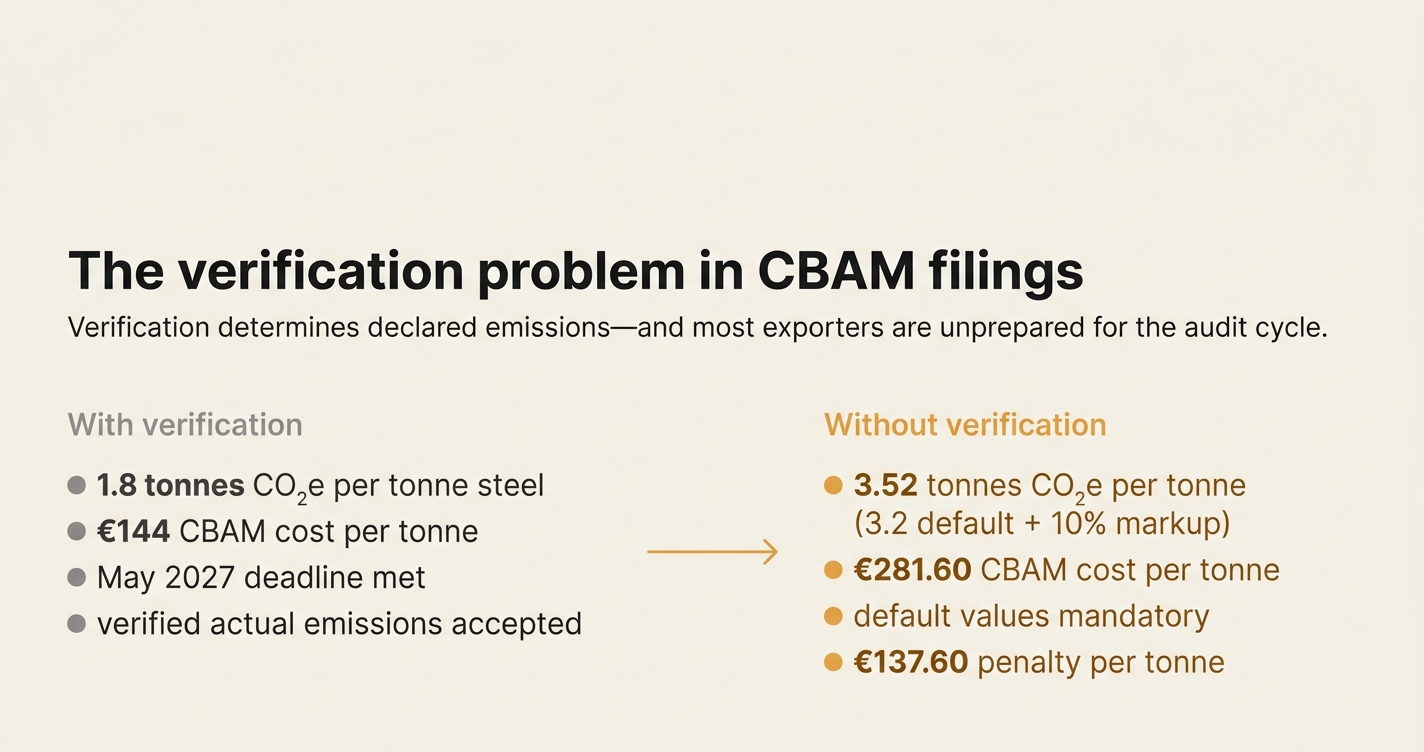
The verification problem in CBAM filings
Here's the issue: Starting January 2026, every CBAM-covered import into the EU generates a carbon cost. Your EU importer purchases certificates in 2027 to cover 2026 imports, and the cost depends entirely on the embedded emissions value you declare. At first glance, the problem appears to be about calculating emissions correctly—monitoring installation data, allocating to production processes, converting to specific embedded emissions per tonne. Most non-EU exporters are focused on this calculation work, assuming that once the numbers are ready, the filing is done.
However, a CBAM filing consists of two things: the declared emissions number and the verification statement that confirms it.
The declared emissions number on its own has no value to the EU importer. The verification statement is what the CBAM declarant is actually required to submit, what the EU customs authority will accept, and what determines whether your actual emissions data can be used instead of punitive default values. Without an accredited verifier's sign-off, your installation-level data is legally equivalent to no data at all—and your EU customer must use country-specific default values with a markup that starts at 10% in 2026, rises to 20% in 2027, and reaches 30% from 2028 onward.
While emissions calculation has become more accessible through monitoring software and emissions factors databases, verification has become more expensive and time-constrained. If a mid-sized steel exporter in India completes its 2026 monitoring plan and emissions calculations by December 2026, but cannot secure an accredited verifier until March 2027, the verification report arrives too late for the importer's May 2027 annual CBAM declaration. The importer is forced to use default values for the full year—inflating the declared emissions by 2-5x compared to actual installation values, and adding the 10% markup on top. For a shipment of 10,000 tonnes of steel with actual embedded emissions of 1.8 tonnes CO₂e per tonne, the difference between verified actuals and defaults could be 15,000-30,000 additional tonnes of declared emissions, at whatever the 2026 EU carbon price settles.
How do you solve this? I think the verification timeline needs to be planned backward from the importer's May 31 declaration deadline, not forward from your December monitoring close. The operators we work with engage verifiers in Q1-Q2 2026 to conduct gap assessments, approve monitoring plans, and establish reporting processes—months before the first verification cycle begins in January 2027. For now, this is the only way to avoid the year-end verifier capacity crunch and ensure your actual emissions data has legal standing when your EU customer files.
The shape of the argument, visualised below.
What verification actually consists of
CBAM verification is not a paperwork review. It is a structured assessment process governed by Commission Delegated Regulation (EU) 2025/2546, requiring physical site visits, materiality testing, and independence standards comparable to financial audits. The verifier must confirm three things:
| Verification requirement | What the verifier checks | Materiality threshold |
|---|---|---|
| Data conformity | Emissions data follows approved monitoring plan and EU calculation methods | 5% of total specific embedded emissions per tonne |
| Material misstatement | No errors or omissions that exceed materiality threshold | 5% of total specific embedded emissions per CN code |
| Process evidence | Installation has monitoring systems in place, data collection is reproducible | Qualitative assessment, no numeric threshold |
For the first year of the definitive phase in 2026, a physical on-site visit to each installation producing CBAM goods is mandatory[1]. From 2027 onwards, verifiers may replace a physical visit with a virtual visit under defined low-risk conditions, but a physical site visit must still occur at least once every two years[1]. This is not a regulatory formality—verifiers are checking whether your monitoring infrastructure exists, whether your data trail from raw meter readings to final emissions calculations is intact, and whether your internal controls prevent manipulation.
The verification report can be transmitted to the installation operator via the CBAM Registry if the operator is registered, or by other means if not registered[2]. Verification reports for 2026 can be issued in an electronic EU template from January 2027 via the CBAM Registry[2]. But here is the constraint most exporters miss: accredited verification bodies are not yet widely available. National Accreditation Bodies (NABs) across EU member states are expected to open CBAM accreditation schemes by May 2026, with the first accreditations issued by late 2026[4]. This means the verifier you need for your January-March 2027 verification cycle may not even be accredited until Q4 2026.
"Accredited verification bodies will gain access to the CBAM Registry from September 2026. Accreditation as detailed in Delegated Regulation (EU) 2025/2551 is thus often a multi-month process designed to ensure verifiers' ability and expertise of the specific rules on CBAM data monitoring and calculation."[4]
The timeline compression is structural, not accidental. Your monitoring plan must cover the full 2026 calendar year. Your data collection closes December 31, 2026. Your verifier needs weeks to conduct the site visit, review data, test materiality, and issue the report. And your EU importer's annual CBAM declaration is due May 31, 2027. If verification takes 4-8 weeks and you start in January 2027, the report arrives in February or March—leaving your importer with tight margins for any corrective actions or resubmissions[3].
The default-value penalty exporters underestimate
If you cannot provide a verification report in time, your EU importer has no choice but to use default values. These are not neutral fallbacks—they are deliberately conservative country-specific averages with a punitive markup designed to incentivise the use of actual data.
The European Commission published default embedded-emissions values by Combined Nomenclature (CN) code and country of origin on December 31, 2025, covering direct, indirect, and total emissions[8]. The framework includes step-change markups: 10% in 2026, 20% in 2027, and 30% from 2028 onward[6]. For US iron and steel goods, default values are set conservatively high, and US exporters relying on these values may face inflated CBAM costs compared to competitors who provide verified actual data[6].
For a concrete example: If your steel installation in India has actual embedded emissions of 1.8 tonnes CO₂e per tonne of finished product, but the default value for Indian steel under your CN code is 3.2 tonnes CO₂e per tonne, the importer declares 3.2 + 10% markup = 3.52 tonnes CO₂e per tonne in 2026. If the EU carbon price averages €80 per tonne in 2026, the CBAM certificate cost per tonne of your steel is €281.60 using defaults, versus €144 using verified actuals—a difference of €137.60 per tonne, or €1,376,000 on a 10,000-tonne annual shipment.
This cost does not stay with the importer. CBAM contract clauses are already appearing in purchase orders, where the EU buyer specifies that the CBAM certificate cost will be deducted from the invoice price if the supplier cannot provide verified actual emissions data[5]. The carbon cost becomes a supplier cost, and the penalty for missing verification is immediate and quantifiable.
| Scenario | Embedded emissions (tonnes CO₂e/tonne) | CBAM certificate cost per tonne shipped (€80/tonne carbon price) | Annual cost on 10,000 tonnes |
|---|---|---|---|
| Verified actual data | 1.8 | €144 | €1,440,000 |
| Default value (India steel, 2026) | 3.52 (3.2 + 10%) | €281.60 | €2,816,000 |
| Default value (India steel, 2027) | 3.84 (3.2 + 20%) | €307.20 | €3,072,000 |
| Default value (India steel, 2028+) | 4.16 (3.2 + 30%) | €332.80 | €3,328,000 |
The markup escalation is automatic. If you do not secure verification for 2026, the penalty worsens in 2027 and again in 2028. The longer you delay, the more expensive your products become at the EU border relative to competitors who invested in verification infrastructure early.
The three-month verification preparation window
Most exporters are treating verification as a 2027 problem—something to address after the 2026 monitoring year closes. But verification preparation is a 2026 problem, and the window to act is narrowing.
Here is what the preparation timeline actually looks like:
Q1-Q2 2026: Verifier engagement and gap assessment
Identify accredited verifiers (or verifiers in the accreditation pipeline) who operate in your country and have CBAM scope. Conduct a gap assessment: Does your monitoring plan meet EU methodology requirements? Are your data collection systems audit-grade? Can you reproduce every number in your emissions calculation from source documents? The gap assessment is not a compliance check—it is a risk map that tells you what will fail during the actual verification in 2027[3].
Q3 2026: Monitoring plan approval and infrastructure hardening
Your verifier must approve your monitoring plan before you begin collecting 2026 data under it. If your plan is deficient—missing production process boundaries, unclear allocation methods, no precursor tracking—you cannot fix it retroactively. The data you collect without an approved plan may not be verifiable. This is the period to harden your monitoring infrastructure: calibrated meters, automated data logging, document retention policies, internal audit trails[2].
Q4 2026: Pre-verification data review
Before the calendar year closes, conduct an internal review with your verifier: Are there data gaps? Are there precursors where you will have to use default values because the upstream supplier cannot provide installation-level data? Are there allocation methods that will trigger materiality concerns? This review allows you to correct issues while the monitoring year is still open, rather than discovering them in February 2027 when it is too late to gather missing data[3].
January-March 2027: Formal verification cycle
Physical site visit, data sampling, materiality testing, verification report issuance. If you have prepared correctly, this cycle runs smoothly. If you have not, this is where you discover that your data cannot be verified, and your EU importer must fall back to default values for the entire year.
The preparation window is not three months—it is twelve months, starting now. The verifiers with capacity are already being booked for 2027 cycles. The gap assessments that take two weeks in April 2026 will take eight weeks in November 2026 because every exporter is scrambling at once[4].
How Emission3 fits
Emission3 is built for the verification timeline, not the calculation timeline. We help non-EU exporters implement CBAM-compliant monitoring infrastructure during the preparation window, so that when verification begins in January 2027, your data is already audit-grade.
Our approach:
-
Document-first ingestion: We start with your source documents—utility bills, production logs, BoMs, purchase invoices—and build the emissions calculation from line-item evidence, not aggregated estimates. Every number is reproducible from a source document, which is what verifiers require[2].
-
Installation-level tracking: We track emissions at the installation level, allocate to production processes per EU methodology, and attribute to specific goods by CN code. Your monitoring plan is built into the data model, not bolted on afterward[7].
-
Verification-ready exports: When verification begins, we export an evidence pack: source documents, calculation lineage, allocation tables, precursor data, and the emissions summary in the format verifiers expect. This reduces verification cycle time from 8 weeks to 4 weeks, which matters when your importer's May 31 deadline is fixed[1].
-
Gap identification during setup: We identify verification gaps during onboarding—missing meters, unclear process boundaries, precursors without installation data—so you can fix them in Q2-Q3 2026, not discover them during the 2027 site visit[3].
We do not replace your verifier. We prepare your data so that verification can happen on schedule, without surprises, and without the year-end scramble that forces your importer to use default values.
The 2026 verification capacity crunch
There is a structural mismatch between the number of non-EU installations that need verification in 2027 and the number of accredited verifiers who will be available. NABs are opening accreditation schemes in mid-2026, issuing first accreditations in late 2026, and verifiers gain access to the CBAM Registry in September 2026[4]. This means most accredited verifiers will have less than four months of operational experience before the January 2027 verification wave begins.
The operators who secure verifier commitments in Q2 2026—before accreditation is even finalised—will be first in the queue for January 2027 site visits. The operators who wait until Q4 2026 will be competing for the same verifier capacity, and many will not secure a slot until Q2 2027, which is too late for the May 31 importer deadline.
This is not a hypothetical bottleneck. It is already visible in the advisory market: verification bodies are conducting waitlist intake for 2027 CBAM cycles, and the pricing for late-booking engagements is 40-60% higher than Q2 2026 commitments[3]. The market is pricing the scarcity, and the scarcity is real.
If you are a non-EU exporter shipping CBAM-covered goods to the EU in 2026, the verification problem is not something you will handle next year. It is something you are either handling now, or paying the default-value penalty for not handling.
Start with a CBAM readiness call
We do not onboard customers anonymously. Every engagement begins with a CBAM readiness conversation: we map your supplier relationships, your production installations, your data gaps, and your verification timeline[5]. If you are already behind schedule, we tell you. If your monitoring plan will not pass verification, we tell you. If your EU importer's CBAM clause will push the certificate cost back on you, we tell you.
Book a CBAM readiness call, and we will map your 2026-2027 verification path in the first session.
[1] https://normecverifavia.com/services/sustainability/carbon-border-adjustment-mechanism [2] https://co2-iq.com/en-us/eu-cbam-emissions [3] https://www.thesustainabilitycloud.com/blog/eu-cbam-verifiers-complete-guide-and-checklist-for-indian-exporters-2026-ready [4] https://carboneer.earth/en/2026/03/verification-under-cbam-key-learnings-and-guidance-for-effective-preparation-part-1 [5] https://amblogistic.us/how-eu-carbon-border-tariffs-will-rewire-export-pricing-routing-and-data-in-2026 [6] https://www.omm.com/insights/alerts-publications/how-the-eu-s-new-default-emissions-values-under-cbam-impact-us-exporters-what-you-need-to-know-for-2026 [7] https://asuene.com/us/blog/cbam-enters-its-definitive-phase-on-january-1-2026-what-companies-must-be-ready-for [8] https://oneclicklca.com/en-us/resources/articles/cbam-a-guide-to-carbon-border-adjustment-mechanism [9] /solutions/cbam [10] /book-demo
References & Sources
External Sources
- [1]CBAM Verification & Compliance | Normec Verifavia
Physical site visit requirements and verification timeline for CBAM installations in the first reporting year 2026.
- [2]EU CBAM Emissions Data: Monitoring, Reporting & Verification | CO2-IQ
Installation-level monitoring standards and verification report transmission via CBAM Registry.
- [3]EU CBAM Verifiers: Complete Guide for Indian Exporters | The Sustainability Cloud
Verification cycle duration, timing recommendations, and gap assessment process for non-EU exporters.
- [4]Verification under CBAM – Key learnings and guidance | carboneer
Accreditation timeline for verification bodies and CBAM Registry access from September 2026.
- [5]How EU Carbon Border Tariffs Will Rewire Export Pricing | AMB Logistic
CBAM contract clauses pushing certificate costs back to suppliers and verification data as commercial currency.
- [6]How EU Default Emissions Values Impact US Exporters | O'Melveny
Default value markup structure and conservative country-specific averages for US iron and steel exporters.
- [7]CBAM Enters Its Definitive Phase on January 1, 2026 | asuene
Installation-level data requirements and alignment with EU methodologies for emissions calculation.
- [8]CBAM: A guide to Carbon Border Adjustment Mechanism | One Click LCA
Official default embedded-emissions values by CN code and country, published December 31, 2025.
Related Content
- [9]How Emission3 handles CBAM
Installation-level monitoring infrastructure and verification-ready evidence packs for non-EU exporters.
- [10]Book a CBAM readiness call
Start with a readiness conversation: we map suppliers, gaps, and verification timelines before onboarding.