The verification-timing penalty for non-EU exporters in CBAM filings
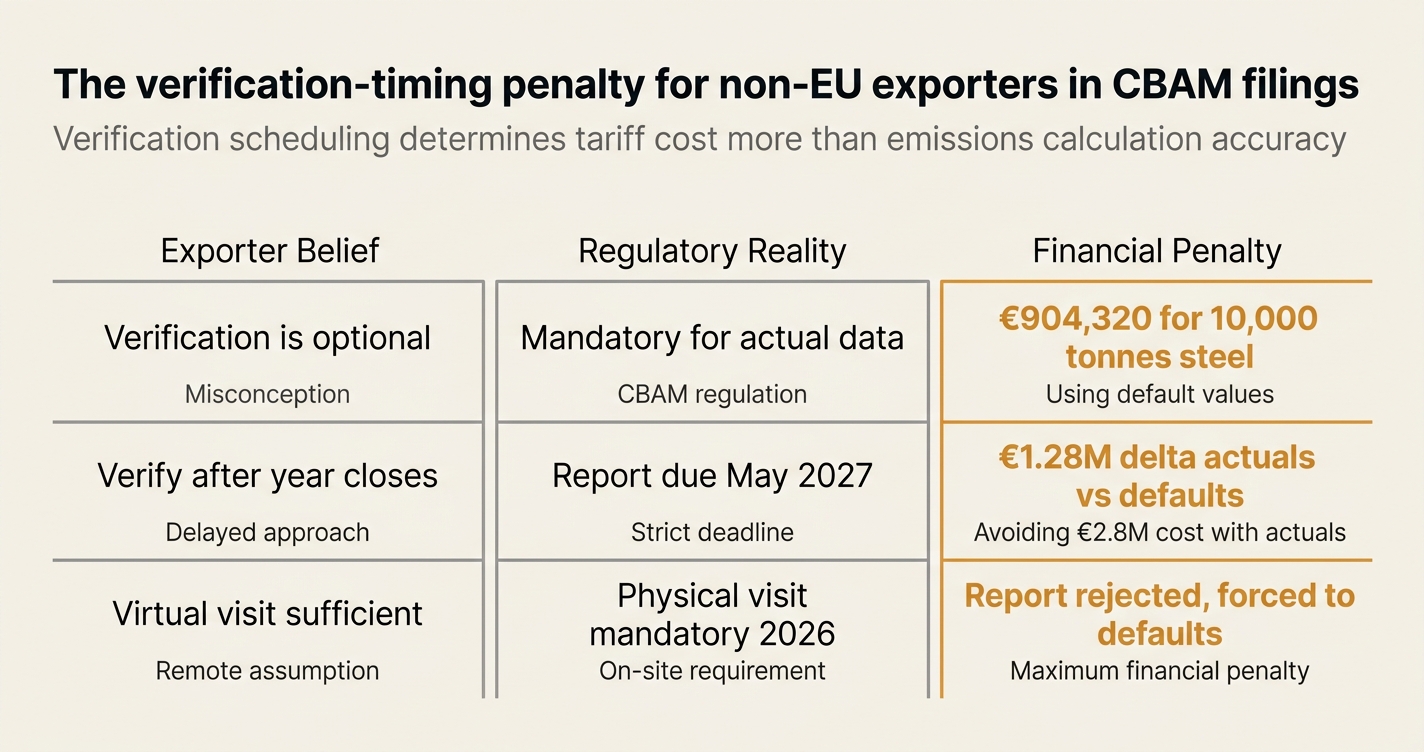
The verification-timing penalty for non-EU exporters in CBAM filings
Here's the issue: Starting January 2026, every Carbon Border Adjustment Mechanism-covered import into the EU generates a carbon cost. Your EU importer purchases certificates in 2027 to cover 2026 imports, and the cost depends entirely on the embedded emissions value you declare. At first glance, the problem appears to be about calculating emissions correctly—monitoring installation data, allocating to production processes, converting to specific embedded emissions per tonne. Most non-EU exporters are focused on this calculation work, assuming that once the numbers are ready, the filing is done.
However, a CBAM filing consists of two things: embedded emissions totals and verification scheduling.
Embedded emissions totals on their own have no value under the Carbon Border Adjustment Mechanism. The verification report is what the EU importer is actually obliged to submit—and what the national competent authority will audit when it reviews the declaration. Without a verification report covering the 2026 calendar year, the importer cannot use actual emissions data[1].
While emissions calculation has become more accessible through monitoring software and emissions factors databases, verification has become more expensive and time-constrained. If a mid-sized steel exporter in India completes its 2026 monitoring plan and emissions calculations by December 2026, but cannot secure an accredited verifier until March 2027, the verification report arrives too late for the importer's May 2027 annual CBAM declaration. The importer is forced to use default values for the full year—inflating the declared emissions by 2-5x compared to actual installation values, and adding the 10 percent markup on top[2].
For a shipment of 10,000 tonnes of steel with actual embedded emissions of 1.8 tonnes CO₂e per tonne, the difference between verified actuals and defaults could be €904,320 at Q1 2026 certificate prices. The cost of third-party verification for a single steel installation in 2026 ranges from €15,000 to €40,000. The payback period is six weeks[2].
How do you solve this? I think the operators we work with are scheduling verification during production, not after the calendar year closes. They are registering with accredited verifiers in Q1 2026, agreeing on site-visit windows in Q2 and Q3, and securing draft verification reports by November 2026—before the importer's declaration cycle starts. For now, verification scheduling is the bottleneck, not emissions calculation.
The shape of the argument, visualised below.
Myth 1: Verification is optional if you have accurate emissions data
Reality: Verification by an accredited third party is mandatory for any importer using actual embedded emissions data in their annual CBAM declaration[3]. Under Article 8 of Regulation (EU) 2023/956, as amended by Regulation (EU) 2025/2083, importers who obtain specific emission measurements from the non-EU production installation must have that data verified before submission[3]. Importers who use default values do not need third-party verification, but they pay a 10 percent markup in 2026, a 20 percent markup in 2027, and a 30 percent markup from 2028 onward above the country-specific average emission intensity[3].
For Indian steel producers using direct reduced iron technology with natural gas, actual emissions may be 40 to 60 percent below the country default. But without accredited verification of actual values, the importer pays Carbon Border Adjustment Mechanism certificates on the inflated default figure[2].
Myth 2: You can verify emissions data after the calendar year closes and still meet the declaration deadline
Reality: The first annual CBAM declaration for 2026 imports is due by May 31, 2027. If an exporter completes its monitoring plan and emissions calculations by December 2026 but cannot secure an accredited verifier until March 2027, the verification report arrives too late. The importer is forced to use default values for the full year[1]. For a 10,000-tonne shipment of steel at €80 per EUA, using defaults at 3.5 tCO₂ per tonne generates a CBAM certificate cost of approximately €2.8 million. The same tonnage with verified actuals at 1.9 tCO₂ per tonne drops the cost to €1.52 million—a €1.28 million delta[2].
The verification timeline is not a post-production formality. It is a parallel process that must begin during the production year to deliver a compliant report before the declaration window closes.
Myth 3: Virtual verification is sufficient for 2026
Reality: For the first year of the definitive phase in 2026, a physical on-site visit to each installation producing CBAM goods is mandatory[1]. From 2027 onwards, verifiers may replace a physical visit with a virtual visit under defined low-risk conditions, but a physical site visit must still occur at least once every two years[1]. This is not a regulatory formality—verifiers are checking whether your monitoring infrastructure exists, whether your data trail from raw meter readings to final emissions calculations is intact, and whether your internal controls prevent manipulation[3].
A physical site visit in 2026 means the verifier must schedule travel, coordinate with installation operators, and complete the visit before the year closes. For installations in regions with limited verifier availability, the scheduling bottleneck compounds.
Myth 4: Default values are a safe fallback option
Reality: Default values are deliberately set conservatively to reflect the worst-case emissions for each country and product type—with a markup[2]. The European Union recently released its regulation setting default greenhouse gas emission values for the Carbon Border Adjustment Mechanism, which applies to importers of steel, iron, aluminium, cement, fertilizers, hydrogen, and electricity. For companies unable to provide precise, third-party-verified emissions data, the EU will apply country and product-specific default values—plus an added markup—to calculate liabilities[4].
By design, the EU has kept very high default values to encourage the use of actual emissions data under the CBAM. Hence, higher default values drastically increase the taxes[5]. If an exporter ships 10,000 tonnes of steel per year to the EU, and the difference between actual emissions and default values is 1.2 tonnes CO₂ per tonne of steel, the annual penalty is €904,320 at Q1 2026 certificate prices[2].
Myth 5: Any third-party auditor can verify CBAM emissions
Reality: CBAM verification must be conducted by an accredited verifier, using the verification principles set out in Annex VI of the CBAM Regulation[3]. Commission Implementing Regulation (EU) 2025/2546 expounds on how these verification principles should be applied in practice. Accredited verifiers are third parties who have been formally approved by a national accreditation body to verify emissions data under the EU Emissions Trading System principles[3].
The pool of accredited verifiers with capacity to serve non-EU installations is limited. For installations in India, Turkey, China, and South Korea—the largest exporters of CBAM-covered goods—verifier availability is the constraining factor in 2026. Exporters who wait until Q4 2026 to engage a verifier may find that all available slots for physical site visits have been booked.
Myth 6: You can use equivalent methods or product carbon footprint standards instead of installation-level monitoring
Reality: During the transitional phase through end-2025, the Commission allows limited use of default values and equivalent methods, for example, if a supplier uses an established product carbon footprint standard. From 2026, the bar rises: you need actual, installation-specific data, and it must be verified by an accredited body under principles similar to those in the EU ETS[6].
Producers seeking to avoid the use of default values must monitor emissions at each installation, allocate emissions to specific production processes, and attribute emissions to individual goods. Actual emissions data must be verified by accredited third parties to ensure compliance with EU standards[4]. The calculation of specific embedded emissions follows a top-down approach as defined in Implementing Regulation (EU) 2025/2547: emissions are monitored at installation level, then attributed to production processes, and then converted to specific embedded emissions for the goods produced[7].
Myth 7: Verification is a one-time cost
Reality: Verification is an annual cost for any exporter whose EU importer uses actual emissions data in their CBAM declaration. The cost of third-party verification for a single steel installation in 2026 ranges from €15,000 to €40,000[2]. CBAM verification is the mandatory third-party process that confirms the accuracy of embedded emissions data before an authorized declarant submits their annual CBAM declaration, with verifier fees ranging from €5,000 to €50,000 per production installation depending on facility complexity[3].
For exporters with multiple installations or multiple product lines within a single installation, the verification cost compounds. However, the payback period is measured in weeks, not years. For a 10,000-tonne shipment of steel, the difference between verified actuals and defaults is €1.28 million[2]. The verification fee is 1.5 to 3 percent of the tariff penalty avoided.
| Myth | Reality | Cost of believing the myth |
|---|---|---|
| Verification is optional if you have accurate emissions data | Verification by an accredited third party is mandatory for any importer using actual emissions data | €904,320 annual penalty for 10,000 tonnes steel at 1.2 tCO₂ delta[2] |
| You can verify after the calendar year closes | Verification report must be complete before May 2027 declaration deadline | €1.28 million for 10,000 tonnes steel using defaults vs. actuals[2] |
| Virtual verification is sufficient for 2026 | Physical on-site visit is mandatory in 2026[1] | Verification report rejected, forced to use defaults |
| Default values are a safe fallback | Default values carry 10 percent markup in 2026, inflated 2-5x vs. actuals[2] | €2.8 million vs. €1.52 million for 10,000 tonnes steel[2] |
| Any third-party auditor can verify CBAM | Only accredited verifiers under EU ETS principles[3] | Verification report rejected, forced to use defaults |
| You can use equivalent methods instead of installation-level monitoring | From 2026, actual installation-specific data required[6] | Verification report rejected, forced to use defaults |
| Verification is a one-time cost | Annual cost, €15,000-€40,000 per installation[2] | €1.28 million tariff penalty avoided per 10,000 tonnes steel[2] |
"For the first year of the definitive phase in 2026, a physical on-site visit to each installation producing CBAM goods is mandatory. From 2027 onwards, verifiers may replace a physical visit with a virtual visit under defined low-risk conditions, but a physical site visit must still occur at least once every two years."[1]
How Emission3 fits
Emission3 positions verification scheduling as part of the implementation workflow, not an afterthought. When a non-EU exporter begins a CBAM readiness call, we map the verification timeline alongside the monitoring plan: which installations need physical site visits in 2026, which accredited verifiers serve the installation's region, and what documentary evidence the verifier will request during the site visit. Our document-first ingestion system builds the evidence pack the verifier needs—utility bills, invoices, bills of materials, meter readings, allocation worksheets—with full lineage from source document to final emissions calculation[8].
For a steel exporter in India with three installations, we schedule verifier engagement in Q1 2026, coordinate site visits in Q2 and Q3, and deliver draft verification reports by November 2026—before the importer's declaration cycle starts. The verifier's materiality threshold is set at 5 percent of total specific embedded emissions per tonne[7]. Our calculation engine ensures that every line-item value in the verification report is reproducible, with a full audit trail to the source document.
The verification report is not a summary of emissions. It is a compliance artifact that the national competent authority will audit when it reviews the importer's annual CBAM declaration. Emission3 exports the verification report in the electronic EU template format from the CBAM Registry[7], with embedded evidence packs that meet the documentary standards verifiers apply during site visits.
The verification-timing penalty, quantified
For a non-EU steel exporter shipping 10,000 tonnes per year to the EU, the difference between securing verification in 2026 and falling back on default values is €1.28 million in CBAM certificate costs[2]. The verification fee is €15,000 to €40,000[2]. The payback period is six weeks.
The penalty is not in the verification fee. The penalty is in the scheduling delay. If an exporter completes its monitoring plan by December 2026 but cannot secure an accredited verifier until March 2027, the verification report arrives too late for the May 2027 declaration deadline. The importer is forced to use default values for the full year, inflating the declared emissions by 2-5x compared to actual installation values[2].
This is the verification-timing penalty: the tariff cost of waiting until the year closes to engage a verifier, when verifier capacity in 2026 is the constraining factor.
Start with a CBAM readiness call
If you are a non-EU exporter facing CBAM in 2026, or an EU importer whose suppliers have not yet secured accredited verifiers, the next step is to map the verification timeline. We begin every CBAM engagement with a readiness call: which installations produce CBAM goods, which accredited verifiers serve the installation's region, what documentary evidence the verifier will request during the site visit, and when the verification report must be complete to meet the May 2027 declaration deadline. No anonymous self-serve onboarding—every implementation starts with a conversation about verification scheduling, not emissions calculation[9].
References & Sources
External Sources
- [1]The verification problem in CBAM filings
For the first year of the definitive phase in 2026, a physical on-site visit to each installation producing CBAM goods is mandatory. From 2027 onwards, verifiers may replace a physical visit with a virtual visit under defined low-risk conditions, but a physical site visit must still occur at least once every two years.
- [2]CBAM Filings: 2026 Verification Timing and Verification Report Importance
For Indian steel producers using direct reduced iron technology with natural gas, actual emissions may be 40 to 60 percent below the country default. But without accredited verification of actual values, the importer pays Carbon Border Adjustment Mechanism certificates on the inflated default figure. If an exporter ships 10,000 tonnes of steel per year to the EU, and the difference between actual emissions and default values is 1.2 tonnes CO₂ per tonne of steel, the annual penalty is €904,320 at Q1 2026 certificate prices.
- [3]CBAM Verification 2026: What Verifiers Check and How to Find One
CBAM verification is the mandatory third-party process that confirms the accuracy of embedded emissions data before an authorized declarant submits their annual CBAM declaration, with verifier fees ranging from €5,000 to €50,000 per production installation depending on facility complexity. The process applies only to importers using actual emission values, not default values.
- [4]How the EU's New Default Emissions Values Under CBAM Impact US Exporters
Producers seeking to avoid the use of default values must monitor emissions at each installation, allocate emissions to specific production processes, and attribute emissions to individual goods. Actual emissions data must be verified by accredited third parties to ensure compliance with EU standards.
- [5]CBAM reporting requirements & Compliance Guide for 2026
Under the CBAM reporting requirements, using default values will always mean paying more carbon tax than applicable on actual emissions. This is a deliberate design to prevent carbon leakage and discourage use of default values. By design, the EU has kept very high default values to encourage the use of actual emissions data under the CBAM.
- [6]Understanding CBAM Regulation (Carbon Border Adjustment Mechanism)
During the transitional phase through end-2025, the Commission allows limited use of default values and equivalent methods. From 2026, the bar rises: you need actual, installation-specific data, and it must be verified by an accredited body under principles similar to those in the EU ETS.
- [7]EU CBAM Emissions Data: Monitoring, Reporting & Verification
The calculation of specific embedded emissions follows a top-down approach as defined in IR 2025/2547: emissions are monitored at installation level, then attributed to production processes, and then converted to specific embedded emissions for the goods produced. Verification reports for 2026 can be issued in an electronic EU template from January 2027 via the CBAM Registry.
Related Content
- [8]Document-first ingestion
How raw documents become audit-grade evidence. Emission3's ingestion system converts utility bills, invoices, bills of materials, and meter readings into line-item evidence with full lineage from source document to final emissions calculation.
- [9]Book a CBAM readiness call
All customers start with a readiness call: we map suppliers, gaps, and implementation. No anonymous self-serve onboarding. We begin every CBAM engagement with a conversation about verification scheduling, accredited verifier availability, and documentary evidence requirements.