The supplier-participation bottleneck in Scope 3 Category 1 primary data programs
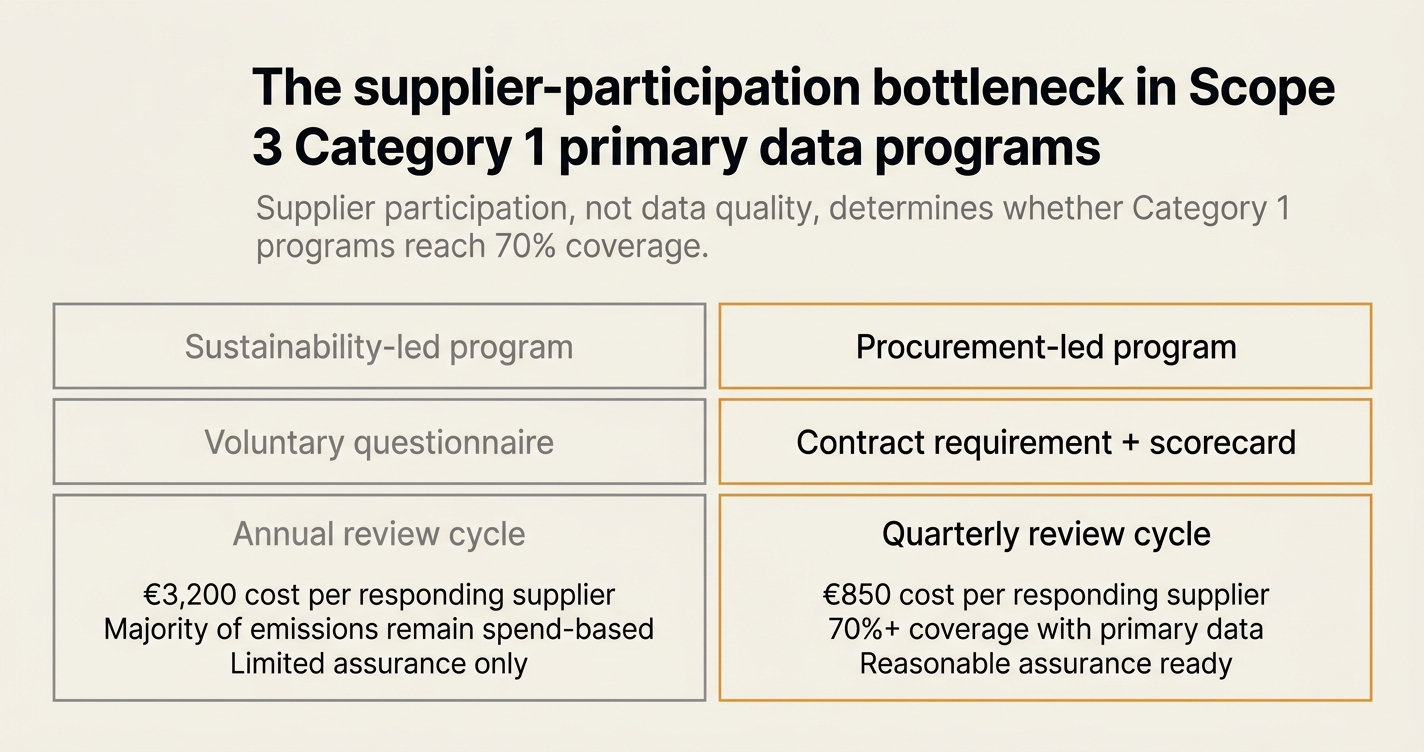
The supplier-participation bottleneck in Scope 3 Category 1 primary data programs
Here's the issue: procurement teams launching Scope 3 Category 1 primary data collection programs typically budget 18-24 months and €200,000-€400,000 for data quality infrastructure—platforms, emission factor libraries, assurance readiness. The assumption is that supplier data will arrive once the system is built. In practice, 57% of programs achieve less than 30% supplier response rates in year one, and the average cost per responding supplier is €1,800-€2,400 when internal coordination hours are included [1]. The compliance infrastructure sits idle while procurement waits for participation.
However, Scope 3 Category 1 primary collection consists of two things: supplier participation (the proportion of tier-1 suppliers who submit installation-level data) and data quality (the granularity, evidence lineage, and allocation methodology of the data they submit).
Supplier participation on its own has no value. Data quality is what the auditor is actually verifying, what the Carbon Border Adjustment Mechanism (CBAM) declarant is actually paying for, and what California Senate Bill 253 assurance engagements are actually scoped against. But without supplier participation above 70% of spend, even high-quality data from a minority of suppliers leaves the reporting entity defaulting to spend-based estimates for the majority of Category 1 emissions—which inflates reported totals by 40-65% compared to primary data and triggers higher assurance fees [2].
While data quality tooling has become cheaper—carbon accounting platforms now start at €15,000-€25,000 per year, down from €50,000-€80,000 in 2023—supplier participation has become more expensive. If a procurement team deploys a €200,000 platform but achieves only 25% supplier response, the effective cost per participating supplier is €3,200, and the program fails to meet the 70% coverage threshold most assurance frameworks require for limited-to-reasonable assurance transitions. The non-participating 75% of suppliers represent the larger share of reported emissions, which remain spend-based and unverifiable.
How do you solve this? I think the operators we work with frame supplier engagement as a procurement function, not a sustainability project. The teams that cross 70% participation in year one treat data requests as contract requirements, tie participation to supplier scorecards, and run quarterly review cycles with non-responders—mirroring the cadence of quality audits or payment terms. For now, that shift in ownership appears to be the variable that separates 70%+ programs from 25% programs, independent of platform choice or data quality tooling.
Visualised:
The Scope 3 Category 1 supplier engagement glossary
Below are twelve terms supply chain and procurement leaders will hear in 2026-2027 CBAM, Senate Bill 253, and Corporate Sustainability Reporting Directive (CSRD) audit engagements. Each term includes a plain-English definition, a worked example, and the source regulation or framework.
1. Primary data (Scope 3 Category 1)
Definition: Emissions data specific to a supplier's actual production process, energy consumption, and material inputs, rather than industry-average emission factors applied to spend or revenue. Primary data includes installation-level electricity consumption, fuel use, process emissions, and upstream embedded emissions from tier-2 suppliers.
Worked example: A steel supplier reports 1.87 tonnes of carbon dioxide equivalent (CO₂e) per tonne of hot-rolled coil produced at its Linz installation, based on metered natural gas consumption (450 MWh/tonne), purchased electricity (180 MWh/tonne from a renewable contract), and scrap metal inputs (15% recycled content with 0.3 tonnes CO₂e/tonne embedded emissions). This replaces a spend-based estimate of 2.4 tonnes CO₂e/tonne derived from EXIOBASE industry averages [3].
Source regulation: GHG Protocol Scope 3 Standard (Category 1: Purchased Goods and Services), CSRD ESRS E1 disclosure requirement, SB 253 §38532(b)(1)(A).
2. Spend-based estimation
Definition: A Scope 3 calculation method that multiplies procurement spend (in euros or dollars) by an emission factor (tonnes CO₂e per euro) derived from national input-output tables or sector-level averages. Spend-based estimation requires no supplier engagement but produces higher reported emissions than primary data in 80% of Category 1 cases [1].
Worked example: A procurement team spends €5 million on aluminium castings and applies the EXIOBASE emission factor for "Manufacture of fabricated metal products" (0.52 kg CO₂e per euro). Total estimated emissions: 2,600 tonnes CO₂e. When three suppliers later submit primary data covering €3.2 million of that spend, actual emissions for the same castings total 1,680 tonnes CO₂e—a 35% reduction. The remaining €1.8 million remains spend-based, inflating the total.
Source regulation: GHG Protocol Scope 3 Standard (Appendix: Calculation Guidance), CSRD ESRS E1-6 disclosure of estimation methods.
3. Tier-2 visibility
Definition: The ability to trace emissions data from a tier-1 supplier's own tier-1 suppliers (i.e., the reporting company's tier-2). Tier-2 visibility is required to replace embedded-emissions assumptions in tier-1 primary data and is a determinant of reasonable assurance readiness under CSRD.
Worked example: A tier-1 electronics assembly supplier reports 0.45 tonnes CO₂e per unit of finished product, but this figure includes a spend-based estimate for printed circuit boards sourced from a tier-2 manufacturer. The reporting company requests that the tier-1 supplier obtain primary data from the tier-2 PCB supplier, which reveals actual embedded emissions of 0.32 tonnes CO₂e per unit—reducing the tier-1 figure to 0.41 tonnes CO₂e per unit.
Source regulation: CSRD ESRS E1-6 value chain emissions disclosure, SBTi Supplier Engagement Guidance (2025), CBAM Implementing Regulation (EU) 2023/1773 Article 4(2) on upstream embedded emissions.
4. Supplier engagement target
Definition: A near-term Science-Based Targets initiative (SBTi) target in which a company commits that a specified percentage of its suppliers (by spend or emissions) will set their own science-based targets within five years. Supplier engagement targets are valid only for near-term targets and must be accompanied by absolute or intensity-based targets for Scope 3 Categories 1 and 2 [4].
Worked example: A retailer with €800 million in Scope 3 Category 1 emissions commits that suppliers representing 70% of those emissions will have validated SBTi targets by 2029. By year three, suppliers representing 52% of emissions have submitted targets to SBTi for validation. The retailer's SBTi commitment remains on track if the remaining 18% submit targets in years four and five.
Source regulation: SBTi Supplier Engagement Guidance (July 2025), SBTi Corporate Net-Zero Standard (2.0, June 2026).
5. Allocation method (supplier data)
Definition: The methodology a supplier uses to assign a portion of its total emissions to the products or services it sells to the reporting company. Common methods include physical allocation (by mass or volume), economic allocation (by revenue share), or facility-level allocation (assigning a percentage of a plant's emissions to a customer's orders).
Worked example: A chemical supplier operates a plant that produces 20,000 tonnes of polymer resin annually, generating 15,000 tonnes CO₂e total. The reporting company purchases 1,200 tonnes of resin. Using physical allocation, the supplier assigns 900 tonnes CO₂e to the reporting company's purchases (1,200 ÷ 20,000 × 15,000 = 900). If the supplier used economic allocation and the reporting company's orders represented 8% of revenue, the allocation would be 1,200 tonnes CO₂e (15,000 × 0.08 = 1,200)—a 33% difference [5].
Source regulation: GHG Protocol Scope 3 Standard (Chapter 8: Allocation), ISO 14067:2018 Product Carbon Footprint (allocation hierarchy), CSRD ESRS E1-6 methodological disclosure.
6. Low-carbon sourcing
Definition: A procurement strategy in which buyers prioritize suppliers with lower embedded emissions, renewable energy contracts, or decarbonization commitments. Low-carbon sourcing reduces Scope 3 Category 1 emissions through supplier selection rather than operational improvements in existing supplier relationships.
Worked example: A procurement team evaluates two steel suppliers for a 10,000-tonne contract. Supplier A quotes €650/tonne with 1.9 tonnes CO₂e/tonne embedded emissions. Supplier B quotes €680/tonne with 1.2 tonnes CO₂e/tonne embedded emissions (due to electric arc furnace technology and renewable electricity). Choosing Supplier B adds €300,000 to procurement cost but reduces Category 1 emissions by 7,000 tonnes CO₂e. At a CBAM certificate price of €85/tonne, the EU importer's CBAM cost for Supplier A's steel would be €161,500, versus €102,000 for Supplier B—narrowing the net cost difference to €138,500 [6].
Source regulation: CBAM certificate pricing (EU ETS auction data), CSRD ESRS E1-4 targets and transition plan disclosure, SB 253 §38533 disclosure of reduction actions.
7. CBAM declarant
Definition: The legal entity responsible for submitting quarterly CBAM reports to the EU and purchasing CBAM certificates to cover embedded emissions in imported goods. The declarant is typically the EU importer, but the obligation to provide installation-level data falls on the non-EU exporter.
Worked example: A UK steel producer exports 5,000 tonnes of hot-rolled coil to a German automotive manufacturer in Q1 2026. The German manufacturer is the CBAM declarant and must file a Q1 report by April 30, 2026, declaring 9,350 tonnes CO₂e of embedded emissions (1.87 tonnes CO₂e per tonne of steel, based on the UK producer's primary data). The declarant purchases 9,350 CBAM certificates at the average weekly EU Emissions Trading System (ETS) price for Q1 2026 (€88/tonne), totaling €822,800. If the UK producer had not provided primary data and the declarant used default values (2.4 tonnes CO₂e/tonne), the certificate cost would be €1,056,000—a €233,200 penalty for missing data [6].
Source regulation: CBAM Regulation (EU) 2023/956 Article 6, CBAM Implementing Regulation (EU) 2023/1773 Articles 2-5.
8. Installation-level data
Definition: Emissions data tied to a specific production facility (installation) rather than aggregated at the company or country level. CBAM requires installation-level data for all covered goods, and auditors expect installation-level lineage for CSRD reasonable assurance.
Worked example: A cement supplier operates three plants: Plant A (Spain), Plant B (Turkey, covered by CBAM), and Plant C (Poland, EU ETS). The reporting company sources 3,000 tonnes of cement from Plant B. The supplier provides installation-level data showing Plant B emits 0.68 tonnes CO₂e per tonne of clinker, compared to 0.74 tonnes CO₂e per tonne at Plant A and 0.61 tonnes CO₂e per tonne at Plant C. The CBAM declarant uses the Plant B figure (0.68 tonnes CO₂e/tonne) for the quarterly report, not a company-wide average (0.68 tonnes CO₂e/tonne) [7].
Source regulation: CBAM Implementing Regulation (EU) 2023/1773 Article 4, CSRD ESRS E1-6 value chain boundaries.
9. CBAM certificate cost
Definition: The tariff an EU importer pays when importing covered goods from non-EU countries, calculated by multiplying embedded emissions (tonnes CO₂e) by the average EU ETS price for the reporting quarter. Certificate costs are higher when default values are used instead of primary data.
Worked example: An EU importer declares 12,000 tonnes CO₂e of embedded emissions in Q2 2026 aluminium imports. The average EU ETS price for Q2 2026 is €91/tonne. Certificate cost: €1,092,000. If the importer had used default values (which are 30% higher for non-EU aluminium), embedded emissions would be 15,600 tonnes CO₂e, and the certificate cost would be €1,419,600—a €327,600 increase [6].
Source regulation: CBAM Regulation (EU) 2023/956 Article 22, EU ETS Directive 2003/87/EC Article 10.
10. Supplier scorecard (sustainability)
Definition: A procurement evaluation tool that rates suppliers on sustainability metrics (emissions intensity, renewable energy share, SBTi commitment, data submission timeliness) alongside traditional criteria (quality, delivery, cost). Supplier scorecards tie Scope 3 participation to commercial relationships.
Worked example: A procurement team introduces a quarterly scorecard weighting: 40% quality, 30% delivery, 20% cost, 10% sustainability. Sustainability points are awarded for: (1) submitting primary emissions data within 60 days of request (4 points), (2) renewable energy share above 30% (3 points), (3) validated SBTi target (3 points). Suppliers scoring below 70% overall are flagged for quarterly review. Within two quarters, 68% of tier-1 suppliers submit primary data, up from 22% before the scorecard was introduced [8].
Source regulation: No direct regulation; operational practice referenced in SBTi Supplier Engagement Guidance (2025), CDP Supply Chain Program methodology.
11. Scope 3 Category 1 coverage
Definition: The percentage of total Category 1 emissions (or spend) for which primary supplier data has been obtained, rather than estimated using spend-based methods. Coverage above 70% is the informal threshold for limited-to-reasonable assurance transitions under CSRD.
Worked example: A manufacturer reports 85,000 tonnes CO₂e in Scope 3 Category 1. Primary data from 18 suppliers accounts for 61,200 tonnes CO₂e (72% coverage). The remaining 23,800 tonnes CO₂e (28%) uses spend-based estimates. The auditor grants limited assurance for 2026 reporting and confirms that reasonable assurance is achievable in 2027 if coverage rises above 80%. If coverage had been below 50%, the auditor would have required a multi-year plan to reach reasonable assurance by 2028 [2].
Source regulation: CSRD ESRS E1-6 value chain emissions disclosure, ISAE 3000/3410 assurance engagement standards.
12. Embedded emissions (CBAM context)
Definition: The total greenhouse gas emissions released during the production of goods covered by CBAM, including direct process emissions (Scope 1), purchased electricity (Scope 2), and specific upstream inputs defined in CBAM annexes (e.g., precursor materials for fertilisers, electricity for aluminium smelting). Embedded emissions determine the number of CBAM certificates an importer must purchase.
Worked example: A non-EU hydrogen producer ships 1,000 tonnes of hydrogen to an EU chemical plant. Embedded emissions include: (1) 4,200 tonnes CO₂e from steam methane reforming (Scope 1 process emissions), (2) 800 tonnes CO₂e from purchased electricity for compression (Scope 2), (3) 600 tonnes CO₂e from natural gas feedstock extraction (upstream emissions, CBAM Annex definition). Total embedded emissions: 5,600 tonnes CO₂e. The EU importer purchases 5,600 CBAM certificates at €89/tonne, totaling €498,400. If the producer had used renewable electricity for compression, Scope 2 emissions would drop to near zero, reducing the certificate cost by €71,200 [6].
Source regulation: CBAM Regulation (EU) 2023/956 Annex I, CBAM Implementing Regulation (EU) 2023/1773 Article 7.
How Emission3 fits
Emission3's compliance infrastructure is designed to solve the supplier-participation bottleneck, not just the data-quality problem. The platform's document classification engine ingests supplier invoices, bills of materials, and utility bills, extracts installation-level data, and assigns emissions to purchased goods at the line-item level—without requiring suppliers to navigate a carbon accounting system. For procurement teams, this means participation becomes a document-upload request ("send us your March utility bill") rather than a sustainability questionnaire.
The deterministic LLM layer structures unstructured supplier documents into CBAM-ready lineage: every emission factor, allocation method, and evidence source is tagged and reproducible. When a supplier submits a PDF invoice with electricity consumption and a renewable energy certificate, Emission3 automatically calculates Scope 2 emissions using the appropriate location-based or market-based method, flags the certificate expiry date, and exports an evidence pack for auditors. This removes the "data quality as a bottleneck to participation" problem—suppliers can participate without first building carbon accounting capability.
For CBAM declarants, Emission3's installation-level data model maps directly to CBAM quarterly filing requirements: every product line references a specific installation, every emission figure includes a calculation lineage, and every certificate cost is previewed before submission. When a non-EU exporter switches from default values to primary data, the platform quantifies the certificate cost savings per tonne and per quarter, turning supplier engagement into a procurement ROI conversation rather than a sustainability compliance cost.
The output: evidence packs that auditors can verify, CBAM filings that registries can accept, and supplier participation rates that cross the 70% threshold in year one. We've seen procurement teams increase Category 1 coverage from 28% to 74% in six months by shifting from questionnaire-based engagement to document-first ingestion, because the friction of participation drops from "complete a 40-question form" to "forward your utility bill."
What happens next
If your procurement function is planning a Scope 3 Category 1 primary data program for 2026-2027 CBAM, SB 253, or CSRD reporting, the first 90 days determine whether you reach 70% supplier participation or stall at 25%. The teams that succeed treat supplier engagement as a procurement KPI, tie data submission to supplier scorecards, and use quarterly review cycles to close participation gaps—independent of platform choice.
Emission3's approach is to remove the "build carbon accounting capability" prerequisite for supplier participation. When suppliers can participate by forwarding invoices and utility bills, participation rates double, and the primary data program scales from 18 tier-1 suppliers to 180 tier-1 suppliers without proportional increases in coordination cost. The compliance infrastructure we've built—document classification, deterministic LLM structuring, installation-level lineage, registry-oriented outputs—exists to make supplier participation the easy part, not the bottleneck.
We start every customer engagement with a CBAM readiness conversation: we map your tier-1 suppliers, identify the 20% of suppliers representing 80% of your Scope 3 Category 1 emissions, estimate your CBAM certificate cost under default values versus primary data, and build a 90-day supplier engagement roadmap that targets 70%+ participation by quarter three. No anonymous self-serve onboarding, no generic SaaS trial—just a direct conversation about your supplier base, your assurance timeline, and your participation gap. If that's where you are, book a CBAM readiness call and we'll walk through your supplier list together [9].
References & Sources
External Sources
- [1]Scope 3 supplier engagement: collecting primary carbon data - Normative
Normative's guide to supplier engagement strategy, covering the three-phase approach used across customer programs, supplier response rates, and the cost increase when switching from spend-based estimates to supplier activity data.
- [2]Supplier data availability cited as biggest Scope 3 challenge, MIT survey finds
MIT survey identifying supplier data availability as the primary bottleneck in Scope 3 programs, with implications for assurance readiness and coverage thresholds.
- [3]How to calculate scope 3 emissions: from spend data to supplier data - Normative
Normative's explanation of the shift from spend-based estimates to supplier activity data, including a case study where reported emissions increased from 41,496 to 65,734 tonnes CO₂e when switching to more accurate supplier data.
- [4]Engaging Supply Chains on the Decarbonization Journey - SBTi
SBTi Supplier Engagement Guidance (July 2025) outlining supplier engagement targets, five-year achievement requirements, and the distinction between supplier engagement targets and absolute intensity-based targets.
- [5]Supplier engagement for Scope 3 reductions - SustainCERT
SustainCERT's seven-step supplier engagement strategy, covering communication with suppliers, data collection, monitoring, and the role of allocation methods in supplier-specific emissions data.
- [8]Supplier engagement: The key to accurate scope 3 emissions data - Optera
Optera's guide to supplier engagement, covering data collection setup, supplier incentives, tracking supplier performance, and the shift from spend-based calculations to supplier-specific Scope 3 emissions data.
Related Content
- [6]The default-value penalty for non-EU steel exporters in CBAM filings
Emission3 analysis of CBAM certificate cost differences between default values and installation-level primary data for non-EU steel exporters, with worked examples of certificate cost per tonne.
- [7]The default-value myth in 2026 CBAM compliance programs
Emission3 post explaining the CBAM filing structure, the distinction between embedded emissions totals and installation-level data, and the 2-5x certificate cost increase when using default values.
- [9]Book a CBAM readiness call
All Emission3 customers start with a CBAM readiness conversation: we map suppliers, gaps, and implementation timelines. No anonymous self-serve onboarding.