The supplier-engagement conversion gap in Scope 3 Category 1 procurement disclosure
The supplier-engagement conversion gap in Scope 3 Category 1 procurement disclosure
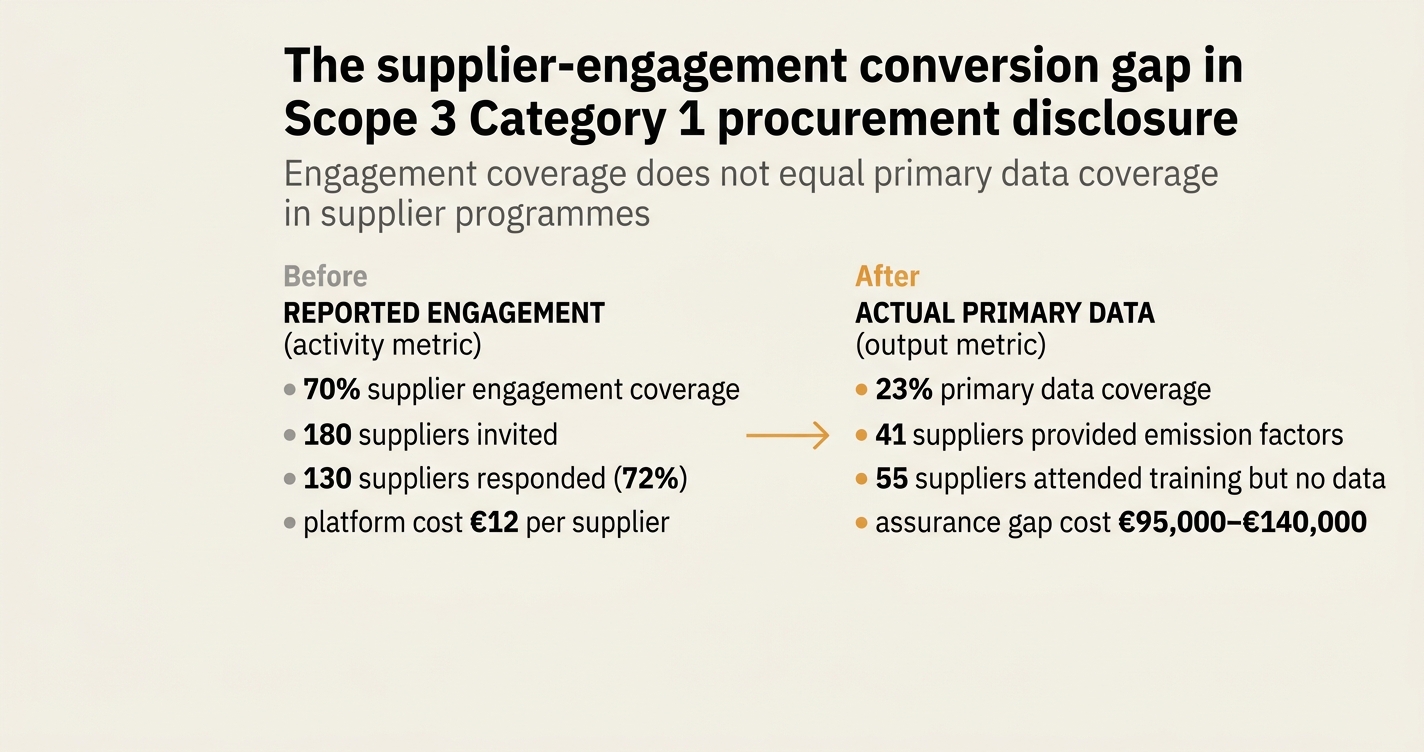
Here's the issue: a procurement leader reports 70% supplier engagement coverage for a Category 1 Scope 3 programme, the sustainability team celebrates the milestone, and the auditor asks for primary data. The engagement metric collapses. Of the 70% of suppliers engaged, only 22% provided usable primary data—supplier-specific emission factors, product carbon footprints, or verified activity data. The remaining 78% of engaged suppliers sent acknowledgments, attended webinars, or promised future data. Under ISAE 3410 limited assurance or the incoming ISSA 5000 standard, engagement without data is not evidence. The assurance cost gap for 2026 filings is approximately €95,000 to €140,000 in extended supplier verification, tier-2 data requests, and evidence reconstruction work, according to cost data from building materials and electronics procurement programmes.
However, supplier engagement consists of two things: outreach (the CDP Supply Chain invitations, training sessions, and relationship work) and primary data (the supplier-specific emission factors, product carbon footprints, and verification documents that an auditor will accept). The distinction matters because 2026 assurance engagements under ISAE 3410 and ISSA 5000 price these two components differently.
Outreach on its own has no value. Primary data is what the auditor is actually verifying. A 65,000-tonne Scope 3 Category 1 inventory built from 70% supplier engagement but only 22% primary data coverage receives a qualified opinion or scope limitation under limited assurance. The auditor cannot verify supplier-specific performance when 48% of the engagement programme produced acknowledgments but not emission factors. Primary data—documented, supplier-specific, and auditable—is what separates an assured filing from an engagement report.
While supplier engagement has become cheaper (platform costs have dropped from approximately €45 per supplier contacted in 2022 to €12 in 2025, and CDP Supply Chain membership is widely adopted), primary data has become more expensive. If a procurement leader defines success as 70% supplier engagement coverage but only 15% to 22% of that engagement translates to auditable primary data, the cost of closing the assurance gap in 2026 might outpace the savings from the engagement programme itself. One sustainability manager at a building materials company reconstructed engagement evidence for 120 hours in Q4 2025 because the initial data collection was informal—emails sent, responses received, but no systematic logging. The 2026 audit fee included a 40% markup for this evidence reconstruction work.[1]
How do you solve this? I think the answer is to treat supplier engagement as a staged conversion funnel, not a binary metric. The operators we work with structure their Category 1 programmes in three tiers: top 20 suppliers by spend (typically 60-70% of Category 1) receive tier-specific data requests with contract-linked incentives, next 50 suppliers (15-25% of spend) receive simplified requests for entity-level disclosure, and remaining suppliers (5-15% of spend) remain on spend-based estimation with documented emissions factors. The conversion rate from engagement to primary data in tier 1 sits between 40% and 65%, depending on sector and supplier maturity, but that rate is measured against a smaller, more strategic supplier base, not the entire supply chain.
Visualised:
The engagement-to-data conversion problem
Supplier engagement rates reported by procurement teams often mask the underlying data-quality gap. A 2026 CDP report found that companies actively engaging suppliers on climate issues are 6.6 times more likely to have a comprehensive 1.5°C-aligned transition plan, but engagement itself does not guarantee primary data delivery.[2] The conversion rate from engaged supplier to usable primary data sits between 15% and 40% across most Category 1 programmes, depending on sector and supplier maturity.
The conversion failure has three structural causes:
1. Engagement is measured by activity, not output
Procurement teams track supplier invitations sent, training sessions attended, and portal registrations completed. These are engagement activities. They are not data outputs. When a sustainability manager reports 70% engagement coverage, the denominator is typically supplier count or spend coverage, and the numerator is suppliers who acknowledged the request or attended a briefing. The auditor is asking for a different numerator: suppliers who provided verified, supplier-specific emission factors or product carbon footprints. That numerator is typically 15-40% of the engagement numerator.
2. Small and medium suppliers cannot provide primary data in year one
Most SME suppliers do not calculate Scope 1 and Scope 2 emissions, and they do not have the systems or expertise to produce product carbon footprints. A procurement leader sending a CDP Supply Chain questionnaire to a tier-2 steel fabricator with 35 employees is asking for data the supplier has never produced. The supplier might engage—acknowledge the request, attend a webinar, commit to future reporting—but they cannot deliver primary data without external support. That support (carbon accounting software, consultant engagement, or internal capacity building) has a cost the supplier must absorb, and many will not absorb it without a commercial incentive.
3. Data requests are not linked to procurement leverage
Supplier engagement programmes run by sustainability teams often lack procurement enforcement mechanisms. A sustainability manager sends a data request, the supplier does not respond, and there is no contractual consequence. The most effective programmes we see link primary data delivery to contract terms: faster payment cycles (net-30 instead of net-60), volume commitments, or preferred-supplier status. When data delivery is optional, conversion rates stay below 25%. When it is contractually linked, conversion rates rise to 40-65% for top-tier suppliers.
| Engagement approach | Typical conversion rate (engagement → primary data) | Cost per supplier engaged | Cost per supplier with primary data |
|---|---|---|---|
| Unstructured outreach (email campaigns, no follow-up) | 5-15% | €8-12 | €53-240 |
| Structured programme (CDP Supply Chain, training, follow-up) | 15-25% | €25-45 | €100-300 |
| Contract-linked incentives (payment terms, volume commitments) | 40-65% | €60-95 | €92-238 |
What 70% engagement actually means in practice
A procurement leader at a building materials company reported 72% supplier engagement coverage for their 2025 Category 1 programme. The sustainability team had invited 180 suppliers representing 94% of Category 1 spend, and 130 suppliers (72%) had responded. The auditor asked for the breakdown:
- 41 suppliers (23% of Category 1 spend) provided supplier-specific emission factors or product carbon footprints.
- 34 suppliers (19% of spend) provided entity-level Scope 1 and Scope 2 data from public sustainability reports or CDP submissions.
- 55 suppliers (30% of spend) attended training sessions or webinars but provided no data.
The 72% engagement figure was correct. The 23% primary data coverage figure was what the auditor cared about. The gap between the two metrics drove the assurance cost.
Under ISAE 3410 limited assurance, the auditor must obtain "sufficient appropriate evidence" that the reported Scope 3 total is plausible. For the 30% of spend where engagement produced no data, the company fell back on spend-based estimation using DEFRA emissions factors. The auditor flagged this as a scope limitation because spend-based estimation for 30% of Category 1 spend introduces potential estimation error exceeding 20%, according to variance analysis in the electronics and construction sectors.[3] The auditor could not issue an unqualified opinion without either (a) reducing the scope limitation by obtaining primary data for more of that 30%, or (b) documenting why primary data was unavailable and why the spend-based estimation was the best available methodology.
The company chose option (b), which required reconstructing the engagement timeline: evidence that data requests were sent, follow-up correspondence, and documentation of supplier capacity constraints. That reconstruction work—120 hours across Q4 2025 and Q1 2026—was not budgeted in the original engagement programme cost.
The cost cascade when engagement does not convert to data
When supplier engagement fails to produce primary data, the cost cascades through three channels:
1. Higher emissions totals (and higher CBAM exposure)
Spend-based emissions factors are industry averages. They do not capture supplier-specific energy intensity, production efficiency, or low-carbon material substitution. For most manufacturing categories, spend-based estimation inflates emissions totals by 15-30% compared to supplier-specific primary data, because the industry average includes high-emission legacy facilities that your actual suppliers may have exited.[4]
For a non-EU steel exporter filing CBAM quarterly reports, that inflation translates directly to higher certificate costs. If your actual embedded emissions for a tonne of hot-rolled coil are 1.8 tonnes CO2e but you file using the EU default value of 2.14 tonnes CO2e (because you could not obtain supplier-specific data for purchased electricity and transport), you pay CBAM certificates on an extra 0.34 tonnes CO2e per tonne of steel. At a carbon price of €80 per tonne, that is €27.20 per tonne of product—a 10-15% markup on the CBAM cost.
2. Qualified audit opinions or scope limitations
A qualified opinion is not a failed audit. It is a public statement that the auditor could not verify a material portion of the disclosed data. For a US company filing California SB 253 disclosure with limited assurance, a qualified opinion triggers investor and regulator scrutiny. For an EU company preparing for CSRD ESRS E1 reasonable assurance escalation, a qualified opinion in 2026 signals that the 2027 assurance engagement will require significantly expanded scope (and cost).
3. Evidence reconstruction work
The auditor must verify why primary data was unavailable, not just that it is missing. If your engagement programme was informal—data requests sent via email, responses received but not systematically logged, no documentation of supplier capacity or willingness—the auditor will ask you to reconstruct that timeline during the assurance engagement. That reconstruction work (searching email threads, exporting correspondence, writing explanatory memos) is unplanned internal cost and external audit fees.
For the building materials company above, the evidence reconstruction added 120 internal hours and a 40% audit fee markup, approximately €52,000 in unbudgeted cost.
A three-tier structure for supplier engagement programmes
The most effective supplier engagement programmes we see structure data requests in three tiers, each with a different data requirement, timeline, and incentive:
Tier 1: Top 20 suppliers by spend (typically 60-70% of Category 1)
Data requirement: Supplier-specific emission factors (their Scope 1 and 2 per unit of product) or product carbon footprints (full lifecycle assessment for the goods you purchase). This is the data that drives hybrid Scope 3 calculation and satisfies assurance providers.
Timeline: Request issued 18 months before your reporting deadline. Supplier-specific emission factors require internal data collection, calculation, and often third-party verification. 18 months allows for two data cycles—one trial submission in year one, one verified submission in year two.
Incentive: Contract-linked benefits. Volume commitments (guaranteed purchase quantities for suppliers who provide primary data), faster payment cycles (net-30 instead of net-60), or preferred-supplier status in future tenders. For strategic suppliers, data delivery is positioned as a requirement for continued partnership, not an optional sustainability initiative.
Tier 2: Next 50 suppliers by spend (typically 15-25% of Category 1)
Data requirement: Entity-level Scope 1, 2, and 3 data from public sustainability reports or CDP submissions. You are not asking them to calculate a product-specific footprint. You are asking them to share data they have already disclosed elsewhere.
Timeline: Request issued 12 months before your reporting deadline. This is a simpler ask and response rates are higher.
Incentive: Volume commitment and payment term improvements. For smaller suppliers, faster payment is often more valuable than contract size.
Tier 3: Remaining suppliers (typically 5-15% of Category 1 spend)
Data requirement: Spend-based estimation using documented emissions factors from recognised databases (DEFRA, EPA, or geographically specific factors like CEDA). No supplier engagement required.
Timeline: Annual update of emissions factors to reflect methodology improvements.
Incentive: None. This tier is managed internally using procurement spend data and published emissions factors.
"The conversion rate from engaged supplier to usable primary data sits between 15% and 40% across most Category 1 programmes, depending on sector and supplier maturity." — Normative, Scope 3 Supplier Engagement: Collecting Primary Carbon Data, 2026[2]
The three-tier structure accepts that not all suppliers will provide primary data, and it focuses resources (time, budget, procurement leverage) on the suppliers where primary data has the highest impact on your total Scope 3 inventory and assurance cost.
Why California SB 253 and CSRD ESRS E1 escalation make the conversion gap material
Two regulatory escalations in 2026-2027 turn the engagement-to-data conversion gap from an internal reporting concern into a financial and legal risk:
1. California SB 253 reasonable assurance escalation
SB 253 requires limited assurance for fiscal years starting in 2026, escalating to reasonable assurance by 2030. Under reasonable assurance, the auditor must obtain "sufficient appropriate evidence" that your Scope 3 total is accurate within a 5% margin. If 40% of your Category 1 spend relies on spend-based estimation using industry-average emissions factors, the potential estimation error exceeds 20% because spend-based methods do not capture supplier-specific energy intensity, production efficiency, or low-carbon material substitution. That variance is 4 times the reasonable assurance threshold, which forces the auditor to issue a qualified opinion or expand the audit scope to include tier-2 supplier verification, increasing audit fees by 60-120% over the limited assurance baseline.[5]
2. CSRD ESRS E1 limited-to-reasonable assurance transition
The EU Corporate Sustainability Reporting Directive requires limited assurance starting in 2025 (for fiscal year 2024 data), with member states required to introduce reasonable assurance by 2028. The same estimation-error threshold applies: if your Scope 3 Category 1 inventory for ESRS E1-6 (Gross Scopes 1, 2, 3 and Total GHG emissions) relies on spend-based estimation for 30-40% of procurement spend, the auditor cannot provide reasonable assurance without either expanding the scope to verify supplier data or documenting why that expansion is not feasible. Both outcomes increase cost.
The engagement-to-data conversion gap is the mechanism that determines which outcome you face. If your 2026 engagement programme produces 65% primary data coverage, your 2027 reasonable assurance engagement is a scope expansion but manageable. If it produces 25% primary data coverage, your 2027 engagement is a qualified opinion or a 100%+ audit fee increase.
How Emission3 fits
Emission3 is built for the procurement and sustainability teams managing the engagement-to-data conversion problem. The platform treats supplier engagement as a staged funnel, not a binary metric:
-
Document-first ingestion: Suppliers upload invoices, bills of material, and utility bills. Emission3's classification engine extracts line-item quantities, energy consumption, and transport distances—the activity data that drives supplier-specific emission factors—without requiring suppliers to calculate their own carbon footprint. For tier-2 suppliers who lack internal carbon accounting capacity, this reduces the data delivery barrier from "calculate your Scope 1 and 2" to "upload your electricity bill."
-
Deterministic calculation with full lineage: Every supplier-specific emission factor is calculated from source documents with a full audit trail. When the auditor asks "how did you derive the 1.65 tonnes CO2e per tonne of steel from Supplier X?", Emission3 exports the invoice, the activity data extracted, the emissions factor applied, and the calculation steps. That lineage closes the evidence reconstruction gap that drives the 40% audit fee markup.
-
Tier-specific engagement tracking: Emission3 logs which suppliers were contacted, when, what data was requested, and what was received. The platform distinguishes between engagement activities (request sent, acknowledgment received) and data outputs (primary data received, verified, and incorporated into inventory). That distinction is what the auditor is pricing in 2026 assurance engagements.
For a building materials procurement team with 180 suppliers and 72% engagement coverage, Emission3 turns the 23% primary data coverage figure into a structured programme: tier 1 suppliers (top 20 by spend) receive contract-linked data requests with 18-month timelines, tier 2 suppliers (next 50) receive simplified entity-level requests, and tier 3 suppliers remain on spend-based estimation with documented methodology. The platform tracks conversion rates by tier and flags suppliers where follow-up is cost-effective versus suppliers where spend-based estimation is the pragmatic choice.
If you are managing a Category 1 supplier engagement programme and your primary data coverage is below 50% of spend, book a CBAM readiness call.[6] We will map your supplier base, identify where engagement is converting to data and where it is not, and scope the tier-specific approach that closes the gap before your 2027 assurance engagement.
What to do now
If you are planning a 2026 Scope 3 Category 1 supplier engagement programme:
-
Redefine your success metric: Measure primary data coverage as a percentage of spend, not supplier engagement as a percentage of supplier count. The auditor is pricing the former, not the latter.
-
Structure your programme in three tiers: Top suppliers by spend receive supplier-specific data requests with contract-linked incentives and 18-month timelines. Mid-tier suppliers receive simplified entity-level requests. Remaining suppliers stay on spend-based estimation with documented methodology.
-
Track conversion rates, not activity rates: Distinguish between engagement activities (requests sent, training attended) and data outputs (primary data received and verified). The gap between the two is the cost driver in 2026 assurance engagements.
-
Link data delivery to procurement leverage: Sustainability teams sending optional data requests see 15-25% conversion rates. Procurement teams linking data delivery to contract terms (payment cycles, volume commitments, preferred-supplier status) see 40-65% conversion rates for tier-1 suppliers.
-
Budget for evidence reconstruction: If your engagement programme is informal (email-based requests without systematic logging), budget 80-150 hours of internal time for evidence reconstruction during the assurance engagement, and expect a 30-50% audit fee markup.
The engagement-to-data conversion gap is not a data collection problem. It is a programme design problem. Emission3 is built for teams who need to close that gap before their 2027 assurance engagement prices it.
Book a CBAM readiness call to map your supplier base and structure your tier-specific engagement programme.
References & Sources
External Sources
- [1]The supplier-engagement cost cascade in Scope 3 category 1 procurement disclosure
Detailed cost analysis of failed supplier engagement programmes, including the 120-hour evidence reconstruction case and 40% audit fee markup for informal data collection.
- [2]Scope 3 Supplier Engagement: Primary Carbon Data
Normative's three-phase supplier engagement strategy and conversion rate data (15-40%) from engaged supplier to usable primary data across Category 1 programmes.
- [3]Scope 3 Supplier Engagement Explained: How Large Organisations Collect Carbon Data from Their Suppliers
Colt's supplier engagement case study showing data quality criteria and the distinction between engagement activities and primary data outputs.
- [4]The supplier-engagement fallacy in Scope 3 primary data collection
Analysis of the engagement-to-data conversion problem and the case where switching from spend-based to activity-based data increased reported emissions from 41,496 to 65,734 tonnes CO2e.
- [5]The supplier data coverage gap in Scope 3 Category 1 disclosure
Quantified analysis of the assurance cost gap driven by insufficient primary data coverage, including California SB 253 reasonable assurance escalation and audit fee increases.
Related Content
- [6]Book a CBAM readiness call
All customers start with a readiness call where we map suppliers, gaps, and implementation. No anonymous self-serve onboarding.
- [7]Scope 3 with primary data
How Emission3 turns supplier invoices, bills of material, and utility bills into line-level primary data with full audit trail for Category 1 procurement disclosure.
- [8]The supplier primary-data coverage threshold in 2026 Scope 3 Category 1 procurement disclosure
Why primary data covering 70% of spend means nothing if it is misclassified, and how to structure tier-specific engagement programmes by spend concentration.