The supplier-engagement cost cascade in Scope 3 category 1 procurement disclosure
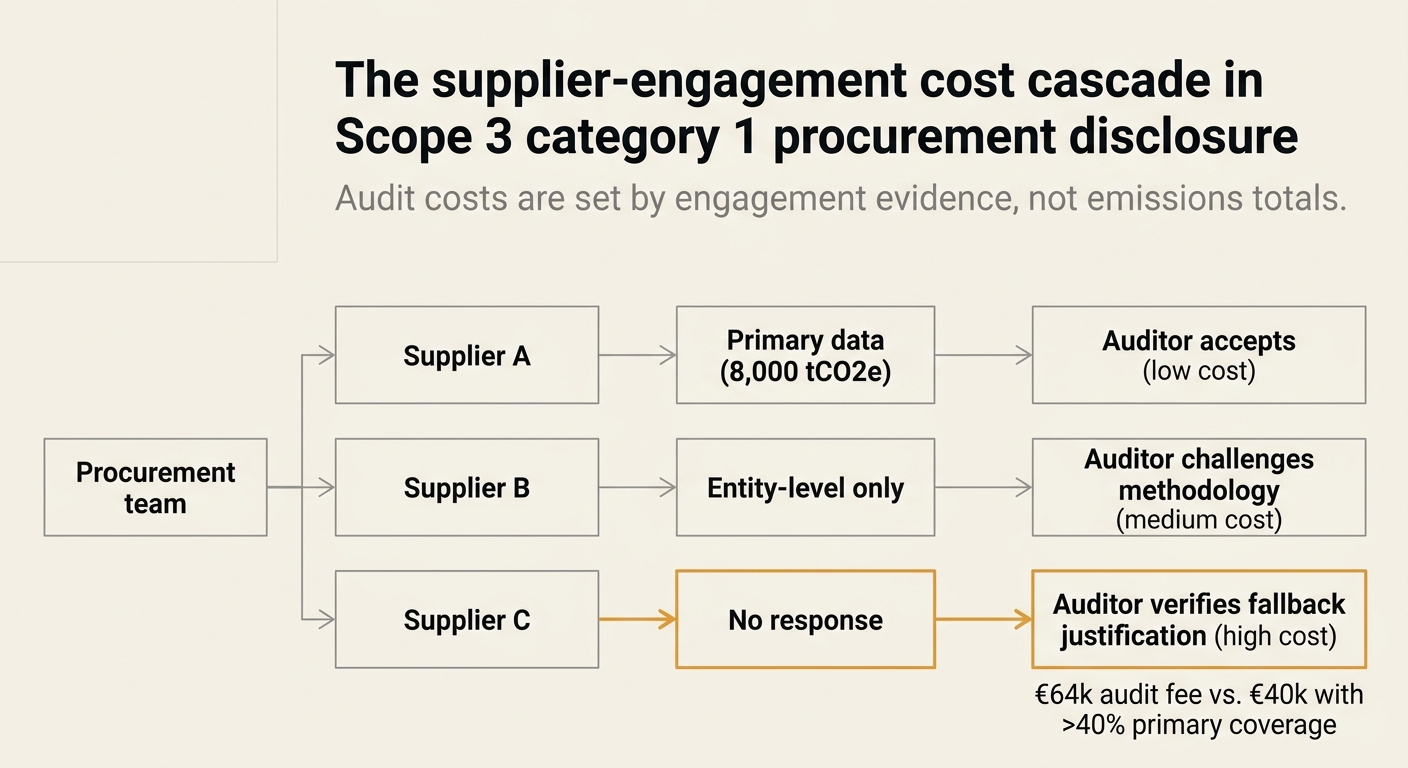
The supplier-engagement cost cascade in Scope 3 category 1 procurement disclosure
Here's the issue: A procurement leader at a mid-sized exporter receives the 2026 CSRD assurance quote. The auditor flags Scope 3 category 1—purchased goods and services—as the primary cost driver. The emissions total is high, 40,000 tonnes, but the line item that doubles the audit fee is "supplier engagement evidence." The team has supplier invoices, spend data, and emissions factors. What more could an auditor want?
However, Scope 3 category 1 disclosure consists of two things: the emissions inventory itself (activity data × emissions factors), and the documentation of how you engaged suppliers to move from spend-based estimates to primary data.
The inventory on its own has no value. Supplier engagement is what the auditor is actually verifying. A 40,000-tonne Scope 3 inventory built entirely from spend-based factors (€ spent × industry-average intensity) receives a qualified opinion or scope limitation under limited assurance. The auditor cannot verify supplier-specific performance when the methodology assumes all suppliers in a category emit at the same rate. Engagement evidence—correspondence, data requests sent, responses received, primary data incorporated—is what separates an auditable filing from a modelled estimate.
While the cost of calculating a Scope 3 inventory has fallen (software now automates spend classification and factor lookup), the cost of documenting supplier engagement has risen sharply. If a procurement team serves 300 tier-1 suppliers and must evidence engagement attempts for the top 70% by spend, the documentation burden might require 40–60 hours per quarter: tracking emails, logging data requests, recording refusals, updating data quality scores. For a team already managing cost negotiations and lead times, this is a second full-time workstream. When engagement fails—suppliers ignore requests, submit incomparable formats, or provide entity-level data that cannot be allocated to purchased products—the audit cost escalates further, because the auditor must verify why primary data was unavailable, not just that it is missing.
How do you solve this? I think the operators we work with are converging on a two-part answer. First, segment suppliers by emissions contribution and engagement feasibility, not just spend. A €2M supplier responsible for 8,000 tonnes of category 1 emissions is a higher engagement priority than a €5M supplier responsible for 800 tonnes, even if procurement typically ranks by contract value. Second, automate the engagement-evidence trail from the first interaction. When a data request is sent, log it. When a supplier submits an invoice with embedded emissions data, classify it as primary and link it to the product line. When a supplier refuses, document the refusal and the fallback methodology applied. This creates a compliance artifact in real time, not a retrospective reconstruction at audit.
Visualised:
What Scope 3 category 1 actually requires
The GHG Protocol Corporate Value Chain (Scope 3) Standard defines category 1 as emissions from the production of goods and services purchased or acquired by the reporting company during the reporting period. This includes all upstream emissions of purchased goods (cradle-to-gate), from raw material extraction through manufacturing to the point of sale to the reporting company.
For a steel importer, category 1 is the embedded emissions in the steel itself—raw material extraction, blast furnace operation, rolling mill energy—up to the point it arrives at the importer's gate. For a textile brand, it is the fibers, dyeing, weaving, and cutting of purchased garments. For a food company, it is the agricultural emissions, processing, and packaging of purchased ingredients.
The standard allows three calculation approaches, in order of preference:
| Approach | Data source | Accuracy | Audit acceptance |
|---|---|---|---|
| Supplier-specific | Primary data from the supplier (actual energy, process emissions, transport) | High | Required for reasonable assurance, expected for limited assurance on material categories |
| Activity-based | Secondary data specific to the product or material (e.g., EPDs, industry LCAs) | Medium | Acceptable for non-material categories or where supplier engagement has failed |
| Spend-based | Financial spend × average industry emissions intensity (€ × kgCO2e/€) | Low | Only acceptable as a fallback, often triggers qualified opinions |
The cost cascade emerges because most companies start at the bottom of this table and are now being asked to move up. Spend-based calculation is cheap—link ERP procurement data to an emissions factor database, multiply, sum. Supplier-specific primary data is expensive—send data requests, chase responses, validate formats, integrate into the inventory, document every step.
Under CSRD ESRS E1, companies must disclose the percentage of Scope 3 emissions calculated using primary data versus secondary data. This forces transparency on data quality. A filing that reports 40,000 tonnes of category 1 emissions with 5% primary data coverage tells the auditor that 95% of the inventory is modelled, not measured. That is not inherently non-compliant, but it shifts the assurance burden from verifying emissions to verifying why primary data was unavailable.
The engagement-evidence documentation burden
Auditors verify Scope 3 category 1 by sampling suppliers and tracing the data lineage. For a sample of purchased products, the auditor will ask:
- What was the activity data? (Kg purchased, units procured, MWh consumed by the supplier on your behalf.)
- What emissions factor or primary data was applied?
- If primary data: what evidence supports it? (Supplier declarations, verified reports, product-level carbon footprints.)
- If secondary data: what evidence supports the factor selection? (Correspondence showing primary data was requested and unavailable.)
- If spend-based: what evidence supports the fallback? (Documentation of engagement attempts and supplier non-response.)
For each sampled line item, the auditor is building a "data quality score" that feeds into the overall assurance opinion. If the score is too low—too much spend-based, too little engagement evidence—the opinion is qualified or the scope is limited.
This creates the documentation burden. Procurement teams must maintain:
- Supplier engagement logs: A record of every data request sent, to whom, when, and the response status.
- Data request templates: Proof that requests were clear, standardised, and aligned with recognised formats (e.g., PACT Technical Specifications for PCF data exchange).
- Response files: Supplier submissions, whether complete, incomplete, or refused, stored in a format the auditor can review.
- Fallback justifications: For suppliers who do not respond or provide unusable data, a written justification of why spend-based or activity-based factors were applied instead.
- Data quality flags: Metadata on each emissions line item indicating whether it is primary, secondary, or modelled, and the date the underlying data was last updated.
One sustainability manager at a building materials company told me her team spent 120 hours in Q4 2025 reconstructing engagement evidence for the 2024 inventory, because the initial data collection was informal—emails sent, responses received, but no systematic logging. When the auditor asked for proof of engagement, the team had to search email threads, export correspondence, and write explanatory memos linking each supplier to a data quality tier. The 2026 audit fee included a 40% markup for this evidence reconstruction work.
The cost of failed supplier engagement
When supplier engagement fails, the cost cascades through three channels:
1. Higher emissions totals (and higher CBAM exposure)
Spend-based emissions factors are deliberately conservative. Because they represent an industry average, they often overstate the emissions of efficient suppliers and understate the emissions of inefficient ones. For a procurement team, this means the reported Scope 3 inventory may be 30–50% higher than actual supplier performance, because the factors do not reflect specific process improvements, renewable energy adoption, or low-carbon sourcing the supplier has implemented.[1]
Under CBAM, this inflation becomes a direct cost. When an EU importer files a CBAM declaration using default emissions values (the regulatory equivalent of spend-based factors for embedded emissions), the importer pays for certificates based on those defaults, not actual supplier emissions. If the default for steel is 2.1 tCO2e per tonne and the supplier's actual emissions are 1.4 tCO2e per tonne, the importer overpays for 0.7 tCO2e per tonne. At €80 per certificate, that is €56 per tonne of steel, or €560,000 on a 10,000-tonne annual import volume. This is the "verification cost penalty" I described in a previous post.[2]
2. Higher audit fees
Auditors price limited assurance engagements based on data quality and documentation completeness. A Scope 3 inventory with high primary data coverage and clear engagement evidence is cheaper to audit than an inventory with low coverage and missing documentation, because the auditor spends less time verifying fallback justifications and challenging assumptions.
One audit partner at a Big Four firm quoted a 60% fee premium for Scope 3 category 1 assurance when primary data coverage is below 40% by emissions mass. The premium reflects the additional sampling, correspondence review, and methodology validation required to issue an opinion on a largely modelled inventory. For a mid-sized company, this can mean the difference between a €40,000 limited assurance engagement and a €64,000 engagement, purely due to data quality.
3. Procurement decisions locked to high-carbon suppliers
When procurement lacks supplier-specific emissions data, carbon performance cannot influence sourcing decisions. A procurement team choosing between two suppliers on cost and lead time alone may unknowingly favour the higher-emitting supplier, because emissions are invisible in the evaluation.
Research from EcoVadis and BCG shows that companies with supplier engagement programmes are 9× more likely to hit Scope 3 reduction targets than companies relying on modelled data alone.[3] The mechanism is simple: you cannot decarbonise what you do not measure at supplier level. If your Scope 3 inventory is built from spend-based factors, a 10% reduction in category 1 emissions requires either a 10% reduction in procurement spend (cutting revenue) or a 10% shift to lower-carbon suppliers—but without supplier-specific data, you cannot identify who those suppliers are.
This locks the procurement function into high-carbon sourcing by default, because the data infrastructure required to prefer low-carbon suppliers does not exist.
What supplier engagement looks like when it works
Successful supplier engagement is not annual surveys. It is procurement-integrated carbon data exchange, where emissions data flows through the same channels as invoices, quality certificates, and delivery schedules.
One approach I have seen work:
-
Segment suppliers by emissions contribution, not just spend. Use spend-based factors as a first pass to identify the top 20–30 suppliers by emissions mass, even if they are not the top 20–30 by contract value. These are your engagement priorities.
-
Embed carbon data requests in commercial negotiations. When renewing a contract or onboarding a new supplier, include a clause requiring annual submission of primary emissions data for supplied products, aligned to a named standard (e.g., ISO 14067 for product carbon footprints, or PACT Pathfinder for PCF data exchange).
-
Provide a clear data template and support. Suppliers resist engagement when requests are vague or incompatible with their own reporting cycles. A one-page data request specifying product ID, production volume, energy consumption, and process emissions—aligned to the structure the supplier already reports internally—is far more likely to receive a response than a 40-question survey on generic sustainability practices.[4]
-
Log engagement in the ERP or procurement system. Every data request sent, every response received, every follow-up scheduled should be a system record, not an email thread. This creates the engagement-evidence trail the auditor will verify, without requiring retrospective reconstruction.
-
Co-invest in supplier decarbonisation. For strategic suppliers, carbon data exchange is the start of a deeper partnership. If a supplier provides primary data showing 8,000 tonnes of category 1 emissions and a pathway to cut that to 5,000 tonnes through renewable energy adoption, procurement can co-fund the transition (e.g., through advance purchase commitments or green procurement premiums) and claim the reduction in its own Scope 3 inventory. This shifts the conversation from "give me your data" to "let's reduce emissions together."[5]
One European automotive supplier told me they piloted this approach with 15 tier-1 suppliers in 2025. By embedding carbon data clauses in contract renewals and providing a standardised data template, they achieved 78% primary data coverage by emissions mass within nine months—up from 12% under the previous survey-based approach. The key was making carbon data a commercial requirement, not a voluntary sustainability request.
How Emission3 fits
Emission3 is built for procurement teams that need to move from spend-based Scope 3 inventories to supplier-specific primary data without doubling their workload.
The platform automates the engagement-evidence trail from the first data request:
- Supplier data requests are generated from your procurement system, pre-filled with product IDs and volumes, and sent through the platform. Every request is logged with a timestamp and recipient.
- Supplier responses—whether structured PCF submissions or embedded emissions data in invoices—are ingested as documents, classified by product line, and linked to the corresponding activity data in your inventory.
- Primary data integration is automatic. When a supplier submits a product-level carbon footprint, the platform replaces the spend-based factor for that product with the supplier's declared emissions, recalculates the category 1 total, and flags the line item as "primary data" in the audit trail.
- Engagement evidence is compiled in real time. At quarter-end, the platform exports a supplier engagement report showing requests sent, responses received, data quality scores, and fallback justifications for non-responders—structured for auditor review.
For one building materials importer, this reduced the Q4 documentation burden from 120 hours to 8 hours, because the engagement trail was already system-native, not email-reconstructed.
The platform also handles the CBAM-specific workflow: when a supplier provides actual embedded emissions for a product, Emission3 generates the CBAM declaration using those figures instead of default values, calculates the certificate cost difference, and exports the evidence pack (supplier declaration + calculation lineage) required for customs verification.
What this means for procurement teams in 2026
Scope 3 category 1 disclosure is moving from an emissions-total exercise to a supplier-engagement exercise. The audit question is shifting from "what is your total?" to "how did you get your suppliers to give you primary data, and where did they refuse?"
For procurement leaders, this creates three priorities:
| Priority | Action | Timeline |
|---|---|---|
| Segment suppliers by emissions, not spend | Use spend-based factors to identify the top 30 suppliers by emissions mass; prioritise engagement with these suppliers, even if they are not top-30 by contract value | Q1 2026 |
| Embed carbon data clauses in commercial contracts | Include a requirement for annual primary emissions data in all new contracts and renewals above a spend threshold (e.g., €500k annually) | Ongoing from Q1 2026 |
| Automate the engagement-evidence trail | Implement a system (ERP module, procurement platform, or carbon accounting tool) that logs every data request, response, and follow-up as a compliance artifact | Q2 2026 |
The cost of inaction is a qualified audit opinion, a Scope 3 inventory inflated by 30–50%, and a procurement function locked to high-carbon suppliers because the data to prefer low-carbon alternatives does not exist.
The cost of action is manageable: supplier segmentation is a one-time analytical exercise, contract clauses are a legal template, and engagement-evidence automation is a workflow tool.
If you are a procurement leader preparing for 2026 CSRD or CBAM filings, the first step is not sending surveys. It is deciding which 20–30 suppliers you will engage deeply, and building the infrastructure to document that engagement as it happens.
"Scope 3 is the blind spot: Upstream supply chain emissions are, on average, 21× higher than direct emissions, yet >90% of corporates lack reduction targets. The cost of inaction is massive: By 2030, unmanaged Scope 3 emissions could create $500B+ in annual liabilities, equivalent to 15–20% of EBIT for S&P 500 companies. The ROI is real: Up to 50% of supplier emissions can be abated at neutral or low cost, with returns of 3–6× on investment, and one-third of emissions can be cut for under €10 per tonne. Supplier engagement is the game-changer: Companies that partner with suppliers are 9× more likely to hit Scope 3 targets. Yet only 1 in 3 corporates are doing so today."[3]
Book a CBAM readiness call[6] to map your supplier engagement priorities, identify primary data gaps, and build a documentation workflow that turns procurement into a decarbonisation engine, not a reporting bottleneck.
References & Sources
External Sources
- [1]Supplier Engagement Strategies for Scope 3 Decarbonization
Explains how spend-based estimates apply industry averages, and for certain categories, actual emissions differ from the average. One case study showed switching to supplier activity data increased reported emissions from 41,496 to 65,734 tonnes of CO2e—not a worsening performance, but better accounting.
- [3]Global Launch: Carbon Action Report 2025
EcoVadis and BCG research showing Scope 3 upstream emissions are 21× higher than direct emissions, unmanaged Scope 3 could create $500B+ annual liabilities by 2030, and companies with supplier engagement are 9× more likely to hit Scope 3 targets.
- [4]Scope 3 Supplier Engagement: Primary Carbon Data
Guidance on structuring supplier data requests to align with ISO 14067 and industry-standard PCF formats, and why supplier-specific activity data is more accurate than spend-based estimates for procurement carbon accounting.
- [5]The Key Role of Supplier Engagement in Scope 3 Reporting
Identifies survey fatigue as a growing barrier to supplier engagement, and recommends integrating carbon data requests into commercial workflows rather than standalone sustainability surveys.
- [7]CPG scope 3 emissions suppliers: Why your carbon data determines your contracts
Explains how major CPG brands are phasing in carbon data requirements by supplier tier and spend category between 2025-2030, and how carbon performance increasingly differentiates suppliers in procurement decisions.
Related Content
- [2]The verification cost penalty in CBAM default-value filings
Details the tariff markup incurred when exporters file CBAM declarations using default emissions values instead of verified actual emissions, and how this penalty compounds for high-volume import categories.
- [6]Book a CBAM readiness call
All Emission3 customers start with a readiness call where we map suppliers, identify data gaps, and design a supplier engagement workflow that creates audit-ready documentation from the first interaction.
- [8]Scope 3 with primary data
Emission3's approach to Scope 3 category 1 accounting, designed for procurement teams that need to replace spend-based estimates with supplier-specific primary data while automating the engagement-evidence workflow required for audit.