The verification cost penalty in CBAM default-value filings
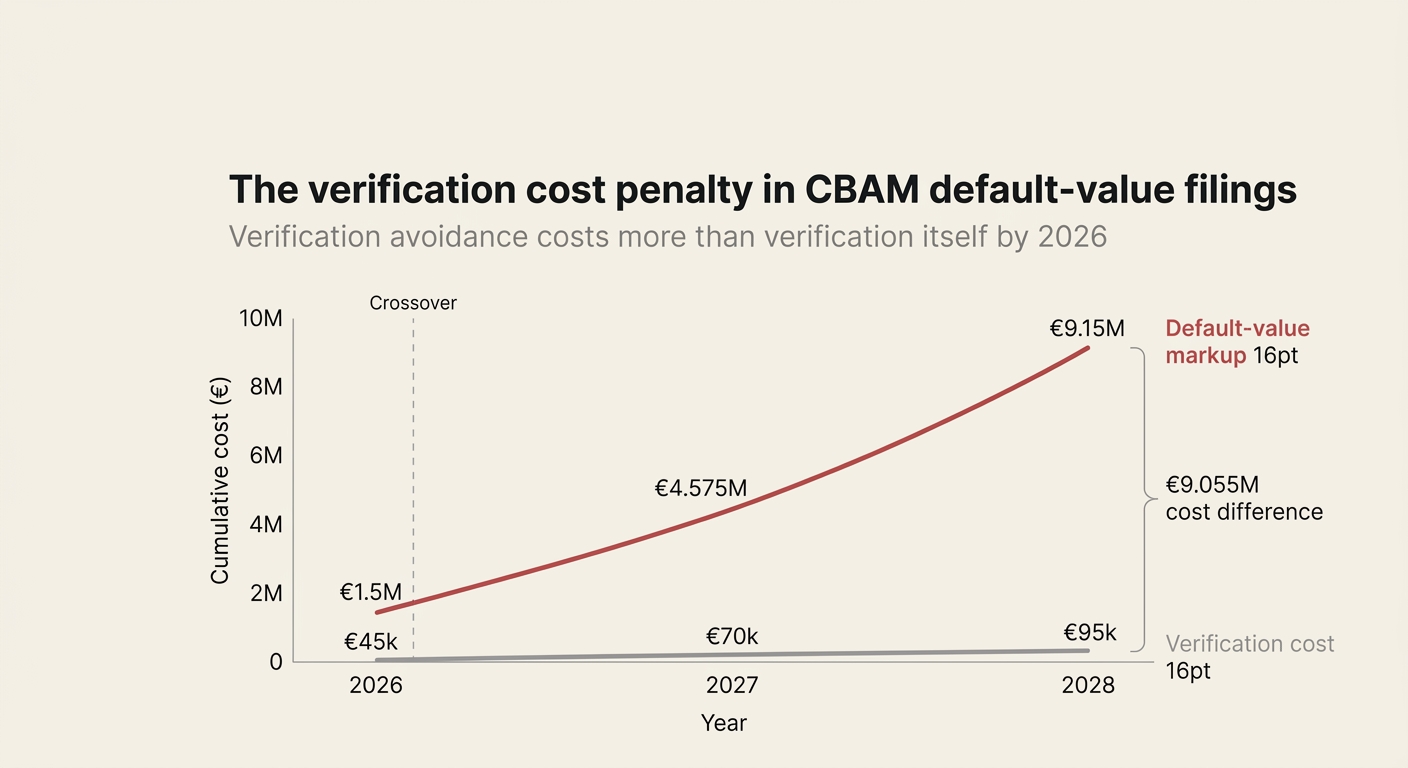
The verification cost penalty in CBAM default-value filings
Here's the issue: Non-EU exporters of steel, aluminium, cement, fertilisers, hydrogen, and electricity face a choice in 2026. They can provide verified actual embedded emissions to their EU importers, or they can allow importers to use default values published by the European Commission. Default values require no third-party verification, no monitoring plan, no site visit. On the surface, defaults appear to be the low-friction path—exporters avoid the cost and complexity of a verification engagement, and importers file quarterly CBAM declarations without waiting for installation-level data. The choice appears to trade a modest increase in declared emissions for the elimination of verification cost.
However, a CBAM filing consists of two things: the embedded emissions figure itself, and the methodology used to produce that figure. The first determines the number of CBAM certificates the EU importer must purchase. The second determines whether the exporter remains commercially viable as a supplier.
The emissions figure on its own has no competitive value. What the EU importer is actually paying for—and what determines the long-term cost of the filing—is the delta between the installation's true emission intensity and the default value assigned to its product-country combination. For a modern blast-furnace basic-oxygen-furnace steel mill in India, the actual embedded emissions might be 1.70 tonnes CO₂ per tonne of steel. The EU default value for Indian BF-BOF steel under Implementing Regulation (EU) 2025/2621 is 2.04 tonnes CO₂ per tonne, a 20% markup. At a €75 per tonne ETS certificate price, the cost difference is €25.50 per tonne of steel shipped. For a mill exporting 100,000 tonnes annually to the EU, the annual penalty for using defaults is €2.55 million.
While verification has become more accessible—accredited verifiers are registering under Regulation (EU) 2025/2083, and the first-year site visit requirement is a one-time cost—the markup applied to default values has become more expensive. If an exporter chooses defaults in 2026, the 10% markup costs more than the avoided verification fee. In 2027, the markup rises to 20%. In 2028, it reaches 30%. The cost of defaults compounds annually, while the cost of verification remains fixed per engagement cycle.
How do you solve this? I think the answer depends on the gap between the installation's actual emission intensity and the country default, and on the exporter's willingness to treat CBAM as a commercial negotiation rather than a compliance filing. For installations operating significantly below the country average—modern mills, gas-based production routes, or facilities with high renewable energy penetration—the cost of defaults will exceed the cost of verification within the first year. For marginal cases, the breakeven might arrive in 2027. For now, the operators we work with are treating 2026 as the last year in which defaults are financially defensible, and they are commissioning monitoring plans and verification engagements before Q1 2026 reporting opens.
The shape of the argument, visualised below.
The default-value markup schedule, 2026–2028
The European Commission's markup on default values is not static. Article 7(7) of Regulation (EU) 2023/956 prescribes an incremental penalty structure designed to incentivise the transition from defaults to verified actual emissions. The table below shows the markup percentage and the resulting cost per tonne of embedded emissions for three representative product-country combinations, calculated at the current EU ETS certificate price of approximately €75 per tonne CO₂.[1]
| Product-country combination | Actual emissions (tCO₂/tonne) | Default value 2026 (tCO₂/tonne) | Markup 2026 (10%) | Cost difference 2026 (€/tonne) | Markup 2027 (20%) | Cost difference 2027 (€/tonne) | Markup 2028 (30%) | Cost difference 2028 (€/tonne) |
|---|---|---|---|---|---|---|---|---|
| Indian BF-BOF steel | 1.70 | 2.04 | +0.20 | +€15.00 | +0.41 | +€30.75 | +0.61 | +€45.75 |
| Turkish EAF aluminium | 8.50 | 10.50 | +1.05 | +€78.75 | +2.10 | +€157.50 | +3.15 | +€236.25 |
| Chinese grey cement | 0.82 | 0.95 | +0.10 | +€7.50 | +0.19 | +€14.25 | +0.29 | +€21.75 |
The cost difference column quantifies the per-tonne penalty the EU importer incurs by relying on default values instead of obtaining verified actual data from the installation. For a Turkish aluminium smelter exporting 50,000 tonnes annually to the EU, the 2028 penalty reaches €11.8 million. The markup is cumulative—it applies to every tonne shipped, every quarter, for as long as the exporter continues to provide default-level data.
Why verification avoidance is no longer a cost-saving strategy
The logic that made defaults attractive during the transitional phase—no verification cost, no monitoring plan, no third-party engagement—breaks down when the markup exceeds the cost of the verification itself. A first-year CBAM verification engagement for a mid-sized steel or aluminium installation, including the mandatory on-site audit under Delegated Regulation (EU) 2025/2551, typically costs between €30,000 and €60,000, depending on the complexity of the production process and the availability of installation-level metering.[2] Subsequent verification cycles, which do not require a site visit unless the installation's emission intensity changes by more than 5%, cost approximately €15,000 to €25,000.
For an exporter shipping 100,000 tonnes of BF-BOF steel annually to the EU, the 2026 markup penalty is €1.5 million. The verification engagement costs €45,000. The cost ratio is 33:1. Even if the exporter delays verification until 2027, the two-year cumulative penalty (€1.5 million in 2026 plus €3.075 million in 2027) is €4.575 million, while the cumulative verification cost is €70,000. The breakeven threshold for verification is reached in the first quarter of 2026.
The counterargument—that verification introduces schedule risk, and that a failed or delayed verification forces the importer back onto defaults—is valid, but it misstates the risk. Under Article 10 of Implementing Regulation (EU) 2025/2547, a verification report must be issued by the end of the reporting year to qualify as verified actual data for that year's CBAM declarations.[3] If the verification is delayed or unsuccessful, the importer uses defaults for the affected quarters and retroactively adjusts the declaration once the verification report is issued. The markup penalty applies only to the quarters in which defaults were used, not to the entire year. The risk is temporal, not categorical.
"To use actual emissions data, companies must undergo third-party verification, including an on-site audit in the first year and assessment against a strict 5% variance threshold. Verification capacity is tightening as accreditation rules evolve. If verification is delayed or unsuccessful, default values apply—removing cost control at precisely the moment financial liability begins."[4]
The operational bottleneck is not the verification itself, but the preparation of the monitoring plan and the installation's ability to produce reproducible emission calculations under the CBAM methodology. Exporters who commission a monitoring plan in Q1 2025 and conduct a pre-verification readiness audit in Q3 2025 have sufficient lead time to complete the first verification cycle before Q1 2026 reporting opens. Exporters who wait until Q4 2025 to engage a verifier are accepting the markup penalty by default.
The commercial pressure on suppliers using defaults
The financial penalty for using default values is not absorbed by the exporter in isolation. Under the economic structure of CBAM, the EU importer purchases the CBAM certificates and includes the cost in the total landed cost of the imported goods. If the exporter's default-value data inflates the certificate cost by 15–30% compared to a competitor providing verified actual data, the importer faces a binary choice: negotiate a price reduction with the exporter to offset the markup, or shift procurement to a supplier who can provide lower actual emissions.[5]
The negotiation is not hypothetical. EU importers are already including CBAM cost clauses in 2026 supply contracts, specifying that the exporter is responsible for providing verified actual data or absorbing the cost difference between defaults and actuals. The clause structure varies—some contracts make the exporter liable for the full markup, others split the penalty 50/50, and some include a ratchet mechanism that increases the exporter's share of the penalty as the markup percentage rises from 10% to 30%—but the commercial intent is consistent. Importers are treating default values as a supplier quality issue, not a regulatory abstraction.
For exporters with thin margins, the cost of defaults can exceed the profit margin on the sale. A Turkish EAF aluminium producer with a 12% operating margin and a €78.75 per tonne CBAM penalty in 2026 (10% markup) loses two-thirds of its margin on EU sales. If the penalty rises to €236.25 per tonne in 2028 (30% markup), the sale becomes loss-making unless the exporter raises prices or reduces production costs. The financial pressure is immediate, not deferred.
The data-quality threshold for verification
The barrier to replacing defaults with verified actual emissions is not financial—it is methodological. A verification engagement under CBAM requires three elements: a monitoring plan that documents how embedded emissions are measured and calculated at the installation level, an operator's emissions report that compiles the data in the format prescribed by Implementing Regulation (EU) 2025/2547, and a verification report issued by an accredited verifier certifying that the emissions data meets the 5% materiality threshold.[6]
The monitoring plan is the foundational document. It must specify the emission sources (fuel combustion, process emissions, electricity consumption), the measurement approach (continuous emission monitoring systems, calculation-based methods, or a hybrid), the allocation methodology for multi-product installations, and the treatment of precursor emissions if the product includes upstream inputs covered by CBAM. The plan must be installation-specific—industry averages, national benchmarks, and supplier-provided emission factors are not accepted.[7]
The operator's emissions report translates the monitoring plan into a quarterly or annual dataset. For each CBAM good produced, the report must include the specific embedded emissions (in tonnes CO₂ per tonne of product), the direct emissions attributable to the production process, the indirect emissions from electricity consumption, and the precursor emissions if applicable. The report must also disclose the data quality level—whether the emissions were measured directly, calculated using installation-specific factors, or estimated using default factors—and the percentage of the total emissions covered by each quality level.
The verification report assesses whether the operator's emissions report is free from material misstatement. The verifier conducts a site visit in the first year, reviews the monitoring plan, inspects the metering and measurement systems, recalculates a sample of emission values, and issues an opinion on whether the reported emissions are accurate within a 5% margin. If the verifier identifies a discrepancy exceeding 5%, the operator must revise the emissions report and resubmit it for verification. If the discrepancy cannot be resolved, the verification fails, and the importer must use default values for the affected reporting period.
The three-document structure is not negotiable. An exporter cannot bypass the monitoring plan by submitting a standalone calculation spreadsheet, and an importer cannot bypass verification by accepting a supplier attestation. The regulatory architecture of CBAM is designed to produce audit-grade evidence, not supplier declarations.
How Emission3 fits
Emission3 was built to generate the three documents required for CBAM verification—monitoring plan, operator's emissions report, and evidence pack for the verifier—without requiring the exporter to hire a separate consulting team to prepare the data before the verification engagement begins.
The platform ingests the raw documents that already exist at the installation: invoices for fuel and electricity purchases, bills of materials for precursor inputs, utility bills for natural gas and grid power, and production logs for output volumes. The ingestion engine extracts the line-item data—fuel type, quantity, calorific value, emission factor source—and maps it to the CBAM methodology prescribed in Implementing Regulation (EU) 2025/2547. The calculation engine runs the top-down allocation: total installation emissions are attributed to production processes, then converted to specific embedded emissions per tonne of product.
The monitoring plan is auto-generated from the ingested data. The platform identifies the emission sources present in the installation's invoices and bills, selects the appropriate calculation methodology (Tier 3 for direct measurement, Tier 2 for installation-specific factors, Tier 1 for default factors), and documents the allocation approach for multi-product facilities. The exporter reviews the draft plan, confirms the production process boundaries, and exports a PDF formatted for submission to the verifier.
The operator's emissions report is compiled quarterly. The platform aggregates the fuel consumption, electricity purchases, and precursor inputs for the reporting period, calculates the direct and indirect emissions, applies the allocation methodology to assign emissions to each CBAM good produced, and generates the specific embedded emissions figure per tonne. The report includes the data quality disclosure required by Article 4 of Implementing Regulation (EU) 2025/2547: the percentage of emissions measured directly, the percentage calculated using installation-specific factors, and the percentage estimated using defaults.
The evidence pack for the verifier is exported as a structured dataset: every invoice, every calculation factor, every allocation step, with a full lineage from source document to final emission figure. The verifier does not need to request supporting documents or reconstruct the calculation logic—the evidence pack contains the same documents and calculations the platform used to generate the operator's emissions report. The verification engagement becomes a review of the evidence pack, not an archaeological dig through the exporter's file cabinets.
Emission3 does not perform the verification—that is the verifier's statutory role under Delegated Regulation (EU) 2025/2551. But the platform removes the preparation cost that makes verification prohibitively expensive for mid-sized exporters. The monitoring plan, emissions report, and evidence pack are the inputs the verifier needs to issue a verification report, and Emission3 generates them directly from the documents the exporter already possesses.
Start with a CBAM readiness call
If you are a non-EU exporter shipping steel, aluminium, cement, fertilisers, hydrogen, or electricity to the EU, the financial cost of using default values in 2026 is quantifiable. The 10% markup on default values translates to a per-tonne penalty that, for most installations, exceeds the cost of a verification engagement within the first year. The markup rises to 20% in 2027 and 30% in 2028, making defaults financially indefensible for any exporter operating below the country average.
The decision to commission a monitoring plan and engage a verifier is not a regulatory compliance decision—it is a commercial negotiation with your EU customers. Importers are already including CBAM cost clauses in 2026 supply contracts, and they are treating default values as a supplier quality issue. If you provide defaults, the importer will either demand a price reduction to offset the markup or shift procurement to a competitor who can provide verified actual data.
Emission3 helps exporters move from defaults to verified actuals in weeks, using the invoices, bills of materials, and utility bills you already have. We generate the monitoring plan, operator's emissions report, and evidence pack required for verification, so you do not need to hire a consulting team to prepare the data before the verifier arrives.
Book a CBAM readiness call to map your installation's emission sources, identify the gaps in your current data, and scope the timeline for your first verification cycle.[8] All customers start with a readiness call—we do not offer anonymous self-serve onboarding, because CBAM implementation depends on installation-specific production boundaries and allocation methodologies that cannot be templated. The readiness call is a working session, not a sales pitch.
References & Sources
External Sources
- [1]CBAM Default Values 2026: Country-Specific Mark-ups and How to Avoid Them
Quantifies the financial cost of using default values for high-volume product-country combinations, including the 10% markup in 2026 and the methodology for calculating CBAM certificate cost at €75/tCO₂.
- [2]What EU Importers and Non-EU Manufacturers Need to Understand About CBAM Verification
Details the incremental markup schedule (10% in 2026, 20% in 2027, 30% in 2028) and the financial consequences of relying on default values versus verified actual data.
- [3]Actual emissions in EU CBAM
Explains the monitoring, reporting, and verification requirements under Implementing Regulation (EU) 2025/2547, including the top-down allocation methodology and the operator's emissions report structure.
- [4]CBAM | Your Guide to the EU Carbon Border Adjustment Mechanism
Describes verification pressure, the 5% variance threshold, and the consequence of delayed or unsuccessful verification on default value usage.
- [5]EU CBAM for Steel Exports: Track Embedded Carbon & Ensure Compliance
Quantifies the commercial disadvantage of providing default-level data, including the 15–25% cost increase for BF-BOF steel and the importer's procurement response to suppliers unable to provide actual emissions.
- [6]CBAM Verification: Carbon Border Adjustment Mechanism
Details the three-element structure of CBAM verification: monitoring plan, calculated emission figure under IR (EU) 2025/2547, and third-party verification under DR (EU) 2025/2551.
- [7]CBAM Default Values 2026: How to Replace with Actual Data
Specifies the requirement for installation-level monitoring plans and the rejection of national averages or industry-level emission factors under CBAM methodology.
Related Content
- [8]Book a CBAM readiness call
All customers start with a readiness call: we map suppliers, gaps, and implementation, no anonymous self-serve onboarding.
- [9]How Emission3 handles CBAM
Specific to CBAM exporters, shows the installation-data flow from raw documents to monitoring plan, operator's emissions report, and evidence pack for verification.