The spreadsheet-to-assurance transition problem in California SB 253 first-year filings
The spreadsheet-to-assurance transition problem in California SB 253 first-year filings
Here's the issue: California Senate Bill 253 requires entities with over one billion dollars in annual revenue doing business in California to report Scope 1 and Scope 2 greenhouse gas emissions by August 10, 2026 [1]. The California Air Resources Board has exercised enforcement discretion for this first year—no limited assurance is required in 2026, though it will be mandatory starting in 2027 [2]. Most CFOs initially budgeted fifty thousand to one hundred thousand dollars for the first-year filing, assuming the work was the emissions calculation itself. That assumption is proving expensive.
However, an SB 253 filing consists of two things: the emissions number and the evidence lineage. The first is what finance teams produce in spreadsheets—aggregated utility data, applied emission factors, summed totals. The second is what auditors verify—population completeness reports, calculation lineage, source document traceability, and boundary definitions.
The emissions number on its own has no value under limited assurance. The evidence lineage is what the auditor is actually asking for, paying for, and verifying. A spreadsheet inventory aggregates monthly utility bills, applies emission factors from EPA or IEA databases, and calculates totals. But under limited assurance, auditors demand proof that all thirty-four electricity meters and twelve gas accounts are captured, traceability from each utility invoice to the final emission figure, evidence that the same calculation method applies across all reporting periods, and reconciliation of operational control versus financial control boundaries [3].
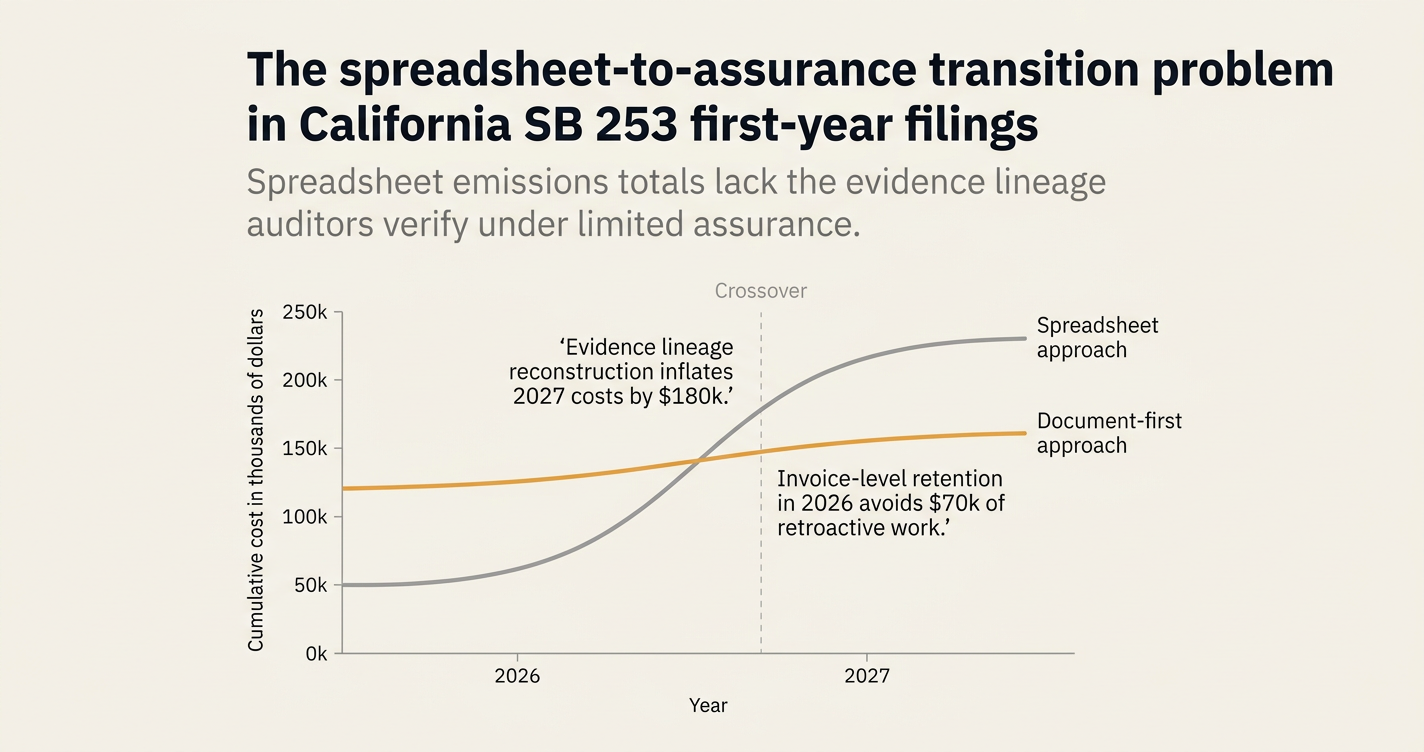
While spreadsheet-based emissions calculations have become cheaper—templated workbooks, free emission factor databases, one-time consultant engagements—evidence lineage construction has become more expensive. If a company treats 2026 as a disclosure-only exercise and reconstructs 2026 data under audit in 2027, the cost of evidence lineage reconstruction might outpace the savings of the initial spreadsheet approach. Assurance providers are already telling clients that they cannot issue an opinion without source-to-calculation traceability, and companies that lack invoice-level retention systems face six-figure retroactive data collection costs [4].
How do you solve this? I think the operators we work with are treating 2026 as an assurance dress rehearsal, not a disclosure exercise. They are retaining invoice-level utility records for 2025, even though CARB is not requiring assurance in 2026. They are documenting facility boundaries and calculation methodologies at the transaction level, not just at the aggregate level. They are running the 2026 emissions calculation in a system that produces auditor-ready outputs—calculation lineage, source document traceability, and boundary definitions. For now, this approach costs more in year one, but it avoids the compressed timeline and cost spike in 2027 when limited assurance becomes mandatory.
The shape of the argument, visualised below.
Why spreadsheets fail under limited assurance
Spreadsheets aggregate emissions at the facility or entity level. Auditors verify at the transaction level. The gap surfaces in three places:
| Auditor requirement | Spreadsheet output | Gap |
|---|---|---|
| Population completeness: proof that all meters, accounts, and facilities are captured | Aggregate totals by month or quarter | No meter-level enumeration, no facility boundary reconciliation |
| Source-to-calculation lineage: traceability from each utility invoice to the final emission figure | Manual formulas referencing cell ranges | No document linkage, no calculation versioning |
| Methodology consistency: evidence that the same calculation method applies across all reporting periods | Ad-hoc factor updates, formula edits without audit trail | No methodology log, no factor provenance |
The problem is not that spreadsheets produce incorrect totals. The problem is that spreadsheets do not produce the audit trail required to prove the totals are correct. Under limited assurance, the auditor's opinion statement includes two assertions: that the emissions figures are free from material misstatement, and that the methodology is consistently applied [5]. The second assertion requires documentation that most spreadsheet workflows do not retain.
Why first-generation ESG platforms fail under limited assurance
First-generation ESG platforms—dashboard aggregators, carbon accounting SaaS, sustainability management systems—solved the data collection problem. They did not solve the evidence lineage problem. The platforms ingest utility data, apply emission factors, and produce dashboards. But they lack:
- Invoice-level retention: platforms store monthly totals, not source documents. Auditors sample invoices, not totals.
- Calculation lineage: platforms apply emission factors in black-box backends. Auditors verify the calculation path, not the output.
- Boundary reconciliation: platforms aggregate by entity or facility. Auditors verify operational control definitions, not aggregations.
- Methodology versioning: platforms update emission factors automatically. Auditors verify factor provenance and change logs, not current factors.
The result: companies using first-generation platforms face the same assurance cost inflation as companies using spreadsheets. The platform solves the emissions calculation, but it does not solve the evidence lineage. Assurance providers are issuing qualified opinions or declining engagements when the underlying system cannot produce source document traceability [6].
"CARB will exercise enforcement discretion for the first report due in 2026, allowing reporting entities to submit Scope 1 and Scope 2 emissions for their prior fiscal year based on information they already have or were collecting when this Notice was issued, whether or not the data received limited assurance. However, during the Q&A portion of the November 2025 workshop, CARB emphasized that this discretionary relief is only applicable in the first year of reporting." [7]
The discretionary relief is a one-time reprieve, not a permanent exemption. CFOs who interpret it as permission to defer assurance preparation are compressing twelve months of evidence lineage construction into a six-month window in 2027.
What compliance-grade software looks like in 2026
Compliance-grade climate disclosure software is document-first, not dashboard-first. The system starts with source documents—utility invoices, purchase orders, bills of materials—and builds the emissions inventory as a derived artifact, not a manual input. The architecture inverts the traditional flow:
Traditional flow:
- Aggregate utility data manually
- Apply emission factors in spreadsheet or platform
- Produce emissions totals
- Retain source documents separately (if at all)
Compliance-grade flow:
- Ingest source documents (utility invoices, POs, BoMs)
- Extract transaction-level data (meter IDs, consumption figures, facility locations)
- Apply emission factors with full provenance (source, version, date)
- Produce emissions totals with calculation lineage (document → transaction → factor → total)
The second flow produces auditor-ready outputs by default. Every emission figure traces back to a source document. Every calculation step is versioned and logged. Every facility boundary is reconciled at the meter level, not the entity level.
This is not theoretical. The companies that are treating 2026 as an assurance dress rehearsal are:
- Retaining invoice-level utility records in the disclosure system, not in separate file storage
- Documenting facility boundaries at the meter level, with operational control definitions tied to specific lease agreements or ownership records
- Running emission factor updates as versioned transactions, with change logs that specify the factor source, update date, and affected calculations
- Producing calculation lineage reports that map each emission figure to a source document, a specific emission factor, and a calculation timestamp
The cost of this approach in 2026 is higher than the cost of a spreadsheet or first-generation platform. But the cost of this approach in 2027—when limited assurance is mandatory—is lower than the cost of retroactive evidence lineage reconstruction.
The assurance cost inflation problem
Assurance providers are re-pricing limited assurance engagements for SB 253 filings. The initial estimates—fifty thousand to seventy-five thousand dollars—assumed that companies would have invoice-level retention, meter-level enumeration, and calculation lineage in place. The revised estimates—one hundred twenty thousand to two hundred fifty thousand dollars—reflect the cost of evidence lineage reconstruction for companies that treated 2026 as a disclosure-only exercise [8].
The cost inflation surfaces in three line items:
| Line item | Initial estimate | Revised estimate | Driver |
|---|---|---|---|
| Document collection and indexing | Included in base fee | $30,000–$60,000 | Retroactive invoice retrieval, meter enumeration, facility boundary reconciliation |
| Calculation lineage verification | Included in base fee | $40,000–$80,000 | Manual reconstruction of factor provenance, methodology logs, boundary definitions |
| Population completeness testing | Included in base fee | $50,000–$110,000 | Statistical sampling, facility walkthroughs, control environment assessment |
The revised estimates assume that the company can produce source documents on demand. If the company cannot—if utility invoices were not retained, if meter-level data was aggregated before storage, if emission factors were applied without version logs—the cost inflates further. Assurance providers are declining engagements or issuing qualified opinions when the evidence lineage cannot be reconstructed.
How Emission3 fits
Emission3 is positioned as productized California SB 253 implementation backed by compliance infrastructure, not generic carbon accounting SaaS. The platform is document-first: utility invoices, purchase orders, and bills of materials are ingested as structured data, not manual inputs. Every emission figure includes a calculation lineage report that maps the source document, the applied emission factor (with provenance and version), and the final total. The system produces auditor-ready outputs by default—population completeness reports, methodology consistency logs, and boundary reconciliation artifacts.
For CFOs preparing for the 2026 SB 253 Scope 1 and Scope 2 deadline, the platform compresses inventory preparation timelines from eighteen to twenty-four months (spreadsheet workflows) to eight to twelve months (document-first workflows). The evidence lineage architecture also supports limited assurance engagement preparation, with API integrations for assurance provider data requests and automated evidence pack exports.
The platform is not a replacement for spreadsheets or first-generation ESG platforms. It is a replacement for the evidence lineage reconstruction work that companies face when they treat 2026 as a disclosure-only exercise. For companies that are treating 2026 as an assurance dress rehearsal, the platform is the compliance infrastructure that makes the dress rehearsal feasible.
What CFOs should do in Q1 2025
The 2026 SB 253 deadline is twelve months away. CFOs should:
- Confirm jurisdictional scope: determine whether the company meets California's "doing business" threshold and whether SB 253 or SB 261 (or both) apply.
- Audit current inventory systems: assess whether the existing GHG inventory can produce population completeness reports, calculation lineage, and methodology consistency evidence.
- Select an assurance provider: initiate RFPs for limited assurance providers with California SB 253 experience. Ask explicitly whether the provider requires invoice-level retention, meter-level enumeration, and calculation lineage.
- Map the reporting boundary: reconcile operational control versus financial control boundaries across all entities. Document facility-level boundary definitions with supporting lease agreements or ownership records.
- Initiate invoice-level retention: for companies that are not already retaining utility invoices at the meter level, implement a retention policy for 2025 invoices. Auditors will sample 2026 data in 2027, and retroactive retrieval is expensive.
The companies that treat 2026 as an assurance dress rehearsal will enter 2027 with invoice-level retention, meter-level enumeration, and calculation lineage in place. The companies that treat 2026 as a disclosure-only exercise will enter 2027 with a compressed timeline, a cost spike, and a qualified opinion risk.
Book a CBAM readiness call to map your SB 253 preparation timeline, supplier gaps, and assurance engagement scope. All customers start with a readiness call—we map suppliers, gaps, and implementation, no anonymous self-serve onboarding.
References & Sources
External Sources
- [1]California's climate disclosure regulations: An update on SB 253 and SB 261
Baker Tilly summary of SB 253 reporting deadlines, assurance requirements, and enforcement discretion for the 2026 first-year filing.
- [2]Sustainability Spotlight — California Climate Legislation Update — Status of CARB Rulemaking and Next Steps
Deloitte analysis of CARB's enforcement discretion for 2026 and the transition to mandatory limited assurance in 2027.
- [3]The US Climate Disclosure Stack: SB 253, SB 261, and the 2026 CFO Reckoning
Emission3 analysis of population completeness, calculation lineage, and boundary documentation requirements under limited assurance.
- [4]The assurance cost inflation problem in California SB 253 first-year filings
Emission3 breakdown of why CFOs initially underestimated SB 253 compliance costs and how evidence lineage reconstruction drives cost spikes in 2027.
- [5]California SB 253 and SB 261: What Businesses Need to Know
Persefoni overview of SB 253 assurance standards, including ISAE 3410, AICPA AT-C 210, and ISO 14064-3 requirements.
- [6]NEW California Climate Disclosure Updates from CARB
Good.Lab summary of CARB's November 2025 workshop clarifications on data quality, assurance readiness, and the 2026 enforcement discretion window.
- [7]Sustainability Spotlight — California Climate Legislation Update — Status of CARB Rulemaking and Next Steps
Deloitte report on CARB's enforcement discretion language and the emphasis that relief is only applicable in the first year of reporting.
- [8]California SB 253 & SB 261 compliance: what you need to know
GreenPlaces guide to SB 253 compliance timelines, fee structures, and assurance cost drivers for CFOs preparing 2026 filings.
Related Content
- [9]Book a CBAM readiness call
All customers start with a readiness call: we map suppliers, gaps, and implementation, no anonymous self-serve onboarding.
- [10]The 2026 California SB 253 compliance timeline for CFOs
SB 253 filings consist of two things: the emissions disclosure and the evidence lineage. Auditors verify the second—and most CFOs are 6-9 months behind schedule.