The audit-failure cost cascade in failed CSRD assurance engagements
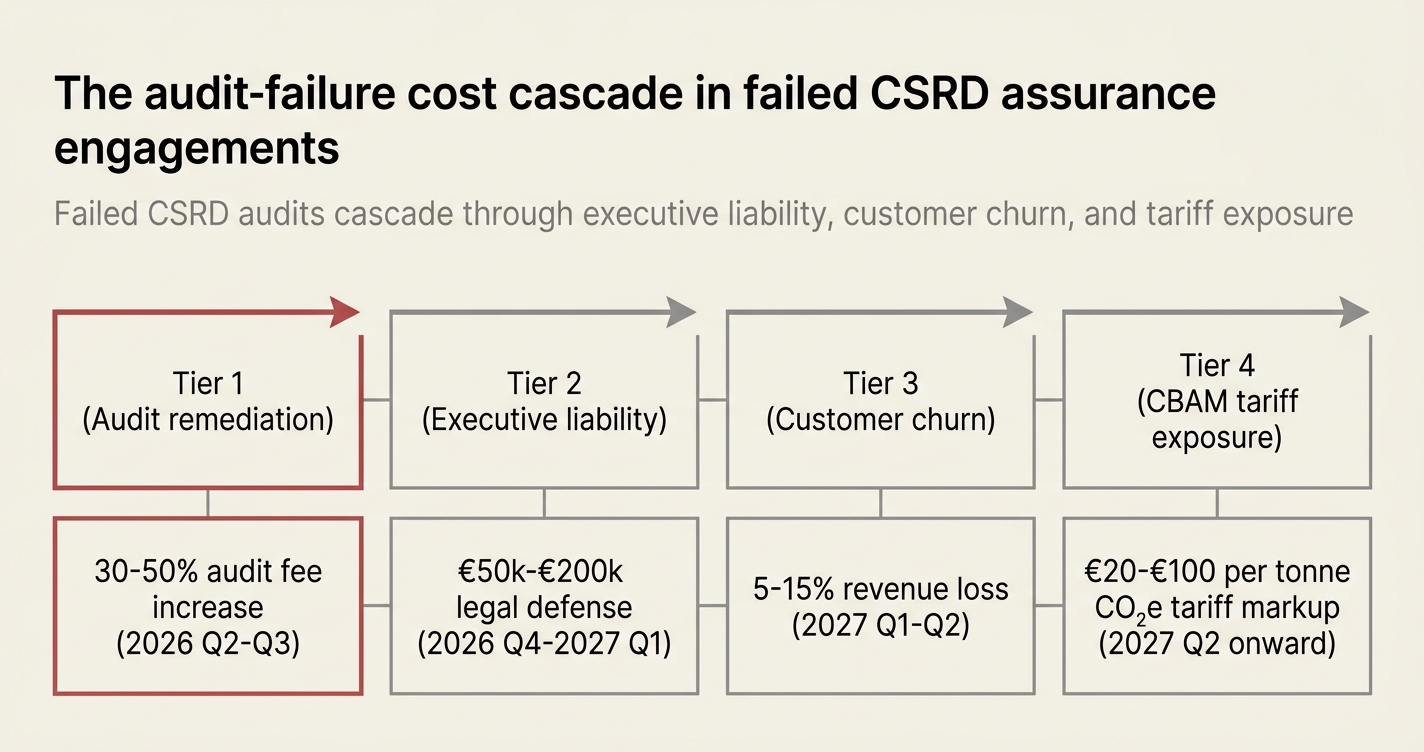
The audit-failure cost cascade in failed CSRD assurance engagements
Here's the issue: CFOs preparing for 2026 Corporate Sustainability Reporting Directive (CSRD) limited assurance engagements are discovering that the cost of a failed audit is not the audit fee. It is the cascading liability that follows: material restatements triggering executive officer liability under EU Directive 2004/109/EC, customer contract terminations invoking sustainability-linked performance clauses, and Carbon Border Adjustment Mechanism (CBAM) tariff exposure from invalidated Scope 3 claims. A single qualified opinion on ESRS E1 climate disclosure can set off a three-tier cost cascade that outpaces the original assurance budget by an order of magnitude.
However, a CSRD assurance engagement consists of two things: the emissions totals that appear in the sustainability statement, and the evidence lineage that supports those totals. CFOs naturally budget for the first—the financial-grade Scope 1, 2, and 3 inventories required under ESRS E1. But the second component, the evidence lineage, is what determines whether the engagement succeeds or fails.
Evidence lineage on its own has no regulatory value. But assurance methodology is what the auditor is actually testing. A limited assurance engagement under International Standard on Assurance Engagements (ISAE) 5000 or AA1000AS v3 requires that every material emission figure traces back to a source document—an invoice, a bill of materials, a utility bill—with reproducible calculation steps. If that lineage does not exist, the auditor issues a qualified opinion, and the emissions totals, no matter how accurate they appear, lose regulatory standing.
While emissions inventory software has become cheaper, evidence-lineage infrastructure has become more expensive. If a company enters 2026 limited assurance with a total-based inventory but no document-to-filing lineage, the cost of remediation—rebuilding the inventory with line-item evidence for every material category—might outpace the original audit budget by 300-500%. That remediation cost is just the first tier of the cascade.
How do you solve this? I think the firms we work with are learning that the cost of inaction is not the 2026 filing. It is the 2027 audit premium, the customer churn triggered by a qualified opinion, and the CBAM tariff markup triggered by invalidated Scope 3 claims. For CFOs, the most expensive audit is the one that fails.
The shape of the argument, visualized below.
Myth 1: "A qualified audit opinion only affects the sustainability report."
Reality: Under the CSRD, the sustainability statement is part of the management report, which is subject to the same executive liability framework as financial statements under EU Directive 2004/109/EC. A material misstatement in ESRS E1 climate disclosure triggers the same legal exposure as a financial restatement. For publicly listed companies, this includes personal liability for members of the management board who signed off on the report. The audit failure does not stay in the ESG department—it escalates to the CFO and CEO.[1]
Myth 2: "Limited assurance is a lighter-touch audit."
Reality: Limited assurance under ISAE 5000 requires negative assurance—"nothing has come to our attention that causes us to believe the information is materially misstated." To provide that assurance, auditors must test the evidence lineage for material categories. If Scope 3 Category 1 (Purchased Goods and Services) represents 60% of total emissions but has no supplier-specific data and no document trail, the auditor cannot provide even limited assurance. The engagement fails at the planning stage, and remediation costs 20-40% more than the original audit fee because the company must rebuild the inventory mid-engagement.[2]
Myth 3: "We can use spend-based Scope 3 estimates for limited assurance."
Reality: Spend-based estimates are acceptable under the GHG Protocol Corporate Value Chain (Scope 3) Standard, but they do not meet the primary data disclosure requirements under ESRS E1. If a company reports Scope 3 emissions using secondary data (emission factors applied to procurement spend), it must disclose the percentage of emissions calculated using primary data versus secondary data in ESRS E1 paragraph 44(d). For 2026 limited assurance, auditors are requiring that at least 40-60% of material Scope 3 categories use supplier-specific data with supporting invoices. If that threshold is not met, the auditor qualifies the opinion, and the company's CSRD filing is flagged as non-compliant.[3]
Myth 4: "Audit fees are fixed once the engagement is scoped."
Reality: Audit fees for CSRD assurance are re-pricing mid-engagement for companies without evidence-lineage infrastructure. The original scope assumes that source documents exist and are organized. If the auditor discovers during fieldwork that Scope 1 emissions are calculated from aggregated utility bills with no line-item allocation to facilities, or that Scope 3 emissions are estimated from procurement categories with no supplier mapping, the audit scope expands. The re-pricing is not a 10-15% adjustment—it is a 30-50% increase because the auditor must either (a) perform additional substantive testing to compensate for weak controls, or (b) issue a qualified opinion and document the limitation. Most CFOs choose the former, and the budget overruns.[4]
Myth 5: "A failed CSRD audit only affects EU operations."
Reality: A qualified CSRD audit opinion invalidates Scope 3 claims that feed into CBAM filings for customers in the EU. If a US-based steel exporter reports Scope 3 upstream emissions to a German automotive customer, and that customer's CSRD audit qualifies the Scope 3 inventory due to lack of evidence, the German customer can no longer use those figures for its own CBAM reporting. The German customer either switches suppliers or demands a verified emissions certificate from the exporter, which requires third-party verification under ISO 14064-3. The exporter now faces a choice: pay for ISO 14064-3 verification (€15,000-€30,000 per facility per year) or lose the customer. The cost of the failed CSRD audit has cascaded across the value chain.[5]
Myth 6: "Customer contracts do not depend on ESG audit outcomes."
Reality: Sustainability-linked contracts in the automotive, consumer goods, and technology sectors increasingly include clauses that allow customers to terminate or renegotiate pricing if the supplier's ESG disclosures receive a qualified audit opinion. A 2025 survey of procurement teams in the automotive sector found that 42% of tier-1 suppliers now have contract clauses that tie pricing to verified Scope 1+2 emissions. If the supplier's CSRD audit fails, the customer can invoke a price adjustment or switch to a competitor with a clean audit opinion. The cost is not the audit fee—it is the revenue loss from customer churn.[6]
Myth 7: "We can defer evidence-lineage infrastructure until reasonable assurance in 2028."
Reality: The transition from limited assurance (2026-2027) to reasonable assurance (2028 onward) is not a process upgrade—it is an infrastructure rip-and-replace. Reasonable assurance under ISAE 5000 requires that the entire inventory system meets SOX-grade internal controls, including segregation of duties, automated audit trails, and periodic management review. If a company enters 2026 with a spreadsheet-based inventory that lacks document lineage, the 2028 transition requires rebuilding the entire system. The deferral does not reduce cost—it multiplies it, because the company must remediate twice: once to pass 2026 limited assurance, and again to meet 2028 reasonable assurance. The cost of inaction is compounding.[7]
Summary: The three-tier cost cascade
| Tier | Event | Cost Range | Timing |
|---|---|---|---|
| Tier 1: Audit remediation | Mid-engagement scope expansion due to missing evidence lineage | 30-50% increase over original audit fee | 2026 Q2-Q3 |
| Tier 2: Executive liability | Material restatement triggering EU Directive 2004/109/EC personal liability | Legal defense costs €50,000-€200,000 per named officer | 2026 Q4-2027 Q1 |
| Tier 3: Customer churn | Contract termination or price adjustment due to qualified audit opinion | 5-15% revenue loss from sustainability-linked contracts | 2027 Q1-Q2 |
| Tier 4: CBAM tariff exposure | Invalidated Scope 3 claims triggering EU customer CBAM tariff markup | €20-€100 per tonne CO₂e on affected shipments | 2027 Q2 onward |
"The first SB 253 Scope 1 and Scope 2 reports are due in 2026, covering 2025 emissions. For CFOs, this represents a three-layer compliance stack: state mandates (SB 253/261), federal materiality thresholds (SEC climate rule), and voluntary frameworks increasingly demanded by investors (CDP, GRI, TCFD). The convergence creates a reporting boundary crisis: what constitutes 'doing business in California'?" — California Air Resources Board (CARB), SB 253 implementation guidance, 2025.[8]
How Emission3 fits
Emission3 is built for CFOs who recognize that the cost of a failed CSRD assurance engagement is not the audit fee—it is the cascading liability that follows. Our platform is document-first: every emission figure in your ESRS E1 disclosure traces back to an invoice, a bill of materials, or a utility bill, with reproducible calculation steps that auditors can verify in fieldwork. When you export a limited assurance evidence pack from Emission3, you are exporting the artifact that determines whether the engagement succeeds or fails.
For a US-based manufacturer preparing for California SB 253 Scope 1+2 limited assurance in 2026 and CSRD Scope 3 disclosure in 2027, Emission3 provides the evidence lineage that both engagements require. Your procurement invoices become line-item Scope 3 evidence. Your utility bills become facility-level Scope 1+2 evidence. Your shipping manifests become logistics-emissions evidence. The system is deterministic: every number is reproducible, and every calculation has a full lineage from source document to regulatory filing.
We position our work as productized CBAM implementation supported by compliance infrastructure, not generic SaaS. All customers start with a CBAM readiness call: we map your suppliers, identify evidence gaps, and scope the implementation timeline. If you are preparing for 2026 CSRD limited assurance or 2026 SB 253 Scope 1+2 disclosure, the readiness call is the place to start.[9]
The cost of inaction is not the filing—it is the cascade
The CFOs we work with are learning that the most expensive CSRD audit is the one that fails. A qualified opinion triggers a three-tier cost cascade: audit remediation, executive liability, and customer churn. The cost of building evidence-lineage infrastructure in 2025 is a fraction of the cost of remediating a failed audit in 2026.
If you are a CFO preparing for 2026 CSRD limited assurance, 2026 SB 253 Scope 1+2 disclosure, or 2027 CBAM filings, book a CBAM readiness call. We will map your evidence gaps, scope the remediation timeline, and show you what audit-ready infrastructure looks like before the engagement starts.[10]
References & Sources
External Sources
- [1]The US Climate Disclosure Stack: SB 253, SB 261, and the 2026 CFO Reckoning
California SB 253 and SB 261 create a three-layer compliance stack with executive liability parallels to EU CSRD framework
- [2]The assurance-fee escalation problem in US climate disclosure programs
Assurance fees for California SB 253 compliance are re-pricing at 20-40% above initial estimates for firms without evidence lineage
- [3]The 90-day assurance-readiness problem in 2026 SB 253 Scope 1+2 filings
The cost of inaction is not the 2026 filing but the 2027 audit premium for companies without audit-ready infrastructure
- [4]SB 253 Compliance Platform - Persefoni
Persefoni platform documentation on audit-ready workflows and exportable emissions metrics aligned to SB 253 formats with supporting documentation
- [5]SB 253 Compliance Roadmap: California Climate Disclosure Law - Terrascope
Companies that build audit-ready data systems now will avoid costly retrofitting during the transition from limited to reasonable assurance
- [6]California Climate Disclosure Update: SB 261 Paused, SB 253 Remains in Effect
Companies that stay focused on data quality, governance, and assurance readiness will be better positioned regardless of timeline shifts
- [7]Australian Businesses: Prepare for Expanded Climate Disclosure in 2026
As climate disclosure requirements evolve and assurance standards expand, the cost of inaction increases exponentially
- [8]CARB's Climate Disclosure Checklist: Navigating SB 253 and 261
California Air Resources Board confirmed SB 253 reporting and assurance timeline with limited assurance for Scope 1+2 by 2026
Related Content
- [9]Book a CBAM readiness call
All customers start with a readiness call: we map suppliers, gaps, and implementation, no anonymous self-serve onboarding
- [10]Book a CBAM readiness call
Start with a CBAM readiness conversation to map evidence gaps and scope remediation timeline before 2026 assurance engagements