The 2026 CBAM verification timeline problem for non-EU exporters
The 2026 CBAM verification timeline problem for non-EU exporters
Here's the issue: CBAM certificate costs are determined by embedded emissions, and embedded emissions require verified data. For goods imported in 2026, verification must be completed by early 2027 to avoid default values. But the verification cycle—site visits, data reviews, report issuance—takes 8-12 weeks, and accredited verifiers are not yet widely available. Most non-EU exporters are operating on a timeline that makes 2026 compliance impossible.
However, CBAM verification consists of two things: the emissions declaration your importer submits, and the evidence trail a third-party verifier audits. The declaration is what the importer files. The evidence trail—installation boundaries, monitoring plans, source documents, allocation logic—is what the verifier certifies.
The declaration on its own has no value. The evidence trail is what the CBAM regulation is actually asking for. Without a verification report, your importer cannot use actual values, regardless of how accurate your internal calculations are. They default to EU benchmark emissions, which are calibrated to the upper quartile of EU production—meaning you pay a certificate cost 2-5x higher than your real emissions warrant[1].
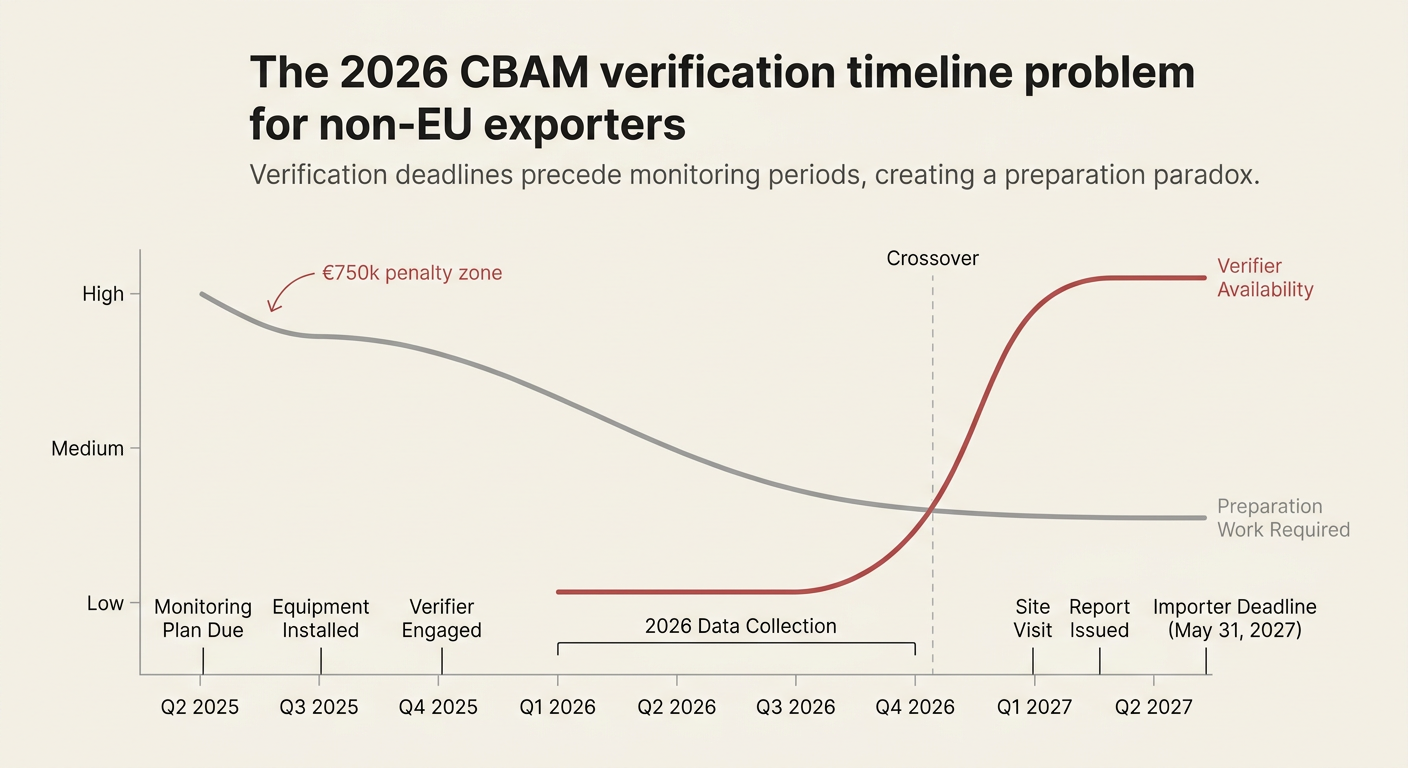
While verification reports can be issued from January 2027, the preparation work must be completed during 2026. If your monitoring plan is not documented by Q2 2026, your meters not calibrated by Q3 2026, and your verifier not engaged by Q4 2026, the January 2027 verification cycle becomes a scramble. For a steel exporter with €50 million in annual EU shipments and embedded emissions 40% below EU averages, the cost of missing the 2027 verification window is roughly €750,000 in excess CBAM certificates for that year alone[2].
How do you solve this? I think the operators who succeed in 2026 are the ones treating Q2 2025 as the last viable preparation window. By May 2025, monitoring plans should be documented, equipment gaps identified, and verifier outreach initiated. For now, the bottleneck is not the calculation methodology—it is the institutional readiness to survive a site visit and produce a verification-grade evidence pack.
The shape of the timeline visualised below.
The CBAM verification milestones exporters are missing
The CBAM regulation establishes a strict sequence of deadlines, and several are already behind schedule for 2026 compliance. The table below maps the critical milestones, the preparation work required, and the cost of missing each one.
| Milestone | Deadline | Preparation Required | Cost of Missing |
|---|---|---|---|
| Monitoring plan documented | Q2 2025 | Installation boundaries defined, emission sources mapped, methodology selected (calculation vs measurement) | Cannot engage verifier in Q4 2026; defaults to 2027 verification for 2027 imports |
| Monitoring equipment installed | Q3 2025 | Meters calibrated, CEMS operational, fuel invoices and utility bills archived monthly | Data gaps force reliance on estimates; verifier issues non-conformities |
| Verifier engagement | Q4 2025 | RFP issued, accredited verifier contracted, site visit scheduled for Q1 2027 | No verifier availability in Q1 2027; importer uses default values for 2026 imports |
| 2026 emissions data collected | Monthly, Jan-Dec 2026 | Activity data logged, emission factors applied, precursor data requested from suppliers | Incomplete data forces default values for affected production routes |
| Internal verification audit | Q1 2026 | Mock site visit conducted, non-conformities identified, corrective actions implemented | Verifier findings in Q1 2027 delay report issuance; importer misses May 31 filing deadline |
| Accredited verifier site visit | Q1 2027 (for 2026 imports) | Full evidence pack prepared: source documents, allocation tables, precursor data, emissions summary | Site visit uncovers methodology gaps; verifier cannot certify; importer defaults |
| Verification report issued | Feb-Mar 2027 | Verifier completes review, issues report via CBAM Registry or direct transmission | Report late; importer cannot submit actual values by May 31, 2027 deadline |
| Importer CBAM declaration filed | May 31, 2027 | Verified emissions data transmitted to importer, importer submits annual declaration | Default values applied; certificate cost inflated 2-5x |
The critical insight: the first three milestones are preparation work that must be completed before the 2026 monitoring period even begins. If your monitoring plan is not documented by Q2 2025, you are already behind schedule for 2026 compliance. If your verifier is not engaged by Q4 2025, you will compete for limited verifier capacity in 2026, when demand spikes and accreditation bottlenecks emerge[3].
The accreditation bottleneck no one is pricing in
Accredited CBAM verifiers are not yet widely available. National Accreditation Bodies (NABs) across EU member states are expected to open CBAM accreditation schemes by May 2026, with the first accreditations issued by late 2026[4]. This means the verifier you need for your January-March 2027 verification cycle may not even be accredited until Q4 2026.
The European Commission anticipated this bottleneck and allowed EU ETS verifiers to extend their scope to cover CBAM verification, but the extension process is not automatic. As of May 2025, only three countries are actively accepting verifier applications: the Netherlands, Sweden, and Italy[8]. For exporters in Turkey, India, or the Gulf, this creates a geographic mismatch—your nearest accredited verifier may be in Amsterdam, with limited capacity and high travel costs for mandatory site visits.
"For the first year of the definitive phase in 2026, a physical on-site visit to each installation producing CBAM goods is mandatory. From 2027 onwards, verifiers may, under defined low-risk conditions and where no significant changes have occurred, replace a physical visit with a virtual visit or waive it entirely, but a physical site visit must still take place at least once every two years."[1]
The site visit requirement is non-negotiable for 2026 imports. This means your 2026 monitoring data must be ready for a physical audit in Q1 2027, regardless of whether your installation has been operational for decades or whether you have internal auditors who already review emissions annually. The CBAM verifier is not auditing your company—they are auditing your installation's compliance with EU ETS Monitoring and Reporting Regulation principles, adapted to a product-based context[7].
What the verification report actually verifies
The verification report is not a stamp on a spreadsheet. It is a structured assessment of whether your emissions data meet the criteria for actual values under CBAM Article 8(3) and Commission Implementing Regulation (EU) 2025/2546. The verifier checks:
- Monitoring methodology: Does your monitoring plan comply with EU Implementing Regulation 2023/1773? Are activity data, emission factors, and calculations documented and reproducible?[3]
- System boundaries: Are all relevant emission sources included? Are precursor emissions attributed correctly? Are indirect emissions (electricity) calculated using the correct grid factors or supplier-specific data?[5]
- Data quality: Are source documents (fuel invoices, utility bills, production logs) complete and auditable? Are meters calibrated? Are emission factors sourced from tier-appropriate references?[3]
- Product attribution: Are installation-level emissions allocated to production processes and then to specific goods by CN code? Is the allocation logic consistent with the functional unit definitions in the CBAM methodology regulation?[7]
- Precursor data: For goods with complex supply chains (e.g., tubes and pipes using upstream steel), is embedded emissions data from precursor suppliers verified, or are default values applied?[5]
The verifier does not accept company-level rollups. They do not accept sector averages. They do not accept "best estimates" based on industry benchmarks. They require installation-specific, product-specific, document-backed emissions data, with a full calculation lineage from source file to final number[4].
For a cement exporter with three kilns at one installation, this means the verifier will ask: which kiln produced the clinker that went into the cement shipped to Hamburg in March 2026? What fuel was used in that kiln during that production run? What was the emission factor for that fuel? Where is the fuel invoice? How was the kiln's output allocated between different cement grades? The verifier is not auditing your emissions total—they are auditing your ability to trace a specific shipment's emissions back to a specific production process and a specific set of source documents.
The default value penalty, quantified
Default values are calibrated to the upper quartile of EU production emissions to maintain carbon leakage protection[2]. Translation: if your installation is cleaner than 75% of EU producers, you overpay under the default method. The penalty is not hypothetical.
For tubes and pipes (CN code 7306 6199) imported in Q1 2026, the default emissions value implies a CBAM certificate cost of roughly €150-300 per tonne, depending on the country of origin and the assumption of no CO2 prices paid in the supply chain[1]. For an exporter shipping 10,000 tonnes per quarter, that is €1.5-3 million in additional certificate costs per quarter, or €6-12 million annually.
If your installation's actual emissions are 40% below the default value—realistic for a modern electric arc furnace or a gas-fired kiln with CCS—your certificate cost per tonne should be €90-180, not €150-300. The €60-120 per tonne difference, multiplied across 40,000 tonnes per year, is €2.4-4.8 million in avoidable costs. That is the cost of not having a verification-ready monitoring system in place by Q4 2026.
The structural tension: verification readiness is a capital investment with a 12-18 month lead time, but the ROI is immediate and quantifiable. CFOs who budget for CBAM as a "reporting cost" miss the point—it is a tariff optimization problem, and the optimization lever is data quality.
What to start this week
If you are a non-EU exporter shipping CBAM goods to the EU, the following actions are time-critical:
-
Document your monitoring plan by end of May 2025: Define installation boundaries, map emission sources, select calculation or measurement methodology, and document the plan in a format a verifier can review. Do not wait for regulatory clarity—the methodology regulation is final, and the monitoring principles are stable[5].
-
Conduct a monitoring equipment audit in June 2025: Identify missing meters, uncalibrated CEMS, or gaps in fuel and electricity data collection. Budget for equipment installation in Q3 2025. If you cannot install equipment by Q3 2025, you will rely on estimates for part of 2026, which triggers verifier non-conformities.
-
Issue a verifier RFP by Q3 2025: Contact accredited verifiers in your region (or in the Netherlands, Sweden, or Italy if no local verifiers are available). Request a preliminary site visit in Q4 2025 to identify gaps before the 2026 monitoring period begins. Budget €15,000-50,000 for the annual verification, depending on installation complexity and verifier travel costs[3].
-
Archive source documents monthly, starting now: Do not wait until December 2026 to pull together fuel invoices, utility bills, and production logs. Set up a document management system that archives PDFs, images, or CSVs as they are generated. Every [N] marker in your emissions calculation must link to a source document, and the verifier will check.
-
Request precursor data from suppliers in Q2 2025: If your goods incorporate precursors (e.g., pig iron in steel, clinker in cement, alumina in aluminium), contact your suppliers now and request installation-level emissions data or verification reports. If suppliers cannot provide verified data by Q4 2026, you will default to precursor default values, which inflates your total embedded emissions[5].
-
Schedule a CBAM readiness call with Emission3: We map your installations, production routes, data sources, and verification gaps in a 60-minute onboarding call. No self-serve signups—just a conversation about what compliance-grade infrastructure looks like for your operations. Book your call here[9].
The timeline is unforgiving. The first three milestones are already in the past for 2026 compliance, but the next three are still achievable if you move in Q2 2025. The exporters who treat May 2025 as the last preparation window will have verified data ready for their importers in Q1 2027. The exporters who wait for regulatory "final clarity" will pay default premiums in perpetuity.
How Emission3 fits into the 2026 CBAM verification timeline
Emission3 is built for exporters who need verification-ready emissions data, not generic carbon accounting. We start with your source documents—utility bills, production logs, BoMs, fuel invoices—and build the emissions calculation from line-item evidence, not aggregated estimates[4].
Our data model enforces installation-level boundaries, allocates emissions to production processes per EU methodology, and attributes to specific goods by CN code. Your monitoring plan is built into the data structure, not bolted on afterward. When your verifier asks "how did you calculate embedded emissions for this rebar shipment?", we export a lineage report showing the upstream pig iron invoice, the emission factor source, and the allocation logic—line by line[4].
For the 2026 CBAM timeline specifically:
-
Q2 2025 monitoring plan documentation: We template your monitoring plan during onboarding, aligned to Implementing Regulation 2023/1773. The template includes installation boundaries, emission source categories, calculation methodologies, and data collection procedures. You review and sign off; we maintain the structured version.
-
Q3 2025 equipment gap identification: We map your current data sources (meters, invoices, logs) and flag gaps that will trigger verifier non-conformities. If you lack a natural gas meter but have monthly invoices, we document the estimation methodology and the planned meter installation date. The verifier sees a gap closure plan, not an unaddressed risk.
-
Q4 2025 mock verification prep: We run an internal audit against the verification checklist: are source documents archived? Are emission factors tier-appropriate? Are allocation tables documented? Are precursor data requests sent? You get a pre-flight checklist 8 weeks before the verifier arrives.
-
Monthly 2026 data collection: We ingest source documents as PDFs, images, or CSVs, extract structured data, and maintain a full audit trail from source file to CBAM XML submission. No data entry, no manual allocation—just upload the documents, and we build the evidence pack.
-
Q1 2027 verification support: When your verifier conducts the site visit, we export an evidence pack: source documents, calculation lineage, allocation tables, precursor data, and the emissions summary in the format verifiers expect. This reduces verification cycle time from 8 weeks to 4 weeks, which matters when your importer's May 31 deadline is fixed[4].
We do not sell software. We sell verification-ready emissions infrastructure, implemented in 4-6 weeks, backed by compliance specialists who have built CBAM filings for steel, cement, and aluminium exporters across Turkey, India, and the Gulf. If your 2026 CBAM timeline is still salvageable, book a readiness call now and we will map your critical path[9].
For more on the underlying methodology problem—why actual values require installation-level data, not company rollups—see our post on the verification problem in CBAM filings[10].
The verification timeline as a competitive filter
The 2026 CBAM verification timeline is not a compliance burden—it is a competitive filter. Exporters with verified data can quote a lower landed price into Europe than competitors with identical real emissions but no audit trail[6]. The carbon price is the same. The visibility is not.
The structural advantage compounds over time. Once your monitoring system is verified in 2027, subsequent years require only incremental updates—new equipment, production route changes, supplier swaps. The 2027 verification becomes a 2-week desktop review, not an 8-week site visit[1]. The exporter who invests in Q2 2025 locks in a cost advantage that persists for the next decade.
The structural disadvantage also compounds. If you miss the 2027 verification window, your importer defaults for 2026 imports, pays the inflated certificate cost, and pushes that cost back to you as a price reduction or a supply chain exit. You lose margin in 2027, and you start 2028 with the same monitoring gaps you had in 2025—except now your competitors have verified data and you do not.
The timeline is unforgiving because the regulation is designed to be unforgiving. CBAM is not a reporting regime—it is a tariff mechanism with a verification gate. The exporters who treat verification as an afterthought will discover, in Q1 2027, that the gate is closed.
Ready to map your 2026 CBAM timeline? Emission3 starts every engagement with a 60-minute onboarding call to assess installation readiness, identify monitoring gaps, and build a verification-grade data collection plan. No self-serve signups—just a conversation about what compliance infrastructure looks like for your operations. Book your readiness call here[9].
References & Sources
External Sources
- [1]Verification under CBAM – Key learnings and guidance for effective preparation (Part 1)
Analysis of CBAM verification requirements, including mandatory physical site visits for 2026 imports, risk-based verification approach, and default value penalties for unverified data.
- [2]CBAM Compliance 2026: Default Method vs Actual Emissions — Which Route Will Cost You More?
Quantitative comparison of default value penalties versus actual emissions pathways, including the European Commission's upper-quartile calibration rationale and installation-level data requirements.
- [3]CBAM Europe - Check your CBAM Obligations
Practical guidance on quarterly preparation actions for 2025-2026, including monitoring plan documentation, equipment installation, and verifier engagement timelines.
- [4]The verification problem in CBAM filings
Explanation of the verification cycle timing constraints, accreditation bottlenecks, and the evidence pack requirements for verification-ready CBAM submissions.
- [5]EU CBAM Emissions Data: Monitoring, Reporting & Verification
Overview of CBAM monitoring methodologies, top-down emissions attribution from installation to goods, and the CBAM Registry's role in verification report transmission.
- [6]EU CBAM 2026: A Practical Guide for Exporters Facing Europe's Carbon Border Tax
Analysis of data quality as a cost-sheet line item, with discussion of how verified installation-level data enables lower landed prices versus competitors using default values.
- [7]A Guide to the EU CBAM
Climate Leadership Council's comprehensive guide to CBAM verification principles, including site visit requirements, reporting period rules, and verification regulation implementation details.
- [8]Guest Post: Whose CBAM is it anyway? Of Default Values and Accreditation
Discussion of verifier accreditation bottlenecks, noting that only the Netherlands, Sweden, and Italy are currently accepting CBAM verifier applications as of May 2025.
Related Content
- [9]Book a CBAM readiness call
All Emission3 customers start with a readiness call: we map suppliers, gaps, and implementation timelines. No anonymous self-serve onboarding—just a structured conversation about verification-grade infrastructure.
- [10]The verification problem in CBAM filings
CBAM filings consist of two things: declared emissions and tariff cost. Verification determines the first—and most exporters are unprepared for the audit cycle.