CBAM Compliance 2026: Default Method vs Actual Emissions — Which Route Will Cost You More?
CBAM Compliance 2026: Default Method vs Actual Emissions — Which Route Will Cost You More?
On January 1, 2026, the European Union's Carbon Border Adjustment Mechanism (CBAM) transitions from voluntary reporting to mandatory declarations with financial consequences. Non-EU exporters of steel, aluminum, cement, fertilizers, electricity, and hydrogen face a binary decision: submit actual installation-level emissions data, or accept the sectoral default values published by the European Commission.
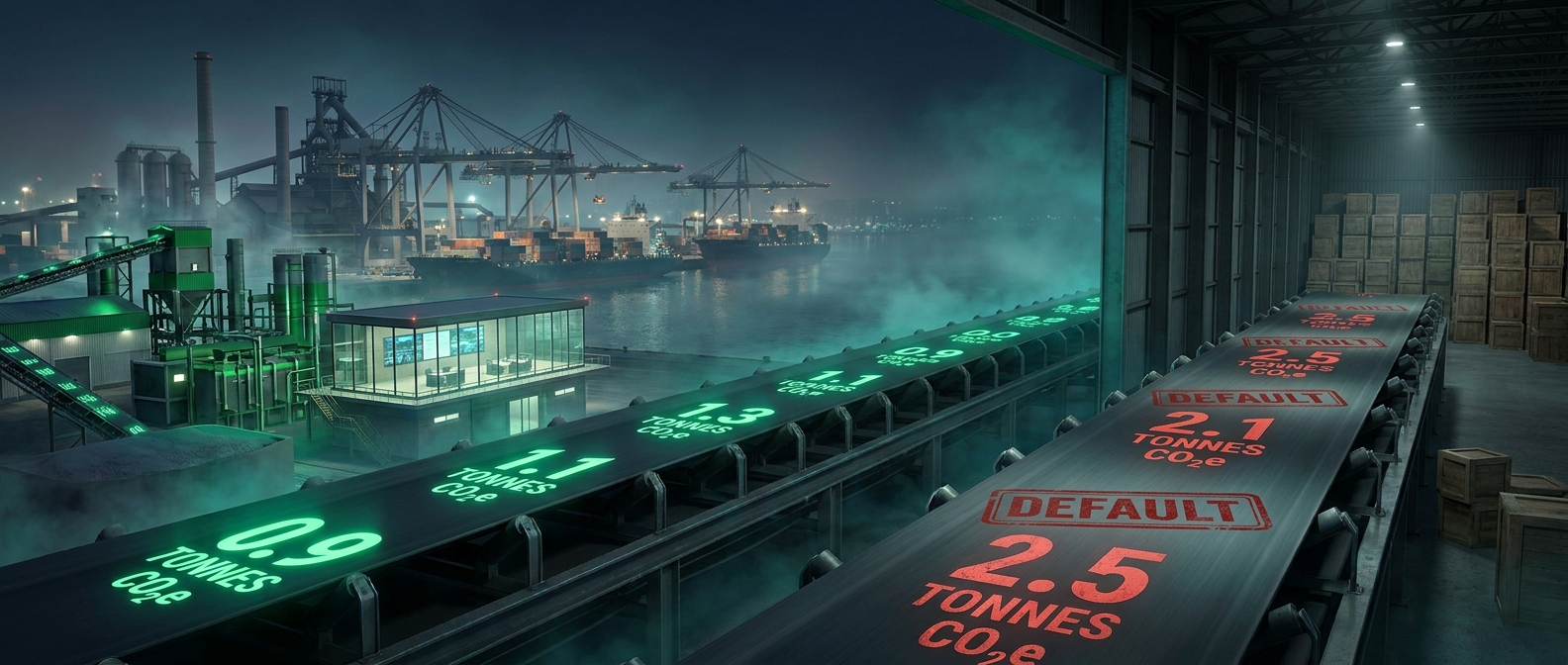
The difference is not academic. Sectoral defaults are deliberately conservative—set at the 90th percentile of EU production emissions to preserve competitive incentives for low-carbon producers [1]. For a typical steel exporter, this means paying CBAM levies on 2.1-2.5 tonnes CO₂e per tonne of product when their actual footprint might be 0.9-1.3 tonnes. Over a 10,000-tonne annual export volume, that's €1.2-1.6 million in unnecessary carbon costs at current ETS prices.
This article compares the two compliance paths head-to-head across five dimensions: data requirements, cost exposure, audit risk, operational burden, and long-term competitiveness.
The Two Paths: A Head-to-Head Comparison
| Criterion | Default Method | Actual Emissions Method |
|---|---|---|
| Data Requirements | None — EU publishes sectoral averages | Installation-level monitoring: energy inputs, process emissions, emission factors, activity data by production route |
| Initial Setup Cost | €0 | €15,000-€80,000 (metering, data infrastructure, inventory consultant) |
| Annual CBAM Levy (10,000t steel example) | €1.68M (at €80/tonne ETS × 2.1t CO₂e default) | €720K (at €80/tonne × 0.9t actual) — €960K savings |
| Audit & Assurance Requirement | None in 2026; likely by 2028 | Third-party verification required from Day 1 |
| Regulatory Risk | High — defaults may rise in 2027+ to further incentivize actual reporting | Low — method locked in, only subject to GHG Protocol updates |
| Competitive Positioning | Invisible — no differentiation from high-emitting peers | Transparent — low-carbon producers can market actual values to EU buyers |
| Administrative Burden | Minimal — single annual declaration | High — quarterly data collection, CBAM registry filings, verifier coordination |
| Long-Term Lock-In | Flexible — switch to actual method any quarter | Committed — reverting to defaults after actual reporting triggers retroactive penalties |
Why Sectoral Defaults Are Deliberately Punitive
The CBAM regulation (EU 2023/956) explicitly sets default values "at a level that does not provide an advantage to installations in third countries" [2]. In practice, this means:
- Steel (basic oxygen furnace): 2.1 tonnes CO₂e per tonne of crude steel — vs. a global average of 1.85 and best-in-class at 1.1 [3].
- Aluminum (primary): 16.8 tonnes CO₂e per tonne — vs. hydroelectric-powered smelters at 4-6 tonnes.
- Cement (grey clinker): 0.766 tonnes CO₂e per tonne — close to the global average but punitive for gas-fired kilns or those using alternative fuels.
The European Commission's impact assessment notes that default values are calibrated to the "upper quartile of EU production emissions to maintain carbon leakage protection" [1]. Translation: if your installation is cleaner than 75% of EU producers, you overpay under the default method.
"Importers using default values will face CBAM obligations reflecting the emission intensity of the least efficient EU installations. This creates a strong incentive for third-country producers to invest in monitoring and reporting systems." — European Commission, CBAM Q&A, October 2023 [2]
The Actual Emissions Path: What It Really Takes
Submitting actual values is not a spreadsheet exercise. The CBAM regulation requires:
- Installation-level boundaries — emissions must be traced to the specific production facility, not averaged across a company.
- Direct + indirect emissions — Scope 1 (on-site combustion, process emissions) + Scope 2 (purchased electricity, heat) for the production process.
- Embedded emissions — for complex goods (e.g., steel rebar), the emissions of precursor materials (pig iron, scrap) must be quantified using actual supplier data or defaults.
- Mass balance reconciliation — total inputs (energy, raw materials) must reconcile with outputs (finished goods, by-products, waste) within ±5% [3].
- Third-party verification — an accredited verifier must audit the installation's monitoring plan, data collection procedures, and emissions calculations annually.
The Documentation Stack
To pass CBAM verification, exporters need:
- Energy metering records — monthly meter reads for natural gas, coal, electricity (kWh or GJ), cross-checked against utility invoices.
- Process emission logs — for cement (calcination), steel (blast furnace CO₂), aluminum (PFC emissions), with lab analysis of carbon content in inputs and outputs.
- Emission factor sources — defaults from IPCC, national inventory reports, or lab-tested factors for non-standard fuels.
- Activity data — production logs in tonnes, hours of operation, batch records.
- Monitoring plan — a GHG Protocol-aligned document describing boundaries, quantification methods, QA/QC procedures, approved by the verifier before the first reporting period.
For a mid-sized exporter (single installation, 2-3 product lines), building this infrastructure costs €15,000-€35,000 in Year 1 and €8,000-€15,000 annually thereafter [4]. For multi-site operations or complex supply chains, initial costs can exceed €80,000.
The Switching Penalty: Why You Can't Flip-Flop
Article 7(6) of the CBAM regulation includes a critical lock-in clause: if an importer switches from actual emissions to default values after having used actual values in any prior quarter, the customs authority may retroactively apply defaults to all previous declarations and assess penalties for underpayment [2].
This means the decision to pursue actual emissions is effectively irreversible. Once you commit, you're locked into annual verification cycles, quarterly data submissions, and the full administrative burden—even if your production process changes or your verifier relationship sours.
The inverse is not true: an importer using defaults can switch to actual values at any time, but must maintain that commitment for at least 12 consecutive months.
The 2027 Ratchet: Defaults Will Likely Tighten
The European Commission is required to review CBAM implementation by December 31, 2027 and may adjust default values "to reflect technological progress and emission reductions in EU installations" [1]. In practice, this means:
- Scenario 1: Defaults remain static, but the ETS carbon price rises from €80 to €120-€150 per tonne (Goldman Sachs 2027 forecast), making the overpayment worse.
- Scenario 2: Defaults are lowered to the 85th or 80th percentile of EU production, narrowing the gap but still penalizing efficient producers.
- Scenario 3: Defaults are differentiated by production route (e.g., separate values for EAF vs. BOF steel), requiring importers to declare their process—removing the "zero documentation" advantage.
Each scenario increases the cost of waiting. An exporter who defers actual emissions reporting until 2027 may face three years of cumulative overpayment (2026-2028) that cannot be recovered, plus the risk of tighter defaults just as they invest in monitoring infrastructure.
Who Should Choose Which Path?
Default Method Makes Sense If:
- Your installation's emissions are at or above the sectoral default (rare, but possible for coal-heavy steel or aluminum without renewable power).
- Export volumes to the EU are below 2,000 tonnes annually — the CBAM levy is de minimis and setup costs exceed savings.
- You plan to exit the EU market by 2028 and are using CBAM as a bridge compliance strategy.
- Your production process is highly variable (seasonal, campaign-based) and you lack continuous metering infrastructure.
Actual Emissions Is the Only Viable Path If:
- Your installation is cleaner than the sectoral average — even marginally (e.g., 1.7 vs. 2.1 tonnes CO₂e for steel).
- EU exports represent >15% of revenue — the CBAM levy becomes a material P&L line.
- You source from best-in-class installations (hydroelectric aluminum, gas-fired cement, EAF steel with high scrap input) and can document it.
- Your customers are EU buyers with corporate decarbonization targets who require supply-chain emissions transparency (CSRD Scope 3 disclosure).
- You're subject to other carbon disclosure regimes (CDP, SBTi, California SB 253) and can leverage the same data infrastructure.
How Emission3 Fits Into the Actual Emissions Path
Emission3 was built for the CBAM actual emissions path—not as a bolt-on to a generic carbon platform, but as a compliance-first system designed around the regulation's evidence requirements.
Document-Native CBAM Registry
Every CBAM declaration starts with source documents:
- Energy invoices → parsed into kWh, GJ, m³ by fuel type.
- Production logs → batch records, shift reports, output tonnage.
- Lab reports → carbon content analysis, emission factor validation.
- Customs declarations → HS codes, shipment weights, destination ports.
Emission3 ingests these as PDFs, images, or CSVs, extracts structured data, and maintains a full audit trail from source file to CBAM XML submission. When your verifier asks "how did you calculate embedded emissions for this rebar shipment?", you export a lineage report showing the upstream pig iron invoice, the emission factor source, and the allocation logic—line by line.
Installation-Level Boundaries, Not Company Rollups
CBAM requires facility-specific emissions, not corporate averages. Emission3's data model enforces installation boundaries:
- Each production site is a discrete "installation" entity.
- Energy and activity data are tagged to installation + production route (e.g., "Plant 3 - EAF Steel").
- Embedded emissions from suppliers are traced to the installation where transformation occurs.
This prevents the common error of averaging emissions across multiple sites and claiming the blended value—an automatic verification failure under CBAM rules [3].
Verifier-Ready Evidence Packs
When you submit for third-party verification, Emission3 generates:
- A monitoring plan document (GHG Protocol-aligned, pre-populated from your installation setup).
- A completeness report (% of production covered by metered data, % using defaults for embedded emissions).
- A calculation lineage export (every tonne of CO₂e traced back to source document and emission factor).
- A reconciliation table (mass balance check: inputs vs. outputs, energy vs. production).
Verifiers spend 60-70% of their time chasing missing documentation. Emission3 frontloads that work into the intake process, cutting verification cycles from 4-6 weeks to 10-14 days [5].
The Verdict: Pay Now or Pay Forever
The default method is not "free"—it's an annuity. Every quarter you use sectoral defaults, you pay 2-5x your actual emissions. For a 10,000-tonne steel exporter, that's €240,000-€400,000 per quarter at €80/tonne ETS.
The actual emissions method has a high entry cost—€15,000-€80,000 to build the monitoring infrastructure—but it's a one-time investment. After Year 1, the marginal cost is €8,000-€15,000 annually for verification, and the savings compound every quarter.
The breakeven point for most exporters is 6-18 months. After that, actual emissions reporting is pure margin recovery.
The strategic question is not whether to pursue actual emissions—it's whether you want to start saving in Q1 2026 or Q1 2027. The exporters who delay will pay full default rates through 2026, then incur setup costs in 2027, then wait another 12 months for verification cycles to stabilize—sacrificing 24-30 months of cost recovery.
The CBAM cliff is not a future event. It's January 1, 2026. The exporters who hit the ground with actual data will outcompete those who don't—not by making better steel, but by making the same steel with a 60% lower carbon bill.
Ready to build your CBAM actual emissions infrastructure? Emission3 starts every engagement with a 60-minute onboarding call to map your installations, production routes, and data sources. No self-serve signups—just a conversation about what compliance-grade looks like for your operations. Book your onboarding call here [4].
For more on how CBAM intersects with CFO-level financial planning, see our 15-Step CFO Checklist: Survive the 2026 CBAM Cliff Without Paying Default Premiums [5].
References & Sources
External Sources
- [1]Regulation (EU) 2023/956 — Carbon Border Adjustment Mechanism
Official CBAM regulation text, including default value methodology and transitional period end date (December 31, 2025).
- [2]European Commission CBAM Q&A — Transitional Period and Reporting Obligations
European Commission guidance on CBAM implementation, default values, and the switch penalty for reverting from actual to default methods.
- [3]IPCC 2006 Guidelines for National Greenhouse Gas Inventories — Industrial Processes
Emission factors and mass balance methodologies referenced in CBAM monitoring plans for steel, cement, and aluminum.
Related Content
- [4]Book your onboarding call
All Emission3 customers start with a personal onboarding call—no self-serve signups. Schedule your 60-minute session to map your CBAM compliance path.
- [5]15-Step CFO Checklist: Survive the 2026 CBAM Cliff Without Paying Default Premiums
A finance-focused guide to CBAM cost exposure, breakeven analysis for actual emissions reporting, and cash flow planning for the 2026 transition.