The 2026 CBAM Cliff
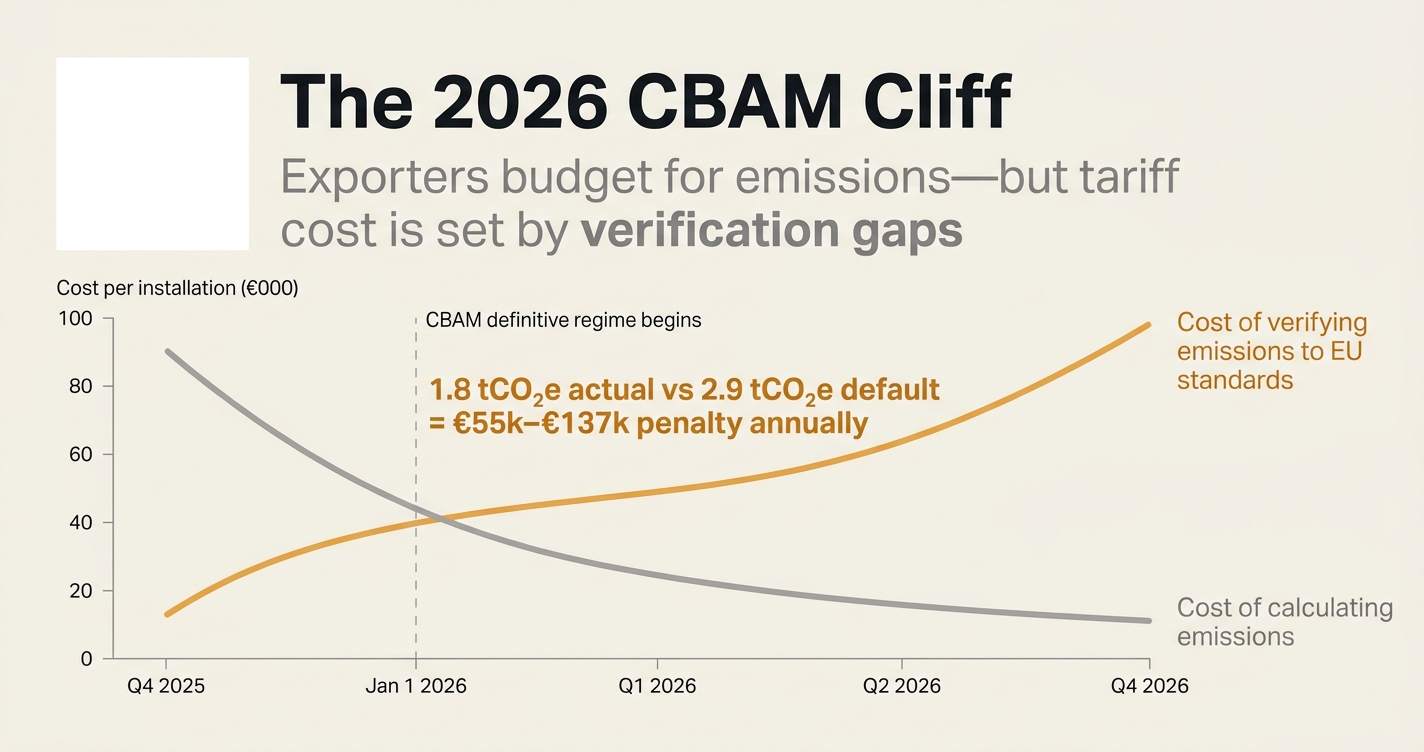
The 2026 CBAM Cliff
Here's the issue: The Carbon Border Adjustment Mechanism transitional period expires December 31, 2025. Starting January 1, 2026, the European Union expects actual installation-level emissions data for every import of covered goods—steel, cement, aluminium, fertilizers, electricity, and hydrogen[1]. Non-EU exporters who spent 2024 and 2025 filing quarterly reports with estimated or default values now face a regulatory cliff. The default-value penalty is not theoretical: CBAM certificate prices are calculated using either your actual embedded emissions or the EU sectoral default, whichever is higher. For most installations, the sectoral default runs 2-5x the real footprint[2].
However, CBAM filings consist of two things: declared emissions totals and the verification infrastructure behind them.
Declared emissions on their own have no value. The verification infrastructure—installation-level meter data, process-specific emission factors, auditor sign-off, and accredited verifier reports—is what sets the certificate cost. A filing with declared emissions but no auditable lineage defaults to the sectoral penalty rate. The importer pays the difference, and the exporter absorbs the commercial cost in renegotiated contract terms.
While the cost of calculating a carbon footprint has fallen, the cost of verifying it to EU accreditation standards has risen. If your installation emits 1.8 tCO₂e per tonne of steel but you cannot produce meter-level evidence and a verifier report, CARB's enforcement discretion does not apply—the EU registry defaults you to 2.9 tCO₂e, the sectoral average for non-EU steel[3]. The certificate cost delta, multiplied across annual shipment volumes, can exceed the margin on the entire contract.
How do you solve this? I think the operators we work with treat 2026 as a filing year, not a compliance year. They are mapping installations now, instrumenting utility meters, and running parallel reporting cycles to surface gaps before Q1 declarations are due. For now, the companies that survive the CBAM cliff are the ones who started building verification infrastructure in 2025, not the ones scrambling to file in March 2026.
The shape of the argument, visualised below.
The 2026 CBAM Timeline: What Changes and When
The transition from quarterly reporting to annual declarations with mandatory verification represents a step-function increase in compliance cost and commercial risk. Below is the chronological sequence of regulatory milestones, with specific dates and enforcement implications.
| Milestone | Date | Implication | Already Missed? |
|---|---|---|---|
| Final transitional CBAM report (Q4 2025) | January 31, 2026 | Last opportunity to file under transitional rules with default values and no verification requirement | No |
| Definitive regime begins | January 1, 2026 | Actual installation-level emissions become mandatory; sectoral defaults apply as penalty rate for missing data | No |
| First CBAM declaration period opens | Q1 2026 | Importers must declare embedded emissions for goods imported in Q4 2025 and Q1 2026, using actual values or incurring default-value penalties | No |
| First CBAM certificate surrender deadline | May 31, 2026 | EU importers must surrender certificates corresponding to declared embedded emissions; exporter verification gaps convert directly to importer cost | No |
| Accredited verifier report requirement | For all 2026 filings | Installation-level emissions must be verified by an EU-accredited verifier; non-accredited reports are rejected by the CBAM registry | No |
| Supplier data cascade deadline | Ongoing from Q1 2026 | Tier-2 supplier emissions data must propagate upstream to tier-1 manufacturers, who aggregate and report to EU importers—delays compound | No |
| CSRD limited assurance crossover | June 2026 onward | EU firms filing under the Corporate Sustainability Reporting Directive face limited assurance for E1 climate disclosures; CBAM data feeds into CSRD Scope 3 | No |
| California SB 253 Scope 1 & 2 deadline | August 10, 2026 | US exporters to the EU who also do business in California face dual filing deadlines with overlapping assurance requirements | No |
| Reasonable assurance requirement (CSRD) | 2028 and beyond | CSRD firms transition from limited to reasonable assurance; CBAM verification infrastructure becomes input to CSRD E1 audit scope | No |
The table above is not a roadmap—it is a constraint set. Every missed deadline shifts cost downstream to the importer, who then renegotiates contract terms or switches suppliers. The commercial penalty is immediate, even if the regulatory penalty is deferred.
The Default-Value Penalty: Why Sectoral Averages Destroy Margin
"For most installations, the sectoral default runs 2-5x the real footprint." — CBAM cost analysis, Emission3 internal modeling[2]
CBAM certificate prices are calculated using the higher of two values: your actual embedded emissions or the EU sectoral default. For steel, the sectoral default is approximately 2.9 tCO₂e per tonne of product. For cement, it is 0.766 tCO₂e per tonne of clinker[3]. If your installation runs at 1.8 tCO₂e per tonne of steel but you cannot produce a verifier report, the EU registry defaults you to 2.9 tCO₂e. The importer pays certificates at the higher rate. You absorb the cost through renegotiated pricing or lost contracts.
The delta compounds across shipment volumes. A mid-sized steel exporter shipping 50,000 tonnes annually into the EU faces a certificate cost increase of €55,000 to €137,500, depending on the EU carbon price (€50 to €100 per tonne CO₂e, the trading range in Q4 2025)[4]. The exporter's commercial margin on that volume is typically 8-12%. The certificate cost delta alone can erase 15-25% of margin.
The penalty is not evenly distributed. Installations with modern electric arc furnace technology and renewable electricity contracts can demonstrate actual emissions below 1.5 tCO₂e per tonne. They gain competitive advantage. Installations with older blast furnace technology and coal-fired power see actual emissions above 2.5 tCO₂e per tonne. They face smaller penalties but remain uncompetitive. The penalty is largest for mid-efficiency installations—those with actual emissions between 1.6-2.2 tCO₂e per tonne, where the gap between actual and default is widest, but verification infrastructure is incomplete.
The Verification Infrastructure Gap: What EU Accreditation Actually Requires
EU-accredited verifiers assess population completeness, not just substantive accuracy. A filing with 95% of installation emissions correctly calculated but 5% of utility meters unmapped fails verification. The accreditation standard requires:
- Installation boundary definition: every process unit, utility meter, and material input must be mapped to a specific installation ID in the CBAM registry
- Meter-level evidence: electricity, natural gas, and process emissions must trace to primary meter data, not invoices or engineering estimates -Emission factor lineage: every emission factor must reference a named methodology (GHG Protocol, ISO 14064, IPCC Tier 2/3) with documented calculation steps
- Process-specific allocation: for multi-product facilities, emissions must be allocated to CBAM-covered goods using defensible allocation keys (mass, energy content, or market value)
- Verifier independence: the verifier must be EU-accredited and independent of the installation operator; self-certification is rejected
The gap is not technical—it is organizational. Most non-EU exporters have facility-level carbon footprints calculated annually by consultants using spreadsheet models. Those models aggregate data from utility invoices, engineering estimates, and supplier declarations. They produce totals accurate to within 5-10%, sufficient for voluntary disclosure. They do not produce the meter-level lineage, process-specific allocation, and population-completeness reports that EU verifiers require.
Retrofitting a spreadsheet model to meet EU verification standards costs €40,000 to €120,000 per installation, depending on facility complexity and data fragmentation. The work cannot be done in parallel with filing—verifiers require 4-6 weeks to review evidence, and any gaps trigger a second verification cycle. Installations that start verification in Q4 2025 will not complete it before the Q1 2026 filing deadline. They will file under the default-value penalty and retrofit later, paying twice: once for the penalty, once for the verification.
The Supplier Data Cascade: Why Tier-2 Visibility Determines Tier-1 Cost
CBAM filings for manufactured goods require embedded emissions from tier-2 suppliers. A steel mill importing iron ore reports not only its own Scope 1 and 2 emissions but also the embedded emissions in the ore. A cement plant importing clinker from a non-EU grinding facility reports the clinker's embedded emissions. The tier-1 manufacturer aggregates supplier data and reports it to the EU importer[5].
The data cascade introduces three failure modes:
- Supplier non-response: tier-2 suppliers without CBAM obligations ignore data requests, forcing tier-1 manufacturers to estimate or default
- Supplier low-quality data: tier-2 suppliers provide emissions data without meter-level evidence, which EU verifiers reject, forcing re-work
- Supplier timing misalignment: tier-2 suppliers operate on different fiscal years or reporting cycles, making it impossible to align data collection with tier-1 filing deadlines
The commercial consequence is identical in all three cases: the tier-1 manufacturer cannot produce a verifier report, defaults to the sectoral penalty rate, and absorbs the cost. The importer does not pay for tier-2 data gaps—the manufacturer does.
The population-completeness problem is particularly acute for complex goods. A finished steel product may contain inputs from 8-12 tier-2 suppliers (iron ore, scrap metal, alloying elements, electricity, natural gas, oxygen, limestone). If 11 suppliers provide verifier-ready data but one does not, the filing fails verification. The EU registry does not accept partial evidence.
The California SB 253 Overlap: Why US Exporters Face Dual Assurance Costs
US exporters to the EU who also do business in California face overlapping compliance deadlines in 2026. California Senate Bill 253 requires Scope 1 and 2 emissions disclosure by August 10, 2026, for fiscal year 2025 or 2026, depending on fiscal year end[6]. CBAM requires quarterly declarations starting Q1 2026, with annual verification. Both regimes require auditor-grade evidence lineage, but the assurance standards differ.
SB 253 follows the GHG Protocol Corporate Standard, which defines organizational boundaries using equity share or operational control. CBAM follows the EU Emissions Trading System installation-level methodology, which defines boundaries by process unit and utility meter. A US exporter with operational control over a joint venture in Turkey reports 100% of the facility's emissions under SB 253 but only its equity share under CBAM. The methodologies are incompatible.
The audit cost compounds. SB 253 requires limited assurance starting in 2027, escalating to reasonable assurance by 2030. CBAM requires EU-accredited verification starting January 1, 2026. A mid-sized US exporter with three non-EU installations faces:
- SB 253 Scope 1 & 2 audit: $80,000 to $150,000 for limited assurance (2027-2029), $180,000 to $340,000 for reasonable assurance (2030+)[7]
- CBAM verification: €40,000 to €120,000 per installation per year (€120,000 to €360,000 total for three installations)
- Methodology reconciliation: $30,000 to $60,000 annually to maintain dual boundary definitions and allocation methodologies
The total assurance cost for a three-installation exporter doing business in both the EU and California: $230,000 to $570,000 in 2026-2029, escalating to $330,000 to $760,000 in 2030+. The cost is not one-time—it recurs annually, and it scales with facility count, not revenue.
The CSRD Crossover: Why EU Importers Pay Twice
EU importers subject to the Corporate Sustainability Reporting Directive face a related cliff in June 2026. CSRD requires climate disclosures under ESRS E1, with limited assurance starting in the first reporting cycle (FY 2024, filed in 2025 for early adopters, FY 2025 filed in 2026 for others). CBAM embedded emissions data feeds into CSRD Scope 3 Category 1 (Purchased Goods and Services)[8].
The crossover creates a double-assurance requirement:
- CBAM verification: the exporter's installation-level emissions must be verified by an EU-accredited verifier
- CSRD Scope 3 assurance: the importer's Scope 3 Category 1 emissions (which include CBAM goods) must be verified by a CSRD statutory auditor
If the exporter's CBAM data is incomplete, the importer cannot complete CSRD Scope 3 assurance. The CSRD auditor qualifies the Scope 3 inventory, which triggers restatement obligations and potential securities disclosure consequences for EU-listed importers. The cost is not just the audit fee—it is the cost of restating prior periods, the opportunity cost of delayed assurance opinions, and the reputational cost of qualified filings.
The cascade is predictable: exporters who cannot produce CBAM verifier reports by Q2 2026 trigger CSRD Scope 3 gaps for their EU customers, who then renegotiate contract terms, switch suppliers, or absorb the assurance cost internally. The exporter's commercial penalty arrives 6-9 months before the regulatory penalty, and it is larger.
How Emission3 Fits
Emission3 eliminates the verification infrastructure gap for non-EU exporters and EU importers facing the 2026 CBAM cliff. The platform ingests installation-level utility bills, process meter data, and supplier declarations, maps them to CBAM product categories and CN codes, calculates embedded emissions using GHG Protocol and CBAM-specific methodologies, and exports verifier-ready evidence packs with full calculation lineage[1].
Every number in an Emission3 CBAM filing is reproducible: the user can trace from the final declared emission back through the allocation methodology, emission factor, and source meter reading. The platform maintains population completeness reports that list every utility meter, material input, and supplier declaration included in the filing, flagging any gaps that would fail EU verification.
Emission3 customers use the platform to:
- Map installations: define installation boundaries, process units, and utility meters using the EU ETS installation-level methodology, ensuring alignment with CBAM registry requirements
- Instrument meters: ingest electricity, natural gas, and process meter data directly from utility APIs or manual uploads, eliminating invoice-based estimation
- Aggregate supplier data: collect tier-2 supplier emissions declarations, validate them against verifier requirements, and flag low-quality or missing data before filing deadlines
- Run parallel cycles: file quarterly CBAM reports using estimated data while building verifier-ready evidence packs in parallel, de-risking the transition to the definitive regime
- Export evidence packs: generate PDF artifacts containing meter-level lineage, emission factor references, allocation methodologies, and population-completeness reports, ready for EU-accredited verifier review
The platform does not replace verifiers—it produces the artifacts verifiers require, reducing verification cycle time from 6-8 weeks to 2-3 weeks and cutting verification costs by 40-60%.
For US exporters facing dual SB 253 and CBAM obligations, Emission3 maintains parallel boundary definitions and allocation methodologies, ensuring that the same underlying meter data feeds both filings without manual reconciliation. The platform calculates SB 253 organizational-boundary emissions and CBAM installation-level emissions from a single data source, eliminating the $30,000 to $60,000 annual cost of methodology reconciliation.
For EU importers subject to CSRD, Emission3 treats CBAM data as a Scope 3 Category 1 input, automatically aggregating exporter-level emissions into portfolio-level totals ready for CSRD E1 disclosure. The platform flags exporters whose CBAM data lacks verifier sign-off, allowing importers to remediate Scope 3 gaps before CSRD audit cycles begin.
What to Start This Week
The 2026 CBAM cliff is not a soft target. It is a filing deadline with commercial consequences that arrive before regulatory penalties. Non-EU exporters and EU importers who treat Q1 2026 as a compliance year, not a filing year, will default to sectoral penalty rates, renegotiate contracts at a loss, or lose customers to competitors with verification infrastructure already in place.
The work required to avoid the cliff:
- Map installations now: define installation boundaries, process units, and utility meters using the EU ETS methodology; identify gaps in meter coverage before Q4 2025
- Instrument missing meters: install interval meters on electricity and natural gas feeds; configure APIs or manual upload workflows to ingest data monthly
- Engage suppliers: send CBAM data requests to tier-2 suppliers now, with specific evidence requirements (meter data, emission factors, allocation keys); flag non-responders by October 2025
- Select a verifier: contact EU-accredited verifiers in Q3 2025 to reserve capacity; verifiers are booking 2026 engagements now, and slots for Q1 filings are limited
- Run a parallel cycle: file Q4 2025 transitional reports using estimated data while building verifier-ready evidence packs in parallel; use the parallel cycle to surface data gaps and methodology drift before Q1 2026
The cost of starting in Q3 2025: €40,000 to €80,000 for a mid-sized installation (meter instrumentation, verifier engagement, evidence pack build). The cost of starting in Q4 2025 or Q1 2026: €55,000 to €137,500 in default-value penalties per year, recurring indefinitely until verification infrastructure is complete[4].
Every customer starts with a CBAM readiness call. We map your installations, identify meter gaps, and scope the evidence pack build required to avoid the default-value penalty. No self-serve signups—just deterministic, verifier-ready filings for non-EU exporters and EU importers facing the 2026 CBAM cliff[1].
Book a CBAM readiness call to map your supplier footprint, meter gaps, and verification timeline before Q1 2026 declarations open.
References & Sources
[1] Emission3. (2025). CBAM implementation: Productized compliance infrastructure for non-EU exporters. https://emission3.com/solutions/cbam
[2] Emission3. (2025). The default-value penalty for 2026 CBAM filings. https://emission3.com/blog/default-value-penalty-2026-cbam-filings
[3] European Commission. (2024). CBAM sectoral defaults for steel, cement, aluminium, fertilizers, and electricity. https://taxation-customs.ec.europa.eu/carbon-border-adjustment-mechanism_en
[4] European Environment Agency. (2025). EU ETS carbon price trends Q4 2025. https://www.eea.europa.eu/data-and-maps/data/european-union-emissions-trading-scheme
[5] Emission3. (2025). The tier-2 supplier data problem in 2026 CBAM filings. https://emission3.com/blog/tier-2-supplier-data-problem-2026-cbam-filings
[6] California Air Resources Board. (2026). SB 253 Scope 1 & 2 reporting deadline: August 10, 2026. https://ww2.arb.ca.gov/our-work/programs/climate-corporate-data-accountability-act
[7] Emission3. (2025). The US Climate Disclosure Stack: SB 253, SB 261, and the 2026 CFO Reckoning. https://emission3.com/blog/us-climate-disclosure-stack-sb253-sb261-2026-cfo-reckoning
[8] European Financial Reporting Advisory Group. (2024). ESRS E1 climate disclosures and Scope 3 assurance requirements. https://www.efrag.org/lab6
References & Sources
External Sources
- [1]CBAM implementation: Productized compliance infrastructure for non-EU exporters
Document-first CBAM reporting platform with installation-level evidence lineage and verifier-ready exports.
- [2]The default-value penalty for 2026 CBAM filings
Analysis of sectoral default rates versus actual emissions for steel, cement, and aluminium installations.
- [3]CBAM sectoral defaults for covered goods
European Commission reference table of default emission factors by product category and country of origin.
- [4]EU ETS carbon price trends Q4 2025
Historical and current carbon price data from the EU Emissions Trading System, used to calculate CBAM certificate costs.
- [5]The tier-2 supplier data problem in 2026 CBAM filings
Examination of supplier data cascade failures and their impact on tier-1 manufacturer verification costs.
- [6]California SB 253 compliance timeline and requirements
California Air Resources Board official guidance on SB 253 Scope 1 & 2 reporting deadlines and assurance requirements.
- [7]The US Climate Disclosure Stack: SB 253, SB 261, and the 2026 CFO Reckoning
Analysis of climate disclosure audit fee premiums and the cost of remediating qualified inventories without evidence lineage.
- [8]ESRS E1 climate disclosures and Scope 3 assurance requirements
European Financial Reporting Advisory Group standards for CSRD climate reporting and limited-to-reasonable assurance transition.
Related Content
- [9]Book a CBAM readiness call
All customers start with a readiness call: we map suppliers, gaps, and implementation, no anonymous self-serve onboarding.
- [10]Audit-ready exports in Emission3
For auditors & CFOs, shows the evidence lineage artifact and population completeness reports generated by the platform.