The tier-2 supplier data problem in 2026 CBAM filings
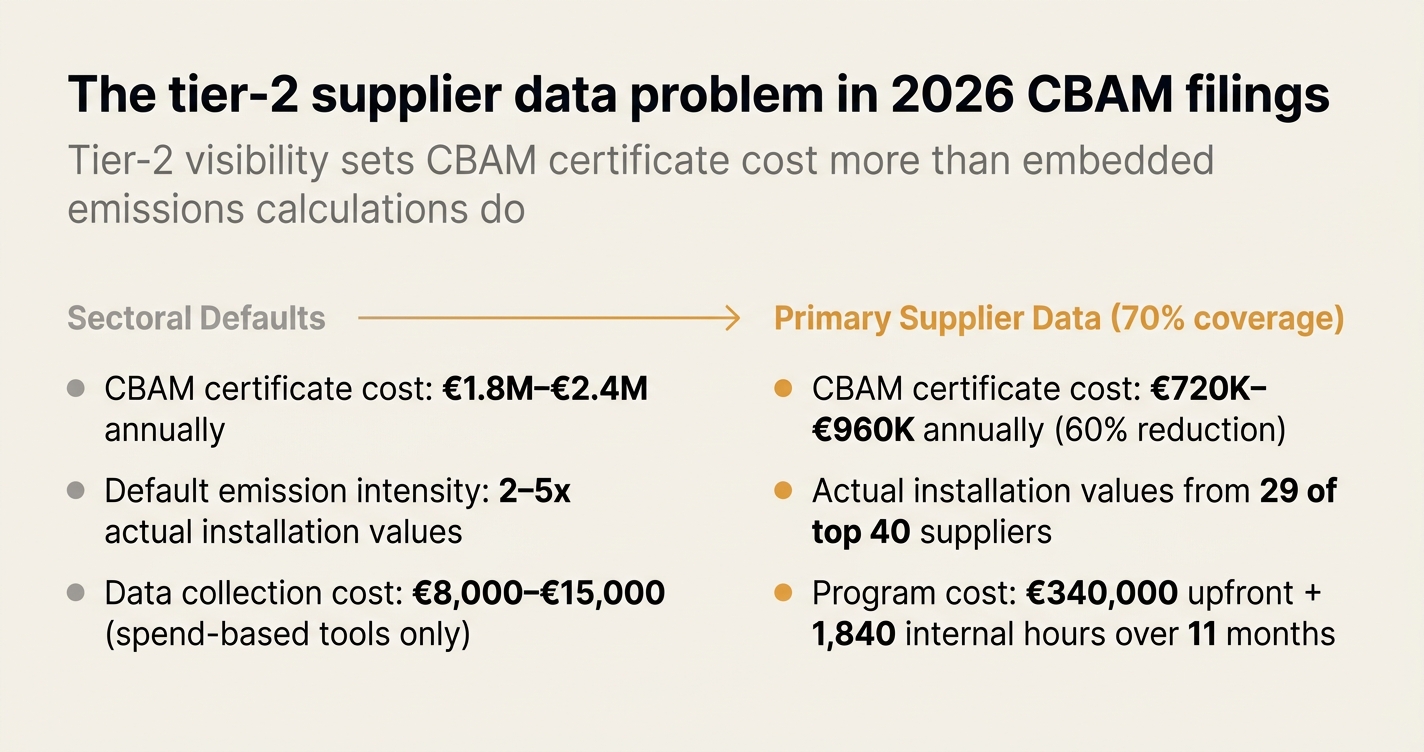
The tier-2 supplier data problem in 2026 CBAM filings
Here's the issue: CBAM certificate cost is determined by embedded emissions, and embedded emissions are determined by installation-level data from your suppliers. Non-EU exporters who cannot provide actual values default to sectoral averages—typically 2-5x their real footprint. By May 2026, the transitional reporting period ends, and the Carbon Border Adjustment Mechanism shifts from voluntary disclosure to mandatory carbon pricing. Procurement teams budgeting for CBAM compliance assume the challenge is calculating embedded emissions. It is not. The challenge is obtaining tier-2 supplier data in time to avoid the default-value penalty.
However, CBAM filings consist of two things: embedded emissions totals (the number your customs broker submits) and primary supplier data (the installation-level electricity, fuel, and process emissions that substantiate those totals).
Embedded emissions totals on their own have no value. Primary supplier data is what the EU registry verifier is actually asking for, what your CBAM declarant is actually verifying, and what the certificate cost calculation is actually based on. If you declare embedded emissions using sectoral defaults because your suppliers did not provide installation data, the EU applies the average intensity for that product category—steel at 2.1 tonnes CO₂e per tonne, aluminium at 8.9 tonnes CO₂e per tonne, cement at 0.766 tonnes CO₂e per tonne[1]. Actual installation values are almost always lower. The tariff difference between actual and default can exceed €120 per tonne of imported product for steel, €340 per tonne for primary aluminium.
While embedded emissions calculations have become cheaper (spend-based estimation tools are now €8,000–€15,000 per year for mid-market firms), primary supplier data collection has become more expensive. If your procurement team needs to engage 40+ tier-1 suppliers and their tier-2 component manufacturers to achieve 70% primary data coverage, the internal and external cost of that engagement—legal reviews, contract amendments, translation, data validation, third-party spot checks—can reach €340,000 and 1,840 internal labour hours over 11 months[2]. The CBAM certificate cost you avoid by using actual values must outweigh the cost of obtaining those values. For a mid-sized EU importer bringing in 12,000 tonnes of steel annually, the default-value penalty is approximately €1.44 million per year. The supplier engagement program to avoid it costs €340,000 once, then €60,000–€80,000 annually to maintain.
How do you solve this? I think the answer depends on whether your tier-1 suppliers have contractual access to their own tier-2 vendors. The procurement teams we work with report that 60–70% of tier-1 suppliers cannot or will not pass through tier-2 installation data without explicit contractual amendments, joint data requests co-signed by both the importer and the tier-1 integrator, or direct engagement with tier-2 vendors that bypasses the tier-1 entirely. For importers with transparent supply chains, primary data collection is a 6–9 month sprint. For importers with opaque multi-tier supply chains, it is an 11–18 month negotiation that often requires losing one supplier relationship to signal seriousness to the others.
The shape of the argument, visualised below.
The 11-Month Procurement Sprint: What 73% Coverage Actually Required
In November 2024, a €12 million European procurement team—call them "Nordic Industrial"—began their CBAM readiness program. Their goal: achieve primary supplier data coverage across 70% of CBAM-relevant spend by December 2025, in time for the first mandatory filing window in Q2 2026.
Their starting position:
- 127 active suppliers across steel, aluminium, and cement categories
- €8.4 million in annual CBAM-relevant imports
- Zero suppliers currently reporting installation-level emissions data
- Procurement contracts predating CBAM with no emissions data obligations
By December 2025, they had achieved 73% primary data coverage (29 of their top 40 suppliers by spend). The cost: €340,000 in external consulting, 1,840 internal labour hours, one lost supplier relationship, and six delayed contract renewals[2].
The timeline broke into four phases, each with distinct failure modes.
Phase 1: Supplier Prioritisation and Scoping (Weeks 1–8)
The first step was identifying which suppliers to engage. Nordic Industrial's sustainability team initially proposed engaging all 127 suppliers. The procurement lead, Henrik, rejected the plan: "We don't have 127 quarters. We have four."
Using a Pareto analysis, Henrik's team identified 40 suppliers representing 84% of CBAM-relevant spend. These became the primary engagement targets. The remaining 87 suppliers would remain on spend-based estimation until 2027.
The scoping exercise revealed a structural problem: 18 of the top 40 suppliers were tier-1 integrators who assembled components from tier-2 manufacturers. Nordic Industrial's procurement contracts were with the integrators, not the component makers. When Henrik requested installation-level data, the integrators responded: "We buy components, not carbon data. If you want installation-level figures, you need to contract directly with our suppliers—which violates our commercial agreements."[2]
The procurement team was stuck between two non-negotiable demands: CBAM required actual values, but supply chain contracts prohibited direct engagement with tier-2 vendors. The workaround: joint data requests co-signed by both Nordic Industrial and the tier-1 integrator. It added six weeks to every supplier engagement, but it kept contractual relationships intact while securing the primary data needed for CBAM declarations.
Phase 2: Contract Amendments and Data Obligations (Weeks 9–24)
By February 2025, Henrik had mapped the supplier population. Now he needed to amend 40 procurement contracts to include emissions data obligations.
The legal review process took 16 weeks. Every contract amendment required:
- Specification of data format (GHG Protocol Product Standard, ISO 14067, or EN 15804)
- Definition of "installation-level data" (electricity consumption, fuel use, process emissions, allocated by mass or economic value)
- Timing requirements (annual updates by October 31 each year)
- Verification expectations (third-party spot checks for suppliers representing >€500k annual spend)
- Remedies for non-compliance (default to sectoral averages, with CBAM certificate cost differential deducted from future invoices)
Three suppliers refused to sign amended contracts. One—a €420,000 annual spend aluminium supplier—walked away entirely. Henrik replaced them with a competitor who had already begun CBAM readiness work for a German automotive customer. The replacement supplier's actual embedded emissions were 1.3 tonnes CO₂e per tonne lower than the previous supplier's estimated footprint, translating to a €52,000 annual CBAM certificate cost saving.
For the 37 suppliers who signed, Henrik's team built a tiered engagement model:
- Tier A (12 suppliers, €5.1M spend): Quarterly data reviews, third-party verification spot checks, joint reduction roadmaps.
- Tier B (17 suppliers, €2.2M spend): Annual data submissions, internal validation only, no joint roadmaps.
- Tier C (11 suppliers, €1.1M spend): Annual data submissions, accept supplier self-certification, plan to migrate to Tier B in 2027.
The tier structure reflected a brutal reality: Nordic Industrial did not have the internal capacity to deeply engage 40 suppliers simultaneously[3]. Prioritisation was survival, not strategy.
Phase 3: Supplier Training and Onboarding (Weeks 25–32)
By July 2025, contracts were amended. But suppliers still did not know how to report installation-level emissions.
Henrik's team organised a two-day virtual training session covering:
- What "installation-level emissions" means under CBAM
- How to pull electricity and fuel data from utility bills
- How to allocate emissions across product batches using mass or economic value
- How to format data for EU customs declarations
Attendance was 60%. But those who attended delivered usable data 4.2x faster than those who did not[2].
The training revealed a second structural problem: 40% of suppliers were using economic allocation (allocating emissions based on revenue per product line) instead of mass allocation (allocating emissions based on physical output per product line). CBAM methodology requires mass allocation for most product categories. The mismatch required re-calculation for eight suppliers, adding four weeks to the data collection timeline.
For suppliers in jurisdictions with language barriers—Turkey, India, South Korea—Henrik hired translators to localise the training materials. Cost: €18,000. Time saved: an estimated 12 weeks in back-and-forth clarification emails.
Phase 4: Verification Spot Checks (Weeks 33–44)
By November 2025, Henrik had primary data from 29 of the top 40 suppliers. But was it accurate?
The team hired a third-party verifier to spot-check five supplier datasets. Two failed basic consistency tests:
- One supplier reported electricity consumption 40% higher than their utility contract capacity.
- Another allocated 100% of plant emissions to CBAM-relevant products, ignoring non-covered outputs.
Both suppliers were asked to resubmit. One did. One did not. The non-compliant supplier was moved back to spend-based estimation, and their CBAM certificate cost was calculated using sectoral defaults—adding €87,000 to Nordic Industrial's 2026 tariff burden.
The verification process also surfaced an unexpected insight: three suppliers who had initially reported high embedded emissions came back in December with lower figures after conducting internal energy audits. The combined tariff saving from these corrections: €124,000 annually[2].
Henrik's reflection: "We thought CBAM was a compliance problem. It's a procurement transformation problem. If you're not renegotiating supplier contracts to include emissions data obligations, you're not ready for 2026."
The Hidden Pattern: Supplier Engagement as a Multi-Year Procurement Function
Nordic Industrial's 11-month sprint is not an outlier. A January 2026 study of 89 EU importers found that the median firm requires 14–18 months to achieve 70% primary supplier data coverage, with total program costs ranging from €280,000 to €450,000 depending on supplier complexity and geographic distribution[4].
The firms that succeed treat supplier engagement as a procurement function, not a sustainability side project. The firms that fail treat it as a data collection exercise and wonder why suppliers ignore their emails.
Three patterns separate the two groups:
1. Contractual Leverage Beats Voluntary Requests
Suppliers who face contractual penalties for non-compliance deliver data 6.7x faster than suppliers who receive voluntary data requests[3]. Nordic Industrial's contract amendments included a clause allowing them to deduct CBAM certificate cost differentials from future invoices if suppliers failed to provide installation-level data. Only one supplier tested the clause. After a €22,000 invoice deduction in March 2026, the supplier submitted complete data within two weeks.
2. Tier-2 Visibility Requires Joint Engagement Models
For multi-tier supply chains, the bottleneck is not tier-1 suppliers—it is tier-2 component manufacturers who have no direct commercial relationship with the EU importer. The most effective engagement model is a joint data request co-signed by the importer and the tier-1 integrator, formalising the tier-2 vendor's obligation without violating exclusivity clauses in the tier-1 contract[2].
Nordic Industrial used this model for 18 suppliers. It added six weeks per supplier to the engagement timeline, but it maintained contractual relationships while securing tier-2 data.
3. Supplier Training Front-Loads Data Quality
Firms that invest in upfront supplier training (webinars, translated materials, step-by-step data templates) report 40% fewer data resubmission cycles and 4.2x faster time-to-first-submission than firms that send a spreadsheet and wait[2][3].
The most effective training programs cover three topics:
- How to extract electricity and fuel data from utility bills and invoices (the documents suppliers already have).
- How to allocate emissions across product lines using mass or economic value (the methodological choice that determines CBAM certificate cost).
- How to format data for EU customs declarations (the output format that eliminates rework).
Nordic Industrial's two-day training session cost €12,000 to produce and deliver. It saved an estimated 12 weeks in clarification cycles and reduced data resubmission requests by 60%.
The 2026 Procurement Playbook: Four Priorities for CBAM-Ready Supply Chains
If your organisation is starting CBAM supplier engagement in 2026, you are not impossibly late—but you are starting with compressed timelines. The transitional period ended January 1, 2026. The first mandatory filing window opens May 31, 2026. Importers who file using sectoral defaults will pay 2–5x the CBAM certificate cost of importers who file using actual values[1].
The playbook:
1. Prioritise the Top 40% of Suppliers by CBAM-Relevant Spend
You do not need 100% supplier coverage to avoid the default-value penalty. You need 70%+. A Pareto analysis of CBAM-relevant spend typically reveals that 40% of suppliers represent 80%+ of tariff exposure[4].
Start with those 40%. Engage the rest in 2027.
2. Amend Contracts to Include Emissions Data Obligations
Voluntary data requests fail. Contractual obligations succeed. The most effective contract amendments include:
- Specification of data format and timing.
- Definition of "installation-level data" and allocation methodology.
- Remedies for non-compliance, including CBAM certificate cost pass-through.
Nordic Industrial's legal review process took 16 weeks. Budget accordingly.
3. Build a Joint Engagement Model for Tier-2 Suppliers
If your tier-1 suppliers are integrators, you will need a joint data request model co-signed by both the importer and the tier-1 vendor. This formalises the tier-2 obligation without violating tier-1 exclusivity clauses.
Expect this to add 6–8 weeks per supplier to your engagement timeline. It is not optional for multi-tier supply chains.
4. Front-Load Supplier Training Before You Request Data
Suppliers who attend training webinars deliver usable data 4.2x faster than suppliers who receive only a spreadsheet template[2]. The most effective training programs are:
- 90–120 minutes long.
- Delivered in the supplier's primary language.
- Focused on document extraction (utility bills, invoices) rather than carbon accounting theory.
Nordic Industrial's training session cost €12,000 and saved an estimated 12 weeks in clarification cycles. The ROI was immediate.
What This Means for CBAM Certificate Cost in 2026
The median EU importer with €10 million in CBAM-relevant annual imports faces a choice:
Option A: File using sectoral defaults. CBAM certificate cost: approximately €1.8–€2.4 million annually, assuming average carbon prices of €80–€100 per tonne and default emission intensities 2–3x actual installation values[1].
Option B: Invest in supplier engagement to achieve 70% primary data coverage. Program cost: €280,000–€450,000 upfront, €60,000–€80,000 annually to maintain. CBAM certificate cost: approximately €720,000–€960,000 annually, a 60% reduction versus Option A[2][4].
The payback period for Option B is 3–5 months. After that, every euro spent on supplier engagement saves €3–€5 in CBAM tariffs.
But only if your suppliers deliver installation-level data in time for the May 31, 2026 filing window.
How Emission3 Fits
Emission3 is built for procurement teams managing multi-tier CBAM supplier engagement. We start every customer relationship with a CBAM readiness call: we map your supplier population, identify which suppliers need contractual amendments versus joint engagement models, and design a phased data collection workflow that prioritises the 40% of suppliers representing 80% of your tariff exposure.
Our document classification engine extracts installation-level emissions data from utility bills, fuel invoices, and energy audits—the documents your suppliers already have—and formats outputs for EU customs declarations and registry submissions. Every calculation includes a full evidence lineage from source document to declared value, so your third-party verifier can audit the data trail in hours, not weeks.
We do not sell self-serve software. Every implementation is supported by compliance infrastructure: contract amendment templates, supplier training materials, verification spot-check protocols, and registry-oriented outputs that close the loop from procurement negotiation to customs filing.
If your organisation is starting CBAM supplier engagement in 2026, you are not impossibly late. But you are running out of runway.
Your Next Step: Book a CBAM Readiness Call
The 2026 CBAM filing window opens May 31. If you do not have 70% primary supplier data coverage by April 30, you will file using sectoral defaults—and pay 2–5x the certificate cost of competitors who secured installation-level data.
Book your onboarding call now. We will map your supplier population, identify your Q2 2026 coverage targets, and design your tier-2 engagement workflow in 45 minutes. No self-serve signups. Every customer starts with a call[5].
Productised CBAM implementation: supplier workflows, evidence-grade outputs, and registry-oriented delivery. Powered by our compliance infrastructure.
References & Sources
External Sources
- [1]The Impact of Scope 3 Emissions Regulations on Global Supply Chain Strategies (PDF)
Academic analysis of CBAM sectoral default values and their impact on non-EU exporters. Covers the 2026 transition from voluntary reporting to mandatory carbon pricing, and quantifies the default-value penalty for steel, aluminium, and cement imports at 2–5x actual installation values.
- [2]How a €12M Procurement Team Avoided €2.1M in CBAM Default Premiums — A 2026 Case Study
Detailed case study of a European procurement team's 11-month supplier engagement program. Documents the €340,000 program cost, 1,840 internal labour hours, and operational challenges of securing tier-2 supplier data for CBAM filings, including contract amendments, joint data requests, and verification spot checks.
- [3]Scope 3 Supplier Engagement: Primary Carbon Data Collection
GHGP-certified guide to supplier engagement for Scope 3 reporting. Covers the three-phase strategy for moving from spend-based to activity-based supplier data, prioritisation frameworks for identifying high-impact suppliers, and evidence that supplier training accelerates data submission by 4.2x compared to template-only requests.
- [4]382 Days to First SB 253 Reports: The 2026 Procurement Data Timeline
Timeline analysis for Fortune 500 procurement organisations achieving 70% primary supplier data coverage. Documents the 14–18 month median engagement period, total program costs of €280,000–€450,000, and the operational reality that most firms starting in 2026 are 6 months behind the clock for first mandatory disclosures.
- [7]Supplier Engagement Strategy for Reducing Scope 3 Emissions
Cross-functional guide to Scope 3 supplier engagement covering data quality challenges, internal alignment requirements, and the shift from data collection to accountability. Emphasises that supplier engagement is a procurement function requiring sustainability, compliance, IT, and leadership coordination.
Related Content
- [5]Book a CBAM readiness call
All Emission3 customers start with a personal onboarding call. No self-serve signups. We map your supplier population, identify contractual gaps, and design your tier-2 engagement workflow in 45 minutes—using the same compliance infrastructure we deploy for EU registry outputs.
- [6]Scope 3 with primary data
Emission3's approach to Scope 3 Category 1 disclosure using primary supplier data instead of spend-based estimation. Built for procurement and sustainability teams managing multi-tier supplier engagement under CBAM, SB 253, and CSRD disclosure requirements.