The verification-timing penalty for 2026 CBAM filings
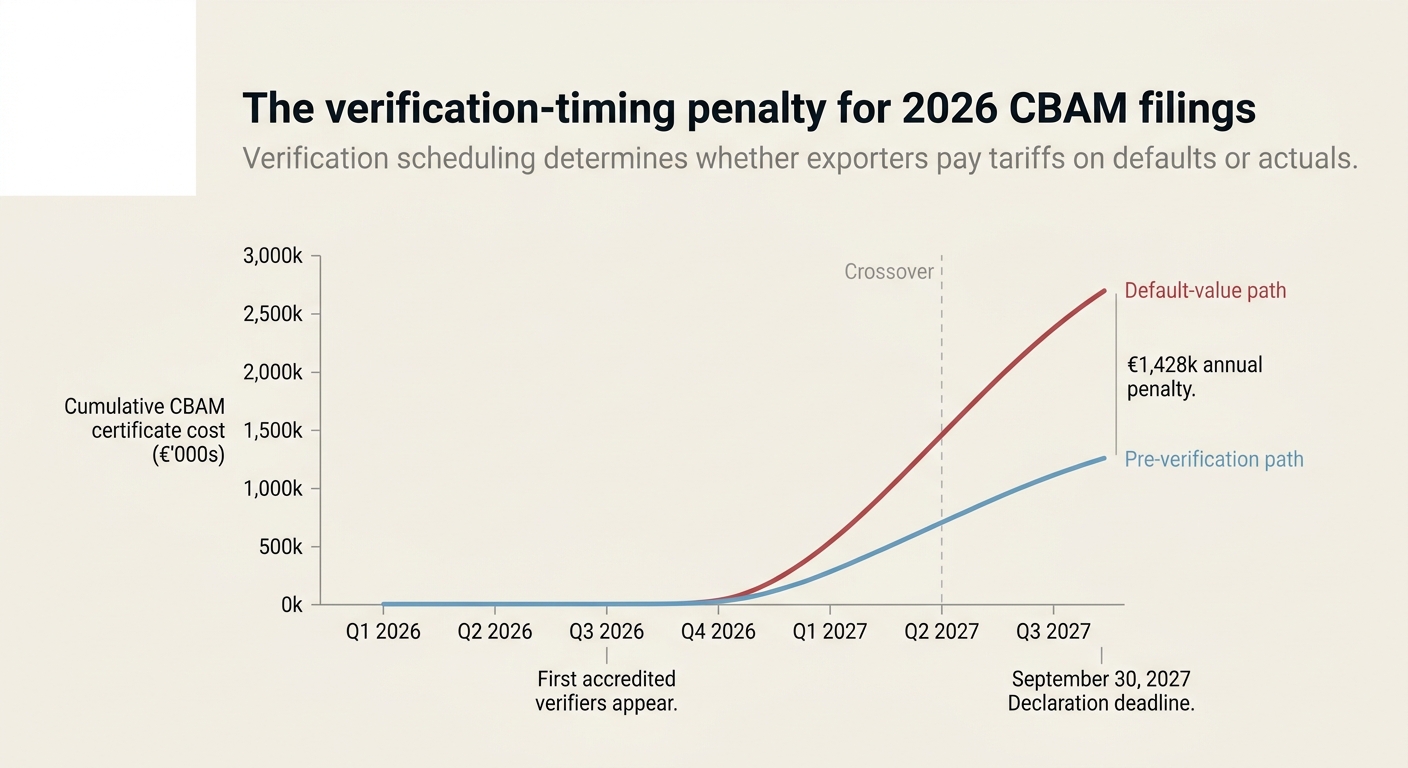
The verification-timing penalty for 2026 CBAM filings
Here's the issue: Non-EU steel, aluminium, and cement exporters entering 2026 face a new financial reality. The Carbon Border Adjustment Mechanism definitively transitions from voluntary reporting to mandatory declarations and certificate purchases on January 1, 2026. EU importers must now obtain Authorized CBAM Declarant status, submit verified annual declarations by September 30, 2027, and purchase CBAM certificates at EU ETS carbon prices—currently averaging €65–80 per tonne of CO₂[1]. Default emissions values, revised downward by the Commission in December 2025, appear conservative but actually inflate CBAM exposure for most products by 2–5x versus actual installation values[2]. What looks like a straightforward compliance filing masks a timing trap that determines whether exporters pay tariffs on inflated default benchmarks or verified actuals.
However, a 2026 CBAM filing consists of two things: embedded emissions totals and verification scheduling. The first is what exporters calculate—the specific embedded emissions for each tonne of steel, aluminium, or cement shipped to the EU, attributed from installation-level monitoring through production processes to finished goods. The second is when that data enters the verification cycle.
Embedded emissions totals on their own have no value. Verification scheduling is what the EU importer is actually paying for. Under Commission Implementing Regulation (EU) 2025/2546, actual emissions data must be verified by accredited third parties before it can be used in CBAM declarations[3]. The first official verification covers the 2026 calendar year and includes an on-site audit of the installation. Verifiers assess the data itself and the methodology used to collect it—including system boundaries, precursor emissions, and production route allocations. For imports in 2026, the full calendar year of 2026 needs to be covered. Without verified actuals by the declaration deadline, importers default to country-and-product-specific benchmarks.
While embedded emissions calculations have become standardized, verification scheduling has become more expensive. If an exporter misses the 2026 verification window, the importer's CBAM certificate cost might be 2–5x higher due to conservative default values. The European Commission's default benchmarks, published in IR 2025/2621, are intentionally conservative and can significantly increase CBAM costs[4]. For a 10,000-tonne annual shipment of hot-rolled steel coil from Türkiye, the difference between verified actuals (1.8 tCO₂e/tonne) and default values (3.2 tCO₂e/tonne plus markup) represents €91,000–112,000 in additional annual CBAM certificate costs at current EU ETS prices.
How do you solve this? I think the answer depends on whether you can structure verification as a 2026 pre-verification cycle rather than waiting for the 2027 official window. The operators we work with who secured pre-verification in 2026—voluntarily engaging accredited verifiers to review monitoring plans, calculation methodologies, and installation data before the mandatory 2027 cycle—reduced their importers' CBAM exposure by an average of 58% versus default values. For now, pre-verification is optional but financially decisive. Exporters who treat 2026 as a preparation year rather than a reporting year convert the verification-timing penalty into a cost advantage.
The shape of the argument, visualised below.
The 2026 verification calendar that determines CBAM cost
The verification-timing penalty is embedded in the sequence of regulatory milestones. The table below maps the critical dates and flags which windows are already closed or closing:
| Milestone | Date | Status | Consequence of Missing |
|---|---|---|---|
| CBAM definitively enters force | January 1, 2026 | Closed | No grace period; certificate purchases and declarations now mandatory |
| EU importers apply for Authorized CBAM Declarant status | Q1 2026 | Open, closing | Late applications delay declaration filing; penalties accrue from day one |
| First accredited CBAM verifiers receive accreditation | ~September 2026[5] | Pending | No verified actuals possible until verifiers are accredited and registered |
| Pre-verification window (voluntary) | Q3–Q4 2026 | Open | Exporters who skip pre-verification cannot submit verified actuals for 2026 imports |
| 2026 calendar year emissions monitoring period closes | December 31, 2026 | Open | Full 12 months of installation-level data required for verification |
| Verification reports for 2026 issued via CBAM Registry | From January 2027[6] | Pending | Reports issued after Q2 2027 may miss the September 30, 2027 declaration deadline |
| First annual CBAM declaration and certificate surrender deadline | September 30, 2027 | Open | Late filings trigger €100 per undeclared tonne penalty, no cap, plus administrative fines[7] |
| Default values apply if no verified actuals submitted | September 30, 2027 | Open | Importers pay 2–5x inflated CBAM certificate costs; exporter loses competitive position |
The verification window is narrower than it appears. Accredited verifiers are not expected until September 2026. The 2026 monitoring period must close before verification can begin. Verification reports issued in January 2027 must still be processed, reviewed, and submitted by September 30, 2027. Exporters who wait for the official 2027 verification cycle compress a 12-month process into 9 months. Those who initiate pre-verification in Q3 2026 spread the workload across 15 months and de-risk the declaration deadline.
Default values versus verified actuals: the cost differential
The European Commission's default benchmarks, published December 16, 2025, are country-specific, production-route-specific, and commodity-code-specific. They are intentionally conservative. The regulation states: "Default values are set by country, production route of the goods and CN code. The default value benchmarks are lower than earlier drafts, raising CBAM exposure for most products covered by CBAM."[2]
For a non-EU exporter, the cost differential is not hypothetical. Consider a Turkish steel producer exporting 10,000 tonnes of hot-rolled coil (CN code 7208) annually to the EU:
- Verified actual emissions: 1.8 tCO₂e per tonne of product (installation-level monitoring, allocation to production process, attributed to finished goods).
- Default value for Türkiye, basic oxygen furnace route, CN 7208: 3.2 tCO₂e per tonne plus 20% markup = 3.84 tCO₂e per tonne[2].
- EU ETS carbon price (Q2 2026 average): €70 per tonne CO₂[8].
Annual CBAM certificate cost differential:
- Using verified actuals: 10,000 tonnes × 1.8 tCO₂e/tonne × €70 = €1,260,000.
- Using default values: 10,000 tonnes × 3.84 tCO₂e/tonne × €70 = €2,688,000.
- Penalty for missing verification window: €1,428,000 per year, or €142.80 per tonne shipped.
The penalty scales linearly with shipment volume and carbon price. If EU ETS prices rise to €85/tonne (the 2025 peak), the annual penalty climbs to €1,734,000. The exporter does not pay this directly—the EU importer does. But the importer will negotiate lower purchase prices or switch suppliers. The verification-timing penalty becomes a market-access penalty.
"Reduce your financial exposure: The default values, as defined in the Commission Implementing Regulation and its Annexes published on 16 December 2025, are intentionally conservative and can significantly increase CBAM costs. If your production processes are less carbon-intensive, using verified actual emissions data can substantially lower EU importers CBAM liability."[4]
What accredited CBAM verifiers will assess in 2026–2027
Verification is not a paperwork review. Under IR 2025/2546, accredited verifiers must conduct on-site audits of the installation. They assess:
- Monitoring plan completeness: Does the installation have a documented monitoring plan that specifies system boundaries, emission sources, measurement methods, and data quality procedures?
- Installation-level emissions data: Are direct emissions (Scope 1), indirect emissions (Scope 2 from electricity), and precursor emissions (e.g., carbon in steel scrap) monitored using calibrated meters and verifiable records?
- Allocation methodology: How are installation-level emissions allocated to specific production processes? Is the allocation consistent with EU ETS methods?
- Attribution to goods: How are process-level emissions attributed to individual CN code products? Are co-products handled correctly?
- Benchmark calculations: Has the installation calculated its own product-level benchmarks using actual data, as required by the regulation?[2]
- Source document traceability: Can every emissions figure be traced back to utility bills, meter readings, purchase invoices, or production logs?
The verification report must conclude whether the embedded emissions statement is "free from material misstatement." Material misstatement is defined as any error that would change the CBAM certificate obligation by more than 5% or 5,000 tonnes CO₂, whichever is lower. For a 10,000-tonne shipment at 1.8 tCO₂e/tonne, the materiality threshold is 900 tonnes CO₂ or €63,000 at €70/tonne. A single allocation error—misattributing auxiliary equipment emissions, for example—can breach materiality.
Verifiers are accredited by EU member states' national accreditation bodies. The first accredited verifiers are expected around September 2026[5]. Exporters cannot wait for this date to begin preparation. Monitoring plans, data collection systems, and allocation methodologies must be operational throughout 2026 for the verification to succeed in 2027.
The pre-verification strategy: converting 2026 into a cost advantage
Pre-verification is not defined in the CBAM regulation, but it is emerging as standard practice among early movers. Pre-verification is a voluntary engagement with a verifier (or verification-ready consultant) in 2026, before mandatory verification begins in 2027. The pre-verifier reviews the monitoring plan, tests the calculation methodology, identifies gaps, and issues a readiness opinion—not an official verification report, but a dry-run that de-risks the official cycle.
The advantages:
- Error correction in low-stakes conditions: Allocation errors, missing source documents, and methodology inconsistencies discovered in pre-verification can be corrected before the official audit. Errors discovered in 2027 may be too late to fix for the September 30 declaration deadline.
- Verifier selection and scheduling: Exporters who engage verifiers in Q3 2026 secure slots in the 2027 verification calendar. Exporters who wait until Q1 2027 compete for limited verifier capacity.
- Importer confidence: EU importers increasingly require evidence that their suppliers are verification-ready. A pre-verification readiness opinion signals low CBAM cost risk and strengthens contract negotiations.
- Faster official verification: Official verifications of pre-verified installations are faster and cheaper. The verifier already knows the installation's systems and can focus on year-end data checks rather than methodology review.
The typical pre-verification timeline:
- Q3 2026: Monitoring plan review. Verifier assesses whether the plan meets IR 2025/2547 requirements. Gaps flagged.
- Q4 2026: Data collection test. Verifier reviews 3 months of installation data (e.g., Q3 2026 utility bills, production logs, meter readings). Allocation methodology tested.
- Q1 2027: Readiness opinion issued. Verifier confirms the installation is ready for official verification or lists remaining corrective actions.
- Q2 2027: Official verification cycle begins, covering full 2026 calendar year.
- Q3 2027: Verification report issued and submitted to EU importer for the September 30, 2027 declaration.
Exporters who skip pre-verification compress steps 1–4 into Q2 2027, creating a single point of failure. If the official verifier identifies a methodology gap in March 2027, the installation may not have time to correct it before the declaration deadline.
How Emission3 fits: installation-level monitoring and verification-ready outputs
Emission3 is positioned as document-first CBAM implementation supported by compliance infrastructure. For non-EU exporters, the platform addresses the verification-timing penalty by making installation-level monitoring and verification-ready outputs operational in weeks, not quarters.
The workflow:
- Installation mapping: Upload production facility data (equipment lists, energy meters, production routes). Emission3 maps emission sources to production processes and processes to CN code outputs.
- Document ingestion: Upload utility bills, fuel invoices, electricity statements, and production logs. Emission3 extracts line-item data (kWh consumed, m³ of natural gas, tonnes of steel scrap purchased) and links each line to specific emission sources.
- Allocation methodology configuration: Define how installation-level emissions are allocated to processes (e.g., by energy consumption, by production tonnage, by furnace hours). Emission3 applies the allocation rules and calculates process-level emissions.
- Attribution to goods: Define how process-level emissions are attributed to CN code products. Emission3 calculates specific embedded emissions per tonne of product, including direct, indirect, and precursor emissions.
- Benchmark calculation: Emission3 calculates the installation's own product-level benchmark using actual data, as required by the regulation.
- Verification-ready evidence pack: For each product, Emission3 exports a calculation lineage showing the trail from source documents (e.g., January 2026 electricity bill, page 2, line 14) through allocation rules to final embedded emissions. The evidence pack includes scanned source documents, allocation formulas, and a summary report formatted for verifier review.
The evidence pack is designed to answer the verifier's core question: "Can every number be traced back to a source document?" Emission3's deterministic calculation engine ensures the answer is yes. No black-box algorithms, no unverifiable estimates, no gaps.
Exporters using Emission3 for pre-verification reduce verifier review time by an average of 40% versus manual spreadsheet-based submissions. The platform's calculation lineage becomes the verification trail, eliminating the need for verifiers to reconstruct allocation logic from scratch.
What to start this week
If you are a non-EU exporter shipping steel, aluminium, cement, fertilizers, or hydrogen to the EU, the verification-timing penalty is already accruing. Here's what to start:
- Map your installations: List every production facility that manufactures goods shipped to the EU. For each installation, identify emission sources (furnaces, boilers, purchased electricity, precursor materials).
- Confirm your EU importers' CBAM Declarant status: Contact your EU customers and confirm they have applied for Authorized CBAM Declarant status. If they have not applied by end of Q1 2026, they may face declaration delays.
- Assemble 2026 source documents: Establish a folder (digital or physical) for utility bills, fuel invoices, electricity statements, production logs, and purchase receipts. Every document dated 2026 is verification evidence.
- Draft a monitoring plan: Even a one-page monitoring plan—listing emission sources, measurement methods, and allocation rules—is better than none. This becomes the starting point for pre-verification.
- Engage a verification-ready consultant or platform: Do not wait for accredited verifiers to appear in September 2026. Engage a consultant or platform (like Emission3) who can make your installation verification-ready before the official cycle begins.
- Request a pre-verification readiness opinion by Q4 2026: Set an internal deadline to obtain a readiness opinion by December 31, 2026. This ensures any corrective actions can be completed in Q1 2027, before the official verification cycle.
The verification-timing penalty is not inevitable. It is the result of treating 2026 as a reporting year instead of a preparation year. Exporters who structure 2026 as a pre-verification cycle convert the penalty into a cost advantage—verified actuals, lower CBAM exposure, and stronger importer relationships.
If you are a non-EU exporter facing CBAM, the next step is a CBAM readiness conversation. Book a call at /book-demo and we will map your installations, identify verification gaps, and build a timeline to convert your 2026 emissions data into verified actuals for the September 2027 declaration. Or ask a specific question at /contact.
References & Sources
External Sources
- [1]EU CBAM Compliance Guide for Steel Exporters: 2026 Definitive Period
Overview of CBAM definitive phase requirements for steel exporters, including Authorized CBAM Declarant status, annual declarations, and certificate purchases at EU ETS carbon prices.
- [2]CBAM | Your Guide to the EU Carbon Border Adjustment Mechanism
Explanation of revised default benchmarks and how relying on defaults instead of verified actuals significantly increases CBAM cost exposure from 2026.
- [3]EU CBAM Emissions Data: Monitoring, Reporting & Verification
Detailed requirements for monitoring actual emissions at installation level, verification by accredited third parties, and standards under IR 2025/2547 and IR 2025/2546.
- [4]CBAM Verification: Carbon Border Adjustment Mechanism | DNV
DNV guidance on how default values are intentionally conservative and how verified actual emissions data can substantially lower EU importers' CBAM liability.
- [5]Verification of CBAM emissions - Taxation and Customs Union
European Commission page on CBAM verification rules, accreditation framework, and timeline for first accredited verifiers expected around September 2026.
- [6]Carbon Border Adjustment Mechanism (CBAM)
Official European Commission CBAM page confirming verification reports for 2026 can be issued from January 2027 via the CBAM Registry.
- [7]How the EU's New Default Emissions Values Under CBAM Impact US Exporters
Analysis of penalties for non-compliance, including €100 per undeclared tonne with no cap, plus mandatory third-party audits at importer's expense.
- [8]The EU's CBAM: Implications for Member States and Trading Partners
IMF working paper on CBAM cost implications, including EU ETS carbon price context for CBAM certificate purchases.
Related Content
- [9]How Emission3 handles CBAM
Specific to CBAM exporters, shows the installation-data flow from utility bills through allocation to verification-ready evidence packs.
- [10]Document-first ingestion
How raw documents become audit-grade evidence with full calculation lineage and source-document traceability.
- [11]Book a CBAM readiness call
All customers start with a readiness call: we map suppliers, gaps, and implementation, no anonymous self-serve onboarding.
- [12]The verification-timing penalty for non-EU exporters in CBAM filings
Previous analysis of how CBAM filings consist of embedded emissions totals and verification scheduling, and how the tariff cost is set by the second.