The verification-cost paradox in 2026 CBAM actual-emissions filing for non-EU installations
The verification-cost paradox in 2026 CBAM actual-emissions filing for non-EU installations
Here's the issue: non-EU exporters facing the Carbon Border Adjustment Mechanism in 2026 see verification as a line-item cost—typically EUR 10,000 to EUR 25,000 for a medium-complexity installation—and many default to using default values to avoid it. The verification invoice arrives quarterly; the default-value penalty compounds annually. At first glance, skipping verification looks like prudent cost control.
However, CBAM filing consists of two things: the verification cost and the default-value markup.
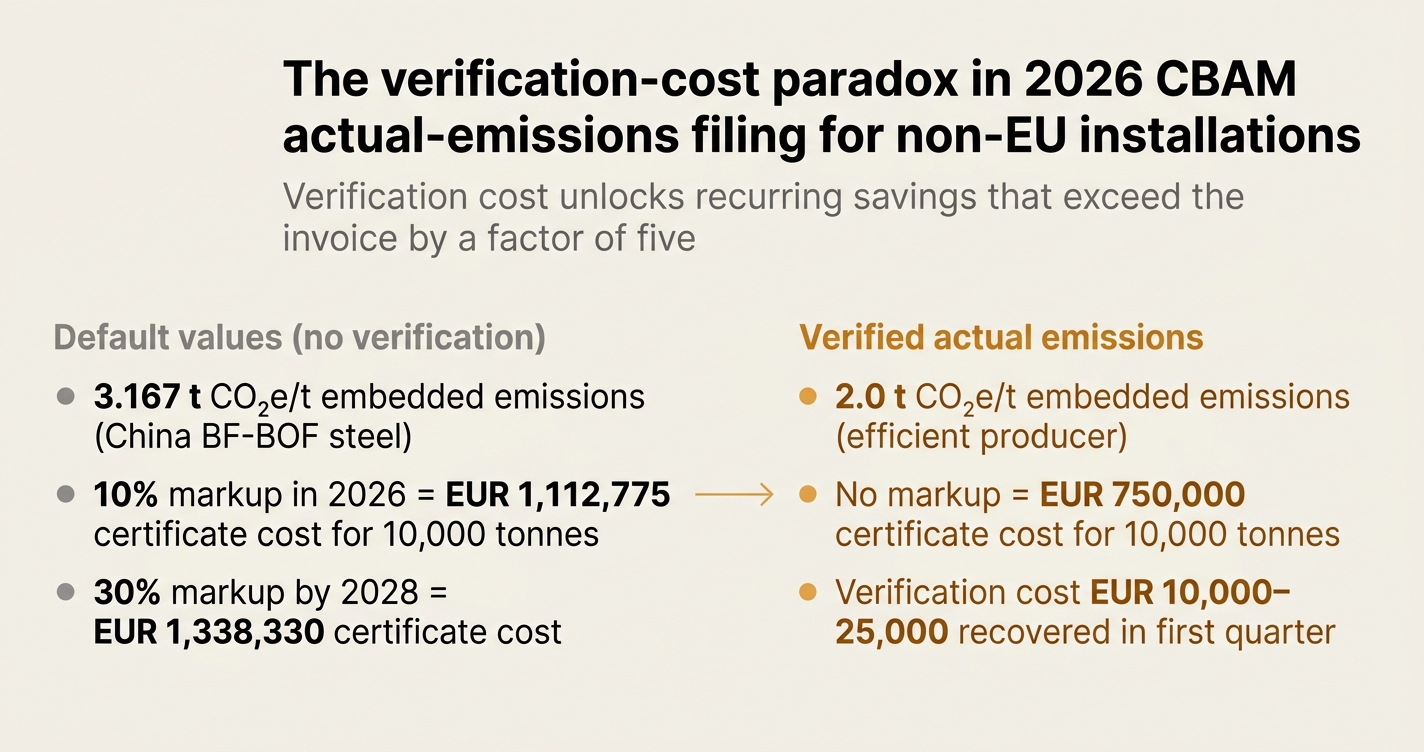
The verification cost on its own has no value to the importer. The default-value markup is what the EU registry is actually charging for—10% in 2026, rising to 30% from 2028 onward. For a Chinese blast furnace-basic oxygen furnace steel installation shipping 10,000 tonnes annually, the Commission default value under Implementing Regulation 2025/2621 is 3.167 tonnes of CO₂ equivalent per tonne of product. Actual installation values for efficient producers typically run closer to 2.0 tonnes. At the current EU Emissions Trading System price of approximately EUR 75 per tonne, an importer relying on defaults pays certificates on 3.167 × 10,000 × 1.10 = 34,837 tonnes rather than 20,000 tonnes under verified actual values. The difference is 14,837 tonnes, or roughly EUR 1.1 million in certificate cost for this single year.
While verification has become more accessible—accredited verifiers registered from September 2026, and the verification scope is now standardised under IR 2025/2546—the default-value markup has become structurally more expensive. If the installation ships the same 10,000 tonnes in 2028, the markup rises to 30%, pushing the certificate cost on defaults to approximately EUR 3.5 million versus EUR 1.5 million under actual values. The verification cost might represent 1.5% of the first year's certificate savings, but it unlocks recurring savings that compound over the regulation's lifetime.
How do you solve this? I think the operators we work with treat verification not as an avoidable cost but as a one-time infrastructure investment that permanently lowers the per-tonne certificate cost. For installations shipping meaningful volumes to the EU, the payback period on verification is measured in months, not years. The first annual CBAM declaration is due September 30, 2027, covering calendar year 2026, which means verification timelines are no longer hypothetical—they are the critical path for 2027 cash outflows.
The shape of the argument, visualised below.
The default-value penalty by sector and country of origin
Default values published in IR 2025/2621 carry sector-specific markups and vary sharply by country. For steel, the range spans from approximately 1.87 tonnes of CO₂ equivalent per tonne for South African and Qatari producers to over 3.5 tonnes for Chinese and Mozambican producers[1]. The markup begins at 10% in 2026, meaning a Chinese exporter using defaults pays certificates on 3.167 × 1.10 = 3.484 tonnes per tonne shipped, compared to typical actual values near 2.0 tonnes for modern installations.
The table below summarises the financial impact for a hypothetical 10,000-tonne annual shipment at an EU ETS price of EUR 75 per tonne:
| Scenario | Embedded emissions (t CO₂e/t) | Markup | Certificate cost (EUR) | Savings vs default |
|---|---|---|---|---|
| Default value (China BF-BOF) | 3.167 | 10% (2026) | 1,112,775 | Baseline |
| Verified actual (efficient producer) | 2.0 | None | 750,000 | 362,775 (33%) |
| Default value (China BF-BOF) | 3.167 | 30% (2028) | 1,338,330 | Baseline |
| Verified actual (efficient producer) | 2.0 | None | 750,000 | 588,330 (44%) |
For a UK steel mill running efficient processes, the gap is smaller but still material. The UK default value is approximately 2.3 tonnes per tonne. At 2.0 tonnes actual, the 2026 savings are approximately EUR 6,930 per year, rising to EUR 184,500 by 2030 as the CBAM phase-in factor reaches 48.5%, and approximately EUR 380,400 by 2034 at full phase-in[2]. These are structural, recurring savings, not one-time adjustments.
"Default values are set at country-level average intensity, not installation-level performance. A UK steel mill running efficient processes will almost certainly have lower actual embedded emissions than the default assigned to UK steel production as a whole."[2]
The verification cost for a single medium-complexity installation—estimated at EUR 10,000 to EUR 25,000[1]—is recovered in the first year for most exporters shipping above 1,000 tonnes annually. The payback period shortens further as the markup escalates and the CBAM phase-in factor rises.
What verification covers: the five core areas under IR 2025/2546
Verification is not a compliance formality. It is an on-site audit of the installation's monitoring systems, data quality, and calculation methodology. The verification scope under IR 2025/2546 is structured around five core areas[1]:
- Installation-level emissions monitoring: verifiers assess whether the operator has captured all direct emissions from production processes, including combustion emissions, process emissions, and emissions from waste gases.
- Precursor emissions allocation: verifiers check how emissions from intermediate inputs—such as pig iron used in steelmaking or ammonia used in fertilizer production—are attributed to final goods.
- Production-route allocations: for installations running multiple production routes (for example, blast furnace and electric arc furnace steel), verifiers confirm that emissions are correctly allocated to each route based on mass or energy flows.
- Boundary definitions: verifiers review whether the operator has defined system boundaries correctly, including which upstream processes are inside the installation boundary and which are outside.
- Methodology documentation: verifiers assess whether the operator's monitoring plan, data collection procedures, and calculation methods align with IR 2025/2547 and are reproducible.
Verification reports can be transmitted to EU importers via the CBAM Registry (if the operator is registered) or by other means. Verification reports for 2026 can be issued in an electronic EU template from January 2027 via the CBAM Registry[4].
The first official verification covers the 2026 calendar year and includes an on-site audit of the installation[3]. This means operators cannot wait until Q4 2026 to begin preparation. Monitoring systems, data collection procedures, and internal controls must be operational from January 1, 2026, so there is a complete calendar year of data ready for verification in 2027.
The verification-timeline gap: why 2026 preparation determines 2027 costs
Verification capacity is finite and heavily concentrated in Q4 2026 and Q1 2027 as the September 30, 2027 declaration deadline approaches[1]. Accredited CBAM verifiers began operating in September 2026, but demand will exceed supply in the months immediately preceding the first filing. Operators who delay engagement until mid-2026 will face scheduling bottlenecks, longer turnaround times, and higher fees.
The verification timeline for the 2026 calendar year looks like this:
- January 1, 2026: monitoring begins. The operator implements a monitoring plan aligned with IR 2025/2547, capturing installation-level emissions data continuously throughout the year.
- Q3-Q4 2026: pre-verification engagement. The operator identifies an accredited verifier, agrees on scope and pricing, and undergoes pre-verification to identify data gaps or methodology issues before the formal audit.
- January-March 2027: on-site verification. The verifier conducts the on-site audit, reviews data quality and methodology documentation, and issues the verification report.
- September 30, 2027: CBAM declaration deadline. The EU importer submits the annual declaration, supported by the verification report and installation-level data.
Operators who begin preparation in January 2026 have time to correct monitoring issues, refine allocation methods, and complete pre-verification before the formal audit. Operators who begin in Q3 2026 face compressed timelines, higher risk of data gaps, and limited verifier availability[5].
"Engage candidates now: verifier registration opened September 1, 2026, and demand will concentrate in Q4 2026 and Q1 2027 as the September 30, 2027 declaration deadline approaches."[1]
The financial consequence of missing the verification window is not a penalty; it is the default-value markup. If an installation cannot provide a verification report by the September 2027 deadline, the importer defaults to country-level values with the 10% markup, locking in higher certificate costs for the entire 2026 import volume.
The markup escalation schedule: how default-value costs compound through 2034
The default-value markup is not static. It rises on a fixed schedule: 10% in 2026, 20% in 2027, and 30% from 2028 onward[7]. This escalation is independent of the CBAM phase-in factor, which determines what share of the certificate cost is charged. The phase-in factor starts at 2.5% in 2026 and reaches 100% in 2034, meaning the full certificate cost applies only at the end of the transition period.
The combined effect of the markup escalation and the phase-in factor is that default-value costs compound sharply from 2027 onward. For a Chinese BF-BOF steel exporter shipping 10,000 tonnes annually:
| Year | Phase-in factor | Markup | Certificate cost (default) | Certificate cost (actual) | Annual savings |
|---|---|---|---|---|---|
| 2026 | 2.5% | 10% | 27,819 EUR | 18,750 EUR | 9,069 EUR |
| 2027 | 5.0% | 20% | 66,915 EUR | 37,500 EUR | 29,415 EUR |
| 2028 | 10.0% | 30% | 167,287 EUR | 75,000 EUR | 92,287 EUR |
| 2030 | 48.5% | 30% | 811,350 EUR | 363,750 EUR | 447,600 EUR |
| 2034 | 100.0% | 30% | 1,673,250 EUR | 750,000 EUR | 923,250 EUR |
The verification cost—EUR 10,000 to EUR 25,000 in year one—is recovered within the first quarter of 2026 under this scenario. By 2028, the cumulative savings exceed EUR 130,000. By 2034, the cumulative savings approach EUR 3.5 million for this single installation[2].
The markup escalation schedule is regulatory fact, not forecast. Operators who treat verification as discretionary are, in effect, choosing to pay 30% above the certificate cost indefinitely.
How Emission3 fits: installation-level monitoring and verification-ready data from day one
Emission3 is built for installations that need CBAM-compliant monitoring and verification-ready data without multi-month implementation cycles. The platform ingests raw source documents—utility bills, production logs, bills of materials—and converts them into installation-level emissions data with full calculation lineage[9].
Every number in the system is reproducible, with a documented path from source document to final emissions figure. When the verifier arrives for the on-site audit, the operator provides not just emissions totals but the underlying evidence: invoices, meter readings, allocation methods, and boundary definitions. This is the documentation verifiers assess under IR 2025/2546[1], and it is the infrastructure that separates actual-value filings from default-value filings.
For non-EU installations preparing for the first 2026 verification, Emission3 provides:
- Document-first ingestion: raw documents become audit-grade evidence, with line-item traceability from invoice to emissions total.
- Installation-level monitoring: emissions are tracked continuously throughout the year, with automated allocation to production processes and goods.
- Verification-ready exports: the platform generates evidence packs, calculation lineage, and submission-oriented outputs formatted for verifier review.
- Pre-verification support: operators can identify data gaps, refine allocation methods, and correct boundary issues before the formal audit.
The primary use case is CBAM compliance for non-EU exporters, but the same infrastructure supports California SB 253 disclosure, EU CSRD limited-to-reasonable assurance transitions, and Scope 3 supplier data collection[10]. The monitoring system is built once; the outputs are reused across multiple disclosure requirements.
All Emission3 customers begin with a CBAM readiness conversation. We map suppliers, identify gaps in monitoring infrastructure, and scope implementation timelines. There is no anonymous self-serve onboarding; the readiness call is how we determine whether the installation is verification-ready now or needs monitoring systems designed first[11].
The call: verification as infrastructure, not compliance cost
The distinction between verification cost and default-value markup is not semantic. One is a one-time infrastructure investment; the other is a recurring operational cost that escalates annually. For installations shipping meaningful volumes to the EU, the payback period on verification is measured in months. For installations shipping above 10,000 tonnes annually, the savings in 2026 alone exceed the verification cost by a factor of five or more.
The first CBAM declaration is due September 30, 2027. Verification reports for 2026 can be issued from January 2027, but only if the installation has monitored emissions continuously from January 1, 2026[4]. The window for preparation is not hypothetical; it is the calendar year now underway. Operators who delay verification until verifier capacity tightens in Q4 2026 will face scheduling bottlenecks, compressed timelines, and higher fees[1].
The default-value markup is not a penalty for non-compliance. It is the EU's structural incentive for installations to provide actual emissions data. The markup is 10% in 2026, 20% in 2027, and 30% from 2028 onward. It is permanent, recurring, and applied to every tonne shipped. For efficient producers with actual emissions below the country default, the markup represents not a compliance cost but an unforced competitive disadvantage[6].
If you are a non-EU exporter preparing for CBAM verification, the question is not whether verification is worth the cost. The question is whether your monitoring systems are operational now, so the verifier has a complete calendar year of data to audit in 2027. Book a CBAM readiness call to map suppliers, identify gaps, and scope implementation timelines. All Emission3 customers start with this conversation[11].
References & Sources
External Sources
- [1]CBAM Verifier 2026: How to Find One, Costs, and What They Check
Detailed breakdown of CBAM verification costs, default-value markups, and the five core areas verifiers assess under IR 2025/2546.
- [2]EU CBAM 2026: How to calculate your liability
Worked examples of default-value penalties for UK steel exporters, showing cumulative savings from verified actual data through 2034.
- [3]CBAM | Your Guide to the EU Carbon Border Adjustment Mechanism
Overview of supplier emissions data verification requirements, including on-site audit procedures and pre-verification timing.
- [4]EU CBAM Emissions Data: Monitoring, Reporting & Verification
Detailed guidance on CBAM monitoring methodologies, verification report transmission, and the distinction between actual and default values.
- [5]CBAM Verification & Compliance | Normec Verifavia
Verifier perspective on installation-level monitoring systems, on-site inspection requirements, and preparation timelines for calendar year 2026.
- [6]How the EU's New Default Emissions Values Under CBAM Impact US Exporters
Legal analysis of default-value penalties for US iron and steel exporters, including the markup system and verification pathways.
- [7]The State of Border Carbon Adjustments 2026
Policy analysis of CBAM default-value markups, verifier accreditation timelines, and working capital implications for importers.
Related Content
- [8]How Emission3 handles CBAM
Specific to CBAM exporters, shows the installation-data flow from raw documents to verification-ready evidence packs.
- [9]Document-first ingestion
How raw documents become audit-grade evidence with full calculation lineage and reproducibility.
- [10]The verification-timeline gap in CBAM actual-emissions filing for non-EU installations
CBAM filing consists of actual emissions and verification timelines. Exporters budget for the first—but 2027 certificate costs are set by the second.
- [11]Book a CBAM readiness call
All customers start with a readiness call: we map suppliers, gaps, and implementation, no anonymous self-serve onboarding.