The verification-timeline gap in CBAM actual-emissions filing for non-EU installations
The verification-timeline gap in CBAM actual-emissions filing for non-EU installations
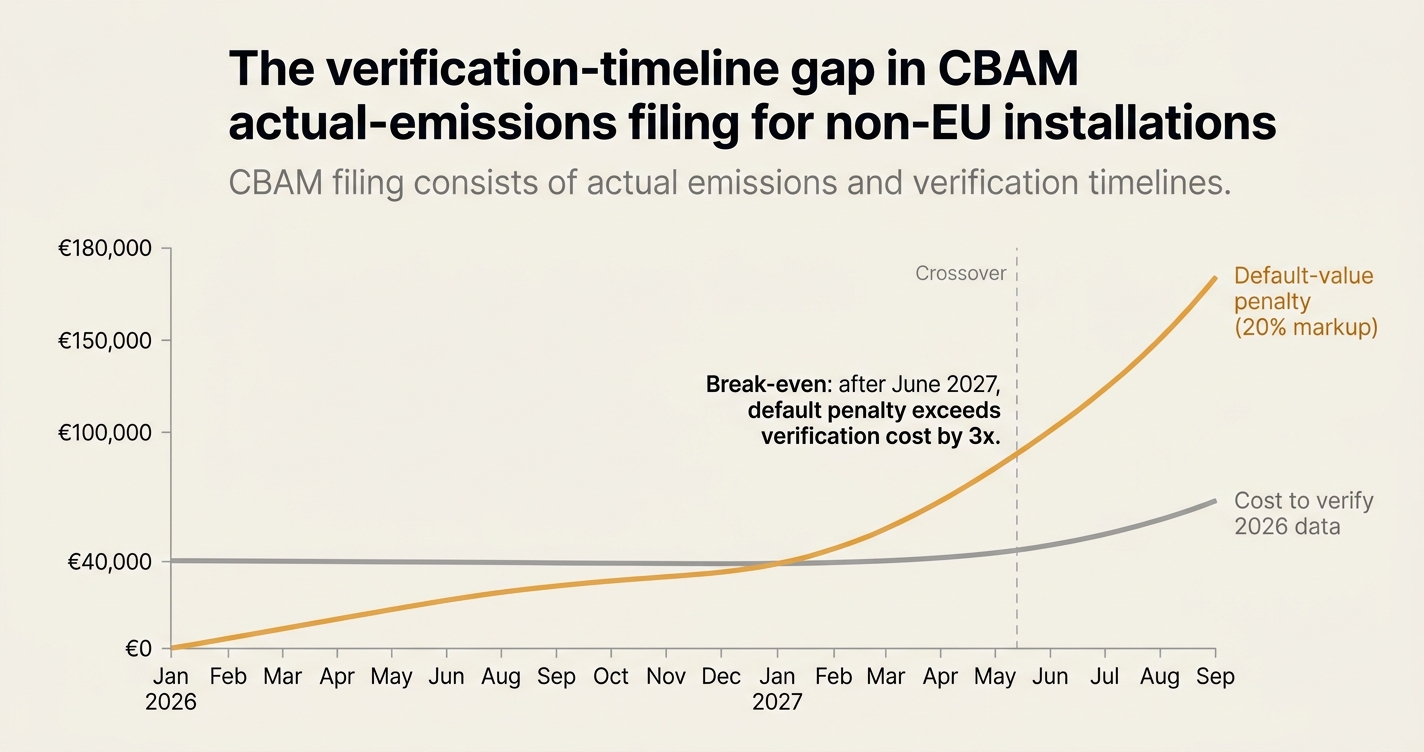
Here's the issue: Non-EU producers of Carbon Border Adjustment Mechanism goods face a choice between actual emissions values and default values when their EU customers file CBAM declarations. Actual values require accredited verification; defaults do not. At first glance, avoiding verification looks like the cheaper path—no auditor fees, no site visits, no monitoring-plan review. But the European Union legislated a markup on defaults: 10% in 2026, 20% in 2027, 30% from 2028 onward. For a steel exporter shipping 50,000 tonnes annually at 1.8 tCO₂/tonne embedded emissions, the 2027 default markup alone costs €180,000 in additional CBAM certificates if the EU Emissions Trading System certificate price holds at €100/tonne.
However, CBAM filing consists of two things: the emissions intensity declared per tonne of goods, and the verification timeline that determines when actual values can replace defaults.
The emissions intensity on its own has no value. The verification timeline is what the EU importer is actually paying for. A producer who starts collecting installation-level data in January 2027 cannot obtain accredited verification for the 2026 reporting year, because the data trail does not exist for the period under audit. The first accreditations are expected around September 2026, and the first annual declaration—covering calendar year 2026 imports—is due 30 September 2027. Verification examines the 2026 monitoring year, so the audit trail has to be built during 2026, not after.[1]
While monitoring-plan preparation has become cheaper—many producers now use ISO-conformant emissions-accounting systems that generate traceable output—verification scheduling has become more expensive. If a producer waits until Q1 2027 to engage a verifier, the verifier's 2027 calendar is likely full, pushing the engagement into Q3 2027 or later. The 2026 declaration deadline remains 30 September 2027. A producer who misses that window cannot use actual values for 2026 imports, and the 20% default markup applies to the full year's shipments. For the 50,000-tonne steel exporter, that delay costs an additional €180,000 in 2027, even if actual emissions are 15% below the default benchmark.
How do you solve this? I think the operators we work with treat verification scheduling as a 2026 deliverable, not a 2027 task. They engage verifiers in Q3 2026, before the first accreditations close calendars, and they instrument monitoring during 2026 so the audit trail exists when the verifier arrives in January 2027. For now, the gap between "we will verify in 2027" and "we can verify 2026 in 2027" is the difference between actual-value economics and default-value penalties.
The shape of the argument, visualised below.
The CBAM verification calendar: key dates non-EU installations cannot miss
| Milestone | Date | Implication | Consequence of missing |
|---|---|---|---|
| Monitoring begins | 1 January 2026 | Installation-level emissions data collection starts for the 2026 reporting year. Monitoring plan must be in place. | No audit trail exists for 2026. Actual values cannot be verified for 2026 imports. Default values with 10% markup apply to all 2026 shipments. |
| First verifier accreditations | ~September 2026 | Accredited verification bodies begin accepting engagement requests for 2026 data audits. | Late engagement pushes verification into Q3 2027, risking missed declaration deadline. Verifier calendars fill quickly. |
| 2026 reporting year ends | 31 December 2026 | Full calendar year of installation-level data must be complete, traceable, and ready for audit. | Incomplete data forces partial reliance on defaults. Mixed methodologies complicate verification and raise audit fees. |
| Verifier site visits begin | January 2027 | Physical site visits at every installation producing CBAM goods. No substitution allowed in year one.[2] | Virtual visits become possible in year two, but first-year verification requires on-site inspection. |
| First annual declaration due | 30 September 2027 | EU importers must submit 2026 CBAM declarations, including verified actual emissions or default values with markup. | Producers whose verification is not complete by this date cannot use actual values for 2026. 20% default markup applies to all Q1-Q4 2027 certificate purchases. |
| Default markup escalates | 1 January 2027 | Default-value markup increases from 10% (2026) to 20% (2027). | Cost penalty for using defaults doubles. For installations with emissions below the default benchmark, the markup erases any efficiency advantage. |
| Second reporting year begins | 1 January 2027 | Monitoring for 2027 imports starts. Producers who completed 2026 verification can refine methodologies; those who did not remain on defaults. | Default-value users face 20% markup for second consecutive year. Cumulative certificate cost disadvantage compounds. |
| Default markup escalates again | 1 January 2028 | Default-value markup increases to 30%, permanent from 2028 onward. | Three-year cumulative penalty: 10% + 20% + 30% = 60% markup on default benchmarks versus zero markup on verified actuals. |
The table above is not a planning timeline. It is a countdown of dates that have already passed, dates passing now, and dates that will pass while verification engagement conversations are still in procurement review. The European Commission published the detailed calculation methodology on 22 December 2025.[3] Producers who read that document in January 2026 and began monitoring then have an audit trail. Producers who read it in March 2026 have a partial trail. Producers who read it in July 2026 are building the 2027 filing, not the 2026 filing.
What verification actually examines: the five-layer audit stack
Accredited verification under CBAM is not a spreadsheet review. The verifier assesses the installation's monitoring plan, activity data, emission factors, calculation methodology, and completeness for the full reporting period, against a materiality threshold of 5% per Combined Nomenclature code.[4] The audit reaches past the installation's own gate: where a complex good uses precursors declared at actual values, the precursor's emissions need their own accredited verification, or the whole product falls back to defaults.[5]
The five layers the verifier examines:
- Monitoring plan conformance: Does the installation's monitoring plan follow the CBAM calculation methodology published in Implementing Regulation 2025/2547? Are system boundaries, production routes, and functional units defined correctly?
- Activity data traceability: Can the installation produce original source documents—utility bills, fuel invoices, production logs—for every tonne of CO₂ claimed? Are the documents timestamped, complete, and reconcilable to financial records?
- Emission factor justification: Are emission factors for fuels, electricity, and process emissions drawn from accredited databases, direct measurement, or supplier declarations? Are supplier declarations themselves verified?
- Calculation methodology audit: Does the embedded-emissions calculation follow the top-down approach: installation-level emissions attributed to production processes, then converted to specific embedded emissions per tonne of goods? Are weighted averages applied correctly for multi-route installations?
- Completeness check: Does the dataset cover 100% of the reporting period? Are there gaps, estimation adjustments, or proxy values that exceed the 5% materiality threshold?
A producer whose 2026 data is structured, complete, and traceable will clear verification in one pass. A producer whose 2026 data is assembled retrospectively in 2027—spreadsheets from memory, invoices retrieved from email, production logs reconstructed from shipping manifests—will face repeat findings, extended engagements, and material misstatement flags. The Environmental Product Declaration world already priced this dynamic: a single verified declaration costs $24,000 and ten weeks when the underlying data is assembled by hand.[6] CBAM verification covers an entire installation for a full year, and the scope is wider.
"Verification under CBAM examines the year that already happened. The verifier checks the installation's monitoring plan, activity data, emission factors, calculation methodology and completeness for the full reporting period, against a materiality threshold of 5% per good. A producer who starts assembling data in 2027 is verifying a 2026 that was never instrumented."[6]
The verification report can be transmitted to the installation operator via the CBAM Registry (if the operator is registered) or by other means. Verification reports for 2026 can be issued in an electronic EU template from January 2027 via the Registry.[7] But the report cannot be issued if the underlying data does not exist, and the data cannot exist if monitoring did not occur during the period under audit.
The default-value markup: quantified penalty by year and tonnage
Default values are goods-specific average emissions intensity in the country of origin, published by the European Commission in Implementing Regulation 2025/2621. The markup is legislated and non-negotiable:
- 2026: +10% on the default benchmark
- 2027: +20% on the default benchmark
- 2028 onward: +30% on the default benchmark, permanent
For installations that operate more efficiently than the country average, the markup erases the efficiency advantage and then imposes a penalty. Consider three scenarios for a steel producer in Turkey shipping hot-rolled coil to the EU:
| Scenario | Actual emissions (tCO₂/tonne) | Default benchmark (tCO₂/tonne) | Default + 20% markup (2027) | Annual tonnage | CBAM certificates at €100/tonne | Cost difference vs. verified actuals |
|---|---|---|---|---|---|---|
| Efficient installation | 1.50 | 1.80 | 2.16 | 50,000 | €10.8M (default) vs. €7.5M (actual) | +€3.3M penalty for not verifying |
| Average installation | 1.80 | 1.80 | 2.16 | 50,000 | €10.8M (default) vs. €9.0M (actual) | +€1.8M penalty for not verifying |
| Inefficient installation | 2.10 | 1.80 | 2.16 | 50,000 | €10.8M (default) vs. €10.5M (actual) | +€0.3M penalty for not verifying |
The efficient installation pays the largest absolute penalty for using defaults, because the 20% markup applies to a benchmark that is already 20% higher than actual performance. Even the inefficient installation—whose actual emissions exceed the country average—still pays a penalty, because 2.16 is higher than 2.10. The only scenario where defaults might be cheaper than actuals is if actual emissions are so far above the default that the markup does not close the gap. For most installations, that scenario does not occur.
The three-year cumulative penalty for an efficient installation that never verifies:
- 2026: 50,000 tonnes × (1.98 - 1.50) tCO₂/tonne × €100 = €2.4M
- 2027: 50,000 tonnes × (2.16 - 1.50) tCO₂/tonne × €100 = €3.3M
- 2028: 50,000 tonnes × (2.34 - 1.50) tCO₂/tonne × €100 = €4.2M
- Cumulative 2026-2028: €9.9M
That cumulative cost is avoidable. The cost to avoid it is the cost of verification: auditor fees (typically €15,000-€40,000 for a mid-sized installation), monitoring-system setup (€10,000-€50,000 if not already in place), and internal labor to manage the engagement (20-40 hours per quarter). Even at the high end, the total cost is under €100,000. The three-year penalty is €9.9M. The return on verification investment is 99:1.
What exporters and importers must do before 30 September 2027
For non-EU installations (producers and operators)
-
Verify monitoring is live (by 31 January 2026, already missed for most): Confirm that installation-level emissions data collection is active, traceable, and conformant with IR 2025/2547. If monitoring started after 1 January 2026, document the start date and flag partial-year coverage to your verifier.
-
Engage an accredited verifier (by 30 September 2026, closing window): Request engagement proposals from at least two accredited verification bodies. Compare scope, pricing, and 2027 calendar availability. Lock the engagement before Q4 2026, or accept that the 2026 audit may not complete before the 30 September 2027 deadline.
-
Prepare the evidence pack (by 31 December 2026, four months remaining): Assemble original source documents for all activity data: utility bills, fuel invoices, electricity purchase records, process-emissions measurements, production logs. Organize by month and by production process. Verifiers will sample at 5% materiality; incomplete samples trigger expanded scope.
-
Map precursor emissions (by 31 March 2027, if complex goods): Identify which inputs to your CBAM goods are themselves CBAM goods (e.g., steel billets into rebar, aluminium ingots into extrusions). Obtain verified emissions data from precursor suppliers, or flag that those inputs will use defaults. Mixed methodologies are allowed, but the verifier will audit the allocation logic.
-
Complete verification and transmit the report (by 31 August 2027, final deadline): The verification report must reach your EU importer by 30 September 2027. Allow 30 days for verifier review, findings resolution, and report issuance. If the report is not available by the declaration deadline, the importer will file using defaults, and the 20% markup applies.
For EU importers (CBAM declarants)
-
Map which suppliers will use actuals vs. defaults (by 28 February 2026, already missed for most): Survey your non-EU suppliers. Ask which installations plan to undergo verification for 2026 data. Flag suppliers who answer "we will decide in 2027"—they are signaling default-value filings.
-
Quantify the default-value cost exposure (by 31 March 2026): Calculate the CBAM certificate cost for each supplier under default values with 20% markup, versus estimated actual values. Rank suppliers by absolute cost penalty. Prioritize engagement with suppliers whose actual emissions are significantly below the default benchmark.
-
Share verification cost-benefit analysis with suppliers (by 30 April 2026): Provide suppliers with a two-column table: left column is the CBAM certificate cost under defaults, right column is the cost under actuals, with verification fees deducted. Make the economic case explicit: the default markup is a permanent annual penalty; verification is a one-time cost that pays for itself in the first year.
-
Request quarterly monitoring-status updates (Q2, Q3, Q4 2026): Ask suppliers for evidence that monitoring is active: sample data extracts, monitoring-plan summaries, verifier engagement letters. Suppliers who cannot produce these documents in Q3 2026 are not on track for timely verification.
-
Establish fallback suppliers (by 30 June 2026): Identify alternative sources for CBAM goods from suppliers who have completed or are near completing verification. If your primary supplier misses the 30 September 2027 deadline, having a verified alternative prevents supply-chain disruption and default-value penalties.
How Emission3 fits
Emission3 is built for installations and importers who need installation-level emissions data to survive verification, not just pass a spreadsheet review. We start with a CBAM readiness call: we map your installations, your precursor suppliers, your current monitoring state, and your verifier engagement timeline. We do not assume you have been monitoring since 1 January 2026—most installations have not. We flag the gaps, quantify the partial-year impact, and build a monitoring plan that a verifier can audit.
Our document-first ingestion flow turns utility bills, fuel invoices, and production logs into line-item audit trails. Every tonne of CO₂ is traceable to a source document, timestamped, and reconcilable to financial records. The system exports verification evidence packs: original documents, calculation lineage, and emissions totals per Combined Nomenclature code, organized by reporting period. Verifiers receive a structured dataset, not a spreadsheet and a box of PDFs.
For complex goods, we manage precursor emissions recursively: you upload your supplier's verification report or emissions declaration, we attribute it to the relevant input, and we flag where defaults apply. The embedded-emissions calculation follows the top-down methodology in IR 2025/2547: installation-level totals, attributed to production processes, converted to specific embedded emissions per tonne of goods. Weighted averages for multi-route installations are calculated automatically, and the allocation logic is documented for audit.
We do not replace your verifier. We prepare the dataset your verifier will examine, so the verification engagement is a review, not an investigation. For installations whose monitoring started after 1 January 2026, we document the partial-year coverage and calculate the annualized values the verifier will test. For installations engaging verifiers in Q3 or Q4 2026, we deliver the evidence pack by 31 December 2026, giving the verifier three months to complete the audit before the 30 September 2027 deadline.
If you are an EU importer whose suppliers have not yet engaged verifiers, we work with your suppliers directly. We provide the readiness call, the monitoring-plan setup, and the evidence-pack export as a service to your supply chain. The cost is a fraction of the default-value penalty, and the deliverable is a verified actual-emissions filing that reduces your CBAM certificate cost by 20% in 2027, 30% from 2028 onward.
Start this week: the three-action minimum to stay on track for 30 September 2027
If you are reading this in Q2 2026 or later, the 1 January 2026 monitoring start date has passed. The question is not "are we late?" but "how much of 2026 can we still capture?" The three actions that prevent a full-year default-value penalty:
-
Document what monitoring has occurred (1 hour): Pull together whatever emissions data has been collected since 1 January 2026, even if it is incomplete. Invoice dates, meter readings, production logs, fuel purchase records. Timestamp everything. Partial data is better than no data, and verifiers can work with partial-year coverage if it is documented.
-
Request verifier engagement proposals (2 hours): Email at least two accredited verification bodies. Include: installation location, CBAM goods produced (by CN code), estimated annual production tonnage, and current monitoring state. Ask for a proposal, a 2027 calendar availability window, and a list of evidence requirements. If the verifier says "we are fully booked for 2027," ask for a waitlist or a referral.
-
Calculate the default-value penalty for your specific installation (1 hour): Use the default benchmarks in IR 2025/2621, apply the 20% markup for 2027, multiply by your annual tonnage, multiply by an assumed €100/tonne CBAM certificate price. Compare that number to the quoted verification fee. If the penalty is 50x the fee, verification is not optional—it is a cost-avoidance measure with a 98% return.
The verification-timeline gap is not a 2027 problem. It is a 2026 problem being discovered in 2027. The installations that start these three actions this week will have verified actuals for the 30 September 2027 deadline. The installations that start in Q3 2026 might. The installations that start in 2027 will not, and the 20% markup will apply to every tonne they shipped in 2026.[8]
Book a CBAM readiness call to map your installations, your gaps, and your verification timeline. We do not sell software first—we map the problem first, then build the implementation plan that survives the audit.
References & Sources
External Sources
- [1]CBAM verification arrives in 2027. It audits the data you are generating right now.
Verification examines the 2026 monitoring year. The first annual declaration, covering 2026 imports, is due 30 September 2027. The data trail has to be built during 2026, not after.
- [2]CBAM Verification & Compliance | Normec Verifavia
Accredited verifiers must conduct on-site inspections at producing installations in the first reporting year (2026). Rules for verifier accreditation and mutual recognition published.
- [3]CBAM Compliance in 2026: A Practical Readiness Guide for Producers, Traders and Importers
The European Commission published a significant package of new guidance for non-EU installation operators on August 14, 2026, covering calculation methodology, monitoring, and documentation requirements.
- [4]EU CBAM Emissions Data: Monitoring, Reporting & Verification
Verification report can be transmitted to the operator via the CBAM Registry (if the operator is registered) or by other means. Verification reports for 2026 can be issued in an electronic EU template from January 2027 via the CBAM Registry.
- [5]CBAM: A guide to Carbon Border Adjustment Mechanism
Verifiers work against a materiality threshold of 5% of total embedded emissions and 5% of total specific embedded free allocation, assessed per CN code. Where complex goods use a precursor from multiple installations, the embedded free allocation is determined as a weighted average.
- [6]CBAM verification arrives in 2027. It audits the data you are generating right now.
The EPD world already priced this in: a single verified declaration costs $24,000 and ten weeks when the underlying data is assembled by hand. Producers whose 2026 emissions data is structured, complete and traceable will clear verification in one pass.
- [7]CBAM | Your Guide to the EU Carbon Border Adjustment Mechanism
From 2026, relying on defaults instead of verified actuals will significantly increase your CBAM cost exposure. The Commission revised default benchmarks downward in late 2025, which actually raises CBAM exposure for most products.
- [8]CBAM (Carbon Border Adjustment Mechanism) pre-verification
Pre-verification can reduce the number of CBAM certificates to be surrendered in 2027, while using default values cannot. Regulatory readiness helps you align early with CBAM requirements and prepare for mandatory verification of actual values from 2027.
Related Content
- [9]Book a CBAM readiness call
All customers start with a readiness call: we map suppliers, gaps, and implementation, no anonymous self-serve onboarding.
- [10]How Emission3 handles CBAM
Specific to CBAM exporters, shows the installation-data flow.