The tier-2 visibility problem in 2027 Scope 3 supplier engagement programs
The tier-2 visibility problem in 2027 Scope 3 supplier engagement programs
Here's the issue: a supply chain / procurement leader at a mid-market manufacturer launches a Scope 3 supplier engagement program in Q1 2027. The team collects primary data from 80% of tier-1 suppliers by spend. The CEO announces 90% Scope 3 coverage. The sustainability team prepares a board deck showing progress. Then the auditor asks: "Where is the tier-2 visibility?" The answer is: there is none. The 90% coverage claim collapses. The audit scope expands. The filing is delayed. This scenario will repeat across hundreds of companies in 2027 as reasonable assurance requirements and Scope 3 mandates collide with supplier engagement programs that were designed for tier-1 data collection, not tier-2 transparency.
However, Scope 3 Category 1 supplier engagement consists of two things: tier-1 primary data and tier-2 visibility. Tier-1 data captures direct supplier emissions—what your immediate vendors report. Tier-2 visibility captures upstream emissions—what your suppliers' suppliers contribute. Most procurement teams treat these as the same workflow. They are not.
Tier-1 data on its own has no assurance value. Tier-2 visibility is what the auditor is actually verifying. A tier-1 supplier can report a Product Carbon Footprint of 2.4 kg CO2e per unit, but if that PCF is built on spend-based estimates for their own upstream suppliers, the number has no lineage. An auditor cannot verify it. A regulator cannot accept it for CBAM or CSRD. The tier-1 data becomes a placeholder, not evidence.
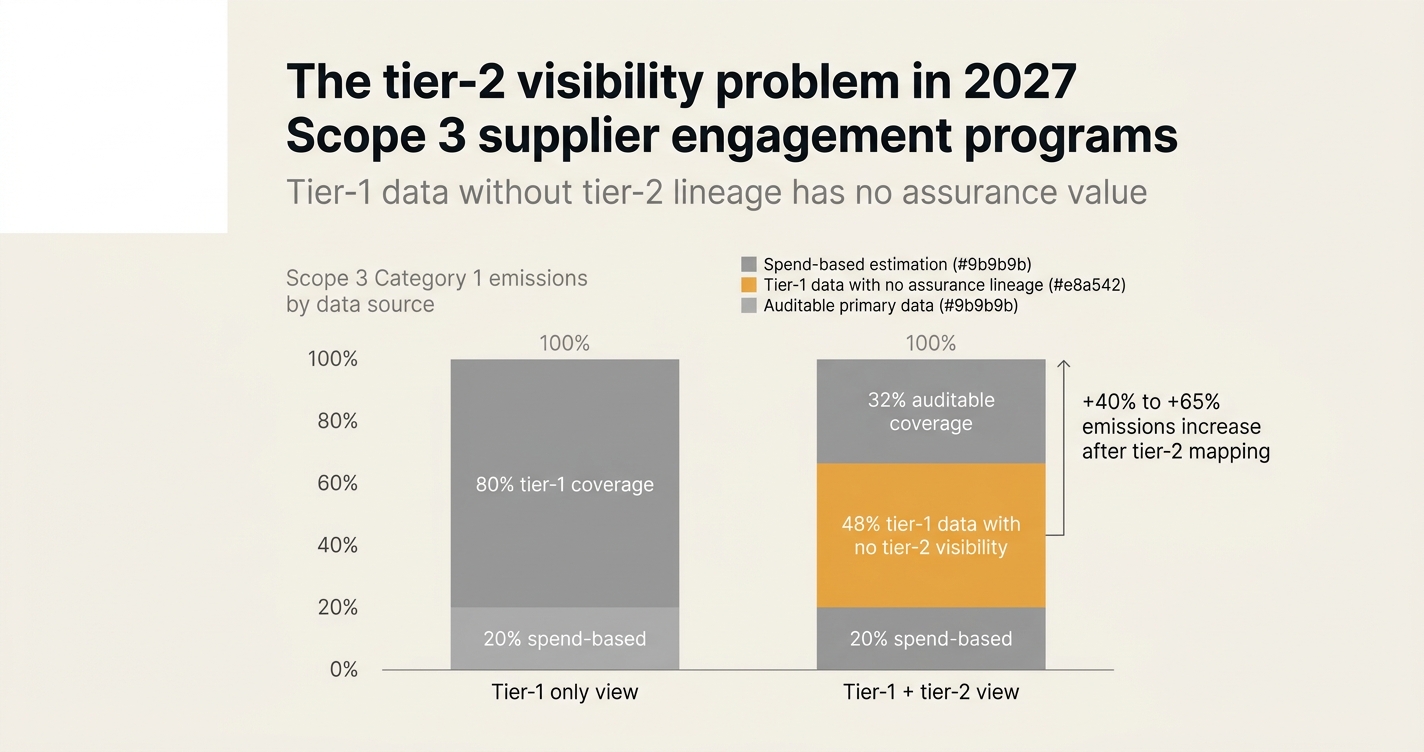
While tier-1 supplier response rates have improved—54% of companies now collect some form of supplier emissions data—tier-2 visibility has become more expensive. If your tier-1 suppliers cover 80% of spend but only 40% of those suppliers have tier-2 transparency, your actual primary data coverage is 32%, not 80%. The gap between reported coverage and auditable coverage is the tier-2 visibility problem. According to research from Normative and PwC, when companies transition from spend-based estimation to supplier-specific data including upstream transparency, reported emissions can increase 40% or more—not because performance worsened, but because the accounting improved.
How do you solve this? I think the answer is to treat tier-2 visibility as a separate procurement function, not a sustainability side project. The operators we work with structure supplier engagement in three phases: tier-1 data collection (months 1-6), tier-2 mapping (months 7-12), and tier-2 data validation (months 13-18). For now, tier-2 visibility is the bottleneck that sets total Scope 3 assurance cost, not tier-1 response rates.
The shape of the argument, visualised below.
The tier-1 coverage illusion: what 80% supplier engagement actually means
Most Scope 3 engagement programs report coverage as a percentage of tier-1 suppliers by spend. This is the wrong denominator. The table below shows what 80% tier-1 coverage translates to in auditable primary data when tier-2 visibility is included:
| Metric | Tier-1 only view | Tier-1 + tier-2 view |
|---|---|---|
| Supplier response rate (by spend) | 80% | 80% |
| Tier-1 suppliers with tier-2 transparency | Assumed 100% | Actual 40% |
| Effective primary data coverage | 80% | 32% |
| Emissions calculated with spend-based defaults | 20% | 68% |
| Auditor-accepted coverage for reasonable assurance | 80% | 32% |
| Scope 3 Category 1 increase after tier-2 mapping | 0% | +40% to +65% |
| Audit cycle extension (months) | 0 | +6 to +9 |
| Additional assurance cost (% of original budget) | 0% | +120% to +180% |
The issue is not that tier-1 suppliers are unresponsive. The issue is that tier-1 responses without tier-2 lineage do not meet the definition of primary data under ISO 14064-3 or GHG Protocol Scope 3 guidance. When Normative worked with a customer to transition from spend-based to activity-based Category 1 data, total reported emissions increased from 41,496 to 65,734 tonnes CO2e—a 58% increase.[1] That increase was not operational; it was methodological. The tier-1 data the company had been collecting was built on tier-2 assumptions, not tier-2 transparency.
"Suppliers who trust a company's intentions and approach are significantly more likely to share potentially sensitive information about their operations. Trust forms the foundation of effective engagement." — Zevero, The Key Role of Supplier Engagement in Scope 3 Reporting[2]
The trust issue compounds at tier-2. A tier-1 supplier has a commercial relationship with you. A tier-2 supplier does not. Asking a tier-1 supplier to disclose their own upstream suppliers, trace material flows, and share tier-2 emissions data is asking them to expose supply chain structure they consider proprietary. This is why tier-2 visibility cannot be a data request—it has to be a procurement lever.
The three-phase structure for tier-2 visibility
The companies that achieve tier-2 visibility in 2027 will do so by treating it as a multi-year procurement function, not a one-year sustainability campaign. The structure below is used by Emission3 customers and aligns with guidance from IntegrityNext and We Mean Business Coalition on scalable supplier engagement.[3][4]
Phase 1: Tier-1 data collection (months 1-6)
- Identify the top 20% of tier-1 suppliers by spend (the 80/20 rule for Category 1 emissions).
- Issue primary data requests using simplified templates: total emissions, scope breakdown, reporting boundary.
- Accept PCF data if available; accept facility-level Scope 1+2 data if PCF is not available.
- Do not yet ask for tier-2 transparency—focus on response rate.
Phase 2: Tier-2 mapping (months 7-12)
- Require tier-1 suppliers to disclose upstream material suppliers and production locations.
- Use data platforms or manual mapping to extend visibility beyond tier-1.
- Identify which tier-1 suppliers have tier-2 lineage and which are using spend-based estimates internally.
- Calculate the effective primary data coverage gap.
Phase 3: Tier-2 data validation (months 13-18)
- Prioritise tier-1 suppliers whose tier-2 inputs represent the largest share of your Category 1 emissions.
- Work with those suppliers to collect tier-2 primary data or trace material flows to specific production facilities.
- Use circular economy levers (recycled content, closed-loop supply) to reduce tier-2 complexity where transparency is not feasible.
- Validate tier-2 data through cross-checks: invoice matching, utility bill reconciliation, production volume alignment.
This structure separates response rate (Phase 1) from coverage quality (Phases 2-3). Most companies stop at Phase 1 and report 80% coverage. The companies that pass reasonable assurance in 2027 will be the ones that complete Phase 3.
The cost of skipping tier-2 visibility in 2027
The quantified consequence of tier-1-only engagement is an audit scope expansion in 2028. The table below shows the cost structure for a mid-market manufacturer with €500M revenue and 200 tier-1 suppliers:
| Scenario | Tier-1 only (2027) | Tier-1 + tier-2 (2028) |
|---|---|---|
| Reported Scope 3 Category 1 coverage | 80% | 80% |
| Auditor-accepted primary data coverage | 32% | 72% |
| Emissions calculated with defaults | 68% | 28% |
| Reasonable assurance scope | Limited to 32% | Extended to 72% |
| Additional supplier engagement required | None | 50-80 tier-2 suppliers |
| Audit cycle extension | 0 months | +6 to +9 months |
| Assurance cost increase | €0 | +€180K to €240K |
| Total 2028 program cost | €120K | €300K to €360K |
The cost of skipping tier-2 visibility in 2027 is a 150-200% assurance cost increase in 2028. This is not a compliance penalty—it is an audit scope adjustment. The auditor is not charging more per hour; they are charging for more hours because the evidence lineage does not exist.
According to Optera's research on supplier engagement maturity, 70% of sustainability teams at companies with over $10B revenue plan to use product-specific emissions data (which requires tier-2 visibility) to inform supplier decisions by 2027.[5] That proportion drops to 40% for mid-market firms. The gap is not ambition—it is procurement infrastructure. The mid-market firms that close the gap will be the ones that structure tier-2 visibility as a procurement function from the start.
The procurement lever for tier-2 transparency
Tier-2 visibility cannot be a voluntary data request. It has to be a procurement requirement. The mechanism is simple: make tier-2 transparency a supplier scorecard criterion, weight it at 10-15% of total supplier evaluation, and tie it to contract renewal cycles. This is how Waitrose & Partners and Innocent Drinks achieved tier-2 visibility in agricultural supply chains—by making transparency a condition of continued partnership, not a favour.[2]
The scorecard structure we see working:
- Tier-2 disclosure: Does the supplier provide a list of their own material suppliers and production locations? (Yes/No, 5% weight)
- Tier-2 data quality: Does the supplier use primary data or spend-based estimates for their own upstream emissions? (Primary/Hybrid/Spend-based, 5% weight)
- Tier-2 improvement commitment: Does the supplier have a plan to improve tier-2 data quality over 24 months? (Yes/No, 5% weight)
This structure creates a compliance path without requiring immediate tier-2 data. A supplier can score positively by disclosing tier-2 structure and committing to a data improvement plan, even if they are currently using spend-based estimates. The key is to make tier-2 visibility a scored criterion, not an optional nice-to-have.
The alternative—treating tier-2 visibility as a sustainability team project—fails because sustainability teams do not control procurement decisions. Suppliers respond to procurement levers, not sustainability requests. IntegrityNext's research on supplier engagement confirms this: suppliers are more likely to provide detailed emissions data when the request is framed as a procurement requirement backed by contract terms, not a voluntary sustainability initiative.[3]
The circular economy shortcut for tier-2 complexity
For certain product categories, tier-2 visibility is structurally difficult: complex global supply chains, commodity inputs, or low-margin suppliers with no reporting infrastructure. In these cases, the fastest path to reduced tier-2 emissions is not better data—it is circular economy value levers that eliminate tier-2 complexity entirely.
The three levers that work:
- Recycled content: Recycled materials have lower upstream emissions because the tier-2 production step (virgin material extraction) is replaced with waste processing. A kilogram of recycled steel has 60-70% lower emissions than virgin steel, and the tier-2 lineage is simpler because the material flow is domestic, not global.
- Closed-loop supply: Contract with suppliers who reprocess your own production waste into new inputs. This eliminates tier-2 visibility problems because you control both ends of the material flow.
- Regional sourcing: Tier-2 visibility is easier when tier-2 suppliers are in the same jurisdiction as tier-1 suppliers. Regional sourcing reduces the number of cross-border material flows that complicate tier-2 traceability.
These levers do not solve the tier-2 visibility problem for all categories, but they reduce the number of suppliers where tier-2 mapping is required. For a mid-market manufacturer with 200 tier-1 suppliers, increasing recycled content from 10% to 30% of material inputs can reduce the number of tier-2 suppliers requiring mapping from 120 to 85—a 30% reduction in program scope.
How Emission3 fits
Emission3 is built for the tier-2 visibility problem. The platform structures supplier engagement in three phases: tier-1 data collection, tier-2 mapping, and tier-2 validation. Customers upload invoices, bills of materials, and supplier responses; the document classification engine extracts line-item data and links it to production locations and upstream material flows. The output is a supplier lineage map showing which tier-1 suppliers have tier-2 transparency and which are using spend-based estimates.
The platform also generates supplier scorecards that weight tier-2 disclosure, data quality, and improvement commitment—making tier-2 visibility a procurement criterion, not a sustainability side project. For customers preparing for 2027 CSRD reasonable assurance or 2028 SBTi Scope 3 target validation, the tier-2 lineage map is the evidence pack the auditor asks for first.
If your organisation is collecting tier-1 data but does not have a tier-2 visibility plan, the gap will surface in your first reasonable assurance cycle. Emission3 helps you map that gap before the auditor does. Book a Scope 3 readiness call to see how tier-2 visibility fits into your 2027 program.[6]
The 2027 outlook: tier-2 visibility becomes table stakes
By the end of 2027, tier-2 visibility will be the dividing line between Scope 3 programs that pass reasonable assurance and programs that do not. The regulatory drivers are clear: CSRD reasonable assurance begins in 2028, SBTi is tightening Scope 3 validation requirements, and CBAM's 2026 shift to actual embedded emissions has exposed how many "primary data" claims are built on tier-2 assumptions.[7]
The companies that solve tier-2 visibility in 2027 will do so by treating it as a procurement function from the start. They will structure supplier engagement in three phases, make tier-2 transparency a scorecard criterion, and use circular economy levers to reduce the number of suppliers where tier-2 mapping is required. The companies that skip tier-2 visibility will face audit scope expansions, assurance cost increases, and filing delays in 2028.
The choice is not whether to solve tier-2 visibility—it is whether to solve it in 2027 or be forced to solve it in 2028 under audit pressure. For supply chain and procurement leaders, that choice is best made now, before the reasonable assurance cycle begins.
If you are planning a Scope 3 supplier engagement program for 2027 and want to understand how tier-2 visibility fits into your timeline, ask a specific question about your supplier base.[8]
References & Sources
External Sources
- [1]How to calculate scope 3 emissions: from spend data to supplier data
Normative case study showing Scope 3 Category 1 emissions increased from 41,496 to 65,734 tonnes CO2e when switching from spend-based to activity-based data, a 58% increase due to better accounting, not worsening performance.
- [2]The Key Role of Supplier Engagement in Scope 3 Reporting
Zevero guidance on building trust in supplier engagement programs, with examples from Waitrose & Partners and Innocent Drinks on providing tailored support and value creation for suppliers.
- [3]Building a Supplier Engagement Strategy to Reduce Scope 3 Emissions
IntegrityNext framework for scalable supplier engagement, including guidance on moving from one-off data requests to strategic two-way partnerships and the importance of aligning procurement and sustainability functions.
- [4]The data showing supplier engagement is driving climate action
We Mean Business Coalition research showing corporate supply chain emissions are on average 26 times greater than operational emissions, making Scope 3 supplier engagement critical for net zero targets.
- [5]Supplier engagement: The key to accurate scope 3 emissions data
Optera research showing 70% of companies with over $10B revenue plan to use product-specific emissions data to inform supplier decisions, rising to 80% for leading firms, indicating growing sophistication in tier-2 visibility requirements.
Related Content
- [6]Book a CBAM readiness call
All Emission3 customers start with a readiness call where we map suppliers, identify coverage gaps, and design a tier-2 visibility plan tailored to your procurement structure and 2027 compliance timeline.
- [7]The verification-timing penalty for non-EU exporters in CBAM filings
How CBAM's 2026 shift to actual embedded emissions exposed the tier-2 visibility gap in many exporters' primary data claims, with verification delays adding 6-9 months to filing cycles.
- [8]Ask a specific question about your Scope 3 program
Direct line to Emission3's founder for supply chain-specific questions about tier-2 visibility, supplier engagement structure, and reasonable assurance readiness for 2027 programs.