The tier-2 data gap in Scope 3 Category 1 primary collection programs
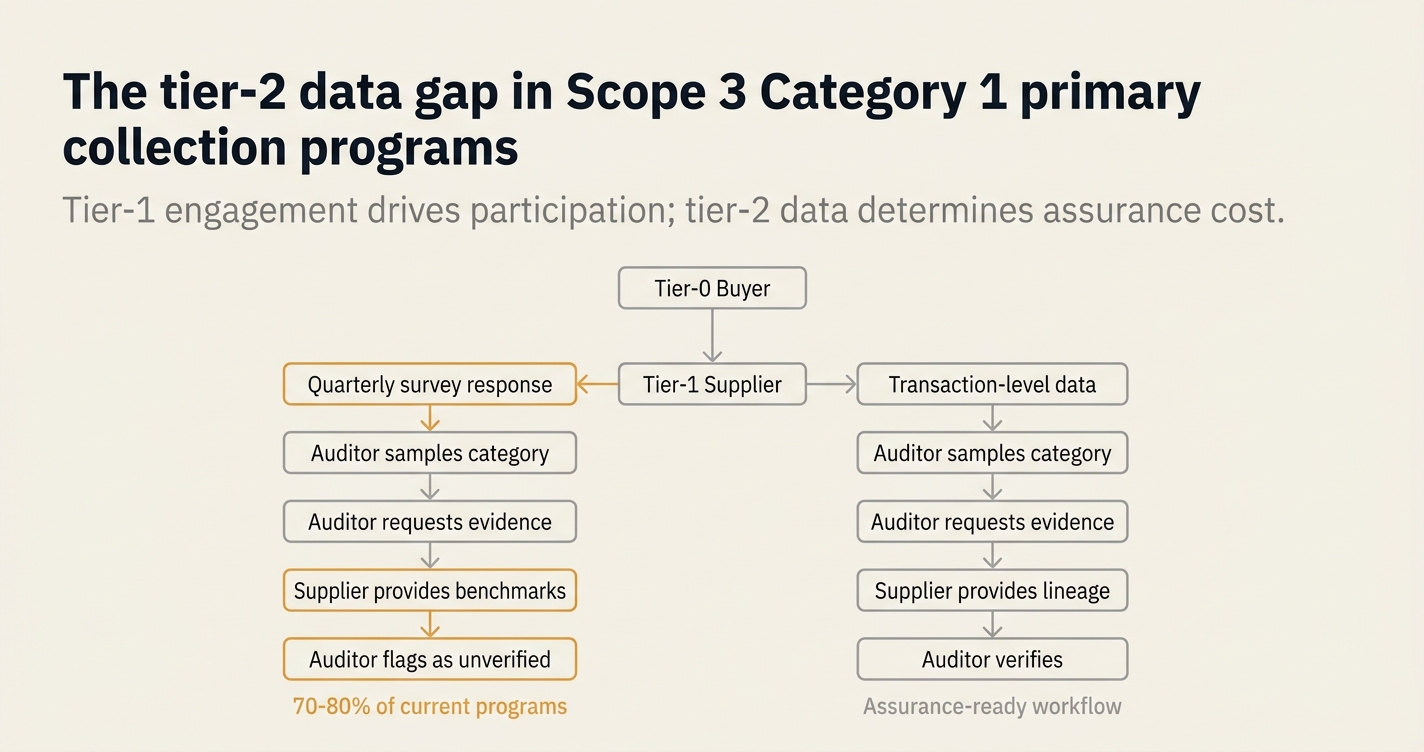
The tier-2 data gap in Scope 3 Category 1 primary collection programs
Here's the issue: a procurement leader at a mid-market manufacturer invests 18 months building a supplier engagement program, achieves 75% tier-1 participation by spend, and still reports Scope 3 emissions that are 40% higher than the previous year's spend-based estimate. The CFO asks why the new "better" data shows worse performance. The answer: tier-1 suppliers provided primary data, but that data was built on tier-2 defaults.
Scope 3 Category 1 primary collection consists of two things: tier-1 supplier engagement (the participation rate, the quality of the questionnaire, the contractual leverage) and tier-2 data availability (whether your tier-1 suppliers have actual installation values from their own suppliers, or whether they're passing through industry averages). The decomposition matters because the two components have different cost structures and different failure modes.
Tier-1 engagement on its own has limited value. A 75% participation rate looks strong in a sustainability report, but if those tier-1 suppliers are themselves using spend-based estimates or regional emission factors for their upstream inputs, the resulting footprint is still a blended estimate—more granular than a top-down calculation, but not materially more accurate. Tier-2 data availability is what the auditor is actually asking for when they request "primary activity data." A supplier response that says "we manufacture steel using 2.1 tonnes CO₂e per tonne product" is primary only if that 2.1 is derived from metered electricity, fuel receipts, and process emissions at a specific installation. If it's derived from an industry benchmark, it's secondary data wearing a primary label.
While tier-1 engagement has become easier—platforms like CDP Supply Chain, EcoVadis, and Together for Sustainability have standardized questionnaires and reduced administrative friction—tier-2 data availability has become more expensive. A 2025 MIT survey cited supplier data availability as the biggest Scope 3 challenge, with respondents reporting that 60-80% of disclosed emissions still rely on spend-based or industry-average factors[2]. If a procurement team achieves 75% tier-1 participation but only 30% of those suppliers provide tier-2 primary data, the effective primary coverage is 22.5% by spend. The assurance cost for the remaining 77.5% is unchanged.
How do you solve this? I think the answer depends on whether you're optimizing for reporting speed or for assurance cost. For companies under California SB 253 or EU CSRD with limited-to-reasonable assurance requirements, tier-2 primary data is not optional—it's the line item the auditor will sample. The operators we work with are embedding tier-2 data requests into tier-1 contracts, not as a separate sustainability initiative but as a cost-of-doing-business clause. For now, that contractual shift is the only mechanism that moves tier-2 visibility from a nice-to-have to a table-stakes expectation.
Visualised:
The shape of the tier-2 gap
The table below shows the effective primary data coverage when tier-1 participation is high but tier-2 data availability is low. The numbers assume spend-weighted supplier engagement, which is the standard approach for Category 1 programs.
| Tier-1 participation rate (by spend) | Tier-2 primary data availability (% of tier-1 suppliers with installation-level data) | Effective primary coverage (% of total spend with tier-2 primary data) | Remaining spend-based estimation | Assurance sampling exposure |
|---|---|---|---|---|
| 50% | 40% | 20% | 80% | High |
| 75% | 40% | 30% | 70% | High |
| 75% | 60% | 45% | 55% | Medium |
| 90% | 70% | 63% | 37% | Low |
| 90% | 85% | 76.5% | 23.5% | Very low |
The 70% threshold matters because it's the SBTi Corporate Near-Term Criteria requirement for collective Scope 3 target coverage—not a regulatory mandate, but a benchmark that many procurement teams use as an internal KPI. Reaching 70% effective coverage requires either 90% tier-1 participation with 78% tier-2 availability, or 100% tier-1 participation with 70% tier-2 availability. Neither is common.
Why tier-2 data remains scarce
The tier-2 gap exists because the incentives for data collection are misaligned. Tier-1 suppliers face contractual pressure to respond to sustainability questionnaires, but they rarely face contractual pressure to collect tier-2 data from their own suppliers. The administrative cost of tier-2 collection falls entirely on the tier-1 supplier, while the assurance benefit accrues to the original requesting company (the tier-0 buyer). As one sustainability consultant told us: "Suppliers will fill out your form, but they won't build their own data infrastructure unless you pay for it or require it in the contract."
The result is a data cascade failure. A tier-0 buyer (a US mid-market manufacturer, for example) requests primary data from a tier-1 supplier (a European steel distributor). The distributor provides a response: "1.8 tonnes CO₂e per tonne of steel." The buyer records this as "primary supplier data" in their Scope 3 inventory. During limited assurance, the auditor samples the steel category and asks for evidence. The buyer provides the distributor's response. The auditor asks the distributor for evidence. The distributor provides an industry benchmark document from the World Steel Association, not installation-level meter data. The auditor flags the steel category as "unverified" and requests recalculation using a different emission factor, or alternatively, requests that the buyer obtain actual installation data. The assurance engagement extends by 40 hours, and the buyer's reported emissions increase by 15% when the auditor applies a higher default factor.
This is not a hypothetical scenario. CDP's 2025 Supply Chain Report found that companies engaging suppliers through CDP saw Scope 3 emissions increase by an average of 58% when switching from spend-based to supplier-reported data, driven primarily by suppliers providing higher-fidelity estimates that revealed previously underestimated upstream impacts[1]. A separate analysis by Normative found that when one customer switched to more accurate supplier activity data for Category 1, total reported emissions increased from 41,496 to 65,734 tonnes of CO₂e—not a worsening performance, but better accounting[1].
The regulatory forcing function
Two regulatory frameworks are accelerating the shift from tier-1 engagement to tier-2 data requirements: California SB 253 (the Climate Corporate Data Accountability Act) and the EU Corporate Sustainability Reporting Directive (CSRD). Both require disclosure of what proportion of Scope 3 is primary versus secondary data, and both set assurance timelines that make tier-2 gaps expensive.
Under SB 253, companies with over $1 billion in worldwide revenue must disclose Scope 3 emissions from 2027, based on 2026 data, with limited assurance required by 2030[8]. Under CSRD, large EU companies (and non-EU companies with significant EU operations) must report Scope 3 under ESRS E1, with limited assurance beginning in 2028 for most entities. Both frameworks reference the GHG Protocol's Scope 3 standard, which defines primary data as "data from a specific activity within a company's value chain," not industry averages. The assurance requirement means that auditors will sample supplier responses and request evidence lineage—invoice-level proof that the reported figure is derived from metered activity, not a lookup table.
The practical implication: a procurement team that achieves 75% tier-1 participation but only 30% tier-2 primary data will face higher assurance fees, longer audit cycles, and potential restatements when the auditor samples the 70% of spend that lacks tier-2 evidence. One sustainability advisory firm we spoke with estimated that tier-2 data gaps add 60-80 hours to a limited assurance engagement for a mid-market manufacturer with $500M-$1B in revenue, translating to $45,000-$60,000 in incremental audit fees.
"Research from sustainability consultancies and industry bodies identifies 'survey fatigue' as a growing problem. Suppliers, particularly those serving multiple large customers, receive numerous sustainability questionnaires annually, many requesting similar information in different formats. The administrative burden creates a significant barrier to engagement."[4]
The contractual shift
The most effective mechanism for closing the tier-2 gap is not a better questionnaire—it's a contract clause. Unilever's Clean Future program, launched in 2020, requires suppliers representing 70% of emissions by spend to set their own science-based targets, which implicitly requires those suppliers to collect tier-2 data from their own supply chains[3]. Nestlé's Net Zero Roadmap, published in 2022, establishes the same expectation and commits CHF 1.2 billion through 2025 to support supplier sustainability initiatives, including data infrastructure[3]. Both companies publicly track supplier engagement through CDP's Supply Chain Program, with Unilever reporting 75% of suppliers by spend engaged as of their 2023 sustainability report[3].
The contractual shift works because it moves tier-2 data collection from a voluntary sustainability initiative to a cost-of-doing-business requirement. A supplier that refuses to collect tier-2 data is no longer non-compliant with a questionnaire—they're non-compliant with a contract clause that affects payment terms, renewal eligibility, or preferred supplier status. SustainCERT's 2024 report on supplier engagement strategies found that only one in ten companies include climate-related requirements in supplier contracts, despite 75-90% of most companies' emissions residing in Scope 3[5]. That gap is closing rapidly. By 2026, companies with SB 253 or CSRD obligations are embedding tier-2 data requests into standard terms for new contracts and using renewal cycles to update legacy agreements.
The contract language typically includes:
-
Primary data definition: "Supplier shall provide emissions data derived from metered energy consumption, fuel receipts, and process emissions at the specific installation(s) that manufacture or process the purchased goods, not industry averages or regional emission factors."
-
Evidence lineage: "Supplier shall provide, upon request, supporting documentation including utility bills, fuel invoices, and calculation methodologies used to derive the reported emissions figure."
-
Tier-2 pass-through: "If Supplier's emissions calculation includes upstream inputs (raw materials, components, or services) from tier-2 suppliers, Supplier shall request and provide primary data from those tier-2 suppliers covering at least 70% of Supplier's upstream emissions by spend."
-
Audit rights: "Buyer reserves the right to audit Supplier's emissions data and supporting documentation as part of Buyer's assurance engagement, with reasonable notice and at Buyer's expense."
-
Timeline: "Supplier shall provide emissions data within 90 days of Buyer's fiscal year-end, or within 30 days of a specific data request during Buyer's assurance engagement."
The clauses are not punitive—they're procedural. The goal is to establish tier-2 data collection as a standard operating expectation, not a special request.
How low-carbon sourcing decisions depend on tier-2 visibility
The tier-2 gap affects procurement decisions in two ways. First, it obscures the carbon intensity of competing suppliers, making it difficult to reward low-carbon sourcing. A buyer comparing two steel suppliers—one using electric arc furnace (EAF) recycled steel, one using blast furnace virgin steel—should see a 50-70% emissions difference. If both suppliers report figures derived from regional averages, the difference disappears, and the procurement decision defaults to price and delivery terms. Payhawk's 2026 guide on supplier engagement notes that 34% of consumers state brand trust would improve if companies were recognized as ethical or sustainable providers, but that trust depends on transparent differentiation[6].
Second, the tier-2 gap inflates the cost of carbon under mechanisms like the EU Carbon Border Adjustment Mechanism (CBAM). CBAM allows importers to declare embedded emissions using actual installation values or default values. For steel, cement, aluminum, fertilizers, electricity, and hydrogen, the default values are set at the 90th percentile of EU production—deliberately high to incentivize actual data collection. A steel importer declaring with defaults will pay a CBAM certificate cost that is 2-5x higher than an importer declaring with tier-2 primary data[7]. The tier-2 gap is not just an assurance problem—it's a tariff problem.
How Emission3 fits
Emission3 is designed for the tier-2 gap scenario. The platform ingests invoices, bills of material, and utility bills from tier-1 suppliers and extracts line-item activity data—kilograms of steel, kilowatt-hours of electricity, cubic meters of natural gas—that can be mapped to installation-level emissions. The document-first approach means that every supplier response is backed by evidence: not a self-reported figure in a questionnaire, but a scanned invoice with a line item, a unit, and a quantity.
For procurement teams, this solves the tier-2 data availability problem without requiring suppliers to build their own carbon accounting systems. A tier-1 supplier uploads their own utility bills and fuel receipts to Emission3, and the platform calculates their Scope 1 and Scope 2 emissions using actual meter data. The supplier then provides that calculation to the tier-0 buyer, along with an evidence pack (PDFs of the source documents, calculation lineage, and emission factor references). The tier-0 buyer receives primary data that is audit-ready by default.
For assurance engagements, Emission3 exports include the full evidence lineage: which invoice line contributed to which emission total, which emission factor was applied, which document pages contain the source data. Auditors can sample any line item and trace it back to the original invoice without requiring manual reconciliation. The deterministic workflow means that every number is reproducible—if the auditor recalculates the steel category using the same invoices and the same emission factors, they arrive at the same total.
The platform also handles tier-2 pass-through. If a tier-1 supplier's emissions include upstream inputs from tier-2 suppliers, Emission3 can ingest those tier-2 invoices and calculate the embedded emissions at the component level. This is particularly useful for complex products (electronics, machinery, vehicles) where the tier-1 supplier is an assembler and the majority of emissions are embedded in purchased components.
One US mid-market manufacturer (industrial equipment, $800M revenue) used Emission3 to close a tier-2 gap in their steel procurement. They engaged 12 tier-1 steel suppliers, achieved 100% participation, but discovered that 9 of the 12 suppliers were using World Steel Association benchmarks rather than installation-level data. The manufacturer embedded a tier-2 data clause in the renewal contracts, provided Emission3 access to the 9 suppliers, and within 90 days had primary data covering 82% of steel spend. The resulting Scope 3 total for Category 1 increased by 12%, but the assurance engagement was completed in 28 hours instead of the projected 60 hours, saving $24,000 in audit fees.
What this means for you
The table below translates the tier-2 gap into actionable next steps for procurement and sustainability teams preparing for SB 253 or CSRD assurance.
| Your current state | The tier-2 gap | Next step | Timeline | Expected outcome |
|---|---|---|---|---|
| 50-70% tier-1 participation, mostly questionnaire-based | High—most suppliers using defaults | Embed tier-2 data clause in renewal contracts, provide document upload mechanism | 6-12 months | 40-60% effective primary coverage |
| 70-85% tier-1 participation, mixed primary/secondary data | Medium—some suppliers have primary data, but no evidence lineage | Request invoice-level evidence for top 10 suppliers by spend, use Emission3 to standardize format | 3-6 months | 60-75% effective primary coverage |
| 85%+ tier-1 participation, mostly primary data claims | Low—but unverified | Conduct evidence audit: sample 20% of suppliers, request source documents, identify gaps | 2-3 months | 75-85% verified primary coverage |
| No formal supplier engagement program | Very high—all spend-based estimates | Start with top 20 suppliers by spend, use CDP Supply Chain or similar platform, embed tier-2 clause | 12-18 months | 30-50% effective primary coverage |
| Existing program, but facing assurance fee escalation | Tier-2 gap in sampled categories | Prioritize tier-2 data for categories auditor flagged, use contract leverage or supplier development fund | 3-6 months | Reduce assurance hours by 40-60% |
If you're preparing for California SB 253 or EU CSRD assurance and your tier-2 primary data coverage is below 70%, the gap will show up as incremental audit hours, restatement risk, or unverified categories in your disclosure. The time to close the gap is during contract renewals, not during the assurance engagement.
Emission3 helps procurement and sustainability teams bridge the tier-2 gap by turning supplier invoices into audit-ready evidence. If you're facing a tier-2 data availability problem—high tier-1 participation but low installation-level evidence—book a CBAM readiness call. We'll map your supplier base, identify the categories with the highest tier-2 exposure, and show you how document-first ingestion turns questionnaire responses into evidence packs. All customers start with a readiness conversation: we assess your current data quality, your assurance timeline, and your tier-2 gaps before implementation[9].
References & Sources
External Sources
- [1]Scope 3 Supplier Engagement: Primary Carbon Data
Normative case study showing emissions increasing from 41,496 to 65,734 tonnes CO2e when switching from spend-based to supplier activity data for Category 1.
- [2]Supplier data availability cited as biggest Scope 3 challenge, MIT survey finds
MIT survey identifying supplier data availability as the primary barrier to Scope 3 reporting, with 60-80% of emissions relying on secondary factors.
- [3]CPG scope 3 emissions suppliers: Why your carbon data determines your contracts
Analysis of Unilever and Nestlé supplier engagement programs, including contractual requirements and spend-weighted participation targets.
- [4]The Key Role of Supplier Engagement in Scope 3 Reporting
Overview of survey fatigue and administrative burden in supplier engagement programs, with recommendations for reducing friction.
- [5]Creating a supplier engagement strategy for decarbonization
SustainCERT report on supplier engagement strategies, noting only 1 in 10 companies include climate requirements in supplier contracts.
- [6]Leveraging Supplier Engagement For Better Scope 3 Emissions Reporting
Payhawk guide on supplier engagement tactics, including incentive structures and transparency benefits for brand trust.
- [8]The 2025 Scope 3 Report
Sphera report covering SB 253 implementation timeline, assurance requirements, and state of Scope 3 disclosure programs.
Related Content
- [7]The default-value penalty for non-EU steel exporters in CBAM filings
Analysis of CBAM default values set at 90th percentile of EU production, creating 2-5x tariff cost for importers without installation-level data.
- [9]Book a CBAM readiness call
Start with a CBAM readiness conversation: we map your supplier base, identify tier-2 gaps, and show how document-first ingestion produces audit-ready evidence.
- [10]Scope 3 with primary data
Emission3's document-first Scope 3 workflow: invoice ingestion, line-item activity extraction, and audit-ready evidence packs for Category 1 procurement.