The spend-based estimation penalty in 2026 Scope 3 supplier data collection for CFO finance teams
The spend-based estimation penalty in 2026 Scope 3 supplier data collection for CFO finance teams
Here's the issue: CFOs preparing for California SB 253 or CSRD Scope 3 disclosure typically budget for supplier engagement—the outreach campaigns, the data requests, the follow-up cycles. What they underestimate is the downstream consequence of how missing supplier data gets handled. Spend-based estimation looks efficient at the data-collection stage. It fills gaps quickly, keeps the inventory moving, and avoids the friction of chasing tier-2 suppliers. But from an assurance perspective, spend-based estimates are now a compliance risk. Under SB 253, Scope 3 disclosures begin in 2027 for fiscal year 2026 data, with limited assurance anticipated by 2030.[1] Under CSRD, limited assurance begins in 2025 for Wave 1 filers, with the Omnibus removing the mandatory transition to reasonable assurance but leaving the escalation window open.[2] In both regimes, auditors are re-pricing engagements based on methodology decisions locked in your 2025–2026 base year.
However, Scope 3 disclosure consists of two things: supplier engagement and estimation methodology.
Supplier engagement on its own has no value. Estimation methodology is what the auditor is actually verifying, and what determines whether your inventory can support limited-to-reasonable assurance escalation without a full re-baseline. Spend-based estimation—multiplying procurement spend by industry-average emission factors—was acceptable under voluntary GHG Protocol disclosure. It is not acceptable under financial-grade assurance. The reason is reproducibility. An auditor conducting limited assurance on a Scope 3 inventory needs to verify that each emission figure is grounded in a specific transaction, a specific supplier, and a specific calculation lineage. Spend-based estimates provide none of this. They aggregate entire supplier categories into a single emission factor, making it impossible to trace a reported tonne back to a source document. When SB 253 or CSRD assurance begins, inventories built on spend-based estimation will require full re-baselining, not incremental evidence collection.
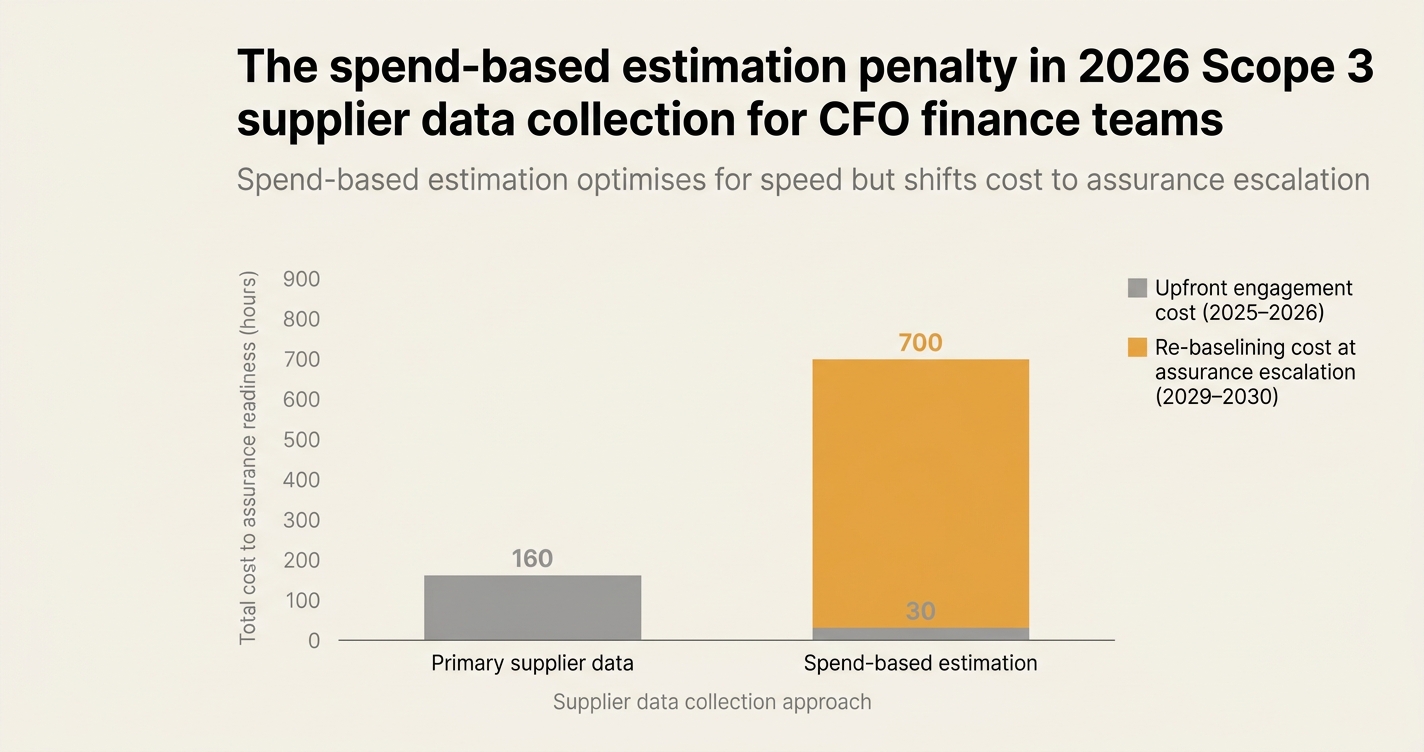
While supplier engagement has become cheaper—automated outreach tools, standardized request templates, multi-tier cascading—methodology lock-in has become more expensive. If your 2026 Scope 3 inventory uses spend-based estimation for 40 percent of Category 1 emissions, and SB 253 assurance begins in 2030, the cost of re-baselining that 40 percent with primary supplier data might outpace the savings from fast initial data collection. CARB's final SB 253 regulations confirmed that the first Scope 1 and Scope 2 reports are due August 10, 2026, with Scope 3 reporting beginning in 2027.[3] The safe harbor for good-faith misstatements runs through 2030, but it does not exempt filers from assurance readiness. CFOs who treat 2026 as a soft-launch year are locking in methodology decisions that will determine 2030 audit fees. For a $5 billion revenue filer with 200 Category 1 suppliers, re-baselining a spend-based inventory in 2029 could add 600–800 hours of auditor time, at $250–$400 per hour, compared to an inventory built on primary data from the start.
How do you solve this? I think the answer is to treat estimation methodology as a financial control decision, not an operational efficiency decision. The operators we work with at Emission3 are building 2026 Scope 3 inventories under the assumption that limited assurance is already in effect. For now, that means treating every supplier emission figure as if it will be audited—collecting line-item purchase orders, utility bills, and production data, even when the supplier does not provide them voluntarily. Spend-based estimation is still used, but only as a placeholder for specific suppliers where primary data is genuinely unavailable, and even then, the estimation is documented with a clear substitution rule and a re-collection plan.
The shape of the argument, visualised below.
The two approaches to missing supplier data in 2026 Scope 3 inventories
CFOs evaluating Scope 3 data strategies typically compare primary supplier data collection against spend-based estimation on the basis of speed, cost, and supplier burden. The comparison below scores each approach against five criteria that matter under SB 253 and CSRD assurance.
| Criterion | Primary supplier data collection | Spend-based estimation | Score |
|---|---|---|---|
| Assurance readiness | Every emission figure traces to a source document (invoice, utility bill, BoM). Auditors can verify line-item calculations without re-baselining the inventory. | Emission figures trace to industry-average factors, not specific suppliers. Auditors must re-baseline or apply broad materiality thresholds, increasing fees. | Primary data: 9/10. Spend-based: 3/10. |
| Methodology lock-in risk | Calculation lineage is reproducible. If assurance escalates from limited to reasonable, incremental evidence is added, not replaced. | Calculation lineage is not reproducible. If assurance escalates, the entire methodology must be re-baselined with primary data. | Primary data: 9/10. Spend-based: 2/10. |
| Upfront supplier engagement cost | Requires outreach campaigns, data requests, follow-up cycles, and tier-2 visibility. Median engagement cost: 120–180 hours per 100 suppliers. | Requires minimal supplier engagement. Emission factors are applied to procurement spend data already in the ERP. | Primary data: 4/10. Spend-based: 9/10. |
| Re-baselining cost at assurance escalation | Minimal. Additional evidence (e.g., utility bill scans, third-party verifications) is added incrementally. | High. 40–60% of the inventory must be re-collected with primary data, adding 600–800 auditor hours for a 200-supplier portfolio. | Primary data: 9/10. Spend-based: 2/10. |
| Regulatory safe harbor applicability | SB 253 safe harbor applies to good-faith misstatements, not methodology gaps. Primary data reduces misstatement risk. | Safe harbor applies through 2030, but does not exempt from assurance readiness. Auditors may challenge methodology in pre-assurance reviews. | Primary data: 8/10. Spend-based: 5/10. |
The table clarifies the trade-off: spend-based estimation optimises for speed at the data-collection stage, but shifts cost and risk to the assurance-escalation stage. Primary supplier data inverts this, front-loading engagement cost but eliminating re-baselining risk.
Why spend-based estimation is now a financial liability, not an operational shortcut
Under voluntary GHG Protocol disclosure, spend-based estimation was considered reasonable for Scope 3 Category 1 (Purchased Goods and Services) when supplier-specific data was unavailable. The 2011 Corporate Value Chain (Scope 3) Standard states that companies "should use the highest quality data available," but explicitly allows for "average data" when primary data is not feasible.[4] This framing positioned spend-based estimation as a pragmatic fallback, acceptable for materiality screening and target-setting.
That framing no longer holds under SB 253 or CSRD. Both regimes treat climate disclosure as financial disclosure, with executive liability and third-party assurance. SB 253 applies to U.S. companies with over $1 billion in revenue doing business in California, requiring Scope 1 and 2 disclosures in 2026 and Scope 3 disclosures from 2027, with administrative penalties up to $500,000 per year for non-compliance.[5] CSRD applies to EU-listed companies and large non-EU subsidiaries, requiring double materiality assessment and limited assurance on sustainability information, with phased escalation to reasonable assurance.[6] In both cases, the disclosure is not a separate sustainability report—it is integrated into the financial filing, subject to the same audit standards as revenue recognition or inventory valuation.
This changes the calculus for spend-based estimation in three ways. First, auditors are now verifying whether each emission figure is reproducible, meaning it can be recalculated from source documents. Spend-based estimates fail this test, because the emission factor is applied at the category level, not the transaction level. If a CFO reports 1,200 tonnes of Category 1 emissions from "professional services" suppliers, and the figure is derived by multiplying $2 million in spend by a 0.6 kg CO2e per dollar factor, the auditor has no way to verify whether that 1,200 tonnes is accurate for the specific services procured. The figure could be off by 30–50 percent, and there would be no line-item evidence to challenge or confirm it.
Second, SB 253 and CSRD both require methodology consistency across reporting periods. If your 2026 inventory uses spend-based estimation for 40 percent of Category 1 emissions, and your 2027 inventory switches to primary supplier data for those same suppliers, you have introduced a methodology discontinuity. Auditors will flag this as a prior-period restatement risk, because the 2026 and 2027 figures are not comparable. The only way to avoid this is to re-baseline the 2026 inventory with primary data before the 2027 filing, effectively doubling the data-collection work.
Third, spend-based estimation increases audit fees at the assurance-escalation stage. SB 253 requires limited assurance on Scope 1 and 2 emissions starting in 2027, with reasonable assurance anticipated by 2030. Scope 3 is expected to undergo limited assurance beginning in 2030.[7] CSRD's limited assurance began in 2025 for Wave 1 filers, with the Omnibus removing the mandatory transition but leaving the escalation window open. In both cases, auditors are re-pricing engagements based on how much of the inventory can support reasonable assurance without re-baselining. If 40 percent of your Category 1 emissions are spend-based estimates, auditors will either apply broad materiality thresholds (reducing the assurance value) or require full re-collection of primary data (increasing the audit fee by 30–40 percent).
"SB 253 requires disclosure of greenhouse gas emissions, beginning with Scopes 1 and 2 in 2026, followed by Scope 3 in 2027. The disclosures must follow recognized GHG accounting standards and will eventually require independent assurance. The first disclosures for Scope 1 and 2 emissions are due June 30, 2026."[8]
The quote from CARB's rulemaking clarifies the timeline, but it understates the methodology lock-in problem. CFOs reading this guidance often interpret "eventually require independent assurance" as a distant future state, giving them a multi-year buffer to refine their data strategy. The reality is that assurance begins in 2027 for Scope 1 and 2, and the methodology decisions made in 2026 will determine whether the 2030 Scope 3 assurance is incremental or requires a full inventory re-baseline. By the time the assurance requirement is formally in effect, the window to fix the methodology has closed.
How primary supplier data reduces assurance escalation cost
Primary supplier data collection—requesting line-item emissions from suppliers, grounded in their own utility bills, production logs, or environmental permits—inverts the cost structure. Upfront engagement cost is higher, because it requires outreach campaigns, follow-up cycles, and tier-2 visibility. Median engagement cost for primary data collection is 120–180 hours per 100 suppliers, compared to 20–40 hours for spend-based estimation applied to ERP procurement data. But the downstream assurance cost is lower, because every emission figure is reproducible from source documents.
For a CFO evaluating the trade-off, the question is not whether primary data is more work, but whether the upfront work eliminates the need for re-baselining in 2029–2030. If your 2026 Scope 3 inventory uses primary data for 80 percent of Category 1 emissions, and SB 253 assurance escalates from limited to reasonable in 2030, the auditor can verify those emissions incrementally—requesting additional evidence packs, third-party verifications, or utility bill scans, but not re-collecting the entire inventory. If your 2026 inventory uses spend-based estimation for 40 percent of Category 1 emissions, the auditor will require full re-collection of primary data for that 40 percent before they can issue a reasonable assurance opinion. The cost difference is 600–800 hours of auditor time, at $250–$400 per hour, for a 200-supplier portfolio.
The operators we work with at Emission3 are building 2026 inventories under the assumption that limited assurance is already in effect. This means treating every supplier emission figure as if it will be audited—collecting line-item purchase orders, utility bills, and production data, even when the supplier does not provide them voluntarily. Spend-based estimation is still used, but only as a placeholder for specific suppliers where primary data is genuinely unavailable, and even then, the estimation is documented with a clear substitution rule and a re-collection plan. The result is a Scope 3 inventory that supports limited-to-reasonable assurance escalation without re-baselining.
The tier-2 supplier data gap that spend-based estimation hides
One of the hidden costs of spend-based estimation is that it obscures the tier-2 supplier data gap. Tier-1 suppliers—those you contract with directly—are the easiest to engage, because you have an existing procurement relationship. Tier-2 suppliers—those your tier-1 suppliers contract with—are harder to engage, because you have no direct relationship, no contractual leverage, and often no visibility into who they are. Spend-based estimation treats tier-1 and tier-2 emissions identically, because it applies the same industry-average factor to all procurement spend in a given category. This makes the inventory look complete, but it does not reflect the actual emissions profile of your supply chain.
Primary supplier data collection exposes the tier-2 gap immediately, because tier-1 suppliers will often provide their own Scope 1 and 2 emissions, but not the Scope 3 emissions embedded in the goods they procure from tier-2 suppliers. This creates a decision point: do you accept the tier-1 data as-is, knowing it underreports by 30–50 percent, or do you request tier-2 visibility as part of the supplier engagement? The latter is harder, but it is the only path to an inventory that supports reasonable assurance. The former is easier, but it locks in a methodology gap that will be flagged by auditors in 2029–2030.
For a CFO evaluating this trade-off, the question is not whether tier-2 data is harder to collect, but whether the cost of collecting it now is lower than the cost of re-baselining later. If your 2026 Scope 3 inventory accepts tier-1 data without tier-2 visibility, and SB 253 assurance escalates to reasonable in 2030, the auditor will require tier-2 data before they can verify the inventory. If your 2026 inventory requests tier-2 visibility upfront, the auditor can verify incrementally. The cost difference is the same as the spend-based estimation penalty: 600–800 hours of auditor time, at $250–$400 per hour, for a 200-supplier portfolio.
How Emission3 fits: audit-ready Scope 3 inventories built on primary supplier data
Emission3 is built for CFOs who are treating 2026 Scope 3 disclosure as if limited assurance is already in effect. We start with a CBAM readiness call—not a software demo, but a gap analysis of your current supplier engagement strategy, your estimation methodology, and the tier-2 visibility problem. From there, we build a document-first Scope 3 inventory where every emission figure traces to a source document: invoices, utility bills, bills of material, or production logs.
The workflow is:
-
Supplier engagement audit: We map your Category 1 suppliers, identify which ones have provided primary data, and quantify the emissions currently covered by spend-based estimation. This gives you a baseline for how much of your inventory can support limited-to-reasonable assurance escalation without re-baselining.
-
Substitution rule documentation: For suppliers where primary data is unavailable, we document the spend-based estimation with a clear substitution rule, a sensitivity analysis, and a re-collection plan. This makes the estimation auditable, even if it is not based on primary data.
-
Line-item evidence packs: For suppliers who provide primary data, we collect the source documents (utility bills, production logs, environmental permits) and link them to specific emission figures in the inventory. This creates a calculation lineage that auditors can verify without re-collecting data.
-
Tier-2 visibility roadmap: We identify which tier-1 suppliers are reporting only their Scope 1 and 2 emissions, and quantify the tier-2 gap. This gives you a decision point: accept the gap and disclose it, or request tier-2 data as part of the next supplier engagement cycle.
The output is a Scope 3 inventory that supports SB 253 or CSRD assurance from day one, with full calculation lineage, documented substitution rules, and evidence packs that auditors can verify without re-baselining. For a CFO budgeting for 2026 Scope 3 disclosure, this eliminates the re-baselining cost in 2029–2030, when assurance escalates from limited to reasonable.
You can see the audit-ready export artifact we generate at /solutions/audit, or review engagement options at /pricing. Both are scoped after the readiness call, not before, because we do not do anonymous self-serve onboarding.
Closing: the methodology lock-in window closes in 2026
The window to fix your Scope 3 estimation methodology is shorter than most CFOs realise. SB 253's first Scope 3 disclosures are due in 2027 for fiscal year 2026 data. CSRD's limited assurance began in 2025 for Wave 1 filers, with reasonable assurance escalation left open by the Omnibus. In both regimes, the methodology decisions made in 2025–2026 will determine 2029–2030 audit fees. If your 2026 inventory uses spend-based estimation for 40 percent of Category 1 emissions, you are locking in a re-baselining cost of 600–800 auditor hours when assurance escalates.
The alternative is to treat 2026 as the base year for an audit-ready inventory, built on primary supplier data, with documented substitution rules and tier-2 visibility. The upfront cost is higher—120–180 hours per 100 suppliers, compared to 20–40 hours for spend-based estimation. But the downstream cost is lower, because you eliminate the re-baselining work in 2029–2030. For a CFO evaluating this trade-off, the question is not whether primary data is more work now, but whether the work you do now eliminates the need for re-baselining later.
If you are preparing for SB 253 or CSRD Scope 3 disclosure, and you want to map the re-baselining cost before you lock in your 2026 methodology, book a CBAM readiness call at /book-demo. We will walk through your current supplier engagement strategy, quantify the spend-based estimation exposure, and build a roadmap for audit-ready primary data collection. All customers start with this call—we do not do anonymous self-serve onboarding, because the implementation is scoped to your specific supplier portfolio and assurance timeline.
References & Sources
External Sources
- [1]California's climate disclosure regulations: An update on SB 253 and SB 261
Baker Tilly overview of SB 253 reporting timeline, showing Scope 3 reporting begins in 2027 for fiscal year 2026 data, with limited assurance anticipated by 2030.
- [2]The Real Cost of Getting Scope 3 Wrong Under SB 253 & CSRD and Data Strategies That Work
Credibl analysis of CSRD limited assurance requirements, noting the Omnibus removed the mandatory transition to reasonable assurance but left the escalation window open.
- [3]SB 253 Compliance Roadmap: How to Prepare for California's Climate Disclosure Law Now That CARB Has Finalized the Rules
Terrascope roadmap confirming CARB's February 2026 approval of initial regulations, with first Scope 1 and 2 reports due August 10, 2026, and Scope 3 reporting beginning in 2027.
- [5]The Real Cost of Getting Scope 3 Wrong Under SB 253 & CSRD and Data Strategies That Work
Credibl overview of SB 253 penalties, noting administrative penalties up to $500,000 per year for non-compliance per CARB guidance.
- [6]The Real Cost of Getting Scope 3 Wrong Under SB 253 & CSRD and Data Strategies That Work
Credibl comparison of CSRD requirements, noting double materiality assessment and phased limited assurance with robust, evidence-based methodologies.
- [7]California's climate disclosure regulations: An update on SB 253 and SB 261
Baker Tilly timeline showing limited assurance on Scope 1 and 2 begins in 2027, transitioning to reasonable assurance by 2030, with Scope 3 limited assurance beginning in 2030.
- [8]CARB Delays Climate Disclosure Rulemaking, but Reporting Deadlines Remain
Yahoo Finance summary of CARB's rulemaking extension, confirming first Scope 1 and 2 disclosures are due June 30, 2026, with Scope 3 following in 2027.
Related Content
- [4]The tier-2 supplier data gap in 2026 Scope 3 Category 1 primary data collection for procurement teams
Emission3 analysis of the tier-2 supplier visibility problem, showing how procurement teams budget for tier-1 engagement but 2026 assurance costs are set by tier-2 emissions.
- [9]Book a CBAM readiness call
All Emission3 customers start with a CBAM readiness call. We map suppliers, gaps, and implementation. No anonymous self-serve onboarding.
- [10]Audit-ready exports in Emission3
For auditors and CFOs: see the evidence lineage artifact Emission3 generates, showing full calculation lineage from source document to filing.