The tier-2 supplier data gap in 2026 Scope 3 Category 1 primary data collection for procurement teams
The tier-2 supplier data gap in 2026 Scope 3 Category 1 primary data collection for procurement teams
Here's the issue: procurement teams launching Scope 3 Category 1 primary data collection in 2026 budget for supplier engagement—the training, templates, and relationship management required to get tier-1 suppliers to respond. A 30-supplier engagement programme might cost €40,000 in staff time and platform fees, and achieve a 60% response rate within six months. That looks like progress. However, the assurance costs for the resulting inventory are not set by the 18 tier-1 suppliers who responded, but by the tier-2 emissions those 18 suppliers did not provide.
However, Scope 3 Category 1 emissions consist of two things: tier-1 supplier engagement and tier-2 supplier emissions. The first is the outreach, training, and data collection workflow that procurement teams manage. The second is the upstream emissions embedded in the materials, components, and services that tier-1 suppliers procured from their own suppliers—emissions that rarely appear in a tier-1 supplier's first Product Carbon Footprint (PCF) submission.
Tier-1 engagement on its own has no value for assurance purposes. Tier-2 emissions are what the auditor is actually asking for. Under ISAE 3410, limited assurance requires population-level completeness for material categories. If a tier-1 supplier submits a PCF that covers only their direct manufacturing emissions (Scope 1 and Scope 2) but excludes the raw materials they purchased (their own Scope 3 Category 1), the purchasing company's inventory has a coverage gap. The auditor flags it. The buyer either re-engages the supplier to collect tier-2 data, or accepts a qualification in the assurance report.
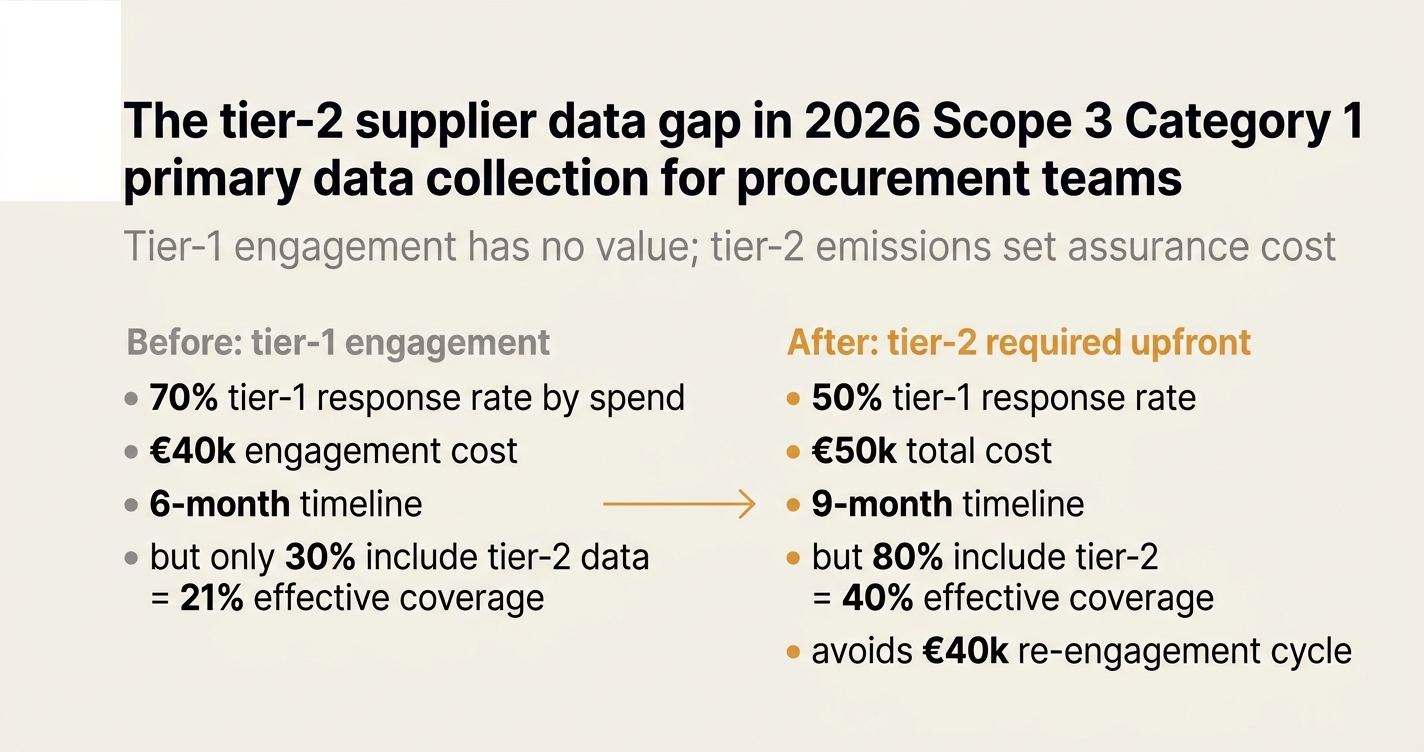
While tier-1 engagement has become cheaper—supplier engagement platforms now cost €3–8 per supplier per year, and standardised PCF templates reduce training time—tier-2 data collection has become more expensive. If a procurement team achieves 70% tier-1 response coverage by spend, but only 30% of those responses include tier-2 emissions, the effective coverage for assurance purposes is 21%. Closing that gap typically requires a second engagement cycle, which can add €25,000–60,000 in procurement time, third-party verification fees, and supplier training, plus three to six months to the timeline.
How do you solve this? I think the answer depends on whether your 2026 objective is to report a Scope 3 total or to pass limited assurance. For CFOs preparing for California SB 253 or EU CSRD ESRS E1, the second objective is the one that sets the budget. The operators we work with prioritise spend-weighted tier-2 coverage from the start: they identify the 10–15 tier-1 suppliers who represent 60–80% of Category 1 spend, then structure the data request to require tier-2 inclusion as a condition of submission. That front-loads the complexity, but it avoids re-engagement.
The shape of the argument, visualised below.
The anatomy of a tier-2 data gap
A European industrial equipment manufacturer launched Scope 3 Category 1 primary data collection in Q1 2026. Procurement identified 42 tier-1 suppliers representing 85% of purchased goods spend. The engagement programme ran for five months, using a supplier engagement platform and a standardised PCF template aligned with the GHG Protocol Product Life Cycle Standard. By June 2026, 28 suppliers (67% by count, 78% by spend) had submitted PCFs.
The compliance team declared the programme successful and began populating the ESRS E1 E1-6 disclosure table. However, when the external auditor reviewed the submitted PCFs in September 2026, they flagged a population-completeness issue: 19 of the 28 PCFs covered only the supplier's direct emissions (Scope 1 and Scope 2) and excluded the supplier's purchased goods and services (the supplier's own Scope 3 Category 1). For a steel fabricator, this meant the PCF included the emissions from cutting and welding, but excluded the emissions from the steel billet itself. For a chemical supplier, it included the emissions from the reactor, but excluded the emissions from the feedstock.
The auditor's preliminary finding: the inventory had 78% tier-1 coverage by spend, but only 32% tier-2 coverage (the nine suppliers whose PCFs included upstream materials). Under ISAE 3410, that was insufficient for a clean limited assurance opinion on a category representing 68% of total Scope 3 emissions. The manufacturer had three options:
- Re-engage the 19 suppliers to collect tier-2 data, adding three to five months and an estimated €40,000 in procurement time and third-party verification fees.
- Accept a qualified assurance opinion, with a material limitation disclosed in the CSRD report.
- Revert to spend-based estimation for the suppliers without tier-2 data, but label the data quality as Tier 3 under the revised GHG Protocol's proposed quality tiers (Revision A1), which would trigger a disclosure note under ESRS E1 that 46% of Category 1 emissions by spend were estimated using monetary proxies.[1]
The manufacturer chose option 1. The re-engagement cycle took four months and cost €52,000. The final inventory, submitted in January 2027, had 68% tier-2 coverage by spend—enough to satisfy the auditor's materiality threshold, but well below the 95% coverage floor proposed in the GHG Protocol's March 2026 Phase 1 Progress Update (Revision B1).[2]
The tier-1 versus tier-2 distinction in supplier engagement
The distinction between tier-1 engagement and tier-2 emissions is not semantic. It's structural. A tier-1 supplier is the entity with whom the purchasing company has a direct contractual relationship. A tier-2 supplier is the entity from whom the tier-1 supplier procured materials, components, or services. The purchasing company has no direct relationship with tier-2 suppliers, and typically no visibility into tier-1 procurement decisions.
When a procurement team runs a supplier engagement programme, the primary deliverable is a PCF from each tier-1 supplier. However, the scope of that PCF determines whether it's useful for assurance purposes. A gate-to-gate PCF (covering only the supplier's direct emissions) is insufficient. A cradle-to-gate PCF (covering the supplier's direct emissions plus the supplier's purchased goods and services) is what the auditor requires. The difference is tier-2 data.
The practical consequence: a 70% tier-1 response rate does not mean 70% assurance-ready coverage. If only half of the responding tier-1 suppliers provide cradle-to-gate PCFs, the effective coverage is 35%. The procurement team has done the engagement work, but the inventory still has a coverage gap.
This is not a new insight. The GHG Protocol's Scope 3 Corporate Standard (2011) has always distinguished between gate-to-gate and cradle-to-gate boundaries. However, the 2026 enforcement context makes the distinction material. Under the EU CSRD, ESRS E1 E1-6 requires companies to disclose Scope 3 emissions by category, with a data quality note for each category. Under California SB 253, Scope 3 emissions must be reported starting in 2027, with third-party assurance required by 2030. Under the proposed GHG Protocol revisions, companies must disaggregate Scope 3 data by quality tier, with spend-based proxies labeled as the lowest tier (Revision A1).[3]
The combined effect: procurement teams can no longer rely on tier-1 response rates as a proxy for assurance readiness. They need to track tier-2 coverage explicitly.
The trade-off table: engagement speed versus assurance cost
| Approach | Tier-1 response rate (6 months) | Tier-2 coverage at first submission | Re-engagement cycles | Total cost to assurance-ready inventory | Timeline to clean opinion |
|---|---|---|---|---|---|
| Broad engagement, no tier-2 requirement | 60–70% | 20–35% | 1–2 | €80,000–140,000 | 12–18 months |
| Narrow engagement, tier-2 required upfront | 40–50% | 65–80% | 0–1 | €50,000–90,000 | 9–12 months |
| Hybrid: 80/20 spend focus, tier-2 prioritised | 50–60% (by count), 75–85% (by spend) | 55–70% | 0–1 | €60,000–100,000 | 10–14 months |
The table assumes a 30–50 supplier portfolio, annual procurement spend of €20–50 million in Category 1, and a target of limited assurance under ISAE 3410. Cost includes internal procurement time (€400–600 per day), supplier engagement platform fees (€3–8 per supplier per year), third-party verification fees for high-spend suppliers (€2,000–8,000 per PCF), and auditor fees for re-engagement review (€15,000–30,000 per cycle).[4]
The trade-off: the broad engagement approach maximises tier-1 response rates, but guarantees re-engagement. The narrow approach front-loads complexity and accepts lower tier-1 coverage, but avoids qualification. The hybrid approach is the one we see most CFOs adopt in 2026: focus on the 10–15 tier-1 suppliers who represent 70–80% of spend, require cradle-to-gate PCFs from that group, and accept spend-based estimation for the tail.
The 2026 playbook: 30/60/90-day roadmap for procurement leaders
Days 1–30: Spend analysis and tier-2 exposure mapping
The first 30 days are spend analysis, not supplier outreach. Procurement teams should:
- Map Category 1 spend by supplier and sub-category. Use ERP data to identify the top 20 suppliers by annual spend. Break down spend by sub-category (raw materials, components, packaging, logistics). This determines which suppliers are material for assurance purposes.
- Assess tier-2 exposure by supplier type. A steel supplier has high tier-2 exposure (the steel billet is 70–80% of the PCF). A machining supplier has lower tier-2 exposure (the raw material is typically customer-supplied). Categorise suppliers into high, medium, and low tier-2 exposure.
- Set a spend-weighted tier-2 coverage target. If the auditor's materiality threshold is 70% coverage for a category representing 60% of total Scope 3 emissions, the procurement target might be 75% tier-2 coverage by spend for the top 15 suppliers. This provides a buffer.
Deliverable: a one-page supplier prioritisation matrix, ranking suppliers by spend, tier-2 exposure, and existing data availability (e.g., suppliers who already publish EPDs or have ISO 14067-certified PCFs).
Days 31–60: Tier-2 requirement specification and supplier onboarding
The second 30 days are requirement specification and onboarding. Procurement teams should:
- Draft a cradle-to-gate PCF template. The template must explicitly require tier-2 data. For a steel supplier, this means the PCF must include the emissions from iron ore extraction, blast furnace operation, and steel production, not just the emissions from cutting and forming. The template should reference the GHG Protocol Product Life Cycle Standard and specify system boundaries (cradle-to-gate, not gate-to-gate).
- Pre-qualify high-spend suppliers. Before launching a formal data request, conduct 20-minute calls with the top 10 suppliers to assess readiness. Ask: "Do you currently calculate product carbon footprints? If yes, do they include the emissions from the materials you purchase?" This flags suppliers who will require training or third-party support.
- Offer verification support for high-priority suppliers. If a supplier represents 15% of Category 1 spend and does not have an existing PCF, offer to co-fund third-party verification (€3,000–5,000 per PCF). This de-risks the engagement and signals commitment.
Deliverable: a supplier engagement playbook, including the PCF template, a training deck (10 slides), and a verification support offer for the top five suppliers by spend.
Days 61–90: First submission and tier-2 gap assessment
The third 30 days are data collection and gap assessment. Procurement teams should:
- Launch the data request with a 60-day response window. Use a supplier engagement platform (e.g., EcoVadis, IntegrityNext, or a custom portal) to track submissions. Set a hard deadline, but offer a 30-day extension for suppliers who commit to cradle-to-gate PCFs and request verification support.
- Review submissions for tier-2 completeness. When a PCF arrives, check whether it includes the supplier's purchased goods and services. If the supplier is a steel fabricator and the PCF shows 0.8 tonnes CO2e per tonne of finished product, but the steel billet itself has an industry average of 1.8 tonnes CO2e per tonne, the PCF is incomplete. Flag it for follow-up.
- Calculate spend-weighted tier-2 coverage. If 12 suppliers (representing 68% of spend) submit cradle-to-gate PCFs, the tier-2 coverage is 68%. If the target was 75%, the gap is 7 percentage points. Identify the 2–3 suppliers who would close the gap (typically the next-largest by spend) and prioritise re-engagement.
Deliverable: a tier-2 coverage dashboard, showing spend-weighted coverage by sub-category, the number of suppliers requiring follow-up, and the estimated cost to close the gap.
The supplier engagement versus primary data distinction
The language matters. "Supplier engagement" refers to the relationship management, training, and data collection workflow. "Primary data" refers to the supplier-specific emission factors, product carbon footprints, and verification documents that an auditor will accept. A procurement team can have a successful supplier engagement programme (high response rates, good relationships, smooth workflows) and still fail the assurance test if the primary data does not include tier-2 emissions.
This distinction is explicit in the revised GHG Protocol's proposed quality tiers (Revision A1). Tier 1 data is supplier-specific, verified, and includes upstream emissions. Tier 2 data is supplier-specific but unverified or incomplete. Tier 3 data is spend-based proxies. A procurement team that collects Tier 2 data (gate-to-gate PCFs from tier-1 suppliers) has better data than spend-based estimates, but not good enough data to avoid re-engagement under ISAE 3410.[5]
The practical consequence: procurement teams should not optimise for response rates. They should optimise for tier-2 coverage. A 50% response rate with 80% tier-2 coverage is preferable to a 70% response rate with 30% tier-2 coverage, because the first scenario avoids re-engagement and the second scenario does not.
How Emission3 fits
Emission3's supplier data workflow is built around the tier-2 distinction. When a customer uploads a tier-1 supplier PCF, the system checks whether the PCF boundary is cradle-to-gate or gate-to-gate. If it's gate-to-gate, the system flags the supplier for follow-up and calculates the spend-weighted tier-2 coverage gap. If it's cradle-to-gate, the system extracts the line-item emissions, maps them to the customer's Category 1 sub-categories, and includes the supplier in the assurance-ready inventory.
The workflow also handles the hybrid case: if a tier-1 supplier provides a gate-to-gate PCF but the customer has the supplier's material invoices (showing the tonnage of steel, chemicals, or components the supplier purchased), Emission3 can apply supplier-specific activity data to industry-average tier-2 factors, label the result as Tier 2 data quality, and include it in the inventory with a disclosure note. This is not as good as a cradle-to-gate PCF from the supplier, but it's better than a spend-based proxy, and it closes the coverage gap without requiring the supplier to re-do their PCF.
For procurement teams preparing for 2026 CSRD or 2027 SB 253 assurance, the decision is not whether to collect primary data, but whether to collect it in a way that avoids re-engagement. Emission3 positions that decision as a workflow choice, not a compliance choice: the system makes it easier to require tier-2 data upfront than to fix the gap later.
Conclusion: spend-weighted tier-2 coverage as the 2026 procurement KPI
Procurement teams should track one metric for Scope 3 Category 1 primary data collection in 2026: spend-weighted tier-2 coverage. This is not the same as tier-1 response rate, and it's not the same as the number of suppliers who submitted a PCF. It's the percentage of Category 1 spend for which the purchasing company has cradle-to-gate primary data that an auditor will accept.
If the target is 70% tier-2 coverage by spend, and the first submission cycle achieves 45%, the procurement team knows they need to re-engage. If the target is 70% and the first cycle achieves 72%, they can move to assurance without re-engagement. The difference is six months and €40,000–60,000 in procurement time and verification fees.
The 2026 enforcement context makes this metric material. Under CSRD, companies must disclose data quality by category. Under SB 253, assurance is required by 2030. Under the proposed GHG Protocol revisions, spend-based proxies must be labeled as Tier 3 data. Procurement teams that optimise for tier-1 response rates will hit the re-engagement bottleneck in 2027. Teams that optimise for tier-2 coverage will avoid it.
If you're a procurement leader preparing for 2026 Scope 3 assurance, the first question is not "How many suppliers should we engage?" It's "How much of our spend needs cradle-to-gate primary data?" The answer determines the engagement strategy, the budget, and the timeline. Book a CBAM readiness call to map suppliers, gaps, and implementation—no anonymous self-serve onboarding.[6]
References & Sources
External Sources
- [1]Scope 3 Supplier Data: 2026 GHG Protocol Guide
GHG Protocol Phase 1 Progress Update published March 31, 2026: Revision A1 requires disaggregating Scope 3 data by quality tier, with spend-based proxies labeled as the lowest tier.
- [2]GHG Protocol Updates 2026: Scope 2 & Scope 3 Accounting Guide
Proposed Revision B1 requires companies to cover at least 95% of their Scope 3 emissions, with any excluded share capped at 5% and justified with data.
- [3]Scope 3 supplier engagement: collecting primary carbon data
When one customer switched to supplier activity data for Category 1, total reported emissions increased from 41,496 to 65,734 tonnes CO2e—better accounting, not worsening performance.
- [4]Supplier engagement for scope 3
Suppliers who provide solid emissions data are favoured in tenders, get longer contract terms, or gain access to better financing conditions through supply chain finance programmes.
- [5]The supplier-engagement fallacy in Scope 3 primary data collection
Scope 3 primary data collection consists of supplier engagement and primary data. The distinction matters because 2026 assurance engagements under ISAE 3410 and ISSA 5000 price for data quality, not outreach volume.
Related Content
- [6]Book a CBAM readiness call
All customers start with a readiness call: we map suppliers, gaps, and implementation, no anonymous self-serve onboarding.
- [7]Scope 3 with primary data
Specific to supply-chain leaders and sustainability managers: document-first Scope 3 with supplier-specific emissions and tier-2 coverage tracking.