The primary-data collection problem in Scope 3 supplier engagement programs
The primary-data collection problem in Scope 3 supplier engagement programs
Here's the issue: A procurement team launches a supplier engagement program to collect Scope 3 emissions data. They send questionnaires to 200 suppliers, receive responses from 150, and achieve 90% coverage by spend. The program is declared a success. Six months later, during the limited assurance transition, the auditor rejects 60% of the submitted data as secondary or unverifiable. The coverage rate collapses to 35%, and the company must either restate prior-period figures or qualify its disclosure.
However, supplier engagement consists of two things: emissions totals and primary data. An emissions total is a number—tonnes of carbon dioxide equivalent attributable to a purchased good or service. Primary data is evidence that the number came from the supplier's actual operations: utility bills, production logs, product carbon footprints with supplier-specific emission factors, Environmental Product Declarations with third-party verification. The first is what procurement teams optimise for. The second is what auditors verify.
Emissions totals on their own have no compliance value under limited assurance. Primary data is what the Corporate Sustainability Reporting Directive (CSRD) under European Sustainability Reporting Standard E1 (ESRS E1) requires you to disclose, what the Science Based Targets initiative (SBTi) expects you to improve over successive reporting cycles, and what auditors will trace back to source documents during scope 3 verification. A supplier response that reports "450 tCO2e" without lineage to facility-level activity data or a product-level life cycle assessment is secondary data, not primary data. It satisfies the questionnaire but not the assurance requirement.
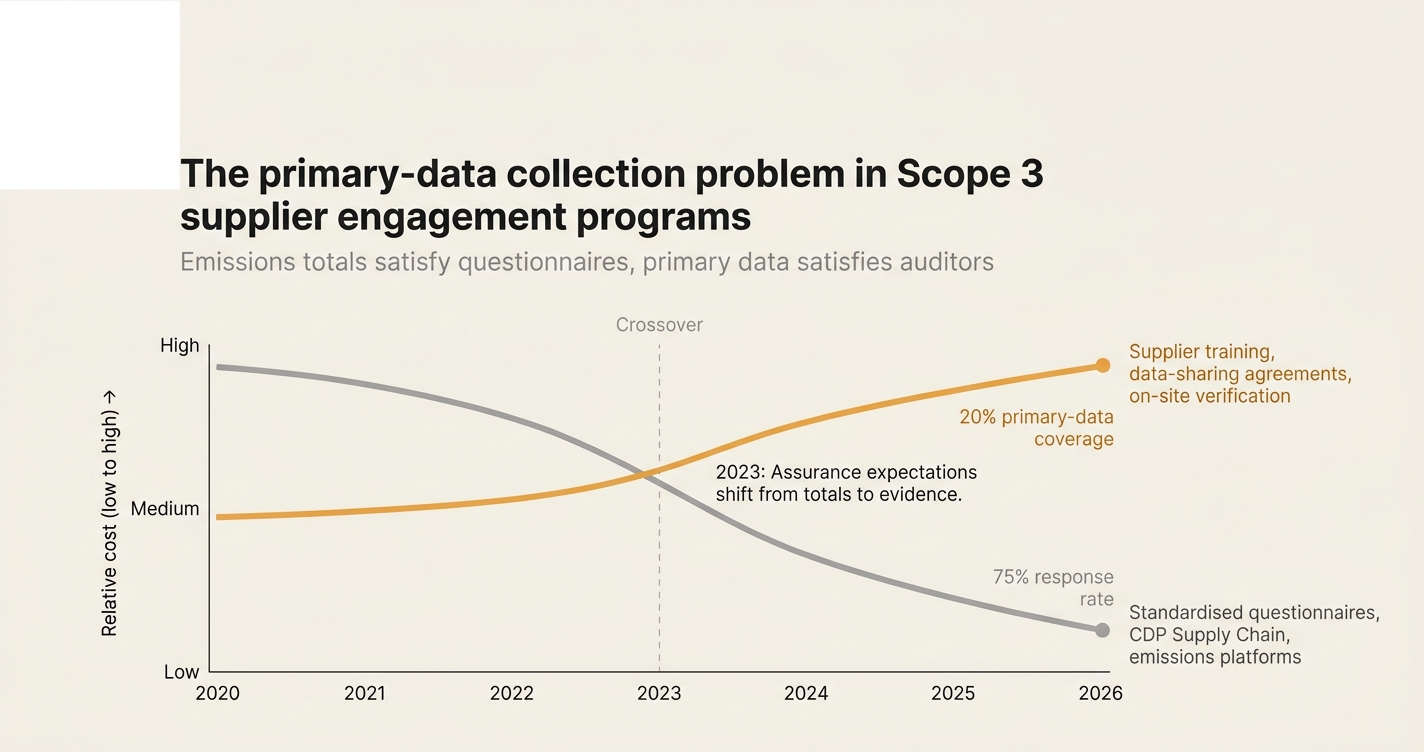
While emissions totals have become easier to collect—through standardised questionnaires, CDP Supply Chain disclosures, and emissions reporting platforms—primary data has become more expensive to obtain. If you have 200 tier-1 suppliers and 150 respond with emissions totals, but only 40 can provide utility bills, production logs, or verified product carbon footprints, your primary-data coverage rate is 20%, not 75%. The cost to close that gap—through supplier training, data-sharing agreements, and on-site verification—may be €50,000 to €150,000 per major supplier category, depending on the complexity of the product and the maturity of the supplier's own inventory.
How do you solve this? I think the companies that will pass limited assurance in 2026 and 2027 are not the ones with the highest questionnaire response rates. They are the ones that identified their top 10 to 15 suppliers by emissions contribution early, framed the data request as a procurement requirement rather than a sustainability survey, and built the request around specific documents: invoices, utility bills, production data, or third-party product carbon footprints. For now, that means accepting lower spend coverage in exchange for higher evidence quality in the categories that matter.
The shape of the argument, visualised below.
Why spend-based coverage rates mislead assurance preparedness
Most supplier engagement programs report success using a spend-based coverage metric: the proportion of procurement spend for which you have received some form of emissions data. A 90% spend coverage rate sounds robust. It suggests comprehensive value chain visibility.
The problem is that spend coverage measures breadth, not depth. It tells you how many suppliers responded. It does not tell you whether the data they provided can survive an auditor's evidence request. Under ESRS E1, companies must disclose the proportion of their scope 3 inventory that is primary versus secondary. Under SBTi, target-setting companies must demonstrate a credible data improvement plan. Both frameworks distinguish between supplier-specific data and industry averages, and both penalise companies that report high coverage using secondary data.
The distinction matters because assurance procedures for scope 3 emissions follow a hierarchical evidence structure. The GHG Protocol Corporate Value Chain (Scope 3) Standard defines four calculation methods, ranked by data quality: supplier-specific methods (primary), hybrid methods (primary for key inputs, secondary for the rest), average-data methods (secondary), and spend-based methods (secondary). Auditors sample from the highest-quality tier first. If your 90% spend coverage consists primarily of spend-based estimates or supplier self-reports without documentation, the auditor will likely reject the sample and request primary evidence.
| Coverage metric | What it measures | What it does not measure | Assurance risk |
|---|---|---|---|
| Spend-based coverage | Proportion of procurement spend with any emissions data | Whether the data is primary or secondary | High—auditor may reject secondary data during sampling |
| Response-rate coverage | Proportion of suppliers who returned the questionnaire | Whether responses include supporting documents | High—self-reported totals without lineage fail verification |
| Primary-data coverage | Proportion of emissions backed by supplier-specific evidence (utility bills, PCFs, EPDs) | Whether all categories are covered | Low—meets ESRS E1 and SBTi expectations |
| Tier-2 visibility | Proportion of tier-1 suppliers who can report their own tier-2 data | Whether tier-2 data is primary or secondary | Medium—tier-2 primary data is rare, but disclosure of the gap satisfies ESRS |
The table reveals the core tension. Spend-based and response-rate coverage are easy to calculate and easy to report to executive stakeholders. Primary-data coverage requires document review, data-quality tagging, and supplier follow-up. It is slower to build and harder to present as a clean percentage. But it is the only metric that survives limited assurance.
The three-phase strategy for primary-data supplier engagement
Climate strategy advisors who run successful supplier engagement programs—ones that pass limited assurance without major restatements—use a three-phase approach. The phases are sequential, not parallel. You cannot skip Phase 1 and succeed in Phase 2.
Phase 1: Identify the right 10 to 15 suppliers
The GHG Protocol Scope 3 Standard includes 15 categories. Most companies find that 3 to 5 categories represent 80% to 90% of their total scope 3 emissions. Within those categories, a small number of suppliers—typically 10 to 15—account for the majority of emissions. Phase 1 is the process of identifying those suppliers using a combination of spend data, product carbon intensity, and volume.
Start with a spend-based screening across all 15 categories to establish a baseline. Use economy-wide emission factors (EXIOBASE, US EEIO) to estimate emissions by category. Rank the categories by contribution. Then, within the top 3 categories, rank suppliers by estimated emissions, not spend. A €10 million steel supplier may have higher emissions than a €15 million software supplier. Volume and carbon intensity matter more than price.
Once you have identified the top 10 to 15 suppliers, verify that they are actually the right targets. Check whether any of them already publish Environmental Product Declarations, product carbon footprints, or CDP Supply Chain disclosures. If a supplier already reports primary data publicly, your engagement effort shifts from data collection to data integration. If they do not, your engagement effort is data collection, and you should prioritise suppliers who are likely to have the internal systems to respond: large suppliers, suppliers in regulated industries (cement, steel, chemicals), and suppliers with existing sustainability reporting obligations.
Phase 2: Frame the request as a procurement requirement
Supplier engagement fails when it is positioned as a sustainability survey. Suppliers receive dozens of sustainability questionnaires each year. Response rates are low, and responses are often incomplete. The requests that succeed are the ones framed as procurement requirements, not voluntary disclosures.
That means embedding the data request in your supplier qualification process, your contract renewal process, or your preferred-supplier criteria. It means having the procurement team, not the sustainability team, send the request. And it means specifying what you will accept as evidence: a product carbon footprint with a third-party life cycle assessment, an Environmental Product Declaration verified to ISO 14025, utility bills and production logs for the reporting period, or a CDP Supply Chain response with supporting documentation.
The request should also clarify what you will not accept: spend-based estimates, industry averages without supplier-specific adjustments, or self-reported emissions totals without calculation methodology. Suppliers who cannot provide primary data in Year 1 should be asked to commit to a data improvement plan with a timeline. That commitment becomes part of the supplier relationship, not a one-time ask.
Phase 3: Make it a procurement function, not a sustainability project
The most common failure mode in supplier engagement programs is treating them as sustainability initiatives that sit outside core procurement workflows. The sustainability team sends the questionnaire, the supplier responds (or does not), and the data is logged in a separate system. Twelve months later, the procurement team renews the contract without referencing the emissions data, and the supplier has no incentive to improve data quality.
Successful programs integrate emissions data into procurement decision-making. That means adding carbon footprint as a weighted criterion in request-for-proposal (RFP) evaluations, requiring primary-data submissions as part of supplier onboarding, and building data-quality improvement into supplier scorecards. It also means training procurement managers to read and interpret product carbon footprints, to distinguish primary from secondary data, and to escalate suppliers who cannot meet the requirement.
Integration also requires systems alignment. The emissions data suppliers provide must flow into the same platform that houses supplier master data, contract terms, and performance metrics. If the sustainability team manages emissions data in a separate tool, procurement teams will not use it, and suppliers will not prioritise it.
What 90% primary-data coverage looks like in practice
A 90% primary-data coverage rate does not mean that 90% of your suppliers provide primary data. It means that 90% of your scope 3 emissions, weighted by contribution, are calculated using supplier-specific evidence. In practice, that usually means:
- 10 to 15 tier-1 suppliers in your top 3 categories provide utility bills, production logs, or verified product carbon footprints.
- Another 20 to 30 suppliers provide hybrid data: supplier-specific data for key inputs (energy, raw materials) and secondary data for minor inputs.
- The remaining suppliers—often hundreds of them—are calculated using activity-based or spend-based methods, but they represent less than 10% of your total scope 3 emissions.
This structure satisfies ESRS E1's requirement to disclose the proportion of primary versus secondary data. It satisfies SBTi's expectation that you will improve data quality in the categories that matter. And it satisfies auditors, because the emissions you are reporting with confidence are the emissions that are material.
The key insight is that primary-data coverage is not a linear function of supplier response rate. You can achieve 90% primary-data coverage with a 20% supplier response rate if you focus on the right 20%. Conversely, you can achieve a 90% supplier response rate and still have only 30% primary-data coverage if most of your responses are self-reported totals without supporting documents.
"Under the CSRD, specifically European Sustainability Reporting Standard E1 (ESRS E1), in-scope companies must disclose what proportion of their scope 3 inventory is primary versus secondary. Meanwhile, the Science Based Targets initiative (SBTi) expects clear plans for how an organization intends to improve data quality over successive reporting cycles. Both frameworks push in the same direction: away from averages, towards supplier-specific data." [1]
The tier-2 visibility problem
Even when you achieve high primary-data coverage at tier 1, you still face the tier-2 visibility problem. Tier-2 suppliers are your suppliers' suppliers. They are the raw material producers, the component manufacturers, and the logistics providers that your tier-1 suppliers rely on. They are also where 30% to 50% of scope 3 emissions often hide.
The GHG Protocol does not require tier-2 visibility for scope 3 reporting. You report the emissions your tier-1 suppliers provide, and your tier-1 suppliers report their scope 1, 2, and 3 emissions, which include their tier-2 purchases. The accounting boundary is clear. But the practical problem is that most tier-1 suppliers do not have primary data for their own tier-2 purchases. They use spend-based estimates or industry averages, and those estimates propagate up the value chain.
ESRS E1 does not explicitly require tier-2 primary data, but it does require disclosure of data quality by category. If your tier-1 suppliers cannot provide primary data for their own scope 3 emissions, you must disclose that limitation. SBTi expects you to work with tier-1 suppliers to improve their own data quality, which means helping them engage their tier-2 suppliers. That is a multi-year effort, and it is where most companies are now in 2026.
The interim solution is to focus primary-data collection on the categories where tier-2 visibility matters most—typically Category 1 (Purchased Goods and Services) for raw materials like steel, cement, and chemicals—and to accept secondary data for categories where tier-2 emissions are less material or less controllable. That approach satisfies disclosure requirements without requiring a full value chain transformation in Year 1.
How Emission3 fits
Emission3 is built for the primary-data collection problem. The platform starts with document ingestion: invoices, utility bills, bills of materials, and product carbon footprints. Every line item is traced to a source document, every calculation is reproducible, and every emissions figure includes its evidence lineage.
For supplier engagement, that means you can upload supplier-provided product carbon footprints, utility bills, or Environmental Product Declarations directly into the platform, and the system will extract the relevant emission factors, trace the data to specific products or shipments, and flag gaps where secondary data is still being used. The platform also generates evidence packs for auditors: PDFs that include the source document, the calculation methodology, the emission factor applied, and the final result, all linked together.
When a supplier cannot provide primary data, Emission3 applies activity-based or spend-based methods as a fallback, but the system tags the data quality level and tracks the gap. That tagging satisfies ESRS E1's requirement to disclose the proportion of primary versus secondary data, and it gives procurement teams a clear list of suppliers to prioritise in the next engagement cycle.
The result is a scope 3 inventory that is assurance-ready by design: every number is traceable, every assumption is documented, and every data quality limitation is disclosed.
Close with a CBAM readiness conversation
If you are preparing for limited assurance on scope 3 emissions, or if you need to improve primary-data coverage in your supplier engagement program, start with a CBAM readiness call. We map your suppliers, identify the categories where primary data will move the needle, and scope the implementation.
No anonymous self-serve onboarding—every customer starts with a readiness call, because the hard part of supplier engagement is not the platform, it is the strategy. [2]
Citations
[1] Normative – Scope 3 Supplier Engagement: Primary Carbon Data
[2] Internal – Book a CBAM readiness call
[3] PwC Viewpoint – Chapter 7: Greenhouse gas emissions reporting
[4] CSRD Reporting Requirements: A Practical Climate & ESRS E1 Guide
[5] Internal – The tier-2 data gap in CBAM-ready supplier engagement programs
References & Sources
External Sources
- [1]Scope 3 Supplier Engagement: Primary Carbon Data
Normative's guide to supplier engagement explains why CSRD ESRS E1 and SBTi both require disclosure of primary versus secondary data proportions, and why effective programs prioritise the right 10 to 15 suppliers rather than maximising response rates.
- [3]Chapter 7: Greenhouse gas emissions reporting | Viewpoint - PwC
PwC's March 2026 guidance on GHG emissions reporting under ESRS E1, including the hierarchy of guidance (ESRS, GHG Protocol, PCAF) and requirements for scope 1, 2, and 3 disclosure with methodology documentation.
- [4]CSRD Reporting Requirements: A Practical Climate & ESRS E1 Guide
Senken's practical guide to CSRD ESRS E1 climate disclosures, covering methodology consistency, traceability, and the four areas auditors focus on during limited assurance: calculation approaches, source data, assumptions, and carbon credit evidence.
- [6]The 15 Scope 3 Emissions Categories Explained | Brightest
Brightest's practitioner guide to the 15 scope 3 categories, including calculation methodology hierarchy (supplier-specific, activity-based, spend-based) and disclosure requirements under CSRD ESRS E1, SB 253, CDP, and ISSB IFRS S2.
- [7]Scope 3 Reporting: CSRD & SBTi Requirements (2026) - Normative
Normative's 2026 guide to scope 3 reporting under CSRD and SBTi, covering the distinction between disclosure completeness (CSRD) and target coverage (SBTi), and the importance of locking base year methodology before submission.
- [8]The GHG protocol explained: A complete guide to corporate emissions accounting
Coolset's complete guide to the GHG Protocol, including how it is embedded in CSRD ESRS E1 as the mandatory methodology for scope 1, 2, and 3 disclosure, and the trade-offs between activity-based and spend-based calculation methods.
Related Content
- [2]Book a CBAM readiness call
All Emission3 customers start with a readiness call: we map suppliers, identify gaps, and scope implementation. No anonymous self-serve onboarding.
- [5]The tier-2 data gap in CBAM-ready supplier engagement programs
Supplier engagement consists of two things: tier-1 data collection and tier-2 visibility. Procurement teams optimize for the first—but 40% of embedded emissions hide in the second.