The tier-2 data gap in CBAM-ready supplier engagement programs
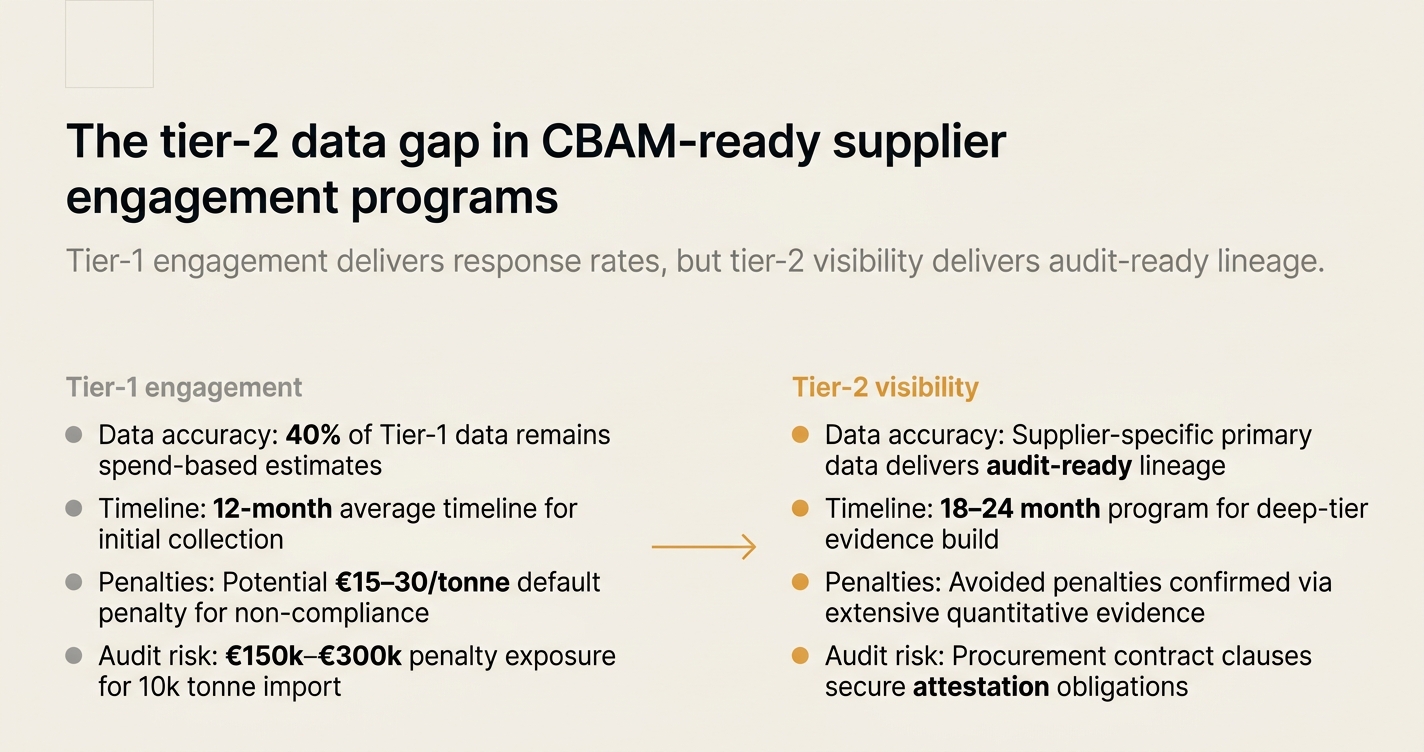
The tier-2 data gap in CBAM-ready supplier engagement programs
Here's the issue: procurement teams investing in Carbon Border Adjustment Mechanism (CBAM) readiness programs are building supplier engagement infrastructure—training workshops, data templates, quarterly tracking cadences—and achieving 70% tier-1 response rates within 12 months. At first glance, this looks like success. The supplier data is flowing, the Product Carbon Footprint (PCF) declarations are arriving, and the CBAM filing preparation is underway.
However, supplier engagement consists of two things: tier-1 data collection (direct suppliers providing their own facility emissions and purchased goods totals) and tier-2 visibility (line-item evidence for the upstream inputs those tier-1 suppliers are purchasing). These are not the same activity.
Tier-1 data on its own has no audit value if the tier-1 supplier is reporting spend-based estimates for their own purchased goods. Tier-2 visibility is what the CBAM verifier is actually asking for—the calculation lineage that traces embedded emissions from raw material extraction through every processing step to the finished import. Without tier-2 primary data, a tier-1 supplier's PCF declaration might still carry a 40% default-value penalty, even if that tier-1 supplier responded to your engagement program.
While tier-1 engagement has become easier—digital platforms now automate data requests, and many large suppliers already participate in CDP Supply Chain programs—tier-2 visibility has become more expensive. If your tier-1 steel supplier in Turkey is reporting their Scope 1 and 2 emissions using primary data but their iron ore and coking coal inputs using industry averages, the CBAM filing for that steel might still require default embedded emissions factors, inflating your carbon liability by €15-30 per tonne of steel imported. A 10,000-tonne annual import volume would face a €150,000-€300,000 penalty versus a filing with full tier-2 lineage.
How do you solve this? I think the answer is not to abandon tier-1 engagement but to treat tier-2 visibility as a separate procurement function, not a sustainability side project. The operators we work with at Emission3 are embedding tier-2 evidence requirements into supplier contracts—specifically, clauses requiring that tier-1 suppliers provide calculation lineage for their top 5 purchased goods categories, not just totals. For now, this is still a negotiation-heavy process, but it shifts the visibility burden upstream where it belongs.
The shape of the argument, visualised below.
The mechanics of the tier-2 gap
The tier-2 gap emerges because most supplier engagement programs are designed around tier-1 response rates, not upstream data quality. A typical program structure looks like this:
| Engagement phase | Activity | Tier-1 coverage outcome | Tier-2 visibility outcome |
|---|---|---|---|
| Scoping (Month 1-2) | Identify suppliers representing 60-80% of purchased goods emissions | High-impact suppliers flagged | No tier-2 mapping yet |
| Outreach (Month 3-6) | Send PCF request templates, host training webinars | 40-60% response rate | Tier-1 suppliers report totals, not lineage |
| Assessment (Month 7-9) | Review submitted data for completeness | 70% of tier-1 data collected | 60-80% of tier-1 data is still spend-based |
| Action (Month 10-12) | Set supplier targets, integrate into procurement KPIs | Tier-1 targets established | No tier-2 reduction levers identified |
This four-phase structure is standard across industry supplier engagement playbooks[1]. It delivers tier-1 data at scale. But at Month 12, when the CBAM filing window opens, the verification problem surfaces: the tier-1 steel supplier's PCF includes embedded emissions for purchased iron ore, but that iron ore calculation is a spend-based estimate using a secondary database factor, not a primary data value from the tier-2 mining operator.
Under CBAM Article 4, if a tier-1 supplier cannot provide "actual embedded emissions based on a method of calculation which is equivalent to the methods set out in Annex III," the importer must use default values[2]. The default value for non-EU steel is often 40% higher than actual values for efficient producers. This is not a compliance failure—it is an economic penalty for incomplete tier-2 visibility.
Why tier-1 engagement does not solve tier-2 visibility
The structural problem is that tier-1 engagement optimizes for response rates, while tier-2 visibility requires calculation lineage. These are different data products:
- Tier-1 response: The supplier provides a PCF declaration with a total embedded emissions number (e.g., "2.1 tonnes CO2e per tonne of steel").
- Tier-2 visibility: The supplier provides a calculation lineage showing how that 2.1 tonnes breaks down—0.8 tonnes from iron ore extraction, 0.6 tonnes from coking coal combustion, 0.4 tonnes from electricity consumption, 0.3 tonnes from transport—and attaches primary data or verifier reports for each input.
Most tier-1 suppliers do not have tier-2 visibility themselves. When Normative, a carbon accounting platform provider, analyzed customer transitions from spend-based to supplier-specific data, one company's Category 1 emissions increased from 41,496 to 65,734 tonnes CO2e—not because performance worsened, but because primary supplier data revealed that industry averages understated actual embedded emissions by 58%[1]. That is a tier-1 data improvement. But even that "supplier-specific" data might still contain spend-based estimates for the supplier's own upstream inputs.
A 2025 supplier engagement survey by Anthesis found that only 28% of companies track Scope 3 emissions, compared to 61% for Scope 1 and 42% for Scope 2[3]. If your tier-1 supplier is in that 72% non-tracking majority, they cannot provide tier-2 visibility—they do not have it. Your engagement program might increase their awareness, but awareness does not generate calculation lineage on a 90-day CBAM filing timeline.
The cost structure of tier-2 visibility
Tier-2 visibility costs more than tier-1 engagement because it requires either:
- Contractual requirements: Adding clauses to supplier agreements that mandate tier-2 evidence provision, with financial penalties or volume reductions for non-compliance. This works for strategic suppliers where you have leverage, but not for spot-market purchases.
- Direct tier-2 engagement: Bypassing tier-1 suppliers and contracting directly with tier-2 operators (e.g., the steel mill engaging directly with the iron ore mine). This requires procurement restructuring and may conflict with existing tier-1 relationships.
- Third-party verification procurement: Hiring verifiers to audit tier-1 supplier data and trace it upstream. Under CBAM, verification is optional for 2026 filings but will be mandatory for 2027[4]. Verifier costs range from €5,000 to €15,000 per supplier for initial audits.
All three options shift costs upstream or onto the procurement function. The sustainability team cannot solve this alone.
A practical example: a German automotive importer sources aluminum castings from a Turkish tier-1 supplier. The tier-1 supplier provides Scope 1 and 2 data using primary electricity bills and natural gas invoices. However, the aluminum ingot input—representing 60% of the casting's embedded emissions—is reported using a secondary emissions factor from an industry database. The CBAM filing must use default values for that 60%, inflating the declared emissions and the carbon liability.
To achieve tier-2 visibility, the importer has three paths:
- Path A: Require the tier-1 supplier to obtain primary data from their aluminum smelter (tier-2). This adds 3-6 months to the data collection timeline and may require the tier-1 supplier to renegotiate their own contracts.
- Path B: Source aluminum castings from a different tier-1 supplier that already has tier-2 visibility. This requires supplier switching costs and may increase unit prices.
- Path C: Accept the default value penalty and pay the higher CBAM liability. For a 1,000-tonne annual casting volume with a default value penalty of €20 per tonne, this costs €20,000 per year.
None of these paths is free. The question is whether the cost of tier-2 visibility is lower than the cost of the default-value penalty over a multi-year import contract.
What tier-2 visibility looks like in practice
Tier-2 visibility is not a single data point—it is a multi-layer calculation lineage. For a CBAM-ready steel import, the tier-2 evidence package includes:
- Iron ore extraction data: Primary activity data from the mine (tonnes extracted, electricity consumption, diesel fuel for haulage), not a spend-based estimate.
- Coking coal data: Primary fuel consumption from the coking plant, including fugitive emissions from coal handling.
- Pelletizing and sintering data: Primary natural gas and electricity data from the pellet plant.
- Blast furnace data: Primary carbon consumption data (coke, pulverized coal injection), oxygen consumption, and slag production.
- Electric arc furnace data (if applicable): Primary electricity data and scrap steel inputs.
- Transport data: Primary freight tonnage and distance data for iron ore to steel mill, not a logistics emissions factor.
Each of these inputs has its own tier-3 and tier-4 dependencies (e.g., the electricity consumed at the mine has upstream emissions from coal or gas power plants). A full tier-2 visibility model can extend 4-6 layers deep.
Most supplier engagement programs stop at layer 1. The tier-1 steel mill provides data. But if that steel mill is using spend-based estimates for layers 2-6, the CBAM filing collapses back to default values.
"Supplier-based [accounting]—As this is primary data, it's the most accurate form of Scope 3 accounting. It involves tracking the emissions from individual suppliers, and then using that data to calculate..." – Sweep, 2025 Scope 3 Emissions Playbook[3]
This is correct for tier-1 data. But "individual suppliers" must include tier-2 operators to meet CBAM's "actual embedded emissions" standard.
The procurement function shift required for tier-2 visibility
Achieving tier-2 visibility at scale requires treating it as a procurement workflow, not a sustainability initiative. The operational changes include:
- Supplier tiering by tier-2 access: Classify suppliers into three tiers—"tier-2 visible" (can provide upstream lineage), "tier-2 capable" (willing to build it with support), and "tier-2 opaque" (no tier-2 access, default values required). Prioritize tier-2 visible suppliers in RFP scoring.
- Contract clauses for tier-2 evidence: Add mandatory tier-2 data provision clauses to strategic supplier agreements, with 12-18 month phase-in timelines. Specify the format (e.g., PACT-compliant PCF files, ISO 14067 verification reports).
- Supplier support programs scaled to tier-2: Provide training not just on Scope 1 and 2 calculation, but on how to request and validate tier-2 data from their own suppliers. This is a multi-year capability build.
- Procurement KPIs aligned to tier-2 coverage: Track "percentage of spend with tier-2 visible suppliers" as a quarterly procurement metric, alongside cost and quality KPIs.
- Verifier procurement as a procurement function: Treat CBAM verification as a category of spend, with preferred verifier panels, volume discounts, and multi-year contracts.
These changes require procurement leadership, not sustainability leadership. The sustainability team can provide technical guidance on emissions calculation, but the contract negotiations, supplier scorecards, and RFP criteria are procurement functions.
A 2026 trend analysis by the Center for Sustainability and Excellence notes: "You will not 'collect data once a year' and call it done. Instead, you will run supplier engagement like a business process."[2] This is the shift. Tier-2 visibility is not an annual data request—it is a continuous procurement workflow.
How Emission3 fits into tier-2 visibility programs
Emission3 does not replace tier-1 supplier engagement platforms. We are not a supplier portal, and we do not automate data requests at scale. What we do is make tier-2 evidence auditable when it arrives.
Our document classification engine ingests the calculation lineage that tier-1 suppliers provide—invoices from tier-2 iron ore suppliers, utility bills from tier-2 smelters, freight manifests from tier-2 logistics operators—and produces line-item evidence packs that match CBAM's Annex III calculation methods[5]. Every embedded emissions number in the CBAM filing has a reproducible lineage from source document to reported value.
This is relevant when your tier-1 supplier sends a PCF declaration with tier-2 data attached, but the tier-2 data is a mix of primary bills, secondary estimates, and verifier summaries. Our engine determines which inputs meet the "actual embedded emissions" standard and which require default values, then produces the evidence pack for the CBAM verifier.
Typical workflow:
- Your tier-1 steel supplier sends a PCF declaration ("2.1 tonnes CO2e per tonne of steel") with attachments—iron ore invoices, coking coal bills, electricity statements.
- Emission3 classifies each attachment (invoice, bill, verifier report, estimate), extracts activity data (kWh, tonnes, cubic meters), and calculates embedded emissions using CBAM-compliant methods.
- If the iron ore invoice is a spend-based estimate (€X spent, no tonnage data), Emission3 flags it as "default value required" and calculates the CBAM penalty.
- The output is a line-item evidence pack: every tonne of embedded emissions is linked to a source document, with a calculation lineage showing how the number was derived.
- This pack goes to the CBAM verifier or directly into the EU CBAM registry, with no manual spreadsheet reconciliation.
We do not create tier-2 visibility—we make it auditable when it exists. If your tier-1 supplier has tier-2 data, we turn it into a CBAM-ready filing. If they do not, we quantify the default-value penalty so you can decide whether to switch suppliers or accept the cost.
Customers typically use Emission3 alongside a tier-1 engagement platform (e.g., Normative, Sweep, or a custom supplier portal). The engagement platform collects data at scale. Emission3 audits it at line-item detail.
The 90-day implementation timeline for tier-2 visibility
If you are starting tier-2 visibility work in Q1 2026 for a Q1 2027 CBAM filing, the timeline is compressed. A realistic 90-day program:
Days 1-30: Tier-2 supplier mapping
- Identify which tier-1 suppliers have tier-2 access (ask them directly: "Can you provide primary data from your iron ore supplier?").
- Classify suppliers into tier-2 visible, tier-2 capable, tier-2 opaque.
- Calculate the default-value penalty for tier-2 opaque suppliers (percentage of spend × default value uplift × carbon price).
Days 31-60: Contract and evidence requirements
- Add tier-2 evidence clauses to renewals and new contracts.
- Specify the evidence format (e.g., "primary activity data for top 3 purchased goods categories, with supporting invoices or verifier reports").
- Provide tier-2 data request templates your tier-1 suppliers can send to their own suppliers.
Days 61-90: Evidence collection and audit prep
- Collect tier-2 evidence from tier-2 visible suppliers.
- Run the evidence through a document classification engine (manual or automated) to verify it meets CBAM's "actual embedded emissions" standard.
- Flag gaps and decide: switch suppliers, accept default values, or defer CBAM filing for affected products.
This is not a complete tier-2 visibility build—that takes 18-24 months. But it is enough to reduce the default-value penalty for your highest-volume imports.
Closing: treat tier-2 visibility as a sourcing decision, not a data request
The tier-2 data gap will not be solved by better engagement templates or more training webinars. It will be solved by procurement leaders deciding that tier-2 visibility is a sourcing criterion, the same way quality certifications and delivery lead times are sourcing criteria today.
If your tier-1 supplier cannot provide tier-2 evidence, and the default-value penalty exceeds the cost of switching suppliers, the procurement decision is clear. If the penalty is lower than switching costs, you accept it and move on. Either way, the decision is a procurement function, not a sustainability function.
The companies that will be CBAM-ready in 2027 are the ones treating tier-2 visibility as a sourcing workflow in 2026. The companies that will face repeated default-value penalties are the ones still treating it as a data collection project.
If you are building a supplier engagement program for CBAM readiness and want to understand how tier-2 visibility fits into your procurement workflow, book a CBAM readiness call. We will map your tier-1 suppliers, identify tier-2 gaps, and show you what a line-item evidence pack looks like for your highest-volume imports[6].
References & Sources
External Sources
- [1]Scope 3 Supplier Engagement: Primary Carbon Data
Normative's guide to supplier engagement for primary carbon data, including the reality that switching from spend-based to supplier-specific data can reveal actual emissions 58% higher than industry averages.
- [2]Where Sustainability Professionals Should Focus in 2026
Center for Sustainability and Excellence analysis of 2026 trends, noting that supplier engagement must shift from annual data collection to continuous business process.
- [3]2025 Scope 3 Emissions Playbook
Sweep's comprehensive playbook for supply chain emissions, including the finding that only 28% of companies track Scope 3 emissions versus 61% for Scope 1.
- [4]The verification-timing problem in CBAM filings for 2026 emissions
Anthesis supplier engagement playbook detailing the four-phase structure (scoping, outreach, assessment, action) used across industry programs.
Related Content
- [5]Document classification engine
How Emission3 turns invoices, bills of materials, and utility bills into line-level evidence packs with reproducible calculation lineage for CBAM filings.
- [6]Book a CBAM readiness call
Start with a readiness call where we map your suppliers, identify tier-2 visibility gaps, and show you what a line-item evidence pack looks like for your imports.