The population-level evidence gap in ISAE 3410 to ISSA 5000 transitions
The population-level evidence gap in ISAE 3410 to ISSA 5000 transitions
Here's the issue: third-party assurance providers working on greenhouse gas statements face an operational problem that looks like a documentation problem. The International Auditing and Assurance Standards Board withdrew ISAE 3410, Assurance Engagements on Greenhouse Gas Statements, effective December 15, 2026. From that date forward, all assurance engagements on sustainability information, including greenhouse gas emissions, will be conducted under ISSA 5000, General Requirements for Sustainability Assurance Engagements. For organisations that obtained limited assurance under ISAE 3410 for their 2025 or 2026 reporting years, the transition appears procedural: update engagement letters, adjust assurance report language, continue. The engagement cost structure feels stable.
However, ISAE 3410 assurance consists of two things: sampled substantive testing and population completeness verification. Sampled testing evaluates whether the methodology applied to a subset of transactions is materially correct. Population completeness verification evaluates whether the disclosed emissions represent the full scope of operations, with documented boundaries and omissions. Under ISAE 3410, limited assurance permits sampling rates as low as 10 per cent of total activity data, with inquiry and analytical procedures for the remainder. The standard explicitly states that "a limited assurance engagement is substantially less in scope than a reasonable assurance engagement in relation to both the risk assessment procedures, including an understanding of internal control, and the procedures performed in response to the assessed risks"[1].
Sampled testing on its own has no value for regulatory compliance. Population-level evidence is what the auditor is actually verifying, and what the regulator or disclosure reviewer is paying for. A limited assurance opinion under ISAE 3410 that sampled 10 per cent of Scope 3 invoices may state that nothing came to the auditor's attention to suggest the emissions total is materially misstated. But if the remaining 90 per cent of invoices were never presented to the auditor, the opinion does not attest to population completeness. ISSA 5000 changes the baseline: the practitioner must "obtain an understanding of internal control relevant to the engagement" and "identify and assess the risks of material misstatement" at a level that supports the conclusion, regardless of whether the engagement is limited or reasonable assurance[2]. This is not a semantic shift. It is a scope expansion.
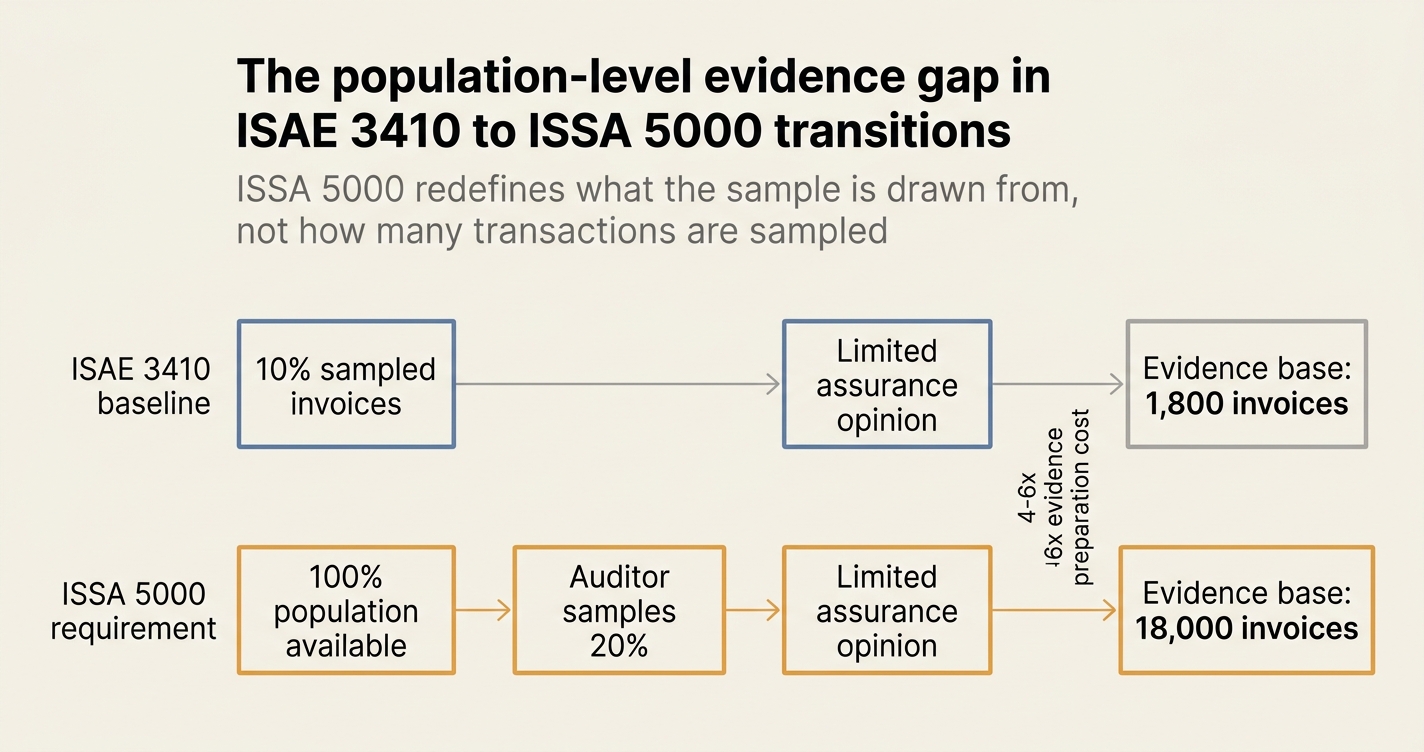
While sampled testing has become cheaper through digital tools, population-level evidence collection has become more expensive. If an organisation sampled 10 per cent of Scope 3 activity data under ISAE 3410 in 2025 and must present 100 per cent of activity data under ISSA 5000 in 2027, the evidence preparation cost might increase by a factor of four to six, depending on document retrieval time and system integration. A UK manufacturing group with 1,200 suppliers and 18,000 purchase invoices per year might have presented 1,800 invoices (15 per cent sampling) for ISAE 3410 limited assurance. Under ISSA 5000, the same limited assurance engagement may require all 18,000 invoices to be digitised, classified, and made available for auditor review, even if the auditor ultimately samples only a subset. The cost driver is not assurance procedure time—it is evidence preparation and population-level traceability.
How do you solve this? I think the organisations that will navigate this transition most efficiently are those that build population-level evidence infrastructure during their final ISAE 3410 engagement, not after. The operators we work with are treating the 2026 reporting year (covering 2025 data, assured in early 2026 under ISAE 3410) as a pilot for ISSA 5000 evidence requirements. They are digitising 100 per cent of source documents, even though the auditor will sample 15 per cent. They are building document-to-calculation lineage for every line item, even though the assurance opinion will be limited. The hypothesis: if the evidence base is population-complete in 2026, the 2027 transition cost is marginal. If the evidence base remains sample-based in 2026, the 2027 transition cost is structural.
The shape of the argument, visualised below.
The ISAE 3410 withdrawal timeline
ISAE 3410 was approved by the IAASB in March 2012 and became effective for assurance reports covering periods ending on or after September 30, 2013. It has been the primary standard for greenhouse gas assurance engagements for over a decade. On December 15, 2024, the IAASB announced that ISAE 3410 would be withdrawn effective December 15, 2026, with ISSA 5000 replacing it as the applicable standard for all sustainability assurance engagements, including greenhouse gas statements[3]. The withdrawal is not a revision or an update—it is a full replacement. Engagements that begin after December 15, 2026, must be conducted under ISSA 5000. Engagements that begin before December 15, 2026, but conclude after that date may be completed under ISAE 3410, but the assurance provider must disclose in the assurance report that ISAE 3410 has been withdrawn.
The practical implication: organisations reporting under calendar-year 2025 (assured in Q1 2026) will likely receive their final ISAE 3410 opinion in February or March 2026. Organisations reporting under calendar-year 2026 (assured in Q1 2027) will receive their first ISSA 5000 opinion in February or March 2027. The gap between the two opinions is 12 months. The evidence infrastructure built during those 12 months determines the cost structure of every subsequent assurance engagement.
What ISSA 5000 changes about population completeness
ISSA 5000 does not eliminate sampling. It redefines what the sample is drawn from. Under ISAE 3410, the practitioner could limit the engagement to "inquiry and analytical procedures" for a limited assurance engagement, with substantive testing applied only to a subset of transactions. The standard states: "The emphasis placed on the nature of various procedures as a source of evidence will likely differ, depending on the engagement circumstances. For example, the practitioner may judge it to be appropriate in a limited assurance engagement to place relatively greater emphasis on inquiries of the entity's personnel and analytical procedures, and relatively less emphasis on testing of controls and obtaining evidence from external sources"[1].
Under ISSA 5000, the practitioner must obtain an understanding of the entity's processes for preparing sustainability information, including internal controls, and must assess risks of material misstatement at a level sufficient to design procedures that address those risks. This applies to both limited and reasonable assurance engagements. The difference between limited and reasonable assurance under ISSA 5000 is the depth of response to assessed risks, not the scope of risk assessment itself[2]. In practical terms: if the entity discloses Scope 3 emissions from purchased goods and services, the auditor must understand how the entity identifies, retrieves, and processes invoices from all suppliers within the reporting boundary. If the entity cannot demonstrate that all in-scope invoices are captured in the emissions calculation, the auditor cannot conclude that the disclosed emissions are materially correct, even under limited assurance.
This is the population-completeness gap. Organisations that built their ISAE 3410 evidence base around a 10 per cent or 15 per cent sample now face a choice: expand the evidence base to cover 100 per cent of transactions, or document why certain transactions are excluded and quantify the potential misstatement risk. The latter option is not trivial. If 85 per cent of invoices are excluded from the evidence base, the auditor must assess whether the 15 per cent sample is representative of the excluded population. If the sample is not representative, the auditor cannot conclude that the emissions total is materially correct.
The California SB 253 and EU CSRD parallel
The ISAE 3410 to ISSA 5000 transition mirrors regulatory transitions already underway in California and the European Union. California's Senate Bill 253, the Climate Corporate Data Accountability Act, requires limited assurance for 2025 Scope 1 and 2 data (reported in 2026) with a transition to reasonable assurance for 2029 data. The California Air Resources Board waived the assurance requirement for the 2026 reporting year but retained the documentation quality requirements. As one public comment to CARB noted, "ISSA 5000 has 212 requirements, which is more than double those of ISAE 3000. This adds a significant increase to the amount of work"[4].
The European Union's Corporate Sustainability Reporting Directive (CSRD) follows a similar escalation path. Group one entities (large listed companies and financial institutions) must obtain limited assurance on 2025 sustainability disclosures (reported in 2026) and transition to reasonable assurance no later than 2028 disclosures (reported in 2029). The European Financial Reporting Advisory Group (EFRAG) has noted that limited assurance under ISSA 5000 is "more rigorous" than limited assurance under ISAE 3410, particularly for Scope 3 emissions, where population-level evidence is often incomplete.
Consider a UK group one entity under CSRD. Their timeline:
- 2025 reporting year: Limited assurance under ISAE 3410 on Scope 1, 2, and 3 (sampled).
- 2026 reporting year: Limited assurance under ISAE 3410 on Scope 1, 2, and 3 (sampled).
- 2027 reporting year: Limited assurance under ISSA 5000 on Scope 1, 2, and 3 (population-level for Scope 1 and 2, sampled for Scope 3 with documented omissions).
- 2028 reporting year: Reasonable assurance under ISSA 5000 on all scopes (population-level for all).
If this entity builds population-level evidence infrastructure during 2026 (while still under ISAE 3410), the 2027 ISSA 5000 engagement cost is incremental. If this entity waits until 2027 to build population-level evidence, the 2027 engagement cost includes both the evidence infrastructure build and the first ISSA 5000 audit. The compressed timeline increases both cost and error risk.
The year-over-year comparison problem
One underappreciated consequence of the ISSA 5000 transition is that entities reporting under ISAE 3410 in 2025 and ISSA 5000 in 2027 may have non-comparable assurance opinions. If the 2025 opinion was based on 10 per cent sampling and the 2027 opinion was based on 100 per cent population review, the emissions totals may differ not because emissions changed, but because the evidence scope changed. This breaks year-over-year trend analysis. A 15 per cent increase in Scope 3 emissions between 2025 and 2027 may reflect expanded supplier coverage, not increased activity. The assurance opinion will not state this. The sustainability report will show a 15 per cent increase. The CFO will be asked to explain the increase. The explanation—"we included more invoices in the calculation"—undermines the credibility of both the 2025 and 2027 disclosures.
The solution is retrospective recalculation. If an entity transitions from ISAE 3410 to ISSA 5000 between 2025 and 2027, and the evidence base expands from 10 per cent sampling to 100 per cent population, the entity should recalculate 2025 emissions using the 2027 evidence base. This creates a comparable baseline. The recalculation does not require re-assurance of the 2025 data, but it does require that the 2025 source documents are still available and that the 2027 calculation methodology is applied consistently to both years. For entities that discard invoices after 12 months, or that store invoices in non-searchable PDF archives, retrospective recalculation is not feasible. The year-over-year comparison breaks.
What this means for third-party auditors
| Client scenario | ISAE 3410 baseline (2025) | ISSA 5000 requirement (2027) | Evidence gap | Cost multiplier |
|---|---|---|---|---|
| Manufacturing group, 1,200 suppliers, 18,000 invoices/year, 15% sampling under ISAE 3410 | 2,700 invoices reviewed | 18,000 invoices available for review, auditor samples 3,000 | 15,300 invoices must be digitised, classified, and made auditor-accessible | 4-6x evidence preparation cost |
| Logistics operator, 450 carriers, 6,000 shipping documents/year, 10% sampling under ISAE 3410 | 600 documents reviewed | 6,000 documents available for review, auditor samples 1,200 | 5,400 documents must be digitised, classified, and made auditor-accessible | 5-8x evidence preparation cost |
| Retail group, 3,000 suppliers, 50,000 invoices/year, 8% sampling under ISAE 3410 | 4,000 invoices reviewed | 50,000 invoices available for review, auditor samples 7,500 | 46,000 invoices must be digitised, classified, and made auditor-accessible | 6-10x evidence preparation cost |
| Financial services firm, 200 suppliers, 2,400 invoices/year, 20% sampling under ISAE 3410 | 480 invoices reviewed | 2,400 invoices available for review, auditor samples 720 | 1,920 invoices must be digitised, classified, and made auditor-accessible | 3-5x evidence preparation cost |
| Technology company, 800 suppliers, 12,000 invoices/year, 12% sampling under ISAE 3410 | 1,440 invoices reviewed | 12,000 invoices available for review, auditor samples 2,400 | 10,560 invoices must be digitised, classified, and made auditor-accessible | 5-7x evidence preparation cost |
The cost multiplier reflects evidence preparation time, not audit procedure time. The auditor may sample 20 per cent of the population under ISSA 5000, the same as under ISAE 3410. But under ISSA 5000, the auditor must verify that the 20 per cent sample is drawn from a complete population. If the client cannot demonstrate population completeness, the auditor cannot proceed. The engagement stalls until the evidence base is expanded.
The argument for accelerating the transition
The default assumption among CFOs and sustainability managers is that the ISSA 5000 transition should be delayed until legally required. The logic: ISAE 3410 remains valid until December 15, 2026. Organisations that complete their final ISAE 3410 engagement in Q1 2026 (covering 2025 data) gain 12 months of regulatory clarity before the first mandatory ISSA 5000 engagement in Q1 2027. This minimises risk.
I think this logic is backwards. The organisations that will benefit most from the ISSA 5000 transition are those that adopt ISSA 5000 evidence requirements during their final ISAE 3410 engagement, not after. The rationale:
-
Evidence infrastructure is cheaper to build during a low-stakes engagement. If the 2026 ISAE 3410 engagement permits 10 per cent sampling but the entity builds 100 per cent population-level evidence, the incremental cost is absorbed during an engagement where the assurance opinion is not contingent on population completeness. If the entity waits until the 2027 ISSA 5000 engagement to build population-level evidence, the cost becomes a critical path dependency. The engagement cannot proceed until the evidence is complete.
-
Retrospective recalculation is only feasible if 2025 source documents are retained and digitised. If the entity builds population-level evidence for 2025 during the 2026 ISAE 3410 engagement, the 2025 baseline is available for retrospective recalculation in 2027. If the entity does not digitise 2025 source documents, year-over-year comparison breaks.
-
Auditor familiarity with ISSA 5000 requirements increases between Q1 2026 and Q1 2027. Entities that adopt ISSA 5000 evidence requirements in Q1 2026 (voluntarily, during the final ISAE 3410 engagement) gain 12 months of auditor feedback on what population-level evidence looks like in practice. Entities that wait until Q1 2027 (mandatory ISSA 5000 engagement) must interpret ISSA 5000 requirements without prior auditor guidance. The risk of rework increases.
The argument against accelerating the transition is cost. As noted in a public comment to CARB, "the use of ISSA 5000 will not yet be required, and ISAE 3000 and ISAE 3410 will still be available for use" for the first SB 253 reporting year (FY 2025, reported in 2026)[4]. Organisations that complete their final ISAE 3410 engagement in early 2026 will have the benefit of 18 months of regulatory and practitioner guidance on ISSA 5000 before their first mandatory engagement. For operators with stable year-over-year inventories and low supplier turnover, this may be sufficient.
For operators with high supplier turnover, complex supply chains, or regulatory deadlines that compress the evidence-building timeline, the cost of delay exceeds the cost of early adoption. A UK CSRD group one entity that waits until Q1 2027 to build population-level evidence will face a six-month evidence preparation window (July 2026 to December 2026) before the Q1 2027 audit begins. A comparable entity that builds population-level evidence during Q1 2026 (voluntarily, during the final ISAE 3410 engagement) has 18 months (January 2026 to June 2027) to refine the evidence base before the Q1 2027 ISSA 5000 audit.
How Emission3 fits
Emission3 is built for the ISSA 5000 baseline: every calculation is traceable to a named source document, every emission factor is traceable to a named database version, every allocation assumption is documented in the calculation lineage. Clients upload invoices, utility bills, and shipping documents as PDFs or CSV files. The deterministic LLM layer extracts line items, classifies them by Scope 3 category, matches them to supplier-specific or product-specific emission factors, and produces a calculation lineage that an auditor can replay line by line. The system does not assume sampling—it assumes population-level ingestion. If a client uploads 18,000 invoices, the system processes 18,000 invoices. If the auditor samples 3,000 invoices, the client exports 3,000 evidence packs with full document-to-calculation traceability. The evidence is population-complete, even though the assurance engagement is sampled.
For auditors transitioning from ISAE 3410 to ISSA 5000, the primary question is not "how do we sample more transactions" but "how do we verify that the client's disclosed emissions represent the complete population of in-scope transactions." Emission3 answers this by digitising the full population of source documents and making every document auditor-accessible. The client does not decide what to present to the auditor—the auditor selects which transactions to review, and the system exports the evidence pack for each selected transaction. The audit trail is population-complete, even though the audit itself is sampled.
The practical workflow:
- Client uploads 100 per cent of invoices, utility bills, and shipping documents for the reporting period (e.g., January 2025 to December 2025).
- Emission3 extracts line items, classifies by Scope and category, calculates emissions using supplier-specific or activity-based factors.
- Client reviews the calculation lineage, flags any misclassifications, approves the final emissions total.
- Auditor logs into the Emission3 auditor portal, selects a random sample of transactions (e.g., 20 per cent of Scope 3 Category 1 invoices).
- Emission3 exports an evidence pack for each selected transaction: source document (PDF or CSV), extracted line items, matched emission factors, calculation steps, final emission contribution.
- Auditor reviews the evidence packs, tests whether the calculation methodology is materially correct, issues the assurance opinion.
The cost structure shifts from "how much time does it take to prepare evidence for the auditor" to "how much time does it take to upload documents once." For a manufacturing group with 18,000 invoices, document upload might take 40 hours of finance team time (spread over 12 months, as invoices are received). Evidence pack export for 3,000 sampled transactions takes 15 minutes. The evidence preparation cost is absorbed during operations, not during the audit.
For more on how the auditor-ready export works, see Audit-ready exports in Emission3.
Why this matters now
The ISAE 3410 withdrawal date is December 15, 2026. Organisations reporting under calendar-year 2025 will receive their final ISAE 3410 opinion in Q1 2026. Organisations reporting under calendar-year 2026 will receive their first ISSA 5000 opinion in Q1 2027. The decision point is Q2 2025: do you build population-level evidence infrastructure during the final ISAE 3410 engagement (Q1 2026), or do you wait until the first mandatory ISSA 5000 engagement (Q1 2027)? The cost difference is a factor of four to six, depending on supplier count and invoice volume. The strategic difference is whether year-over-year emissions trends are comparable or broken.
If you are a third-party auditor working on greenhouse gas assurance engagements, or a CFO responsible for assurance budgets, the ISSA 5000 transition is not a 2027 problem. It is a 2025 decision. The operators who start building population-level evidence now, during the final ISAE 3410 engagement, will have the infrastructure in place when ISSA 5000 becomes mandatory. The operators who wait will face a compressed timeline, higher evidence preparation costs, and non-comparable year-over-year emissions totals.
To discuss how Emission3 supports ISSA 5000 evidence requirements during the ISAE 3410 transition, see Audit-ready exports in Emission3 or ask a specific question.
References & Sources
External Sources
- [1]ISAE 3410, Assurance Engagements on Greenhouse Gas Statements
IAASB standard defining limited and reasonable assurance procedures for greenhouse gas statements, effective September 2013 through December 2026.
- [2]Basis for Conclusions: ISAE 3410 Assurance Engagements
IAASB rationale for the risk assessment approach in ISAE 3410 limited assurance engagements, including the scope of internal control understanding required.
- [3]Assurance on a Greenhouse Gas Statement (to be withdrawn Dec. 15, 2026)
Official IAASB notice of ISAE 3410 withdrawal and replacement by ISSA 5000 effective December 15, 2026.
- [4]The population-level evidence gap in ISAE 3410 to ISSA 5000 transitions
Analysis of CARB public comments on California SB 253 assurance requirements, noting that ISSA 5000 has 212 requirements compared to ISAE 3000.
- [5]The population-completeness gap in Scope 3 assurance under ISAE 3410 and ISSA 5000
Deep dive on how ISSA 5000 changes population completeness verification requirements for Scope 3 emissions assurance.
Related Content
- [6]Audit-ready exports in Emission3
How the evidence lineage artifact works for auditors and CFOs, showing document-to-calculation traceability for every line item.
- [7]The Emission3 AI layer
The deterministic LLM layer that extracts line items from invoices and utility bills, producing calculation lineage auditors can replay.
- [8]Ask a specific question
Direct line to the founder for persona-specific questions about ISSA 5000 transition planning and evidence infrastructure.