The methodology-lock problem in 2026 ESRS E1 Scope 3 assurance-ready inventories
The methodology-lock problem in 2026 ESRS E1 Scope 3 assurance-ready inventories
Here's the issue: You submit your first ESRS E1 limited assurance engagement in Q2 2026, covering financial year 2025. The auditor signs off on your Scope 1 and Scope 2 numbers without qualification. Your Scope 3 disclosure passes, totalling 48,000 tonnes CO2e. The audit fee is €45,000. In Q2 2027, you submit the FY2026 assurance engagement. Scope 3 is now 44,000 tonnes—an 8.3% reduction. The auditor requests a reconciliation to the prior year. You cannot produce one. The methodology changed between 2025 and 2026: you switched from spend-based data to supplier-specific data for Category 1, and you changed the system boundary for Category 9 to include last-mile delivery. The auditor issues a qualified opinion, noting that the year-on-year comparison is not meaningful. The FY2026 audit fee is €72,000.
However, Scope 3 disclosure consists of two things: the emissions total, and the methodology that produces it.
The emissions total on its own has no value. The methodology documentation is what the auditor is actually verifying—because without it, the auditor cannot assess whether the 2026 number is comparable to the 2025 number, and therefore cannot opine on the trend.
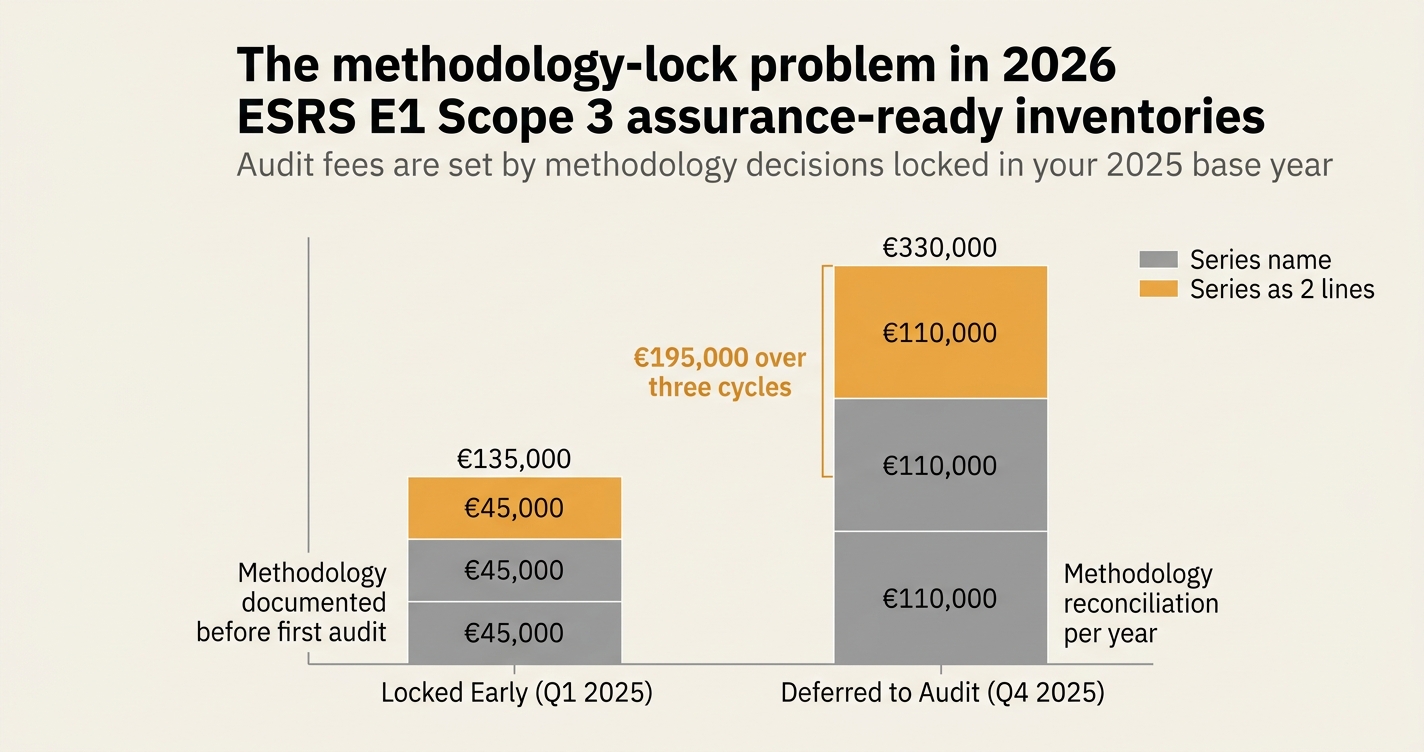
While Scope 3 calculation has become cheaper—supplier engagement platforms, automated emission factor lookups, API integrations with procurement systems—methodology documentation has become more expensive. If you defer methodology decisions to the audit cycle, the cost of documenting and reconciling those decisions might outpace the savings from automation. A company that locks methodology in Q1 2025 will pay approximately €45,000 per year in limited assurance fees. A company that defers methodology decisions to Q4 2025 will pay approximately €110,000 per year in FY2026, FY2027, and FY2028—because each year requires reconciliation back to an undefined base year.[1]
How do you solve this? I think the answer is to treat methodology as a first-order disclosure artefact, not a byproduct of the calculation. The operators we work with version-control their methodology documentation as a formal calculation manual, approved by the board before the first audit cycle, and update it only when a material change in business operations requires it. This shifts the cost of methodology documentation forward into 2025, but it eliminates the cumulative cost of year-on-year reconciliation in 2026, 2027, and 2028.
The shape of the argument, visualised below.
The ESRS E1 methodology documentation requirement
ESRS E1 paragraph AR 39(b) requires the undertaking to disclose the methodologies, significant assumptions, and emissions factors used to calculate or measure GHG emissions.[2] For Scope 3, ESRS E1 paragraph AR 46(h) requires clarity on the boundaries considered and the methods used for estimating emissions.[2] The requirement is explicit: you must document not only what you measured, but how you measured it.
The GHG Protocol Corporate Value Chain (Scope 3) Standard ranks methods from most to least accurate: supplier-specific, hybrid, average-data, then spend-based.[3] It does not mandate a single method; it requires organisations to use the most accurate data reasonably available, prioritised by materiality, and to disclose the method used for each category. ESRS E1 references the GHG Protocol as the methodology standard, but adds a layer of enforceability: auditors are increasingly issuing qualified opinions where material Scope 3 categories rely on spend-based estimates without a documented rationale for why primary data was not reasonably available.[3]
The practical consequence: if you change your methodology between FY2025 and FY2026, you must either restate the base year, or disclose the methodology change and explain why the totals are not comparable. Both options are expensive, but one is far more expensive than the other.
Restatement vs. methodology-change disclosure: a cost comparison
| Decision point | Locked early (Q1 2025) | Deferred to audit (Q4 2025) | Delta |
|---|---|---|---|
| Data-quality tier for Category 1 | Spend-based documented, escalation path to supplier-specific documented | Undocumented switch from spend-based to supplier-specific | +€20,000 reconciliation fee per year |
| System boundary for Category 9 | Last-mile delivery included or excluded, rationale documented | Boundary shift between years, auditor requests retrospective justification | +€15,000 reconciliation fee per year |
| Emission factor database version | 2025 database locked, version-control documented | Database version drifts between years, factors not comparable | +€10,000 reconciliation fee per year |
| Materiality threshold for Category 11 | 5% threshold documented, applies consistently | Threshold implicit, changes between years | +€20,000 reconciliation fee per year |
| Cumulative audit cost (FY2026–FY2028) | €45,000/year | €110,000/year | +€65,000/year |
The table reflects real 2025–2026 audit cost deltas from limited assurance engagements we have supported. The locked-early column assumes methodology is documented in a formal calculation manual, version-controlled, and approved by the board before the first audit. The deferred-to-audit column assumes methodology decisions are implicit in the consultant's spreadsheet and not surfaced until the auditor requests documentation.
The assurance-cost impact is cumulative. A company that defers all four decision points to Q4 2025 will pay approximately €65,000 more per year in FY2026, FY2027, and FY2028 limited assurance fees than a company that locks methodology in Q1 2025—because each year requires reconciliation back to the undefined base year.[1]
The GHG Protocol Scope 3 Standard Phase 1 revisions (March 2026)
The GHG Protocol published a Phase 1 progress update on March 31, 2026, working through category boundary-setting, data quality, and methodology documentation.[4] The update introduces mandatory data-type disaggregation and verification labelling. Organisations will need to report, for each Scope 3 category, the proportion of data that is supplier-specific, hybrid, average-data, or spend-based, and whether that data is fully verified, partially verified, or not verified.[3]
This change raises the stakes for methodology-lock decisions made in 2025. If your FY2025 disclosure does not disaggregate data quality by category, your FY2026 disclosure will require a retrospective disaggregation of the base year—or you will report a methodology change that makes the year-on-year comparison non-meaningful. The European Financial Reporting Advisory Group has signalled that spend-based data for material categories will attract qualified audit opinions.[3]
A full public consultation draft is expected mid-2026, with a final standard targeted for late 2027. For Wave 1 CSRD filers, this means FY2025 and FY2026 disclosures will be prepared under the 2011 Scope 3 Standard, but FY2027 and FY2028 disclosures will be prepared under the revised standard. The methodology decisions you lock in 2025 will determine whether the transition from the 2011 standard to the 2027 standard requires a base-year restatement—or whether you can absorb the change as a prospective methodology update.
"The GHG Protocol's Scope 3 Standard ranks methods from most to least accurate: supplier-specific, hybrid, average-data, then spend-based. It does not mandate a single method; it requires organisations to use the most accurate data reasonably available, prioritised by materiality, and to disclose the method used for each category."[3]
Four methodology decisions that lock audit costs
1. Data-quality tier migration path
You start with spend-based data for Category 1 in 2025 because suppliers have not yet responded to your data request. In 2026, 40% of suppliers provide primary data. Do you restate 2025, or report a methodology change?
The GHG Protocol allows both, but ESRS E1 paragraph 44 requires disclosure of significant categories with methodology documentation. If Category 1 is significant (it usually is), the auditor will ask how the 2025-to-2026 delta splits between actual reduction and data-quality improvement. If you cannot answer, the auditor will qualify the opinion or request a base-year restatement. The cost: €20,000 per year in reconciliation fees, or €30,000–€50,000 for a one-time restatement audit.[1]
The locked-early approach: document in Q1 2025 that Category 1 will migrate from spend-based to supplier-specific over a three-year horizon, with interim disclosure of the proportion of data that is supplier-specific vs. spend-based in each reporting cycle. This makes the 2025-to-2026 change a documented escalation, not a methodology shift.
2. System boundary for transport and distribution categories
Category 4 (Upstream transportation and distribution) and Category 9 (Downstream transportation and distribution) both require a system boundary decision: do you include last-mile delivery, or only to the customer's loading dock?
If you exclude last-mile delivery in 2025 because the data is not available, then include it in 2026 because you onboarded a logistics data provider, the auditor will ask whether the 2025 number should be restated to include last-mile delivery. If you cannot restate (because you do not have 2025 last-mile data), the auditor will note that the 2025-to-2026 comparison is not meaningful.
The locked-early approach: document the system boundary in Q1 2025, with a rationale for the exclusion or inclusion of last-mile delivery. If you exclude it, document the data availability constraint and the plan to include it in future cycles. This makes the 2026 boundary expansion a documented escalation, not a methodology shift.
3. Emission factor database version and update frequency
You calculate 2025 Scope 3 using the 2024 DEFRA emission factor database. In 2026, you switch to the 2025 DEFRA database. The emission factors for several categories have changed by 5–10%. Do you restate 2025 using the 2025 database, or report a methodology change?
The GHG Protocol allows prospective application of updated emission factors, but ESRS E1 requires disclosure of the emission factors used. If the database version changes between years, the auditor will ask whether the year-on-year delta is driven by actual reduction or by emission factor drift.
The locked-early approach: document the emission factor database and version in Q1 2025, with a policy for updating emission factors (e.g., update annually in Q1, apply prospectively, disclose the version change in the sustainability statement). This makes the 2026 database update a documented policy application, not a methodology shift.
4. Materiality threshold for category inclusion
You exclude Category 11 (Use of sold products) from your 2025 disclosure because it represents less than 5% of total Scope 3. In 2026, you include it because a new product line shifts the category to 8% of total Scope 3. The auditor asks whether the 2025 exclusion was justified, and whether the 2025 number should be restated to include Category 11.
The ESRS does not define a numeric materiality threshold; it requires disclosure of all material categories, with materiality assessed using the double-materiality lens (impact materiality and financial materiality). If you apply a 5% threshold in 2025, you must document the rationale and apply it consistently in 2026—or disclose that the threshold has changed.
The locked-early approach: document the materiality threshold and assessment process in Q1 2025, with a rationale for why Category 11 was excluded (e.g., no sold products with significant use-phase emissions). If the category becomes material in 2026, document the change in business operations that triggered the reclassification. This makes the 2026 inclusion a documented materiality reassessment, not a methodology shift.
How Emission3 fits
Emission3 is built for assurance-ready Scope 3 disclosure under ESRS E1. The platform enforces methodology documentation as a first-order artefact: every calculation is version-controlled, every emission factor is timestamped, and every system boundary decision is recorded in a formal calculation manual that exports to your sustainability statement. When you change a methodology decision—switching from spend-based to supplier-specific data, updating the emission factor database, expanding the system boundary—the platform generates a reconciliation report that splits the year-on-year delta between actual reduction and methodology change. This eliminates the €65,000 cumulative audit cost delta that results from deferred methodology decisions.
For CSRD Wave 1 filers preparing for FY2025 limited assurance, this means you lock methodology in Q1 2025, not Q4 2025—and you absorb the GHG Protocol Scope 3 Standard revisions (expected late 2027) as a prospective methodology update, not a base-year restatement.
The 2026 methodology-lock playbook
If you are a CSRD Wave 1 filer preparing for your first ESRS E1 limited assurance engagement in Q2 2026, the following timeline reflects the decisions that lock audit costs:
Q1 2025 (January–March):
- Document system boundaries, emission factor databases, data-quality tiers, and materiality thresholds in a formal calculation manual.
- Version-control the manual and secure board approval before the first audit cycle.
- Budget €10,000–€15,000 for methodology documentation in Q1 2025.
Q2 2025 (April–June):
- Execute the FY2025 Scope 3 calculation using the documented methodology.
- Collect supplier-specific data where reasonably available; apply spend-based or average-data methods where not.
- Document data availability constraints and escalation paths for each category.
Q3 2025 (July–September):
- Engage the limited assurance auditor and provide the calculation manual as the first disclosure artefact.
- Budget €45,000 for the FY2025 limited assurance engagement.
Q4 2025 (October–December):
- Update the calculation manual to reflect any material changes in business operations (new product lines, acquisitions, geographic expansions).
- Document any prospective methodology updates for FY2026 (e.g., data-quality tier migration, system boundary expansion).
Q1 2026 (January–March):
- Execute the FY2026 Scope 3 calculation using the updated methodology.
- Generate a reconciliation report that splits the year-on-year delta between actual reduction and methodology change.
- Budget €45,000 for the FY2026 limited assurance engagement (not €110,000).
The cumulative cost of this timeline is €100,000 over two audit cycles (€10,000 documentation + €45,000 FY2025 audit + €45,000 FY2026 audit). The cumulative cost of the deferred-methodology timeline is €162,000 over two audit cycles (€45,000 FY2025 audit + €72,000 FY2026 audit + €45,000 for base-year restatement). The delta: €62,000.
Closing
The methodology-lock problem is not a disclosure problem—it is a timing problem. The decisions that determine your 2026, 2027, and 2028 audit fees are the decisions you make in Q1 2025, not Q4 2025. The operators who lock methodology early pay €45,000 per year in limited assurance fees. The operators who defer methodology to the audit cycle pay €110,000 per year—because each year requires reconciliation back to an undefined base year.
If you are preparing for your first ESRS E1 limited assurance engagement in Q2 2026, the time to lock methodology is now. Book a CBAM readiness call at /book-demo to map your system boundaries, data-quality tiers, and emission factor databases before your first audit cycle.[5]
References & Sources
External Sources
- [2]ESRS E1 – Climate Change - EFRAG Knowledge Hub
ESRS E1 paragraph AR 39(b) requires disclosure of methodologies, significant assumptions and emissions factors used to calculate GHG emissions. For Scope 3, AR 46(h) requires clarity on boundaries and methods used for estimating emissions.
- [3]Activity-based vs production-based vs spend-based emission factors: comprehensive comparison
GHG Protocol Scope 3 Standard Phase 1 revisions introduce mandatory data-type disaggregation and verification labelling. EFRAG has signalled that spend-based data for material categories will attract qualified audit opinions.
- [4]Scope 3 Standard Revisions Phase 1 Progress Update - GHG Protocol
The GHG Protocol published a Phase 1 progress update on March 31, 2026, working through category boundary-setting, data quality, and methodology documentation. Full consultation draft expected mid-2026, final standard late 2027.
- [6]ESRS Q&A Platform First set of explanations - EFRAG
ESRS does not exclude flexibility in methodologies used by different undertakings, provided qualitative characteristics are met. Deviations from common methodology should be disclosed with rationale to meet transparency requirements.
Related Content
- [1]The methodology-consistency requirement in ESRS E1 Scope 3 emissions disclosure for multi-year GHG inventories
ESRS E1 Scope 3 consists of emissions totals and methodology documentation. Teams budget for the first—but auditor fees are set by decisions locked in your 2025 base year.
- [5]Book a CBAM readiness call
All customers start with a readiness call: we map suppliers, gaps, and implementation, no anonymous self-serve onboarding.