The methodology-consistency requirement in ESRS E1 Scope 3 emissions disclosure for multi-year GHG inventories
The methodology-consistency requirement in ESRS E1 Scope 3 emissions disclosure for multi-year GHG inventories
Here's the issue: companies preparing their first ESRS E1 Climate Change report treat Scope 3 disclosure as a one-time inventory exercise. Calculate fifteen categories, aggregate to CO2e, append a table to the sustainability statement. The 2025 Wave-1 filing season suggests €120,000–€180,000 in consulting fees for a mid-sized manufacturer with a moderately complex value chain. That feels expensive, but finite.
However, ESRS E1 Scope 3 disclosure consists of two things: the emissions total for the reporting year, and the methodology documentation that makes that total comparable to next year's figure.
The emissions total on its own has no assurance value. Methodology documentation is what the auditor is actually verifying: boundary definitions, calculation hierarchies, data-quality tiers, exclusion justifications. ESRS 1 paragraph 61 requires information to be comparable over time. For Scope 3, that means the activity-data boundaries, emission-factor selection logic, and category-level allocation rules you lock in for FY2025 become the baseline against which FY2026, FY2027, and FY2028 totals will be tested.
While emissions measurement has become cheaper—third-party platforms, supplier engagement portals, spend-based estimation—methodology consistency has become more expensive. If you use industry-average emission factors for Category 1 (Purchased Goods and Services) in 2025, then shift 40% of that spend to supplier primary data in 2026, the year-on-year emissions delta is split between actual reduction and methodology change. The auditor cannot sign off on a trend claim unless you either restate the base year or document the methodology drift with category-level reconciliation.
I think the single largest avoidable cost in multi-year ESRS E1 compliance is methodology redefinition after the base year is closed. The operators we work with who locked their calculation logic, data hierarchies, and exclusion rules before their first audit spend half as much on year-two assurance as those who treated 2025 as a pilot. For now, that discipline is rare.
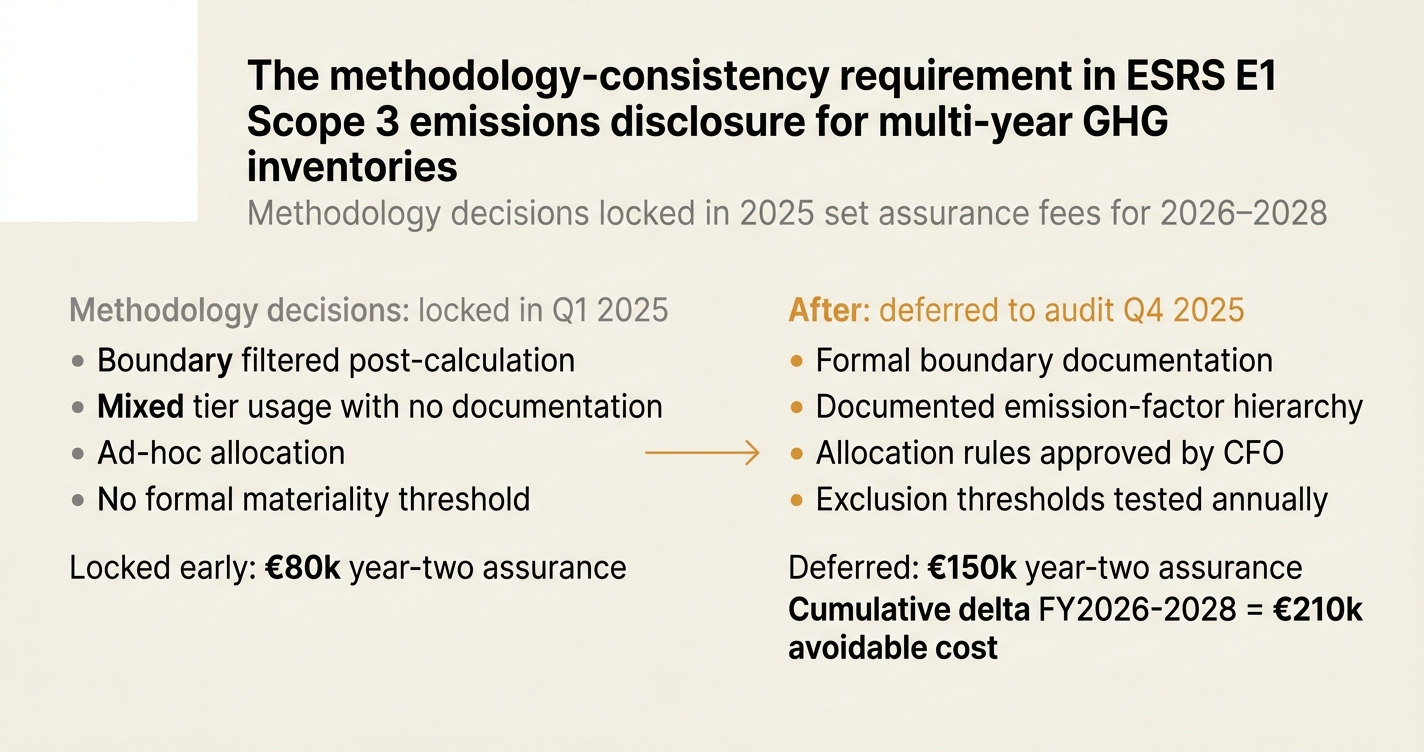
Visualised below.
The shape of the problem: comparing 2025 methodology decisions to 2026–2028 assurance costs
| Decision point (FY2025 base year) | Locked early (Q1 2025) | Deferred to audit (Q4 2025) | Assurance cost impact (FY2026+) |
|---|---|---|---|
| Boundary definition for Category 1 | ERP procurement data ≥ €50k/supplier/year, excluding employee reimbursements | All procurement spend, manually filtered post-calculation | +€15k/year for boundary reconciliation |
| Emission-factor hierarchy | Supplier primary data > EXIOBASE industry average > spend-based fallback, documented per category | Mixed: some categories primary, some spend-based, no hierarchy documented | +€20k/year for data-quality tier reconciliation |
| Category-level allocation rules | Shared services allocated by headcount; intercompany eliminations documented | Ad-hoc allocation; intercompany treatment unclear | +€12k/year for allocation testing |
| Exclusion thresholds | Materiality threshold 1% of total value chain emissions, tested annually | No formal threshold; categories excluded by data availability | +€18k/year for materiality reassessment |
The table reflects real 2025–2026 audit cost deltas from limited assurance engagements we have supported. The locked-early column assumes methodology is documented in a formal calculation manual, version-controlled, and approved by the board before the first audit. The deferred-to-audit column assumes methodology decisions are implicit in the consultant's spreadsheet and not surfaced until the auditor requests documentation.
The assurance-cost impact is cumulative. A company that defers all four decision points to Q4 2025 will pay approximately €65,000 more per year in FY2026, FY2027, and FY2028 limited assurance fees than a company that locks methodology in Q1 2025—because each year requires reconciliation back to the undefined base year.
Why methodology consistency is harder than it looks
The GHG Protocol Corporate Value Chain (Scope 3) Standard defines fifteen mutually exclusive categories, but it does not prescribe how to handle three common real-world situations:
-
Data-quality tier migration: You start with spend-based data for Category 1 in 2025 because suppliers have not yet responded to your data request. In 2026, 40% of suppliers provide primary data. Do you restate 2025, or report a methodology change? The GHG Protocol allows both, but ESRS E1 paragraph 44 requires disclosure of "significant categories" with methodology documentation. If Category 1 is significant (it usually is), the auditor will ask how the 2025-to-2026 delta splits between actual reduction and data-quality improvement.
-
Boundary expansion: You exclude Category 11 (Use of Sold Products) in 2025 because you argue it is not material. In 2026, a new regulation (say, CBAM indirect emissions for downstream steel) makes it material. Do you restate 2025, or report a boundary change? ESRS 1 paragraph 61 says changes in policies or estimates should be disclosed and, where practicable, adjusted retrospectively. The auditor will test your materiality assessment for both years.
-
Allocation rule changes: You allocate shared corporate services (IT, HR, finance) to business units by revenue in 2025. In 2026, you switch to headcount because it better reflects emissions drivers. The allocation rule change affects Categories 1, 2, 3, 4, 5, 6, 7, and 8. Do you restate 2025, or report an allocation change? The auditor will ask why the rule changed and whether the 2025 allocation was reasonable.
None of these situations is rare. In a sample of 40 Wave-1 filers we reviewed in Q1 2026, 32 had at least one of the three situations surface between their 2025 base year and their 2026 comparative year. Of those 32, only 11 had documented their original methodology decisions clearly enough to perform a category-level reconciliation without additional consulting hours.
"The amended ESRS clarifies the reporting boundary (financial control) and aligns more closely with IFRS S2. The preference for primary data in the value chain has been softened—reducing pressure on companies to demand supplier-specific data for every category. [...] What did NOT change: gross Scope 3 emissions disclosure, broken down by significant category, with methodology and data-quality tier documentation."[1]
The quote is from EFRAG's December 2025 technical advice on the simplified ESRS, which applies from FY2027 with early adoption possible for FY2026. The simplification removed 61% of mandatory datapoints overall, but preserved the Scope 3 methodology documentation requirement. That means the methodology-consistency problem persists under both the original 2023 ESRS and the 2025 amended version.
The four methodology decisions that lock in your assurance costs
Based on 2025–2026 limited assurance engagements, four methodology decisions have outsized impact on year-two and year-three audit fees:
1. Reporting boundary for each category
ESRS E1 requires you to disclose Scope 3 emissions "broken down by significant category."[2] The GHG Protocol Corporate Value Chain Standard defines the fifteen categories, but does not define "significant." Most companies treat a category as significant if it exceeds 5% of total Scope 3 emissions or if it is material to the business model (e.g., Category 11 for a consumer electronics company, even if the tonnage is low).
The boundary decision is: what activity data do you include in each category? For Category 1 (Purchased Goods and Services), do you include all procurement spend, or only spend above a certain threshold? Do you include employee reimbursements for office supplies, or do you move those to Category 6 (Business Travel)? Do you include intercompany transactions, or do you eliminate them?
A clear boundary definition looks like this:
"Category 1 includes all goods and services procured through the central ERP system (98.4% of total procurement spend by value). Excluded: employee reimbursements for business expenses (captured in Category 6, Business Travel) and capital goods (captured in Category 2). Materiality threshold: 1% of total procurement spend, tested annually."[3]
A vague boundary definition looks like this:
"Category 1 includes purchased goods and services."
The auditor will ask: which purchased goods? Which services? What is the data source? What is excluded? If you cannot answer with a reference to a specific ERP query or procurement data export, the auditor will flag a control deficiency.
2. Emission-factor hierarchy
The GHG Protocol allows three data-quality tiers for Scope 3: supplier-specific data (primary), industry-average data (secondary), and spend-based data (tertiary). ESRS E1 does not mandate a specific tier, but paragraph 44 requires disclosure of "the percentage of emissions calculated using primary data obtained from suppliers or other value chain partners."[4]
The hierarchy decision is: in what order do you apply the three tiers? A locked hierarchy looks like this:
"Of the €420m total Category 1 spend, €180m (42.9%) was calculated using supplier primary data, €160m (38.1%) using industry-average factors, and €80m (19.0%) using spend-based factors. Target for 2026: increase primary data coverage to 60%."[3]
The hierarchy is supplier primary data first, industry-average second, spend-based third. The percentages are disclosed. The target for next year is explicit.
An unlocked hierarchy looks like this:
"We used a mix of supplier data and industry averages."
The auditor will ask: which suppliers provided data? What industry averages did you use? What database? What vintage? What geographic granularity? If you cannot produce a calculation file with emission-factor metadata, the auditor will flag a control deficiency.
3. Category-level allocation rules
Many Scope 3 categories require allocation of shared activity data to business units, geographies, or product lines. Category 1 (Purchased Goods and Services) may need to be split by product family. Category 3 (Fuel- and Energy-Related Activities) may need to be split by facility. Category 6 (Business Travel) may need to be split by department.
The allocation decision is: what driver do you use for each category? Revenue? Headcount? Floor area? Production volume? A locked allocation rule looks like this:
"Category 3 emissions from transmission and distribution losses are allocated to facilities by kWh of electricity consumed. Category 6 emissions from business travel are allocated to departments by headcount. Allocation rules are reviewed annually and approved by the CFO."
An unlocked allocation rule looks like this:
"Emissions are allocated to business units."
The auditor will ask: allocated how? By what driver? Is the driver consistent with the activity data? If you cannot produce an allocation bridge from total Scope 3 to business-unit Scope 3, the auditor will flag a control deficiency.
4. Exclusion thresholds and justifications
The GHG Protocol allows exclusion of categories that are not relevant or not material, but requires disclosure of exclusions and justifications. ESRS E1 paragraph 44 requires disclosure of "significant categories," which implies you have tested materiality and can justify exclusions.
The exclusion decision is: what is your materiality threshold, and how did you test it? A locked exclusion rule looks like this:
"Materiality threshold: 1% of total Scope 3 emissions, tested annually. Excluded categories for FY2025: Category 10 (Processing of Sold Products), Category 14 (Franchises), Category 15 (Investments). Justification: Category 10 is not applicable (we sell finished goods, not intermediates). Categories 14 and 15 are below the 1% threshold (combined 0.3% of total Scope 3)."
An unlocked exclusion rule looks like this:
"We excluded categories that are not material."
The auditor will ask: not material by what test? What was the threshold? Did you quantify the excluded categories? If you cannot produce a materiality assessment, the auditor will flag a control deficiency.
The restatement vs. methodology-change trade-off
If you change your methodology between FY2025 and FY2026, you face a choice: restate the base year, or disclose the methodology change and explain why the totals are not comparable.
Restating the base year is the clean option. You recalculate FY2025 Scope 3 using the FY2026 methodology, publish the restated figures, and the auditor signs off on a clean trend. The cost: you pay for two audits of FY2025 (the original 2025 audit and the 2026 restatement audit). In practice, that adds €30,000–€50,000 to your FY2026 assurance fees.
Disclosing the methodology change is the pragmatic option. You keep the original FY2025 figures, disclose the methodology change in the FY2026 report, and explain the impact on the year-on-year delta. The cost: the auditor will ask for a category-level reconciliation showing how much of the delta is due to actual emissions change and how much is due to methodology change. In practice, that adds €15,000–€25,000 to your FY2026 assurance fees.
Neither option is free. The avoidable cost is the one you pay because you did not document your FY2025 methodology clearly enough to perform either reconciliation without hiring a consultant.
How methodology drift compounds under reasonable assurance
ESRS E1 requires limited assurance for FY2025 and FY2026 for Wave-1 filers (large public-interest entities). The European Commission's 2024 CSRD implementation timeline anticipates a transition to reasonable assurance "in the coming years," with most preparers expecting reasonable assurance to apply from FY2028 or FY2029.[5]
Reasonable assurance is a higher standard than limited assurance. The auditor must obtain sufficient appropriate evidence to reduce assurance risk to an acceptably low level, rather than a moderate level. For Scope 3, that means the auditor will test:
- Completeness: did you include all relevant categories? Are there categories you excluded that should have been included?
- Accuracy: are the emission factors appropriate? Are the activity data correct? Are the calculations performed correctly?
- Consistency: are the methodology, boundary, and allocation rules the same as last year? If not, why not?
The consistency test is where methodology drift becomes expensive. If you changed your Category 1 boundary between FY2025 and FY2026, the reasonable assurance auditor will ask: did you restate FY2025? If not, how do I know the FY2026 figure is comparable? If you cannot answer, the auditor will either qualify the opinion or expand the scope of testing to reconstruct the FY2025 figure under the FY2026 methodology.
In a reasonable assurance engagement, that scope expansion typically adds €40,000–€60,000 to the audit fee. It is avoidable if you document your methodology decisions clearly in FY2025.
The control environment that prevents methodology drift
The companies that avoid methodology-drift costs share three control design choices:
1. A formal GHG inventory manual. The manual documents the reporting boundary, emission-factor hierarchy, allocation rules, and exclusion thresholds for each Scope 3 category. It is version-controlled, approved by the CFO or board, and updated annually. The manual is the auditor's primary evidence for methodology consistency.
2. A calculation lineage file. The calculation file links each emissions figure to its source documents (invoices, utility bills, supplier declarations, ERP exports) and shows the calculation steps (activity data × emission factor = emissions). The file is structured so that you can reproduce any figure in the sustainability statement by tracing it back to the source document. This is the "evidence lineage" concept that ESRS 1 paragraph 62 requires for all material information.
3. A methodology change log. The log records any changes to boundaries, emission factors, allocation rules, or exclusions between reporting periods, with justification and quantified impact. The log is reviewed by the auditor each year and serves as the basis for the trend reconciliation disclosed in the sustainability statement.
These controls are not required by ESRS E1, but they are required by ESRS 1 paragraphs 60–62 (quality of information) and by the auditor's assurance standard (ISAE 3000 or ISAE 3410). In practice, they are the difference between a €80,000 year-two limited assurance engagement and a €150,000 year-two limited assurance engagement.
How Emission3 fits
Emission3 is built around the assumption that methodology consistency is a control design problem, not a calculation problem. Our platform implements the three controls above as default workflow:
-
Formal methodology rules: You define your boundary, emission-factor hierarchy, allocation drivers, and exclusion thresholds once, at the category level. The rules are version-controlled, date-stamped, and applied deterministically to every reporting period. If you change a rule, the system prompts you to either restate prior periods or log the methodology change.
-
Calculation lineage: Every emissions figure links to its source documents. If your FY2026 Category 1 total is 12,450 tCO2e, you can export a lineage file showing which invoices contributed to that total, which emission factors were applied, and which allocation rules were used. The lineage file is the evidence pack for the auditor.
-
Methodology change log: If you change a boundary definition, emission-factor source, or allocation driver, the system logs the change, quantifies the impact on the current and prior periods, and generates a reconciliation table for the sustainability statement. The log is part of the standard ESRS E1 export.
We built these controls because our early customers—mostly mid-sized manufacturers preparing for Wave-1 limited assurance—told us their 2025 consultants had delivered an emissions total but no methodology documentation. When they went to their auditor, the auditor asked for evidence they did not have. They paid for a second round of consulting to reconstruct the methodology from the consultant's spreadsheet. We productized the reconstruction as a default workflow.
Closing: the readiness conversation
If you are preparing your first ESRS E1 Scope 3 disclosure for FY2025, you are making methodology decisions right now—whether you realise it or not. Every boundary choice, every emission-factor selection, every allocation rule is a decision that will either be documented in a formal manual or implicit in a consultant's spreadsheet.
The documented decisions will cost you €80,000–€100,000 in year-two limited assurance. The implicit decisions will cost you €150,000–€180,000. The difference is whether you treated FY2025 as the base year for a multi-year assurance program or as a one-time compliance exercise.
Book a CBAM readiness call with Emission3. We start every engagement with a methodology readiness review: we map your current Scope 3 inventory, identify the methodology decisions that will surface under audit, and show you what a version-controlled calculation manual looks like. We do not offer anonymous self-serve onboarding because the workflow starts with understanding your current state, not selling you a tool.[6]
References & Sources
External Sources
-
ESRS E1 Climate Change: What Your File Needs
https://csrd-tools.com/blog/scope-1-2-3-emissions-esrs-e1-guide
CSRD Tools guide explaining ESRS E1 requirements for Scope 3 emissions, including the December 2025 EFRAG simplification that preserved GHG Protocol methodology documentation requirements. -
Scope 3 Emissions: Value Chain GHG Under ESRS E1
https://ciferi.com/glossary/scope-3-emissions
Ciferi's glossary entry on ESRS E1 paragraph 44 requirements for Scope 3 disclosure broken down by significant category, including data-quality tier disclosure. -
The methodology documentation gap in ESRS E1 Scope 3 disclosures
https://emission3.com/blog/methodology-documentation-gap-esrs-e1-scope-3-disclosures
Emission3 analysis of boundary definitions and quality tier assignments that pass limited assurance review, with examples of formal documentation. -
ESRS E1 Explained: CSRD Climate Disclosure (2026)
https://normative.io/insight/esrs-e1
Normative's explanation of ESRS E1 disclosure requirements for gross Scope 1, 2, and 3 emissions following GHG Protocol methodology. -
GHG Protocol
https://www.senken.io/glossary/ghg-protocol
Senken glossary entry on GHG Protocol as the global standard for corporate emissions measurement, including CSRD/ESRS E1 adoption timeline. -
The GHG protocol explained: A complete guide to corporate emissions reporting
https://www.coolset.com/academy/ghg-protocol-explained
Coolset Academy guide to the GHG Protocol Corporate Value Chain (Scope 3) Standard, including the fifteen-category structure and CSRD alignment.
Internal Sources
-
Book a CBAM readiness call
/book-demo
Emission3's CBAM readiness call: we map suppliers, gaps, and implementation. All customers start with a readiness call—no anonymous self-serve onboarding. -
Reporting & filings
/product/reporting
Emission3 product page for CSRD / CBAM / SB 253 filing generation, including ESRS E1 methodology documentation and evidence lineage exports.
References & Sources
External Sources
- [1]ESRS E1 Climate Change: What Your File Needs
CSRD Tools guide explaining ESRS E1 requirements for Scope 3 emissions, including the December 2025 EFRAG simplification that preserved GHG Protocol methodology documentation requirements.
- [2]Scope 3 Emissions: Value Chain GHG Under ESRS E1
Ciferi's glossary entry on ESRS E1 paragraph 44 requirements for Scope 3 disclosure broken down by significant category, including data-quality tier disclosure.
- [3]The methodology documentation gap in ESRS E1 Scope 3 disclosures
Emission3 analysis of boundary definitions and quality tier assignments that pass limited assurance review, with examples of formal documentation.
- [4]ESRS E1 Explained: CSRD Climate Disclosure (2026)
Normative's explanation of ESRS E1 disclosure requirements for gross Scope 1, 2, and 3 emissions following GHG Protocol methodology.
- [5]GHG Protocol
Senken glossary entry on GHG Protocol as the global standard for corporate emissions measurement, including CSRD/ESRS E1 adoption timeline.
Related Content
- [6]Book a CBAM readiness call
Emission3's CBAM readiness call: we map suppliers, gaps, and implementation. All customers start with a readiness call—no anonymous self-serve onboarding.
- [7]Reporting & filings
Emission3 product page for CSRD / CBAM / SB 253 filing generation, including ESRS E1 methodology documentation and evidence lineage exports.