The methodology-documentation gap in SB 253 limited assurance engagements
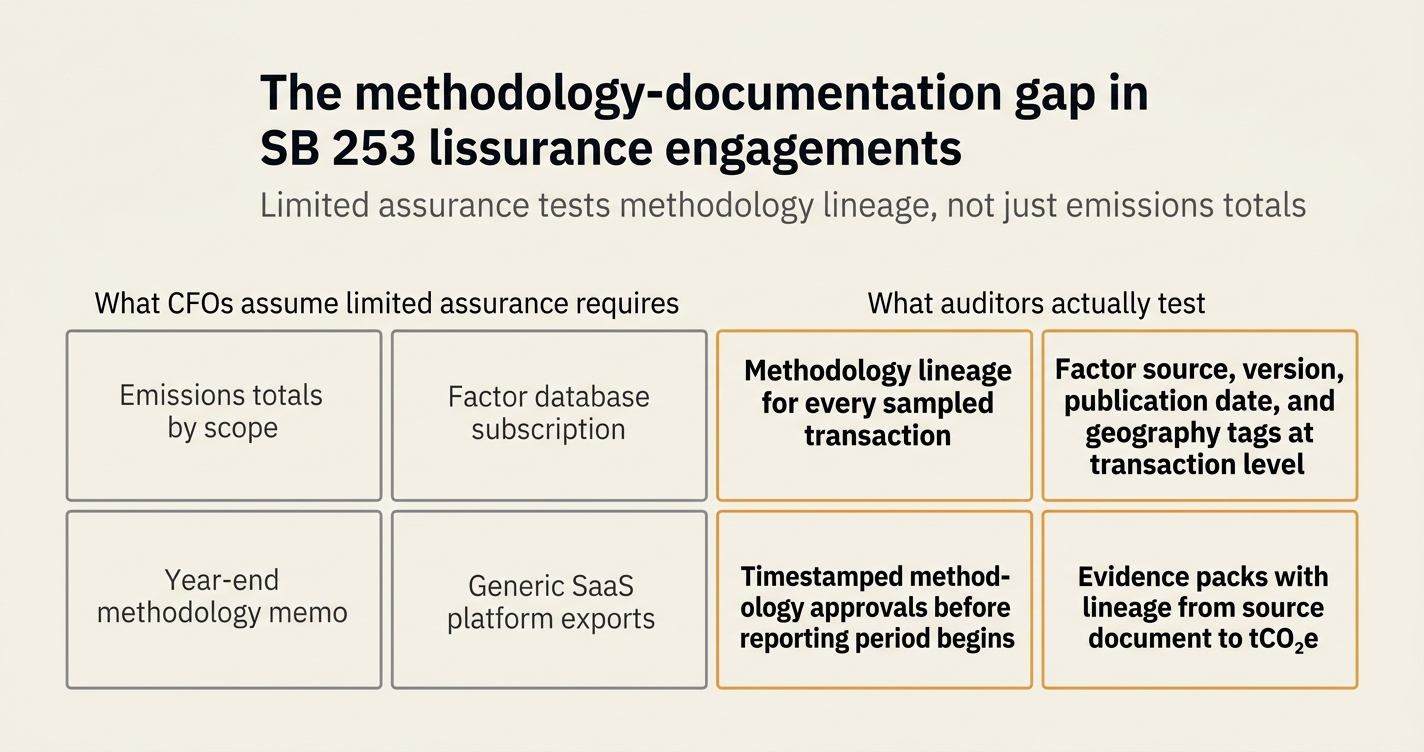
The methodology-documentation gap in SB 253 limited assurance engagements
Here's the issue: CFOs preparing for California SB 253 compliance are discovering that audit quotes for limited assurance engagements are re-pricing at 20-40% above initial estimates, not because the emissions calculations grew more complex, but because the methodology documentation was never built to survive review. A finance director at a manufacturing firm told us their auditor added 140 hours for methodology reconciliation work after discovering that allocation methods changed between Q1 and Q3 without documentation.
However, SB 253 limited assurance consists of two things: emissions totals and methodology documentation. The first is what appears in the disclosure report filed with the California Air Resources Board: the tonnage figure for Scope 1 and Scope 2 emissions. The second is the calculation lineage that proves every allocation decision, factor selection, and boundary choice is reproducible: which emission factors were applied, why spend-based estimation was used for specific categories, how operational control boundaries were drawn, and which methodologies remained consistent across the reporting year.
Emissions totals on their own have no value to an auditor. Methodology documentation is what the assurance provider is actually reviewing when they test a limited assurance engagement. When an auditor requests "support for the boundary definition in Scope 1," they are not asking for a calculation walk-through. They are asking for timestamped evidence that the methodology was selected, approved, applied consistently, and documented at the transaction level.
While emissions calculation has become cheaper through cloud-based platforms and factor databases, methodology documentation has become more expensive. If a 3,200-employee firm without methodology lineage faces a June 2026 limited assurance deadline covering calendar year 2025 emissions, the cost of reconstructing allocation decisions and factor selections might exceed the original compliance budget by 30-50%. The California Air Resources Board estimates annual SB 253 program fees at $3,106 per entity, but third-party assurance providers are quoting $35,000 to $80,000 for limited assurance on Scope 1 and 2, depending on methodology documentation quality.[1]
How do you solve this? I think the firms that will compress 2026 audit timelines are the ones that treat methodology selection as a monthly artifact, not a year-end reconstruction. They are not retrofitting documentation in Q2 2026—they are timestamping factor selections, tagging allocation methods, and recording boundary decisions as part of the emissions close cycle. For CFOs evaluating whether to build this internally or outsource it, the question is whether your carbon accounting system can export methodology lineage in the format an auditor expects.
The shape of the argument, visualised below.
Myth 1: "Limited assurance is less rigorous, so methodology documentation can be lighter."
Reality: Limited assurance provides a negative conclusion ("nothing has come to our attention that the emissions are materially misstated"), but the methodology documentation standard remains identical to reasonable assurance. The difference is scope, not evidence quality. Auditors will sample 10-20% of emissions sources instead of 50-70%, but every source in that sample must have full methodology lineage: factor source, allocation method, boundary definition, approval timestamp.[2]
A worked example: A logistics company reports 87,000 tCO₂e Scope 1 emissions. The auditor selects 15% of vehicle-fleet fuel consumption for testing. For each sampled transaction, the auditor requests:
- The emission factor applied (e.g., EPA 2024 mobile combustion factors).
- The allocation method if the vehicle serves multiple cost centers.
- The operational control boundary rationale if the vehicle is leased.
- The approval record showing the methodology was selected before the reporting period began.
If any of these artifacts is missing, the auditor cannot conclude the sample is free from material misstatement. The engagement extends, and the CFO pays for reconstruction hours.
Myth 2: "We can document methodologies at year-end when we finalize the inventory."
Reality: Methodology selection must be documented before the reporting period begins, not after. Under ISAE 3410 (the international standard for GHG assurance), an auditor tests whether methodologies were selected and approved in advance, then applied consistently.[3] If a company changes its Scope 2 location-based vs. market-based methodology mid-year without documenting the rationale and re-approval, the auditor qualifies the report.
A $2.1 billion manufacturing firm switched from spend-based to supplier-specific emission factors for Scope 3 Category 1 in June 2025. The switch improved accuracy, but the firm did not document the methodology change, the board approval, or the recalculation of Q1-Q2 baselines. When the auditor reviewed the December 2025 inventory in March 2026, they issued a qualified opinion. The firm paid $48,000 for a second engagement cycle to remediate the documentation gap and restate Q1-Q2 emissions under the new methodology.
The cost to remediate a qualified inventory ranges from $120,000 to $340,000, depending on facility count and data fragmentation.[4]
Myth 3: "Default emission factors are safer because they don't require documentation."
Reality: Default emission factors require more documentation, not less. When a company uses a default factor instead of supplier-specific or facility-specific data, the auditor must verify that:
- No primary data was available.
- The default factor source is recognized (e.g., EPA, IPCC, GHG Protocol).
- The factor version and publication date are recorded.
- The factor geography and activity type match the company's operations.
- The same factor was applied consistently across all similar transactions.
A manufacturing firm used EPA 2023 stationary combustion factors for natural gas across 14 facilities. The auditor tested 3 facilities and discovered that 2 used EPA 2023 factors while 1 used EPA 2022 factors because the data analyst had not updated the spreadsheet. The inconsistency triggered a qualification. The firm spent $22,000 recalculating 11 months of natural gas emissions under a single factor version.
Default factors are not a documentation shortcut. They are a methodology choice that requires the same lineage as primary data.
Myth 4: "Scope 3 is not required until 2027, so we can skip methodology planning in 2025."
Reality: SB 253 requires Scope 3 reporting starting with 2027 disclosures covering calendar year 2026 emissions, but the methodology decisions that determine 2027 audit costs must be locked in during 2025.[5] If a company waits until January 2026 to select Scope 3 methodologies, the entire 2026 data collection cycle will lack the documentation structure an auditor expects.
Scope 3 consists of 15 categories under the GHG Protocol. For most companies:
- Category 1 (Purchased Goods and Services) accounts for 40-70% of total Scope 3.
- Category 4 (Upstream Transportation) accounts for 10-20%.
- Category 11 (Use of Sold Products) varies by industry but can exceed 50% for consumer goods.[6]
A $1.8 billion retail firm began Scope 3 supplier outreach in March 2026 for calendar year 2026 data. By December 2026, they had secured primary data from only 35% of tier-1 suppliers by spend. The auditor tested the Scope 3 inventory in Q1 2027 and could not conclude that the emissions total was free from material misstatement because 65% of the inventory relied on spend-based estimation without documented evidence that primary data was unavailable. The firm paid $67,000 for a second data-collection cycle and a follow-on assurance engagement.
CFOs should initiate Scope 3 supplier outreach in Q1 2025 to secure 2026 calendar-year data, even though the disclosure deadline is June 2027.[7]
Myth 5: "Carbon accounting platforms generate methodology documentation automatically."
Reality: Most carbon accounting platforms generate emissions totals, not methodology lineage. A platform may calculate Scope 1 and 2 emissions using EPA factors, but unless it exports:
- The factor source, version, and publication date for every transaction.
- The allocation method if a meter serves multiple cost centers.
- The boundary definition if a facility is under operational vs. financial control.
- The approval timestamp showing the methodology was selected before the reporting period.
...then the auditor must reconstruct the lineage manually. The reconstruction work is where audit fees escalate.
A comparison of what auditors need vs. what most platforms export:
| What the auditor needs | What most platforms export |
|---|---|
| Lineage from utility bill → meter → allocation method → emission factor → tCO₂e, with timestamps | tCO₂e total by scope and category |
| Factor source, version, publication date, and geography for every transaction | Aggregated factor database without transaction-level tags |
| Operational control boundary rationale for every facility | Facility list without boundary definitions |
| Approval records showing methodology was selected before the reporting period | Calculation logs without approval timestamps |
| Methodology consistency report showing no mid-year changes without re-approval | Emissions trend chart without methodology change flags |
A $3.4 billion logistics firm used a carbon accounting SaaS platform for 2025 Scope 1 and 2 emissions. The platform produced a 12-page PDF report with emissions totals by month, facility, and scope. When the auditor requested methodology lineage in March 2026, the firm discovered the platform did not tag emission factors at the transaction level, did not timestamp methodology approvals, and did not flag mid-year allocation changes. The firm paid $34,000 for a data consultant to reconstruct the lineage from raw utility bills and freight invoices.
Spreadsheets and generic SaaS platforms cannot produce methodology lineage at scale. A single missing factor tag or mid-year methodology drift triggers an audit qualification.
Myth 6: "We can reuse last year's methodology documentation for 2026."
Reality: Methodology documentation must be updated annually to reflect boundary changes, factor updates, and new data sources. Under ISAE 3410, auditors test methodology consistency year-over-year. If a company adds a new facility, changes an allocation method, or switches from EPA 2024 to EPA 2025 factors, the documentation must record:
- The change.
- The rationale.
- The approval.
- The recalculation of prior-year baselines if the change is material.
A manufacturing firm added 2 facilities in Q2 2025. The firm's carbon accounting team updated the Scope 1 and 2 emissions totals but did not document the operational control boundary rationale for the new facilities. When the auditor tested the 2025 inventory in March 2026, they could not verify that the new facilities were correctly included under operational control vs. financial control. The firm paid $18,000 for a legal opinion on the boundary definition and a follow-on assurance review.
Methodology documentation is not a one-time artifact. It is a living record that must be updated every time a boundary, factor, or allocation method changes.
Myth 7: "Assurance providers will guide us through methodology selection."
Reality: Assurance providers will test your methodology, not select it. Under independence rules (similar to SOX 404), auditors cannot design the internal controls or methodologies they are hired to test. If a company asks the assurance provider to recommend which Scope 2 methodology to use (location-based vs. market-based), the auditor must decline or recuse themselves from the engagement.[8]
A $2.7 billion manufacturing firm engaged a Big Four auditor for limited assurance in November 2025. During the scoping call, the CFO asked the auditor to recommend Scope 3 Category 1 methodologies for 2026 supplier data collection. The auditor explained that providing methodology selection advice would violate independence rules and offered to refer the firm to the auditor's consulting arm (a separate legal entity with separate fees). The firm paid $42,000 for methodology advisory services before the assurance engagement began.
CFOs should select methodologies with internal or third-party advisory support before engaging an assurance provider. The assurance provider will test the methodologies, not design them.
Summary: What methodology documentation survives limited assurance review
The table below contrasts what CFOs assume limited assurance requires vs. what auditors actually test:
| What CFOs assume | What auditors test |
|---|---|
| Emissions totals by scope | Methodology lineage for every sampled transaction |
| Factor database subscription | Factor source, version, publication date, and geography tags at the transaction level |
| Year-end methodology memo | Timestamped methodology approvals before the reporting period begins |
| Spreadsheet with allocation formulas | Allocation method documentation tied to source documents (utility bills, meter readings) |
| Generic SaaS platform exports | Evidence packs with lineage from source document → allocation → factor → tCO₂e |
| Default factors for all Scope 1 and 2 | Documentation proving no primary data was available and default factor selection rationale |
| Methodology selected at year-end | Methodology selected, approved, and applied consistently before January 1 of the reporting year |
How Emission3 fits
Emission3 is built for CFOs who need methodology documentation that survives limited assurance review without reconstruction work. The platform ingests utility bills, freight invoices, and supplier data at the transaction level, then timestamps every methodology decision: which emission factor was applied, why an allocation method was chosen, how operational control boundaries were drawn. Every number in the Scope 1, 2, or 3 inventory links back to a source document with full lineage.
For SB 253 filers, Emission3 exports include:
- Evidence packs with PDFs of utility bills, calculation steps, and factor tags for every transaction the auditor samples.
- Methodology consistency reports that flag any mid-year factor updates, allocation changes, or boundary adjustments, with approval timestamps.
- Boundary lineage showing operational control vs. financial control rationale for every facility, updated annually.
- Submission-ready CARB templates with emissions totals, methodology disclosures, and assurance provider attestation fields pre-filled.
A worked example: A logistics firm with $2.3 billion in revenue and 18 facilities used Emission3 for 2025 Scope 1 and 2 compliance. The firm ingested 11 months of utility bills (electricity, natural gas, diesel) and freight invoices (upstream transportation for raw materials). Emission3 timestamped the factor selections in December 2024, before the 2025 reporting period began. In March 2026, the auditor requested lineage for 12% of Scope 1 emissions (sampled by facility and fuel type). Emission3 exported evidence packs in 14 minutes. The auditor completed the limited assurance engagement in 6 days instead of the quoted 15 days. The firm paid $38,000 for the engagement, 42% below the original quote.
The platform is designed for CFOs who want to compress audit timelines and avoid reconstruction fees. There is no anonymous self-serve onboarding—every engagement starts with a CBAM and SB 253 readiness call where we map methodology gaps, supplier data workflows, and assurance timelines.
If you are preparing for the June 2026 SB 253 deadline and want to understand whether your current carbon accounting system can export methodology lineage in the format an auditor expects, book a readiness call at /book-demo. We will review your factor selections, allocation methods, and boundary definitions, then show you what the evidence pack would look like for a sample facility.
References & Sources
External Sources
- [1]Navigating Compliance with California's Climate Disclosure Laws
CARB preliminary fee estimates and assurance cost projections for SB 253 limited assurance engagements.
- [2]The US Climate Disclosure Stack: 12 Terms Every CFO Must Know Before 2026 SB 253 Audits
Definition of limited assurance under ISAE 3410 and methodology documentation requirements for SB 253 filers.
- [3]The assurance-methodology gap in 2026 US climate disclosure programs
ISAE 3410 methodology consistency requirements and worked examples of methodology drift triggering audit qualifications.
- [4]The US Climate Disclosure Stack: SB 253, SB 261, and the 2026 CFO Reckoning
Cost to remediate qualified inventories and the re-work timelines for firms without methodology documentation lineage.
- [5]CARB Delays Climate Disclosure Rulemaking, but Reporting Deadlines Remain
SB 253 Scope 3 reporting timeline: required for 2027 disclosures covering calendar year 2026 emissions.
- [6]The assurance-fee escalation problem in US climate disclosure programs
Scope 3 category breakdown and supplier data collection timelines for SB 253 filers facing 2027 deadlines.
- [8]CARB Virtual Public Workshop on SB 253, SB 261, and SB 219
CARB workshop clarifying assurance provider independence rules and methodology selection responsibilities under SB 253.
Related Content
- [7]The supplier-engagement fallacy in Scope 3 primary data collection
Why procurement teams should initiate tier-1 supplier onboarding in Q1 2025 to secure 2026 calendar-year data for 2027 SB 253 Scope 3 disclosures.
- [9]Book a CBAM readiness call
Start with a readiness call: we map suppliers, methodology gaps, and implementation timelines for CBAM and SB 253 compliance.