The methodology-consistency problem in 2027 Scope 3 disclosures
The methodology-consistency problem in 2027 Scope 3 disclosures
Here's the issue: a mid-market manufacturer discloses Scope 3 Category 1 emissions of 42,000 tonnes in 2025, then 38,000 tonnes in 2026. The disclosure narrative claims a 9.5% reduction. The assurance engagement fails in March 2027 because the auditor cannot verify that the reduction reflects real operational change rather than a switch from spend-based estimation to supplier-specific data. The assurance opinion is qualified. The sustainability report is reissued. The CFO discovers that the assurance fee for the restatement engagement is €68,000—more than the original audit budget.
However, Scope 3 disclosure consists of two things: emissions totals and methodology consistency across reporting years.
Emissions totals on their own have no value. Methodology consistency is what the auditor is actually verifying. A 9.5% reduction claim requires proof that the calculation method, organizational boundary, and data sources were applied the same way in both years. If Category 1 emissions in 2025 were calculated using spend-based EEIO factors and 2026 used supplier-specific activity data, the totals are not comparable—even if both comply with the GHG Protocol Scope 3 Standard. The auditor's job is not to verify the magnitude of emissions; it is to verify that the trend is real.
While emissions inventory tools have become cheaper and easier to deploy, methodology documentation and lineage tracking have become more expensive. If a company changes its calculation approach mid-program—switching from the equity share to the operational control consolidation method, or updating emission factors from DEFRA 2024 to DEFRA 2025, or replacing a tier-1 supplier and re-screening Category 1—the assurance cost might outpace the savings from automated data collection. For a manufacturer with 200 tier-1 suppliers and three reporting years of history, a methodology drift event can add 120–180 hours of auditor reconciliation work at €180–220 per hour.
How do you solve this? I think the operators we work with are starting to treat methodology as a controlled artifact, not a rolling decision. They version their calculation logic, lock emission factors at the start of each reporting cycle, and document every boundary or supplier change in a structured decision log. For now, this is enough to pass limited assurance. Whether it scales to reasonable assurance in 2028 depends on whether the GHG Protocol's 2027 Scope 3 Standard revision tightens the comparability requirements—and whether auditors start treating methodology drift as a material misstatement.
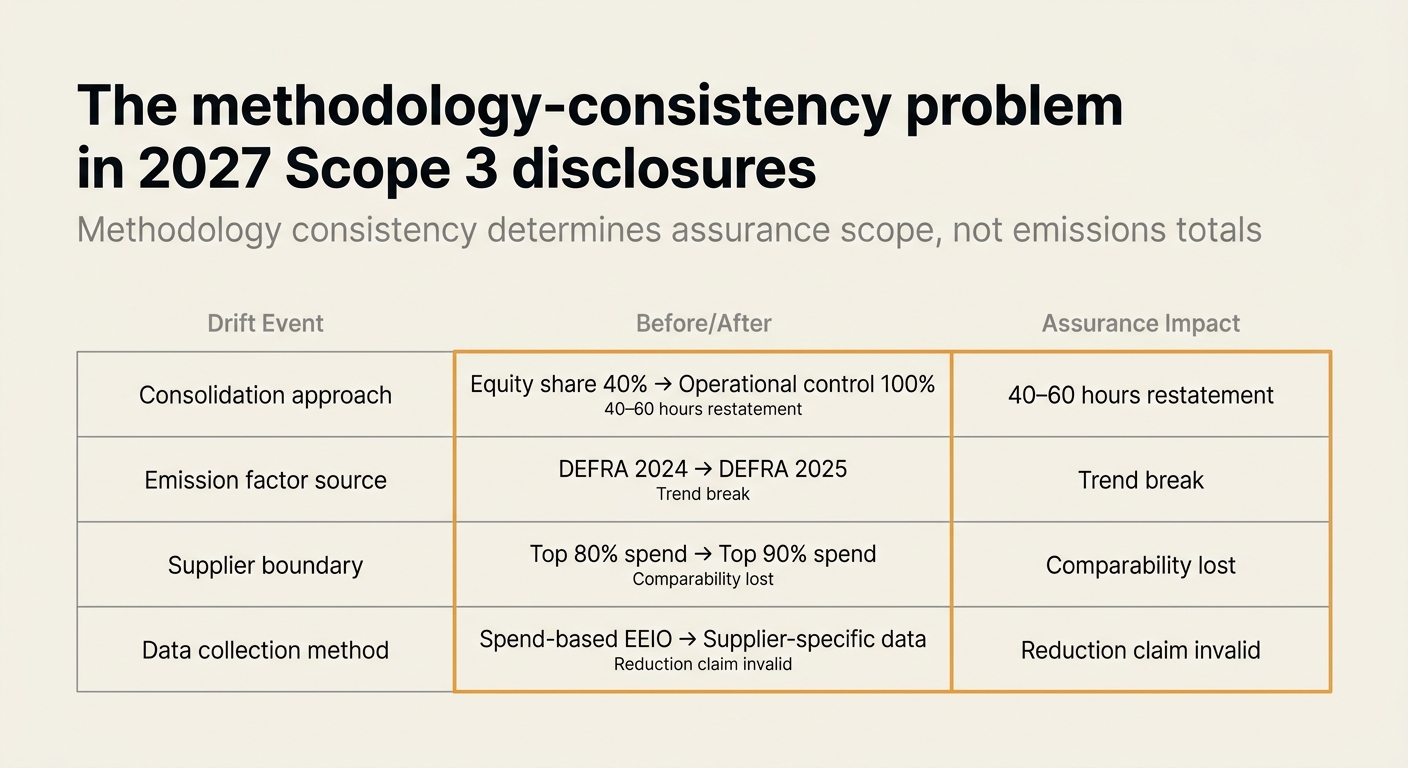
The shape of the argument, visualised below.
The 2027 assurance landscape: what regulators are asking for
The European Sustainability Reporting Standards (ESRS) E1 Climate Change disclosure, mandatory for large EU companies from January 1, 2025, requires Scope 1, 2, and significant Scope 3 emissions with limited assurance starting in 2026 reporting cycles. By 2028, most jurisdictions expect a transition to reasonable assurance—the same standard applied to financial statements.[1] California Senate Bill 253, effective for reporting entities with more than $1 billion in annual revenue, requires Scope 3 disclosure in accordance with the GHG Protocol, with assurance beginning in 2027.[2]
The International Sustainability Standards Board (ISSB) standards require disclosure of material Scope 3 emissions, subject to the same materiality threshold as financial reporting.[2] The UK Sustainability Reporting Standard mirrors ISSB but defers mandatory Scope 3 disclosure for smaller entities until 2026. All frameworks converge on one requirement: disclosed emissions must be comparable year-over-year, and any methodology change must be disclosed and justified.
The GHG Protocol's Scope 3 Standard, last updated in 2011, is undergoing its first major revision. A 65-member working group published a Phase 1 progress update on March 31, 2026, with a full public consultation draft expected mid-2026 and final publication in late 2027.[1] The revision addresses category boundary-setting, quantification for processing and use of sold products, and circularity accounting—areas where most companies' Scope 3 numbers are weakest. Tighter expectations on data quality and methodology consistency are expected.
The twelve methodology decisions that create drift
Methodology drift occurs when a company changes how it calculates emissions between reporting years without documenting the change or adjusting prior-year figures. Below are the twelve most common drift events sustainability teams encounter in Scope 3 Category 1 (Purchased Goods and Services) programs:
| Drift Event | Before | After | Assurance Impact |
|---|---|---|---|
| Consolidation approach | Equity share (40% ownership = 40% emissions) | Operational control (100% emissions if controlled) | Prior-year restatement required; 40–60 hours auditor time |
| Emission factor source | DEFRA 2024 | DEFRA 2025 | Trend break unless prior year is recalculated |
| Supplier boundary | Top 80% of spend (120 suppliers) | Top 90% of spend (180 suppliers) | Comparability lost; requires documented materiality analysis |
| Data collection method | Spend-based EEIO | Supplier-specific activity data (primary data) | Reduction claim invalid unless prior year restated |
| GWP version | AR5 (100-year horizon) | AR6 (100-year horizon) | Minor numerical shift; must be disclosed |
| Reporting boundary | Legal entity A | Consolidated group (A + B) | Non-comparable unless prior year is recalculated |
| Category classification | Category 1 (Purchased Goods) | Category 4 (Upstream Transport) | Breaks category-level trend |
| Cut-off threshold | Suppliers representing <1% of spend excluded | All suppliers included | Absolute emissions increase; trend unclear |
| Allocation method | Revenue allocation for shared services | Mass allocation for shared services | Non-comparable unless prior year restated |
| Time boundary | Calendar year (Jan 1 – Dec 31) | Fiscal year (Apr 1 – Mar 31) | Comparability lost |
| Biogenic carbon treatment | Biogenic CO2 included in Scope 3 total | Biogenic CO2 reported separately | Trend break |
| Sub-category disaggregation | Category 1 reported as single total | Category 1 disaggregated into sub-categories (e.g., cloud computing) | Breaks prior-year comparison unless sub-category data retroactively generated |
The ESRS E1 November 2025 draft clarifies that undertakings must "consider the principles and provisions" of the GHG Protocol Corporate Value Chain (Scope 3) Accounting and Reporting Standard, and should screen total Scope 3 emissions based on the 15 categories.[3] Entities must disclose significant Scope 3 emissions by category, including sub-categories where material—for example, cloud computing and data centre services within Category 1.[3]
A sustainability manager at a European automotive supplier told us in January 2027: "We switched from spend-based to supplier-specific data for 60% of our Category 1 emissions in 2026. Our absolute emissions went down 12%, but the auditor couldn't verify whether that was real decarbonization or just better data. We ended up recalculating 2025 with the new method, which added four weeks and €45,000 to the engagement."
Why methodology drift is an assurance failure, not a data failure
Limited assurance engagements (ISAE 3000 or ISAE 3410) require the auditor to obtain sufficient evidence to conclude that the emissions inventory is plausible and free from material misstatement. Reasonable assurance engagements (the standard required by 2028 under ESRS E1) require positive confirmation that the inventory is fairly stated.[4] Both standards require the auditor to verify that the methodology was applied consistently.
If the methodology changed, the auditor must determine whether the change was:
- Disclosed: explicitly stated in the sustainability report or filing.
- Justified: linked to improved data availability, regulatory alignment, or operational change.
- Retroactively applied: prior-year figures recalculated using the new method, or an explanation provided for why recalculation was impracticable.
If any of these conditions are not met, the assurance opinion is typically qualified ("except for the matters described above") or adverse ("the emissions inventory is materially misstated"). A qualified opinion triggers restatement requirements under most disclosure frameworks.
"An effective inventory begins with a documented objective, reporting scope, boundaries, and standard references. Any exclusion must be justified and recorded to maintain transparency. Every facility, activity, and source must be mapped before quantification. Materiality is determined both quantitatively and qualitatively. High impact sources, even if difficult to measure, must be included for a credible Scope 3 representation."[5]
The Partnership for Carbon Accounting Financials (PCAF) requires financial institutions to track data quality scores (1–5 scale, where 1 is primary data and 5 is spend-based estimation) and to disclose methodology changes.[4] ESRS E1 requires entities to consider PCAF Part A (December 2022 version) when calculating financed emissions (Category 15).[3]
Methodology drift is not a data failure—it is a process failure. The underlying emissions may be accurate, but the trend claim is unsupportable because the calculation method changed. Auditors do not fail engagements because the data is wrong; they fail engagements because the methodology was not controlled.
The versioned-methodology approach: what works in 2027 programs
The sustainability teams that pass limited assurance in 2027 and are preparing for reasonable assurance in 2028 treat methodology as a versioned artifact, similar to how software teams version APIs. The approach consists of five steps:
1. Lock the methodology at the start of each reporting cycle
At the beginning of the reporting year (or fiscal year), the sustainability team documents the following in a structured methodology statement:
- Consolidation approach (operational control, financial control, or equity share)
- Organizational boundary (legal entities included)
- Emission factor sources (DEFRA, EPA, IEA, supplier-specific, or other) with version numbers
- GWP version (AR5 or AR6)
- Category boundaries (which of the 15 Scope 3 categories are included, and which are excluded with justification)
- Data collection methods (spend-based, supplier-specific activity data, hybrid)
- Cut-off thresholds (e.g., suppliers representing <1% of spend)
- Allocation rules (mass, revenue, or other)
This document is version-stamped (e.g., "Methodology v2.3, effective 2026-01-01") and approved by the CFO and Head of Sustainability before data collection begins.
2. Maintain a controlled decision log for mid-cycle changes
If a methodology change is required mid-cycle—for example, a major supplier is acquired, or a new data source becomes available—the change is logged in a structured decision log with the following fields:
- Date of change
- Description of change (e.g., "Switched Category 1 supplier X from spend-based EEIO to supplier-specific activity data")
- Justification (e.g., "Supplier provided ISO 14064-1 verified emissions data")
- Impact on prior years (e.g., "2025 Category 1 emissions recalculated: 42,000 tonnes → 40,500 tonnes")
- Approver (CFO or Head of Sustainability)
This log is reviewed by the auditor during the assurance engagement.
3. Version emission factors and lock them per reporting year
Emission factors are updated annually by their source bodies (DEFRA, EPA, IEA). If a company uses DEFRA 2025 factors in the 2026 reporting cycle, it must continue using DEFRA 2025 factors for that cycle, even if DEFRA 2026 factors are published mid-year. The new factors are applied in the next cycle.
The emission factor source and version are recorded in the methodology statement and in the evidence pack for each calculated emission line item.
4. Recalculate prior-year figures when material changes occur
When a methodology change affects comparability, prior-year figures must be recalculated using the new method. The GHG Protocol Corporate Standard requires recalculation when:
- Structural changes occur (mergers, acquisitions, divestitures)
- Calculation methods improve (e.g., from spend-based to supplier-specific data)
- Errors are discovered in prior-year calculations
- The organizational boundary changes[6]
Recalculation is resource-intensive, but it is the only way to preserve trend validity. The recalculated prior-year figures are disclosed alongside the current-year figures, with a footnote explaining the change.
5. Generate a methodology lineage report for the auditor
At the end of the reporting cycle, the sustainability team generates a methodology lineage report that maps each emission line item to:
- The calculation method (spend-based, activity-based, or supplier-specific)
- The emission factor source and version
- The source document (invoice, utility bill, supplier disclosure)
- The version of the methodology statement under which it was calculated
This report is the primary evidence artifact for the assurance engagement. Auditors sample line items from this report and trace them back to source documents.
What the 2027 Scope 3 Standard revision will likely require
The GHG Protocol's Scope 3 Standard revision, expected in late 2027, is addressing several areas where the 2011 Standard is silent or unclear:[7]
Category boundary-setting: The current Standard defines 15 categories but does not specify minimum boundaries for reporting. The ESRS E1 requires entities to screen all 15 categories and report significant emissions, but "significant" is not quantitatively defined.[3] The revision is expected to tighten this by requiring disclosure of all categories representing more than 5% of total Scope 3 emissions, with a justified exclusion clause for categories where data collection is impracticable.
Data quality and estimation hierarchy: The current Standard allows spend-based estimation (EEIO factors) as a fallback when supplier-specific data is unavailable. The revision is expected to introduce a data quality hierarchy similar to PCAF's 1–5 scoring, with disclosure requirements for the proportion of emissions calculated at each quality level.[7]
Time boundary for investments: The current Standard allows companies to identify investments at a fixed point in time (e.g., December 31) or using a representative average. The revision is expected to require weighted-average approaches for dynamic portfolios to avoid snapshot bias.[7]
Biogenic carbon and removals: The current Standard requires biogenic CO2 emissions to be reported separately. The revision is expected to align with the GHG Protocol's new Land Sector and Removals Standard (effective 2027), using a "gross-flow" approach that accounts for atmospheric CO2 removal in the year it occurs and emissions from end-of-life treatment in the year they are released.[6]
Chain-of-custody and product-level claims: The revision is addressing how emissions reductions from insets (e.g., renewable energy procured by a supplier) are allocated to sold products and whether purchasing clients can claim these reductions in their Scope 3 Category 1 inventories.[6]
A public consultation draft was expected mid-2026, with final publication in late 2027.[1] The revision will not invalidate existing inventories, but it will raise the bar for methodology documentation and lineage tracking.
The assurance-cost model for 2027–2029 programs
Based on engagements we have observed in 2026 and early 2027, the cost structure for Scope 3 assurance follows a predictable pattern:
| Assurance Level | Standard | Scope | Auditor Hours | Hourly Rate (EUR) | Total Cost (EUR) |
|---|---|---|---|---|---|
| Limited assurance, first year | ISAE 3000 | Scope 1, 2, significant Scope 3 | 80–120 | 180–220 | 14,400–26,400 |
| Limited assurance, subsequent year (no methodology changes) | ISAE 3000 | Scope 1, 2, significant Scope 3 | 40–60 | 180–220 | 7,200–13,200 |
| Limited assurance, with methodology drift | ISAE 3000 | Scope 1, 2, significant Scope 3 | 120–180 | 180–220 | 21,600–39,600 |
| Reasonable assurance, first year | ISAE 3410 | Scope 1, 2, significant Scope 3 | 200–300 | 180–220 | 36,000–66,000 |
| Reasonable assurance, subsequent year (no methodology changes) | ISAE 3410 | Scope 1, 2, significant Scope 3 | 120–180 | 180–220 | 21,600–39,600 |
| Reasonable assurance, with methodology drift | ISAE 3410 | Scope 1, 2, significant Scope 3 | 300–450 | 180–220 | 54,000–99,000 |
Methodology drift adds 50–150% to assurance costs because the auditor must:
- Verify that the methodology change was disclosed
- Assess whether the change was justified
- Recalculate prior-year figures (if not already done by the company)
- Verify that the recalculated figures are correct
- Confirm that the trend claim is supportable
For a mid-market manufacturer with 200 tier-1 suppliers, three reporting years of history, and a methodology change affecting 40% of Category 1 emissions, the additional auditor time is typically 100–150 hours.
How Emission3 fits
Emission3 is built for operators who need methodology-consistent Scope 3 inventories that pass assurance without qualification. We treat methodology as a controlled artifact, not a rolling decision.
Every calculation in Emission3 is version-stamped with the methodology statement, emission factor source, and source document reference. When a supplier is onboarded, the data collection method (spend-based, activity-based, or supplier-specific) is locked for that reporting cycle. If a methodology change is required mid-cycle, the platform logs the change in a structured decision log and flags affected prior-year line items for recalculation.
For Category 1 (Purchased Goods and Services), Emission3 ingests invoices, bills of materials, and supplier disclosures, then calculates embedded emissions using the emission factors and allocation rules specified in the methodology statement. Every line item includes a lineage trace: the calculation method, emission factor version, source document, and methodology version. This lineage report is the primary evidence artifact for the auditor.
For operators transitioning from limited to reasonable assurance in 2028, Emission3 generates a methodology consistency report that maps every methodology decision across reporting years, flags drift events, and documents recalculations. This is the artifact the CFO reviews before the auditor arrives.
We work with mid-market manufacturers, EU importers, and California-headquartered firms navigating CSRD, CBAM, and SB 253 requirements. Teams typically start with a readiness call where we map suppliers, identify methodology gaps, and scope the implementation.
The path to assurance readiness in 2027 and beyond
Methodology consistency is not a data problem—it is a process problem. The teams that pass limited assurance in 2027 and are preparing for reasonable assurance in 2028 have made three structural changes:
- Methodology is versioned and locked at the start of each reporting cycle, not rolling.
- Emission factors are version-stamped and controlled, not updated mid-cycle.
- Lineage is tracked at the line-item level, so every calculation is reproducible.
The GHG Protocol's Scope 3 Standard revision, expected in late 2027, will likely tighten comparability requirements and introduce data quality disclosure thresholds. Operators who have already built methodology-consistent inventories will be ready. Operators still relying on spreadsheet-based workflows will face retroactive recalculation work and assurance cost escalation.
The cost of methodology drift is not the audit fee—it is the restatement cycle, the qualified opinion, and the CFO's realization that the sustainability program is not audit-ready. If you are responsible for Scope 3 disclosure in a CSRD, CBAM, or SB 253 program, the question to ask is not "What are our emissions?" but "Can we prove that our trend is real?"
If you are navigating this transition, ask a specific question: contact the Emission3 team to map your methodology gaps and scope a path to assurance readiness.
References & Sources
External Sources
- [1]The GHG Protocol in 2026: What's Changing in Carbon Accounting, and What It Means for Issuers
Summary of GHG Protocol Corporate Standard, Scope 2, and Scope 3 revisions underway in 2026, including timelines, working group composition, and expected publication dates.
- [2]Greenhouse Gas Protocol — EY
EY technical guidance on GHG Protocol application, including California SB-253, ESRS, and ISSB disclosure requirements and Scope 3 category definitions.
- [3][Draft] ESRS E1 - Climate Change
November 2025 draft of ESRS E1 Climate Change disclosure requirements, including Scope 3 category screening, sub-category disaggregation, and PCAF alignment for financial institutions.
- [4]SRG Chapter 7: Greenhouse gas emissions reporting
PwC guidance on ESRS E1, GHG Protocol, and PCAF application, including scope 3 minimum boundaries, assurance standards, and methodology consistency requirements.
- [5]GHG Protocol Scope 3 Standard Update: 2026 Planning Implications
Practitioner summary of effective GHG inventory requirements: documented objectives, boundary setting, source mapping, materiality filtering, and standard-aligned calculation methodology.
- [6]Summary of Scope 3 Proposals - Greenhouse Gas Protocol
Summary of Scope 3 Standard revision proposals, including biogenic carbon accounting, gross-flow approach for removals, chain-of-custody for insets, and project-based method modifications.
- [7]Scope 3 Standard Revisions Phase 1 Progress Update
March 31, 2026 progress update from the 65-member Scope 3 Technical Working Group, covering time boundary guidance, category boundary-setting, data quality hierarchy, and ISO-GHG Protocol partnership.
- [8]What Are Scopes 1, 2 and 3 Emissions? The Ultimate Guide (2026)
Comprehensive guide to Scope 1, 2, and 3 emissions definitions, GHG Protocol classification, and 2025/2026 regulatory expectations under CSRD, UK SRS, California SB 253, SBTi, and EcoVadis.
Related Content
- [9]The Scope 3 methodology-drift problem in ESRS E1 disclosure programs
ESRS E1 disclosure consists of two things: emissions totals and methodology consistency across reporting years. Teams focus on the first—but assurance scope is set by the second.
- [10]Scope 3 with primary data
Emission3's Scope 3 solution for supply-chain leaders and sustainability managers: document-first data collection, tier-2 visibility, and audit-ready evidence packs.
- [11]Ask a specific question
Direct line to the founder for persona-specific questions about CBAM, CSRD, SB 253, and Scope 3 methodology consistency.