The liability-cascade gap in non-EU exporter CBAM filings
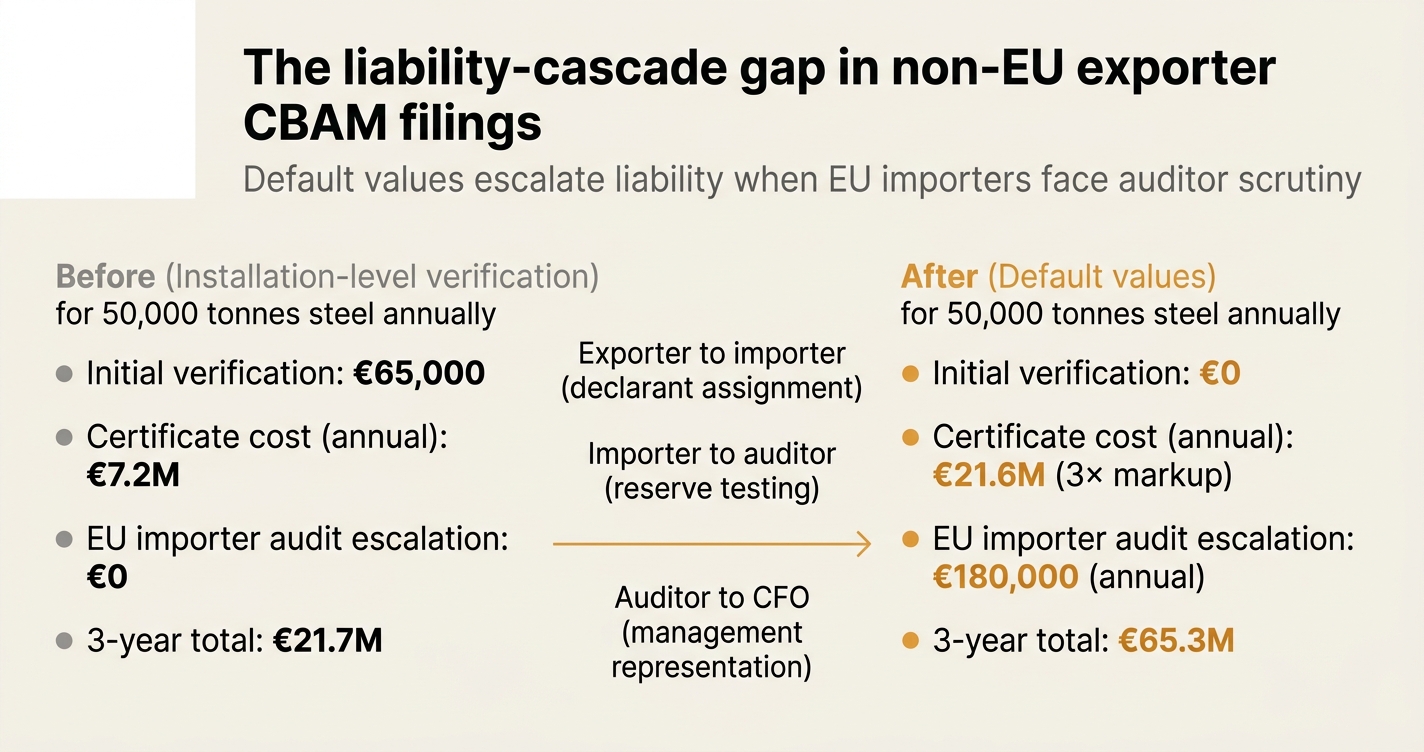
The liability-cascade gap in non-EU exporter CBAM filings
Here's the issue: Most non-EU exporters shipping carbon-intensive goods into the European Union are planning to rely on sectoral default values for Carbon Border Adjustment Mechanism filings in 2026, treating them as a safe harbor that avoids the cost of installation-level data collection. The typical quote for installation-level emissions verification ranges from €45,000 to €85,000 for a mid-sized steel or aluminium facility, depending on batch complexity and production technology variation. Exporters see default values as the path of least regulatory resistance.
However, a CBAM filing consists of two things: the emissions total that determines the certificate cost, and the legal representation that chains liability from the exporter to the EU importer's declarant.
The emissions total on its own has no value. The legal liability chain is what the EU importer's compliance officer is actually managing, because the importer becomes the CBAM declarant, and every default-value filing escalates the importer's exposure when their external auditor tests the CBAM reserve calculation during the annual financial statement audit.
While installation-level data collection has become more standardised through platform tooling, the liability escalation at the importer level has become steeper. If a non-EU exporter ships 50,000 tonnes of steel annually using default values that inflate declared emissions by 3×, the importer does not merely overpay by 3× the certificate cost per tonne. The importer's auditor flags the inflated CBAM reserve as a material misstatement risk, triggering expanded substantive testing, third-party verification requests, and potential restatement discussions that can cost the importer €120,000 to €240,000 in incremental audit fees and internal resource costs, not counting delayed filing penalties if the audit opinion is held.
How do you solve this? I think the non-EU exporters we work with are documenting actual installation emissions from the start, treating the initial CBAM filing as the foundation for a multi-year supplier relationship where the EU importer's compliance team can defensibly represent the emissions data to their own auditors. The upfront cost is higher in 2025–2026, but the liability cascade is contained at the source, and the importer's audit fees do not escalate because the emissions data can survive substantive testing.
The shape of the argument, visualised below.
The two parts of a CBAM filing
Every CBAM filing submitted to an EU customs authority contains:
- Embedded emissions totals: the specific or default emissions per tonne of goods, reported quarterly, that determine the number of CBAM certificates the importer must surrender.
- Declarant liability: the legal attestation by the EU importer (as CBAM declarant) that the emissions data is accurate, which flows back to the exporter's installation-level representations.
Most exporters optimise for the first. The EU importer's compliance officer is managing the second, because the declarant liability does not stop at customs—it extends into the importer's financial statement audit when the auditor tests the CBAM certificate reserve.
| Filing component | What exporters optimise for | What EU importers' auditors test |
|---|---|---|
| Embedded emissions total | Minimising certificate cost per tonne | Whether the declared emissions survive substantive testing |
| Declarant liability | Avoiding installation data collection | Whether the exporter's representation is auditor-defensible |
| Default-value markup | Accepting 2–5× inflation to avoid verification cost | Whether the inflated reserve creates a material misstatement risk |
"If your company ships carbon-intensive goods into the EU, you face a choice in 2026: comply with CBAM's installation-level reporting requirements, or accept sectoral default values that inflate your declared emissions by 2-5×."[1]
The default-value route looks cheaper at the exporter level, but it creates an audit-escalation path at the importer level that most exporters do not see until the importer's procurement team requests a data upgrade mid-year.
Why default values escalate liability at the importer level
CBAM certificate costs are transactional: every tonne shipped triggers a certificate surrender, and the certificate price is set by the EU Emissions Trading System weekly auction average. If an exporter uses default values that inflate embedded emissions from 1.8 tonnes CO₂e per tonne of steel to 5.4 tonnes CO₂e (a 3× markup, common for non-EU facilities without installation-level verification), the importer pays 3× the certificate cost per shipment.
But the financial statement impact is not merely the inflated certificate cost. The importer records a CBAM certificate reserve as a liability on the balance sheet, measured at the expected certificate cost for goods received but not yet declared. When the importer's external auditor tests this reserve during the annual financial statement audit, the auditor applies substantive testing procedures:
- Recalculation: Does the declared emissions total match the installation data from the exporter?
- Third-party confirmation: Can the exporter provide auditor-defensible evidence that the emissions figure is accurate?
- Material misstatement risk: Does the 3× default-value markup create a reserve overstatement that crosses the materiality threshold?
If the exporter cannot provide installation-level evidence, the auditor flags the reserve as unsupported, triggering expanded testing. The importer's compliance team must either:
- Request installation-level data from the exporter mid-audit cycle (often impossible on a 2–3 week timeline).
- Accept an audit adjustment that restates the reserve (requiring board approval and potential restatement of prior quarters).
- Accept a qualified audit opinion (triggering lender covenant reviews and investor disclosure obligations).
The cost of these escalations typically ranges from €120,000 to €240,000 in combined audit fees, legal review, and internal resource costs, based on pricing we see from Big Four audit practices serving mid-sized EU importers with €200 million to €800 million in annual revenue.[2]
The three liability-transfer points exporters miss
The liability cascade flows through three transfer points, and most exporters only see the first:
1. Exporter to EU importer (declarant assignment)
Under CBAM Regulation Article 4, the EU importer becomes the declarant and assumes legal responsibility for the accuracy of the emissions data submitted.[3] The exporter provides the data, but the importer attests to its accuracy when filing the quarterly CBAM declaration.
This is the transfer point exporters understand. What they miss is that the importer's attestation is not ceremonial—it creates a legal chain the importer's auditor will test.
2. EU importer to external auditor (financial statement audit)
The importer's CBAM certificate reserve appears on the balance sheet as a current liability. The external auditor tests this reserve as part of the annual financial statement audit, applying the same substantive testing procedures used for inventory valuation, accrued liabilities, and tax reserves.
If the reserve is based on default values that inflate emissions by 3×, the auditor will challenge whether the overstatement crosses the materiality threshold (typically 1–2% of total assets for a mid-sized EU manufacturer). If it does, the auditor escalates to expanded testing or requests third-party confirmation from the exporter.
This is the transfer point that triggers the cost cascade, because the auditor's expanded testing fees and timeline delays fall on the EU importer, who then pushes the data request back to the exporter—often mid-audit, with a 2–3 week deadline that makes installation-level verification nearly impossible.
3. External auditor to audit committee (management representation letter)
If the exporter cannot provide installation-level evidence and the auditor cannot clear the reserve through alternative procedures, the audit opinion is held pending resolution. The importer's CFO and compliance officer must sign a management representation letter stating that the CBAM reserve is fairly presented based on the best available information.
Under California Senate Bill 253 and similar disclosure regimes, this representation carries personal liability for the executive officer if the reserve is later found to be materially misstated.[4] The CFO's signature escalates the liability from the compliance team to the executive level, which is why many EU importers are now requiring installation-level data from exporters as a condition of continued procurement contracts.
"Executive officer statements under SB 253 carry personal liability. Regulators expect deterministic, reproducible numbers, not estimates."
The third transfer point is where procurement relationships break, because the EU importer's CFO will not sign a representation letter based on default values that inflate the reserve by 3×. At that point, the exporter either provides installation-level data or loses the customer.
The cost comparison: installation verification versus audit escalation
Most exporters compare the cost of installation-level data collection (€45,000 to €85,000 for initial verification) against the cost of using default values (zero upfront cost, 3× certificate cost per tonne). But the real comparison is installation verification cost versus the EU importer's audit escalation cost.
Here is the cost structure we see in anonymised case data from non-EU steel exporters shipping 50,000 tonnes annually into the EU:
| Cost category | Installation-level verification | Default values + audit escalation |
|---|---|---|
| Initial verification (one-time) | €65,000 (installation audit, batch sampling, utility bill reconciliation) | €0 |
| Certificate cost per tonne (annual) | €80 per tonne × 1.8 tonnes CO₂e = €144 per tonne of steel | €80 per tonne × 5.4 tonnes CO₂e = €432 per tonne of steel |
| Total certificate cost (50,000 tonnes) | €7.2 million annually | €21.6 million annually |
| EU importer's audit escalation (annual) | €0 (reserve passes substantive testing) | €180,000 (expanded testing, third-party confirmation requests, legal review) |
| Total 3-year cost | €21.7 million (verification + certificates) | €65.3 million (certificates + audit escalation) |
The 3× certificate cost inflation alone is €14.4 million over three years. The audit escalation adds another €540,000. The exporter's €65,000 verification cost is 0.1% of the total cost differential.
The procurement pressure is immediate: EU importers are revising supplier contracts to require installation-level data as a condition of continued orders, because the importer's CFO will not accept the audit-escalation risk. We see this in steel, aluminium, and cement supply chains where the importer's auditor has flagged the CBAM reserve as a material testing focus in the 2026 audit plan.
Anonymised case: Turkish steel exporter, 60,000 tonnes annually
A Turkish flat steel producer ships 60,000 tonnes annually to three EU customers (Germany, Italy, Poland). In Q1 2026, the producer planned to file using Turkish sectoral default values (5.1 tonnes CO₂e per tonne of steel, versus 1.7 tonnes actual installation emissions based on electric arc furnace technology with renewable energy contracts).
The German importer's auditor (Big Four firm) flagged the CBAM reserve in the Q1 audit planning memo as a substantive testing focus, noting that the 3× default-value markup created a reserve overstatement of €18.2 million (1.8% of the importer's total assets, above the 1.5% materiality threshold).
The importer's compliance officer requested installation-level data from the Turkish exporter in March 2026, with a 3-week deadline to clear the audit testing cycle. The exporter could not mobilise verification resources on that timeline and proposed continuing with default values.
The German importer's CFO declined to sign the management representation letter and notified the exporter that procurement volumes would be reduced by 40% starting Q3 2026 unless installation-level data was provided. The Italian and Polish importers issued similar notices in April 2026.
The Turkish exporter engaged an installation verification provider in May 2026 (€72,000 for initial audit, €18,000 annually for ongoing quarterly updates). The verified emissions data was submitted in June 2026, clearing the German importer's audit testing in July 2026. Procurement volumes were restored in Q4 2026.
The cost differential:
- Default-value path (rejected): €24.5 million certificate cost annually + €180,000 audit escalation at each importer = €25.0 million first-year cost.
- Installation-verification path (accepted): €72,000 verification + €8.2 million certificate cost annually = €8.3 million first-year cost.
- Savings: €16.7 million annually, or 67% cost reduction.
The exporter retained the customer relationship, the importer's audit cleared without escalation, and the CFO signed the management representation letter based on auditor-defensible installation data.
How Emission3 fits
Emission3 is a document-first carbon accounting platform built for non-EU exporters who need to document actual installation emissions to prevent the liability cascade at the EU importer level. We map your production process to CBAM embedded emissions requirements, ingest utility bills, batch production logs, and energy contracts, and produce auditor-defensible evidence lineage that survives substantive testing when your EU importer's auditor challenges the CBAM reserve.
Our compliance infrastructure supports:
- Installation-level data ingestion: invoices, utility bills, batch production records → line-item evidence for embedded emissions calculations, not modelled estimates.
- Deterministic calculation lineage: every emissions figure is reproducible from source documents, with a full audit trail the EU importer's auditor can replay.
- Registry-oriented outputs: CBAM-formatted emissions reports, evidence packs, and calculation lineage documentation that clear substantive testing without expanded audit procedures.
The platform is designed for exporters who understand that the real cost of CBAM is not the certificate price per tonne—it is the liability cascade that breaks procurement relationships when EU importers cannot defend the emissions data to their own auditors.
If you are a non-EU exporter planning to file CBAM declarations in 2026, and your EU customers are starting to ask for installation-level data to support their financial statement audits, the compliance gap is not at customs—it is in the liability chain between your installation data and your customer's CFO signature.
We help you close that gap before the audit escalation starts. Book a CBAM readiness call to map your current data position, identify the liability-transfer points your EU customers' auditors will test, and build the document-first evidence system that prevents the cascade.[5]
References & Sources
External Sources
- [1]CSRD vs CBAM: Which Compliance Path Hits Your 2026 Budget Harder?
Analysis of CBAM's transactional cost structure for non-EU exporters shipping carbon-intensive goods, noting default values inflate declared emissions 2-5× and EU importers push that cost back.
- [2]The executive-liability cost cascade in CSRD limited-to-reasonable assurance transitions
Quantified analysis of audit fee escalation when assurance transitions require methodology remediation, noting 40-60% fee increases in early auditor pricing models.
- [3]CSRD & ESRS E1 Timeline: 14 Critical Dates from 2026 Limited to 2028 Reasonable Assurance
Timeline and assurance requirements for CSRD wave-2 filers, noting reasonable assurance requires sufficient appropriate evidence to conclude information is free from material misstatement.
Related Content
- [4]The assurance-timing gap in 2026 California SB 253 Scope 1 and Scope 2 emissions disclosure
Analysis of executive officer liability under SB 253, noting statements carry personal liability and regulators expect deterministic, reproducible numbers.
- [5]Book a CBAM readiness call
All customers start with a readiness call where we map suppliers, gaps, and implementation. No anonymous self-serve onboarding.