CSRD vs CBAM: Which Compliance Path Hits Your 2026 Budget Harder?
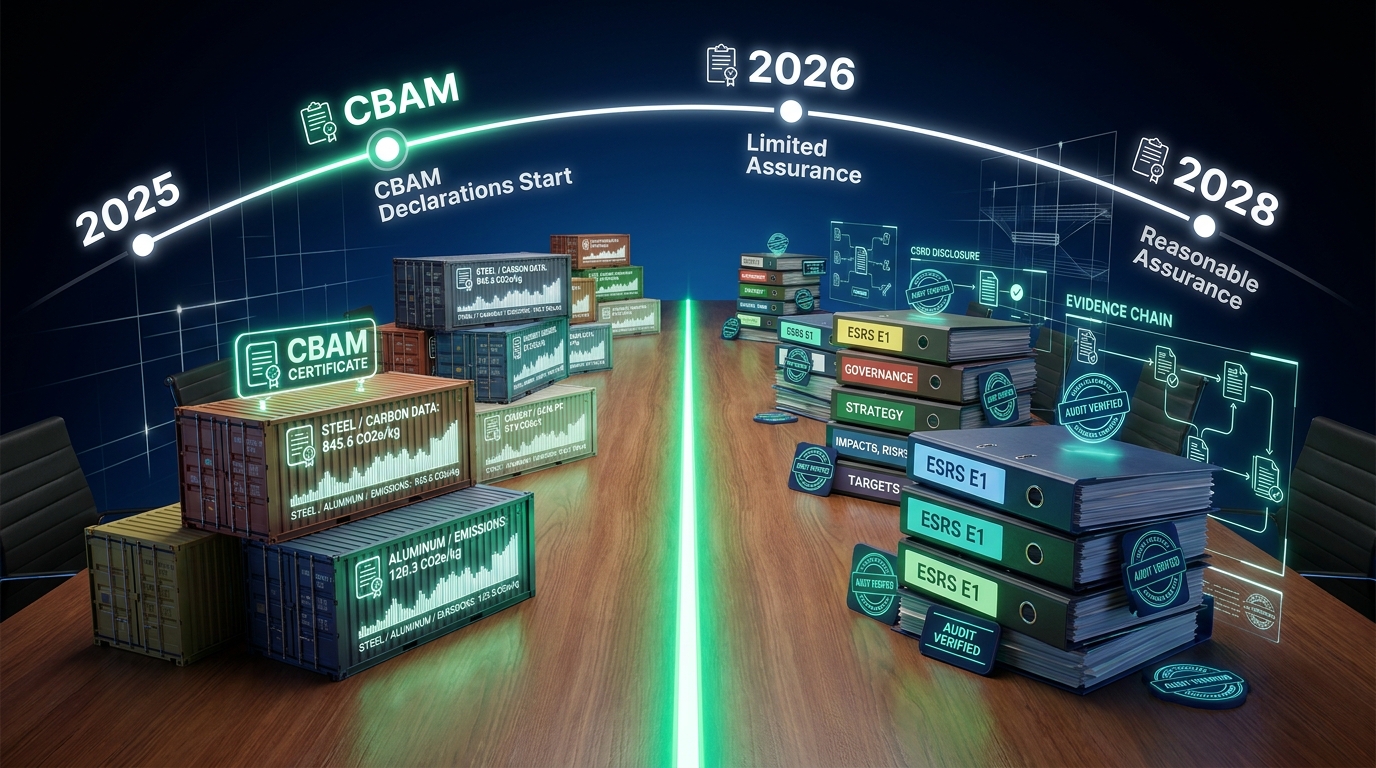
CSRD vs CBAM: Which Compliance Path Hits Your 2026 Budget Harder?
If your company ships carbon-intensive goods into the EU, you face a choice in 2026: comply with CBAM's installation-level reporting requirements, or accept sectoral default values that inflate your declared emissions by 2-5x [1]. If you're an EU entity in CSRD wave 2, you face a different pressure: ESRS E1 limited assurance debuts in 2026, with reasonable assurance by 2028—and most inventories will not pass [2].
Both frameworks demand actual emissions data. Both expose you to premium costs if your data foundation is weak. But the cost structure, timing, and audit burden differ sharply. This comparison helps you decide where to allocate resources first.
The Decision You're Actually Making
You're not choosing between CSRD and CBAM—you may need both. The real question: which compliance path requires immediate investment, and which can you phase in?
- CBAM is transactional: every tonne shipped triggers a certificate cost. Default values mean you overpay on every shipment. Your EU importers will push that cost back to you [3].
- CSRD is reputational and regulatory: missed disclosures or failed assurance trigger penalties, investor flight, and board liability. The first limited assurance cycle happens in 2026 for wave-2 filers [2].
Both require audit-grade evidence lineage—invoices, utility bills, production logs—but the verification cycles and cost models diverge.
Head-to-Head: CSRD vs CBAM Compliance
| Criterion | CSRD (ESRS E1) | CBAM |
|---|---|---|
| Who must comply? | EU entities: listed SMEs (2027), large subsidiaries (2026). Wave-2 filers start limited assurance in 2026. | Non-EU exporters shipping iron, steel, aluminum, cement, fertilizers, electricity, hydrogen into the EU. |
| First mandatory deadline | 2026 reports (FY 2025 data) for wave-2 entities. Limited assurance required. | January 31, 2026: first CBAM declarations due covering Q4 2025. Transitional period ends Dec 31, 2025. |
| Cost if you use defaults | Assurance failure → 20-40% audit fee repricing, potential non-approval, board liability [4]. | Default emission factors inflate declared emissions 2-5x → you overpay per tonne shipped. EU importers reclaim cost from you [3]. |
| Data granularity required | Scope 1, 2, 3 by category. Installation-level not mandatory, but materiality assessment often requires it. | Installation-level actual emissions for every production batch. Defaults only allowed until Dec 31, 2025 [1]. |
| Assurance standard | Limited assurance (2026-2027). Reasonable assurance by 2028. ISAE 3000/3410 frameworks. | Third-party verification bodies accredited by EU member states. Annual verification cycles start Jan 2026. |
| Population completeness | Must report on 100% of material categories. Sampling allowed under ISAE 3000, but gaps reduce assurance opinion. | 100% of shipments. Missing data defaults to highest sectoral value. No sampling. |
| Penalty structure | Member state penalties vary. Potential delisting, fines, director liability. Investors scrutinize failed assurance. | Financial: overpayment per tonne. Reputational: EU importers may switch suppliers to avoid cost pushback. |
| Technology requirement | Evidence lineage from source document → calculation → disclosure. Auditors demand reproducibility [4]. | Evidence lineage from production meter → emission factor → CBAM declaration. Verification bodies audit annually [3]. |
Scoring the Compliance Paths
We score each framework against five criteria non-EU exporters and CSRD wave-2 filers care about:
1. Immediate Cash Impact
- CBAM: 9/10. Every shipment without actual emissions data triggers overpayment. If you export 50,000 tonnes of steel annually and defaults inflate emissions 3x, you pay 3x the CBAM certificate cost—pushed back by your EU customer.
- CSRD: 4/10. Assurance fees rise 20-40% without evidence lineage, but this is a once-annual cost, not per-transaction [4].
2. Data Collection Complexity
- CBAM: 8/10. Requires installation-level meter reads, production batch logs, energy invoices. Must trace emissions to specific shipments.
- CSRD: 7/10. Scope 1+2 require facility-level data. Scope 3 requires supplier engagement across 15 categories. Broader scope, but less transactional granularity.
3. Audit Burden
- CBAM: 7/10. Verification bodies audit annually. Population completeness is binary: missing data defaults to worst case.
- CSRD: 8/10. Limited assurance in 2026, reasonable assurance by 2028. Auditors test materiality, completeness, calculation accuracy. Failed assurance has reputational cost [2].
4. Timeline Urgency
- CBAM: 10/10. Transitional period ends Dec 31, 2025. First mandatory declarations Jan 31, 2026. Supplier data must be in hand by Q4 2025 [1].
- CSRD: 8/10. Wave-2 filers report in 2026 (FY 2025 data). Limited assurance is less stringent than reasonable, but still requires evidence lineage.
5. Cost of Inaction
- CBAM: 9/10. Overpayment is permanent unless you retrofit data. EU importers may switch suppliers to avoid cost pushback.
- CSRD: 8/10. Failed assurance → potential delisting, investor flight, director liability. Penalties vary by member state.
Verdict: CBAM wins on immediate urgency and per-transaction cost impact. CSRD wins on reputational and regulatory risk.
Why Most Companies Underestimate the CBAM Cash Drain
CBAM is not a one-time compliance exercise. It's a recurring per-tonne cost embedded in every shipment. Here's the math:
"For all reporting periods from 1st July 2024 onwards, the regulations state that importers must use emissions data provided by their suppliers and producers. Any business that imports CBAM-regulated goods into the EU is affected by the regulations." [3]
If you export 50,000 tonnes of steel annually, and sectoral defaults inflate your declared emissions by 3x, you pay:
- Actual emissions: 1.8 tCO₂e/tonne steel = 90,000 tCO₂e.
- Default emissions: 5.4 tCO₂e/tonne steel = 270,000 tCO₂e.
- Excess payment: 180,000 tCO₂e × CBAM certificate price.
At €30/tonne (conservative), that's €5.4M in annual overpayment. Your EU importer will negotiate this cost back to you, or find a supplier with actual data.
Why CSRD Assurance Fees Reprice 20-40% Without Evidence Lineage
CSRD limited assurance is less intensive than reasonable assurance, but it still requires traceable evidence from source document to disclosure [4]. If your inventory lacks this lineage, auditors must:
- Perform manual reconciliation between invoices and calculations.
- Test population completeness across facilities.
- Verify third-party data sources (e.g., grid emission factors, supplier-specific factors).
This adds 200-400 audit hours for a mid-sized filer. At €300/hour, that's €60,000-€120,000 in excess fees—before the reasonable assurance transition in 2028 [4].
The 2026-2028 Reasonable Assurance Transition
CSRD wave-2 filers face limited assurance in 2026-2027, reasonable assurance by 2028 [2]. The gap between these standards is significant:
- Limited assurance: auditor performs inquiry, analytical procedures, and selective testing. Opinion: "nothing has come to our attention that causes us to believe the data is materially misstated."
- Reasonable assurance: auditor performs substantive testing, full population verification, and third-party confirmations. Opinion: "the data is fairly stated in all material respects."
Most companies treat 2026-2027 as a rehearsal. But if your evidence lineage fails limited assurance, you face:
- Qualified opinion or disclaimer: auditor cannot form an opinion.
- Investor scrutiny: ESG ratings downgrade on failed assurance.
- Regulatory penalty: member state enforcement varies, but penalties are public.
The transition to reasonable assurance in 2028 means you have two years to fix your data foundation—or face the same audit burden at 2x the cost [4].
How Emission3 Fits
Emission3 is purpose-built for document-first evidence lineage [5]. Every number in your CBAM declaration or CSRD report traces back to a source document—invoice, utility bill, production log—with full calculation lineage.
For CBAM exporters:
- Installation-level ingestion: upload meter reads, energy invoices, production batch logs. Emission3 maps each document to the GHG Protocol installation boundary.
- Per-shipment evidence packs: every CBAM declaration exports with a full evidence pack: source documents, emission factor sources, calculation steps. Verification bodies audit the pack, not your team.
- Default avoidance: Emission3 flags missing data before declarations are due, so you have time to collect actual values—not defaults that inflate cost 2-5x [6].
For CSRD filers:
- Materiality-driven ingestion: Emission3's onboarding call maps your ESRS E1 materiality assessment to source document types. We ingest only what your auditor will test.
- Population completeness reporting: Emission3 exports show coverage % by category, facility, and time period—so your auditor can test completeness without manual reconciliation.
- Limited-to-reasonable assurance transition: the same evidence lineage that passes limited assurance in 2026 scales to reasonable assurance in 2028—no re-work [4].
Every customer starts with a personal onboarding call—no self-serve signups. We map your compliance path (CBAM, CSRD, or both) and build the evidence foundation you need.
The Verdict
If you're a non-EU exporter, CBAM is your immediate budget priority. Transitional period ends Dec 31, 2025. First declarations are due Jan 31, 2026. Default values inflate cost 2-5x per shipment—and your EU importer will push that cost back to you [3].
If you're a CSRD wave-2 filer, your 2026 limited assurance cycle is the test run for 2028 reasonable assurance. Failed assurance triggers 20-40% audit fee repricing, potential non-approval, and reputational cost [4]. Fix your evidence lineage now, or pay premium fees for the next three cycles.
Both frameworks converge on the same foundation: audit-grade evidence lineage from source document to disclosure. Build it once, use it for both.
Ready to map your compliance path? Book your onboarding call [7]. We'll walk through your CBAM shipments, CSRD materiality, and evidence gaps—and show you the document-first foundation that passes verification.
References & Sources
External Sources
- [1]How to calculate emissions for CBAM reporting
Explains the CBAM calculation methodology, including the phase-out of default emission factors after July 2024 and the requirement for actual emissions data from suppliers.
- [2]CSRD reporting: What you need to know
Covers the CSRD rollout phases, ESRS E1 climate disclosure requirements, and the transition from limited to reasonable assurance by 2028.
- [3]CBAM: How to report starting July 2024
Details the July 2024 shift to mandatory supplier-provided emissions data for CBAM compliance, ending the transitional use of default emission factors.
Related Content
- [4]Audit Fees for Climate Disclosure: 20-40% Re-Pricing Without Evidence Lineage
Explains how climate disclosure audit fees reprice 20-40% for firms without evidence lineage, and what CFOs pay for assurance.
- [5]Document-first ingestion
How Emission3 transforms raw documents—invoices, utility bills, production logs—into audit-grade evidence with full calculation lineage.
- [6]How Emission3 handles CBAM
Emission3's CBAM solution for non-EU exporters: installation-level data ingestion, per-shipment evidence packs, and default avoidance through proactive data gap flagging.
- [7]Book your onboarding call
All Emission3 customers start with a personal onboarding call to map compliance requirements and evidence gaps—no self-serve signups.