The failed-assurance cost cascade in California SB 253 Scope 1 and 2 filings
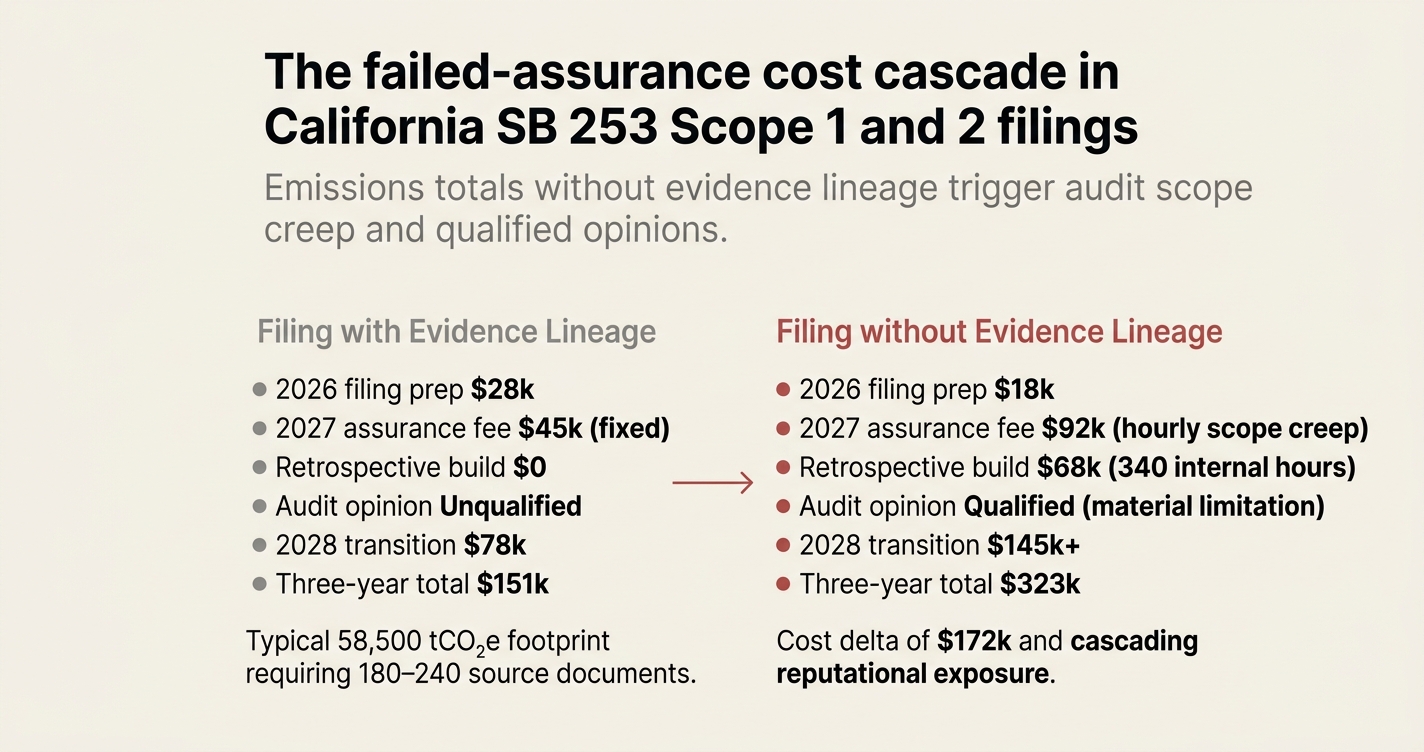
The failed-assurance cost cascade in California SB 253 Scope 1 and 2 filings
Here's the issue: A mid-sized manufacturer with $750 million in California revenue submits its 2026 SB 253 Scope 1 and 2 filing on time, using a GHG Protocol calculator and facility-level templates. The emissions total is correct. The CFO budgets $45,000 for the 2027 limited assurance engagement. Six months into the audit, the engagement partner requests complete population documentation for every emission source from the 2025 baseline onward. The audit fee doubles to $92,000, the filing receives a qualified opinion, and the retrospective documentation build consumes 340 internal hours at a loaded cost of $68,000. Total cost of inaction: $115,000 plus reputational exposure[1].
However, SB 253 assurance consists of two things: emissions totals and evidence lineage.
Emissions totals on their own have no value to an auditor. Evidence lineage is what the 2027 limited assurance engagement is actually verifying. Without population completeness reports, calculation worksheets with source-document traceability, and deterministic lineage from invoice to facility to reported total, the auditor cannot issue an unqualified opinion. The filing becomes an unverified estimate, not a SOX-grade financial disclosure[2].
While the emissions calculation has become cheaper with GHG Protocol calculators and facility-level templates, audit-ready documentation has become more expensive. If a CFO submits a 2026 filing without evidence lineage, the 2027 auditor will request complete population documentation from the 2025 baseline onward. The cost of retrospective documentation builds can outpace the avoided audit fee by 3:1. A typical 58,500 tCO₂e Scope 1 and 2 footprint for a mid-sized manufacturer might require 180 to 240 source documents, each with calculation lineage to the reported total[1].
How do you solve this? I think the operators we work with are correct: treat 2026 as a financial filing deadline, not a sustainability report deadline. The CARB reporting templates, expected January 2025, will specify population completeness and evidence lineage requirements aligned with limited assurance standards[3]. CFOs who defer documentation until the auditor requests it pay twice: once for the retrospective build at scope-creep hourly rates, and once for the audit premium on incomplete client-prepared schedules. For now, the lowest-cost path is to build evidence lineage in 2025, before the 2026 filing window opens.
The shape of the argument, visualised below.
The Cost Structure of Failed SB 253 Assurance Engagements
The cost of inaction is not the 2026 filing. It is the 2027 audit premium. The table below compares the cost profile of a compliant filing with evidence lineage versus a filing without documentation infrastructure:
| Cost Component | Filing with Evidence Lineage | Filing without Evidence Lineage | Delta |
|---|---|---|---|
| 2026 Filing Preparation | $28,000 (120 hours, deterministic inventory) | $18,000 (80 hours, spreadsheet inventory) | +$10,000 |
| 2027 Limited Assurance Fee | $45,000 (fixed-fee engagement) | $92,000 (hourly engagement, scope creep) | +$47,000 |
| Retrospective Documentation Build | $0 | $68,000 (340 internal hours at $200/hour loaded cost) | +$68,000 |
| Audit Opinion | Unqualified | Qualified (material limitation of scope) | Reputational exposure |
| 2028 Reasonable Assurance Transition | $78,000 (fixed-fee, existing lineage) | $145,000+ (auditor-led rebuild from 2025 baseline) | +$67,000 |
| Total Three-Year Cost (2026-2028) | $151,000 | $323,000 | +$172,000 |
The delta compounds. A qualified 2027 opinion triggers investor scrutiny, delays the 2028 reasonable assurance transition, and exposes the CFO to personal liability under California's executive attestation requirement[4].
✅ The Failed-Assurance Readiness Checklist for CFOs
This checklist organizes the preparation work required to avoid a qualified 2027 limited assurance opinion. Each step includes (a) the action, (b) the owner, (c) the evidence artifact produced, and (d) the done-when criterion.
1. ✅ Map the Reporting Boundary
Action: Identify all legal entities, facilities, and emission sources within the SB 253 reporting boundary (all entities with combined California revenue ≥ $1 billion).
Owner: CFO or Director of Financial Reporting.
Evidence Artifact: Organizational boundary memo with legal entity chart, facility list, and revenue allocation by jurisdiction.
Done When: The boundary memo matches the CARB applicability definition and includes all California-nexus subsidiaries, regardless of operational control[5].
2. ✅ Inventory All Emission Sources
Action: Enumerate every Scope 1 source (stationary combustion, mobile combustion, process emissions, fugitive emissions) and Scope 2 source (purchased electricity, steam, heating, cooling) across all facilities in the reporting boundary.
Owner: Sustainability Manager or Environmental Compliance Lead.
Evidence Artifact: Emission source register with facility-level breakdowns and GHG Protocol category codes.
Done When: The register includes 100% population completeness (no material sources excluded) and cross-references to utility accounts, fuel purchase orders, and facility permits[1].
3. ✅ Collect Source Documents for Every Emission Source
Action: Gather utility bills, fuel invoices, refrigerant purchase records, process input logs, and electricity invoices for every emission source identified in Step 2.
Owner: Facilities Manager or Procurement Team.
Evidence Artifact: Source document repository with 180 to 240 documents per typical 58,500 tCO₂e footprint, each tagged by facility and emission source[1].
Done When: Every emission source in the register has corresponding source documents with timestamps, quantities, and supplier verification. No emission total relies on estimates or proxy data.
4. ✅ Build Calculation Worksheets with Source-Document Traceability
Action: Create calculation worksheets that link each source document to the reported emission total via emission factors, conversion factors, and GHG Protocol formulas.
Owner: Sustainability Analyst or Carbon Accounting Lead.
Evidence Artifact: Calculation lineage file (Excel or equivalent) with columns for source document ID, quantity, emission factor, tCO₂e result, and reported-total rollup.
Done When: An auditor can trace any emission figure in the 2026 filing back to a source document in under five minutes. Every calculation step is reproducible without analyst interpretation[6].
5. ✅ Document Emission Factor Choices and Methodologies
Action: Prepare a methodology memo explaining every emission factor choice (EPA eGrid, IPCC defaults, supplier-specific factors), data quality tier, and estimation approach.
Owner: Carbon Accounting Lead or Technical Consultant.
Evidence Artifact: Methodology documentation package with emission factor provenance, uncertainty ranges, and alignment to GHG Protocol Corporate Standard[3].
Done When: The methodology memo addresses every material emission source and quantifies the impact of factor choices on the reported total (e.g., using EPA eGrid subregion factors instead of national averages reduces Scope 2 by 8%).
6. ✅ Prepare a Population Completeness Report
Action: Produce a population completeness report that demonstrates 100% coverage of emission sources, with explanations for any exclusions.
Owner: CFO or Sustainability Manager.
Evidence Artifact: Population completeness attestation with facility-by-facility breakdowns, materiality thresholds, and exclusion justifications.
Done When: The report quantifies the percentage of emissions covered by primary data (invoices, meter readings) versus estimates, and confirms no material sources are omitted due to data availability constraints[1].
7. ✅ Align Internal Controls to Financial Audit Standards
Action: Implement internal controls for emission data collection, calculation review, and documentation retention aligned to COSO or equivalent financial audit frameworks.
Owner: Internal Audit or CFO.
Evidence Artifact: Internal control documentation with segregation of duties, review checkpoints, and error-correction procedures.
Done When: The control environment mirrors SOX-grade financial reporting controls. Every calculation worksheet has a preparer signature and reviewer signature, and documentation retention policies ensure source documents are retained for seven years[7].
8. ✅ Conduct a Pre-Filing Internal Audit
Action: Hire an external auditor or internal audit team to perform a limited-scope review of the 2025 baseline inventory before the 2026 filing window opens.
Owner: CFO.
Evidence Artifact: Pre-filing audit report with findings, recommendations, and remediation plan.
Done When: The auditor confirms population completeness, calculation accuracy, and evidence lineage quality meet limited assurance standards. All material findings are remediated before the 2026 filing submission[1].
9. ✅ Quantify the Cost of Scope 3 Deferral
Action: Model the 2027 Scope 3 reporting requirement (effective for 2026 emissions) and estimate the audit fee premium if Scope 1 and 2 evidence lineage is not already in place.
Owner: CFO or Financial Planning Lead.
Evidence Artifact: Three-year cost projection comparing (a) building Scope 1, 2, and 3 lineage concurrently in 2025-2026 versus (b) building Scope 1 and 2 lineage in 2026, then retrofitting Scope 3 lineage in 2027.
Done When: The cost projection quantifies the scope-creep penalty (typically 40% to 60% audit fee premium) and the internal labor burden of retrospective Scope 3 supplier engagement[8].
10. ✅ Map Supplier Engagement Requirements for 2027 Scope 3 Filings
Action: Identify the top 80% of purchased goods and services suppliers by spend, and initiate data-request outreach to establish primary-data collection workflows.
Owner: Procurement Lead or Supplier Relations Manager.
Evidence Artifact: Supplier engagement register with contact names, data-request templates, and response deadlines.
Done When: At least 60% of spend-weighted suppliers have acknowledged the data request and committed to providing primary data (product-level emissions factors or supplier-specific calculation worksheets) by Q3 2026[8].
11. ✅ Budget for Annual Assurance Fees and Implementation Costs
Action: Allocate budget for (a) 2027 limited assurance engagement ($45,000 to $92,000 depending on evidence lineage quality), (b) 2028 reasonable assurance transition ($78,000 to $145,000), and (c) annual CARB implementation fees ($TBD, flat fee structure expected Q1 2026).
Owner: CFO.
Evidence Artifact: Three-year budget allocation with line items for assurance fees, internal labor, and technology infrastructure.
Done When: The budget includes contingency for scope creep (20% to 30% of base assurance fee) and accounts for the annual CARB flat fee, estimated at $8,000 to $12,000 per covered entity based on CARB's $14 million program cost estimate divided by approximately 5,400 covered entities[5][7].
12. ✅ Align the 2026 Filing to CARB Template Requirements
Action: Once CARB publishes the final reporting templates (expected January 2025), map every required data field to the internal evidence lineage system.
Owner: Sustainability Manager or Carbon Accounting Lead.
Evidence Artifact: Template mapping document with field-by-field correspondence between CARB requirements and internal calculation worksheets.
Done When: The mapping document confirms 100% data availability for all required fields, with no reliance on placeholder values or estimates[3].
13. ✅ Establish Executive Attestation Protocols
Action: Draft executive attestation language for the CFO or Principal Executive Officer to sign, certifying the accuracy and completeness of the 2026 filing.
Owner: General Counsel or CFO.
Evidence Artifact: Attestation protocol memo with legal review, liability disclosure, and sign-off procedures.
Done When: The attestation protocol aligns with SOX 302-style certification language and includes officer liability acknowledgments[4].
14. ✅ Prepare for 2030 Reasonable Assurance Standards
Action: Model the reasonable assurance standard (ISAE 3000, equivalent to financial audit rigor) and identify gaps in current evidence lineage systems.
Owner: CFO or Director of Financial Reporting.
Evidence Artifact: Gap analysis report comparing current documentation standards to reasonable assurance requirements, with remediation roadmap.
Done When: The gap analysis quantifies the incremental cost of transitioning from limited to reasonable assurance (typically 40% to 60% audit fee premium) and confirms internal controls meet ISAE 3000 thresholds[6].
15. ✅ Document the Cost of Inaction
Action: Prepare a board-level memo quantifying the cost cascade of (a) qualified 2027 opinion, (b) retrospective documentation builds, (c) executive liability exposure, and (d) investor scrutiny.
Owner: CFO.
Evidence Artifact: Cost-of-inaction memo with three-year financial impact projection and reputational risk assessment.
Done When: The memo includes the $172,000 three-year cost delta (from the table above), the $500,000 annual SB 253 non-compliance penalty, and the reputational cost of a qualified audit opinion in institutional investor communications[4][5].
The Retrospective Documentation Premium
"While the emissions calculation has become cheaper with GHG Protocol calculators and facility-level templates, audit-ready documentation has become more expensive. If a CFO submits a 2026 filing without evidence lineage, the 2027 auditor will request complete population documentation from 2025 baseline onward. The cost of retrospective documentation builds can outpace the avoided audit fee by 3:1."[1]
The cost structure of climate assurance mirrors financial audit: fixed-fee engagements assume the client has prepared complete documentation, while hourly engagements price for auditor-led evidence builds. CFOs who treat SB 253 as a sustainability report deadline, rather than a CFO-owned financial disclosure obligation, will face audit qualifications, re-work costs, and investor scrutiny[2].
The 2026 deadline is not a soft target. It is a regulatory cliff. CARB will assess annual implementation fees starting September 10, 2026, with a 60-day payment window[7]. Companies without evidence lineage infrastructure by Q3 2026 will not have time to remediate before the 2027 assurance engagement begins.
How Emission3 Fits
Emission3 eliminates the evidence lineage gap between spreadsheet inventories and assurance-ready reporting. The platform produces:
- Population completeness reports with facility-level breakdowns and materiality thresholds.
- Calculation lineage files linking every source document to the reported total via reproducible calculation steps.
- Audit evidence packs with source-document traceability, methodology documentation, and internal control attestations.
- CARB-aligned exports matching the January 2025 reporting templates, with no manual reformatting required.
Every customer starts with a personal readiness call to map their reporting boundary, facility footprint, and compliance timeline. No self-serve signups—just deterministic, auditor-ready inventories for SB 253 limited and reasonable assurance engagements.
The cost of deferring documentation is not the 2026 filing fee. It is the 2027 audit premium, the 2028 reasonable assurance transition cost, and the executive liability exposure of a qualified opinion. CFOs who build evidence lineage in 2025 avoid the retrospective documentation penalty and lower their three-year assurance cost by $172,000 or more.
Book a CBAM readiness call to map your SB 253 compliance timeline, supplier engagement requirements, and assurance-ready workflow. All customers start with a readiness conversation—we map suppliers, gaps, and implementation before any contract is signed[9].
[1] https://emission3.com/blog/90-day-assurance-readiness-problem-2026-sb253-scope-1-2-filings-2026-0
[2] https://emission3.com/blog/us-climate-disclosure-stack-sb253-sb261-2026-cfo-reckoning
[3] https://dart.deloitte.com/USDART/home/publications/deloitte/sustainability-spotlight/2025/california-climate-legislation-reporting-updates-2026
[4] https://www.nelsonmullins.com/insights/insights/navigating-california-s-climate-disclosure-laws-your-complete-guide-to-sb-253-and-sb-261
[5] https://www.insideenergyandenvironment.com/2025/12/california-climate-disclosure-laws-carb-draft-regulations-clarify-fees-deadlines-and-applicability
[6] https://esgnews.com/eight-sustainability-forces-shaping-us-businesses-in-2026
[7] https://www.nelsonmullins.com/insights/insights/navigating-california-s-climate-disclosure-laws-your-complete-guide-to-sb-253-and-sb-261
[8] https://www.cascadeenergy.com/news/californias-sb-253-and-sb-261-what-they-mean-for-your-business
[9] /book-demo
References & Sources
External Sources
- [1]The 90-day assurance-readiness problem in 2026 SB 253 Scope 1 and 2 filings
Analysis of the evidence lineage gap and retrospective documentation cost premium for SB 253 limited assurance engagements.
- [2]The US Climate Disclosure Stack: SB 253, SB 261, and the 2026 CFO Reckoning
Regulatory cliff analysis for 2026 climate compliance deadlines, including SB 253 audit fee premiums and qualified inventory costs.
- [3]California Climate Legislation Update — Status of CARB Rulemaking
Deloitte analysis of CARB draft regulations, reporting templates, and implementation fee structures for SB 253 and SB 261.
- [4]Navigating California's Climate Disclosure Laws: Your Complete Guide to SB 253 and SB 261
Legal analysis of executive attestation requirements, non-compliance penalties, and annual fee structures for SB 253 and SB 261.
- [5]California Climate Disclosure Laws: CARB Draft Regulations Clarify Fees, Deadlines, and Applicability
Analysis of CARB's flat fee structure, implementation cost estimates, and September 2026 assessment timeline.
- [6]Eight Sustainability Forces Shaping US Businesses in 2026
Overview of 2026 climate disclosure requirements, audit-ready data standards, and limited-to-reasonable assurance transitions.
- [7]Nelson Mullins - California Climate Disclosure Laws Fee Structure
Detailed breakdown of CARB annual fee calculation methodology and September 10, 2026 assessment timeline.
- [8]California's SB 253 and SB 261: What They Mean for Your Business
Analysis of Scope 3 supplier engagement requirements, non-compliance penalties, and 2027 reporting timeline.
Related Content
- [9]Book a CBAM readiness call
All customers start with a readiness call: we map suppliers, gaps, and implementation, no anonymous self-serve onboarding.
- [10]Audit-ready exports in Emission3
For auditors and CFOs, shows the evidence lineage artifact and population completeness reports for SB 253 assurance engagements.