The default-value cost multiplier in CBAM filings for non-EU exporters
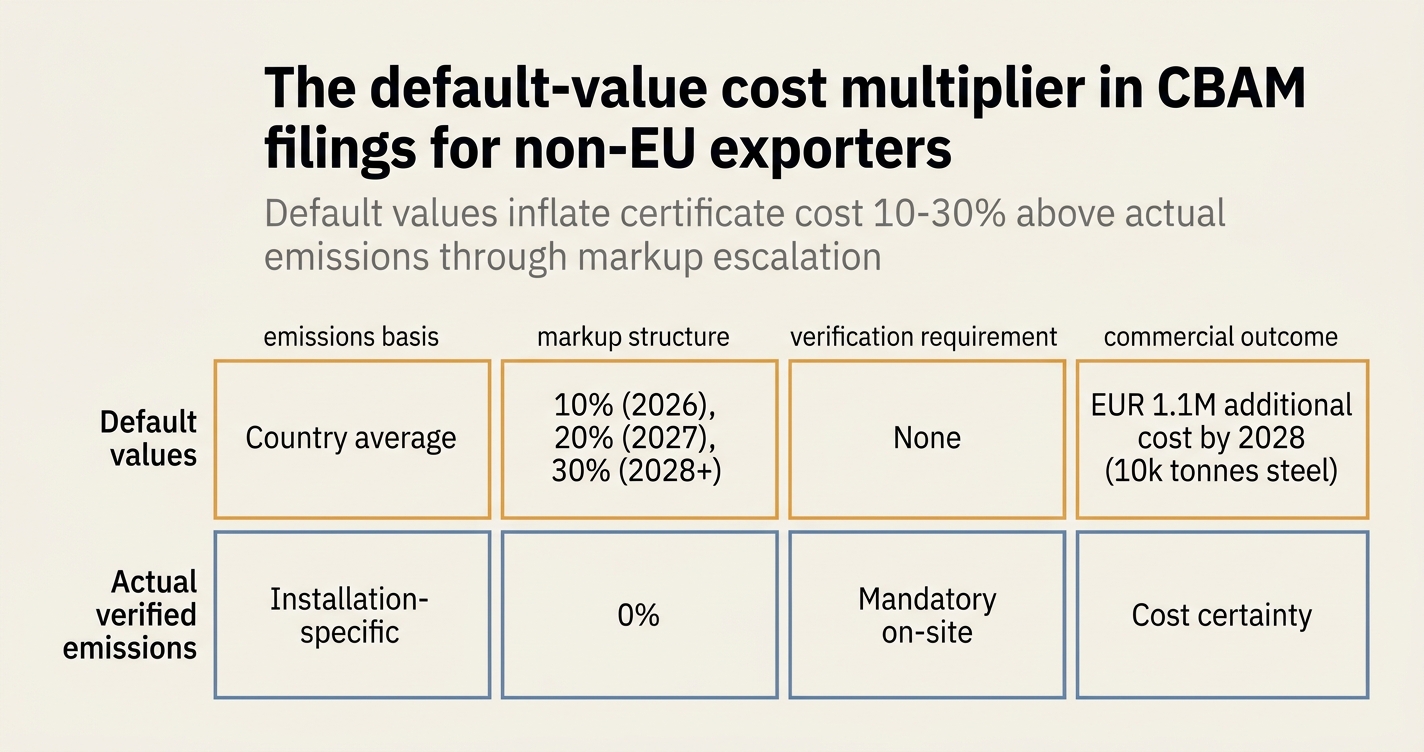
The default-value cost multiplier in CBAM filings for non-EU exporters
Here's the issue: Non-EU exporters shipping steel, aluminium, cement, fertiliser, hydrogen, or electricity to the EU in 2026 face a choice between providing actual, verified embedded emissions data or accepting country-level default values. Most exporters treat this as a data collection burden versus administrative simplicity trade-off. They assume default values avoid the overhead of installation-level monitoring, reporting, and third-party verification. That assumption costs them 10-30% more per tonne of carbon than their competitors who provide actual data.
However, a CBAM filing consists of two things: embedded emissions declared to the EU CBAM Registry, and the certificate cost calculated from those emissions. The embedded emissions number determines how many certificates the EU importer must purchase to cover the goods' carbon footprint. The certificate cost is the financial liability.
Embedded emissions on their own have no commercial value. Certificate cost is what the EU importer is actually paying for, and what they will push back onto the supplier if it exceeds the cost of competing goods. If your embedded emissions are declared using default values, the certificate cost includes a markup that rises every year: 10% in 2026, 20% in 2027, 30% from 2028 onward. Actual emissions, verified by an accredited verifier, carry no markup.
While default values have become administratively cheaper to report, they have become more expensive to file. A UK steel exporter using the country-level default for basic oxygen furnace steel in 2026 will generate a certificate cost roughly 2.1 times higher than the same exporter using verified actual emissions from an efficient installation, before applying the markup. After applying the 10% markup, the multiplier rises to 2.31. By 2028, the multiplier reaches 2.73. If the exporter ships 10,000 tonnes of steel per year at an EU carbon price of EUR 80 per tonne, the annual cost difference between default and actual values approaches EUR 1.1 million by 2028.
How do you solve this? I think the operators we work with who start monitoring in Q4 2026 are treating verification readiness as a 2027 competitive advantage, not a 2028 compliance obligation. For now, the financial gap between default and actual values is widening faster than the administrative cost of verification is falling. The shape of the argument, visualised below.
Myth 1: Default values are a safe fallback for 2026 filings
Reality: Default values are country-specific average emissions intensity, not installation-specific performance. The EU Commission published default values for CBAM goods on 31 December 2025 in Implementing Regulation (EU) 2025/2621. These values reflect the average carbon intensity of production in each country, not the efficiency of individual installations. A modern steel mill in the United States operating an electric arc furnace will almost certainly emit less carbon per tonne than the US country-level default for steel, which aggregates data from blast furnace, basic oxygen furnace, and electric arc furnace routes. Using the default means paying for emissions you did not generate. [1]
The markup compounds this penalty. In 2026, importers using default values pay a 10% markup on top of the certificate cost. This rises to 20% in 2027 and 30% from 2028 onward. [2] For a UK steel exporter shipping 10,000 tonnes per year, the difference between a country-level default of 2.1 tonnes CO₂ per tonne of steel and an actual installation value of 1.0 tonne CO₂ per tonne translates to an additional EUR 88,000 in certificate cost in 2026 at EUR 80 per tonne of carbon, before applying the markup. After the markup, the additional cost rises to EUR 96,800.
Myth 2: Verification is only required for 2027 filings
Reality: Verification covers emissions generated in 2026, but the verification process cannot begin until monitoring systems are in place and operating for the full calendar year. Accredited CBAM verifiers are not expected to be widely available until September 2026. [3] Verification of an installation's actual 2026 emissions cannot be completed before the first annual CBAM declaration is due on 30 September 2027. Exporters who wait until 2027 to start monitoring will miss the 2026 reporting period and be forced to use default values for their first annual declaration.
The verification requirement includes a mandatory on-site inspection of the installation in the first year. [4] In subsequent years, virtual site visits or waivers may be permitted under strict conditions, but the initial physical site visit is non-negotiable. Exporters who do not have monitoring systems in place by January 2026 will not have verifiable data for the full year, and partial-year data is not accepted for the first reporting period.
Myth 3: EU importers will absorb the CBAM certificate cost
Reality: The legal obligation to surrender CBAM certificates falls on the authorised CBAM declarant, which is either the EU importer or a customs representative acting on their behalf. However, commercial contracts increasingly shift the economic burden of CBAM compliance back to the supplier. If your embedded emissions are higher than your competitor's, your EU customer will pay more for CBAM certificates to cover your goods. That cost difference becomes a price disadvantage in future procurement negotiations.
The default-value markup makes this cost shift explicit. An EU importer purchasing steel from two suppliers, one using verified actual emissions and one using default values, will pay 10-30% more in CBAM certificates for the default-value supplier, even if the actual emissions are identical. [5] Over a multi-year supply contract, this difference compounds. By 2028, the cumulative cost disadvantage of default values can exceed the total cost of implementing monitoring and verification systems.
Myth 4: Monitoring embedded emissions is technically complex
Reality: The CBAM calculation methodology follows a top-down approach defined in Implementing Regulation (EU) 2025/2547. Emissions are monitored at installation level, attributed to production processes, and converted to specific embedded emissions for the goods produced. [1] For most installations, this means collecting data that already exists for other purposes: fuel consumption, electricity usage, process emissions, and production volumes. The challenge is not technical complexity but administrative consistency.
The monitoring plan must be documented and followed for the full calendar year. The data must be traceable to source documents: utility bills, fuel invoices, production logs. The calculation must follow the CBAM methodology, which is deterministic. There is no modelling, no estimation, no allocation by revenue. Every number must have a lineage from source document to reported value. This is why document-first ingestion systems built for CBAM compliance reduce verification risk: the evidence pack exists before the verifier arrives, not after.
Myth 5: Verification reports are standardised across verifiers
Reality: Verification reports must follow the principles set out in Annex VI of the CBAM Regulation and the detailed requirements of Implementing Regulation (EU) 2025/2546. However, verifiers interpret materiality thresholds, risk assessments, and data quality differently. [6] The Verification Regulation establishes materiality thresholds at the level of individual goods, generally set at 5% of total specific embedded emissions per tonne. A verifier who applies a 5% threshold strictly will flag more data quality issues than a verifier who applies a 10% threshold. This variability creates a first-mover advantage for exporters who engage verifiers early and establish monitoring systems that exceed the minimum threshold.
The verification report itself must include a statement of verification, a description of the monitoring methodology, a summary of findings, and an assessment of materiality. The report must be transmitted to the installation operator via the CBAM Registry if the operator is registered, or by other means if not. [1] Verification reports for 2026 can be issued in an electronic EU template from January 2027 via the CBAM Registry. Exporters who are not registered in the CBAM Registry by Q4 2026 will face delays in receiving their verification reports, which delays the EU importer's ability to file the annual declaration by 30 September 2027.
Myth 6: Actual emissions data increases commercial risk
Reality: The opposite is true. Providing actual emissions data to your EU customer increases transparency, but it also locks in a lower certificate cost that your competitors using default values cannot match. Once your actual emissions are verified, your EU customer knows the exact CBAM liability for your goods. This certainty reduces procurement risk and makes your goods easier to budget for in multi-year contracts.
The commercial risk is in not providing actual data. If your competitor provides verified actual emissions that are lower than the default value, your EU customer will pay less for CBAM certificates when they buy from your competitor. Over time, this cost difference becomes a structural disadvantage. By 2028, the 30% markup on default values means your goods carry a 30% higher carbon cost than your competitor's goods, even if your actual emissions are identical. That cost difference is not invisible. It shows up in the CBAM Registry, in the quarterly declarations, in the annual certificate surrender calculations. Your EU customer sees it, and your competitor's EU customer sees it.
Myth 7: The first verification cycle is low-stakes
Reality: The first verification cycle in 2027 covers emissions generated in 2026, which means the data quality, monitoring consistency, and documentation completeness established in 2026 determine whether your installation passes verification in 2027. If the verifier identifies material misstatements, the EU importer must use default values for the goods covered by the failed verification. [7] This means the exporter loses the benefit of actual emissions for the full year, not just the quarter in which the verification failed.
The stakes are higher for exporters who supply multiple EU importers. A failed verification affects all EU customers who rely on your actual emissions data, not just one. If your installation supplies 50,000 tonnes of steel per year across five EU importers, a failed verification forces all five importers to use default values for your goods, which means all five importers pay the markup. The reputational cost of a failed verification extends beyond the immediate financial penalty. EU importers who experience a verification failure with one supplier become more cautious about accepting actual emissions data from other suppliers without additional due diligence.
Summary: The cost structure of default versus actual values
| Factor | Default values | Actual verified emissions |
|---|---|---|
| Embedded emissions basis | Country-level average | Installation-specific performance |
| Markup on certificate cost | 10% (2026), 20% (2027), 30% (2028+) | 0% |
| Verification requirement | None | Mandatory, on-site in first year |
| Data collection burden | None | Installation-level monitoring |
| Commercial risk | Price disadvantage versus competitors using actual data | Certainty, lower certificate cost |
| First-year cost difference (10,000 tonnes steel, EUR 80/tonne CO₂) | EUR 96,800 additional cost (2026) | Baseline |
| Three-year cumulative cost difference | EUR 330,000+ additional cost | Baseline |
How Emission3 fits
Emission3 is built for the non-EU exporter who needs to be verification-ready in Q1 2027 without waiting until December 2026 to start. The system ingests the source documents you already have—utility bills, fuel invoices, production logs—and builds the calculation lineage from document to declared value. Every number in the CBAM report traces back to a source document. Every allocation follows the CBAM methodology deterministically. When the verifier arrives for the on-site inspection in 2027, the evidence pack exists in full: monitoring plan, source documents, calculation lineage, materiality checks.
The document-first ingestion layer means you do not need to re-enter data or reconcile spreadsheets. The deterministic calculation engine means the numbers do not drift between quarters. The auditor-ready export format means the verification report can be generated directly from the system, not reconstructed from emails and file shares. [8]
For non-EU exporters facing the 30 September 2027 declaration deadline, the difference between starting monitoring in Q4 2026 and waiting until Q1 2027 is the difference between verified actual emissions and default values with a 10% markup. The cost difference is measurable, the timeline is fixed, and the commercial advantage compounds over time. If you are exporting CBAM-covered goods to the EU in 2026, the decision to implement monitoring systems is not a 2028 problem. It is a Q4 2026 decision with a Q1 2027 verification deadline.
Book a CBAM readiness call to map your supplier installations, identify monitoring gaps, and build the implementation timeline that gets you to verification-ready by Q1 2027. [9] The operators we work with treat this as a competitive advantage, not a compliance obligation. The cost multiplier from default values is real, the markup is rising, and the EU importers are watching. Start now.
References & Sources
External Sources
- [1]EU CBAM Emissions Data: Monitoring, Reporting & Verification
Explains the distinction between actual values monitored at installation level and default values as country-specific averages with markup, and the top-down calculation methodology from installation to goods.
- [2]How the EU's New Default Emissions Values Under CBAM Impact US Exporters
Details the 10% markup in 2026, rising to 30% by 2028, applied to default values to incentivise use of actual emissions data.
- [3]EU CBAM 2026: How to calculate your liability
Notes that accredited CBAM verifiers are not expected to be operating before around September 2026, and verification of 2026 emissions cannot be completed before 30 September 2027.
- [4]CBAM Verification & Compliance
Confirms that on-site inspection of the installation by an accredited verifier is required under the December 2025 rules, and preparation starts with monitoring systems and internal data quality.
- [5]What EU Importers and Non-EU Manufacturers Need to Understand About CBAM Verification
Explains that default values now carry a 10-30% markup, making it increasingly costly to avoid using actual values, and that verified data almost always comes back lower than defaults.
- [6]A Guide to the EU CBAM
Details the verification principles in Implementing Regulation (EU) 2025/2546, including materiality thresholds at 5% of total specific embedded emissions per tonne and mandatory site visits in 2026.
- [7]The verification-timing problem in CBAM filings for 2026 emissions
Emission3 internal post explaining why exporters need to be verification-ready in Q1 2027 without waiting until December 2026 to start monitoring.
Related Content
- [8]Document-first ingestion
How raw documents become audit-grade evidence in Emission3's document-first ingestion system, building calculation lineage from source to declared value.
- [9]Book a CBAM readiness call
All customers start with a readiness call: we map suppliers, gaps, and implementation, no anonymous self-serve onboarding. Get verification-ready by Q1 2027.