The verification-timing problem in CBAM filings for 2026 emissions
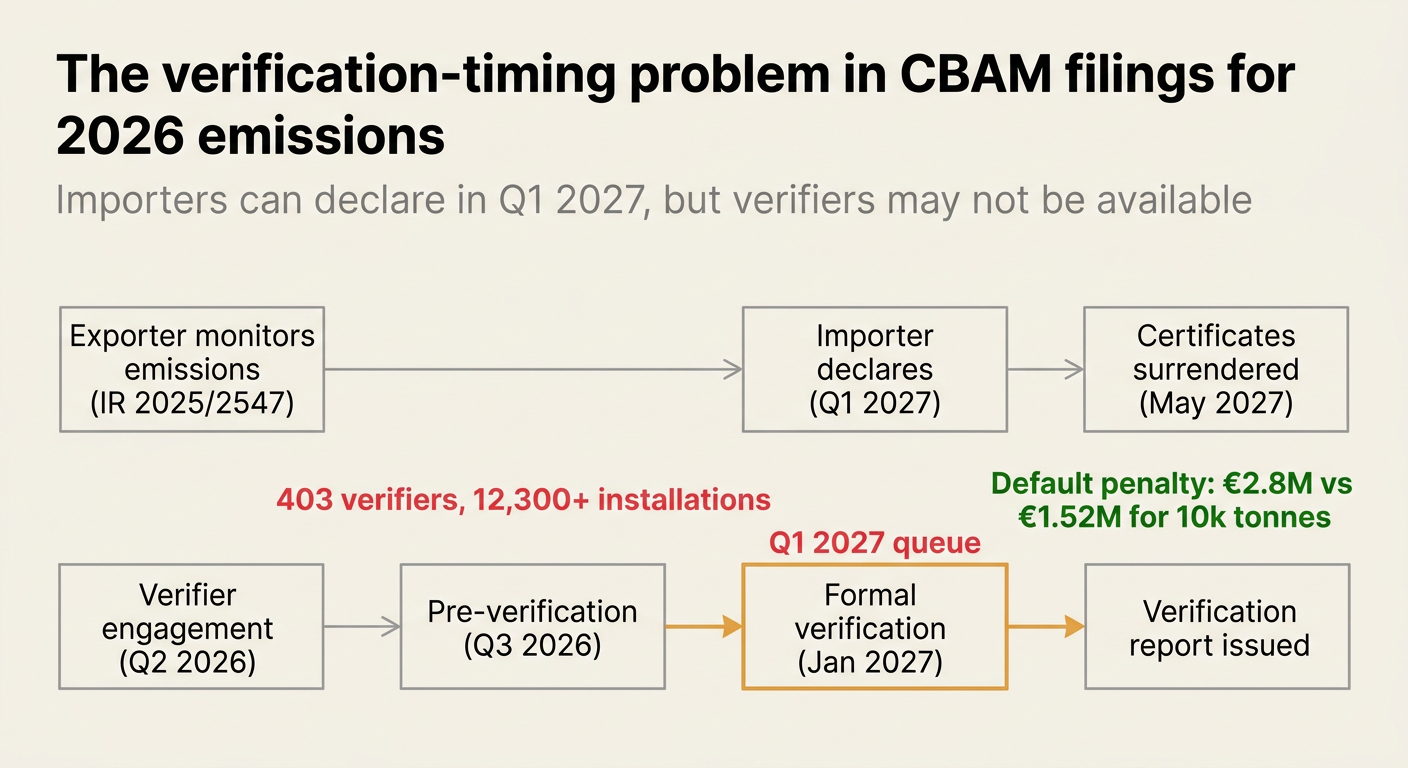
The verification-timing problem in CBAM filings for 2026 emissions
Here's the issue: from January 2026, non-EU exporters and EU importers face a new compliance interface. The exporter must monitor actual installation-level emissions throughout 2026, following IR 2025/2547 methodology. The EU importer declares those emissions in Q1 2027 and surrenders CBAM certificates by May 31, 2027. On paper, this sequence looks straightforward—monitor, declare, surrender. In practice, a timing gap has opened between the declaration deadline and the availability of accredited verifiers.
However, CBAM filings consist of two things: the embedded emissions total for the goods shipped, and a third-party verification report confirming that the methodology, monitoring plan, and calculation lineage meet EU ETS-equivalent standards. The first is a number. The second is an audit artifact that takes 4–8 weeks to produce and requires an accredited verification body to conduct an on-site or virtual visit, review system boundaries, assess precursor allocations, and issue a verification statement.
The emissions total on its own has no value under CBAM. The verification report is what the EU importer is actually obliged to submit—and what the national competent authority will audit when it reviews the declaration. Without a verification report covering the 2026 calendar year, the importer cannot use actual emissions data. They fall back to default values, which the Commission has deliberately set at conservative levels with a 10% markup in 2026, rising to 30% by 2028. For blast furnace steel from China, defaults sit at approximately 3.5 tCO₂ per tonne; verified actuals from a modern electric arc furnace might come in at 1.9 tCO₂ per tonne. The cost difference is material.
While the monitoring and reporting infrastructure has become clearer with the December 2025 implementing acts, the verification infrastructure has become more constrained. If an installation cannot secure a verifier in Q1 2027, the importer must use default values for the entire 2026 shipment volume. A 10,000-tonne shipment of steel at €80 per EUA, using defaults at 3.5 tCO₂ per tonne, generates a CBAM certificate cost of approximately €2.8 million. The same tonnage with verified actuals at 1.9 tCO₂ per tonne drops the cost to €1.52 million—a €1.28 million delta. If the verifier queue runs 12 weeks instead of 6, that delta compounds across every shipment the importer receives from that installation.
How do you solve this? I think the operators we work with are treating 2026 as the pre-verification year: engage a verifier in Q2 2026, conduct a gap assessment on the monitoring plan and data collection systems, run a trial verification cycle on Q1–Q3 2026 data, and schedule the formal 2026 verification for January 2027. For now, this front-loads the relationship with the verification body and reduces the risk of being caught in the Q1 2027 queue when every other installation in the same sector is competing for the same 403 accredited verifiers registered in the Union Registry.
The shape of the argument, visualised below.
The verification bottleneck in numbers
As of January 1, 2026, the Union Registry lists 403 accredited verifiers available for CBAM verification across all EU member states. By comparison, 4,100 CBAM declarants have been authorised, and nearly 12,000 economic operators have submitted authorisation applications. Each declarant may source from multiple installations—steel importers commonly work with 5–15 suppliers, each operating one or more production sites. If we conservatively assume an average of 3 installations per declarant, the 4,100 authorised declarants represent approximately 12,300 installations requiring verification in Q1 2027 for their 2026 emissions. That ratio—12,300 installations to 403 verifiers—implies an average workload of 30 installations per verifier, assuming perfect geographic and sectoral distribution.
In practice, distribution is not perfect. France's national competent authority has warned that accredited verifiers may not be ready in time to meet anticipated demand, with the first batch expected in autumn 2026. The accreditation process itself is progressing at varying speeds across member states, with only a handful of jurisdictions currently accepting applications. This creates a geographic bottleneck: an installation in India exporting to France cannot simply engage a verifier accredited in Germany or Poland if that verifier lacks the capacity or sectoral expertise to audit a blast furnace installation.
| Metric | Value | Source |
|---|---|---|
| Accredited verifiers (Union Registry) | 403 | IELP guest post, Jan 2026[1] |
| Authorised CBAM declarants | 4,100 | IELP guest post, Jan 2026[1] |
| Economic operators with pending applications | ~12,000 | IELP guest post, Jan 2026[1] |
| Estimated installations per declarant | 3–5 | Industry avg (steel, aluminium) |
| Implied installations requiring verification | 12,300+ | Calculated |
| Average workload per verifier (if evenly distributed) | 30+ installations | Calculated |
| Typical verification duration | 4–8 weeks | The Sustainability Cloud[2] |
| First verification deadline (2026 emissions) | Q1 2027 | CBAM Regulation |
The timing constraint is structural, not operational. Verification is not a paper exercise—it requires methodology review, data lineage audit, system boundary checks, precursor allocation validation, and in many cases a physical site visit. A verifier working with a new installation in 2027 must first understand the production process, review the monitoring plan, assess whether the operator followed IR 2025/2547 methodology, and confirm that emissions were correctly attributed to the goods produced. This cannot be compressed into a 2-week sprint in February 2027.
The default-value penalty for late or missing verification
When an importer cannot provide a verification report for actual emissions, they must use default values published by the Commission in IR 2025/2621. These defaults are set at conservative levels—typically the higher end of the emissions spectrum for a given country and CN code—and include a markup that escalates over time. In 2026, the markup is 10%. In 2027, it remains 10%. From 2028 onward, it rises to 30%.
For steel products, the penalty is immediate and quantifiable. Default values for Chinese billet sit at approximately 1.87–3.5 tCO₂ per tonne, depending on production route. Russian slab defaults are around 2.3 tCO₂ per tonne. Indian slab defaults reach 3.0 tCO₂ per tonne, and Indonesian defaults spike to 5.4 tCO₂ per tonne. By contrast, verified actual emissions from a modern electric arc furnace using high-grade scrap and renewable electricity can come in below 1.0 tCO₂ per tonne. The spread between default and actual is not a rounding error—it is a multiple.
"The final default values practically make CBAM reporting by defaults infeasible for most importers. It will be the year of convulsive verifications of actual emissions." — Italian slab producer, quoted in EUROMETAL, December 2025[3]
The cost arithmetic is straightforward. Assume a 10,000-tonne shipment of steel billet from China, EUA price at €80 per tonne of CO₂, and a choice between default values at 3.5 tCO₂ per tonne or verified actuals at 1.9 tCO₂ per tonne. Using defaults, the CBAM certificate cost is 10,000 × 3.5 × €80 = €2.8 million. Using verified actuals, the cost is 10,000 × 1.9 × €80 = €1.52 million. The difference—€1.28 million—is the verification dividend. For an importer receiving monthly shipments of this size, the annualised delta exceeds €15 million.
The markup escalation compounds this penalty. In 2028, when the markup rises to 30%, the default value for Chinese billet becomes 3.5 × 1.30 = 4.55 tCO₂ per tonne. The same 10,000-tonne shipment now costs €3.64 million in CBAM certificates, versus €1.52 million with verified actuals. The delta widens to €2.12 million per shipment, or €25.4 million annualised. For exporters competing on price, this is not a compliance cost—it is a market exit cost.
The Q1 2027 verification queue: who gets in, who waits
The first verification cycle for 2026 emissions opens in January 2027. The Commission's implementing acts specify that verification must cover the full calendar year, assess the monitoring plan, review calculation methodologies, and confirm that emissions were correctly attributed to goods produced. Physical site visits are required unless the verifier can justify a virtual audit. The materiality threshold is set at 5% of total embedded emissions and 5% of total specific embedded free allocation, assessed per CN code.
For installations that waited until December 2026 to engage a verifier, the Q1 2027 queue is a bottleneck. Verifiers will prioritise clients with whom they have an existing relationship, clients who completed pre-verification in 2026, and clients whose monitoring plans are already approved and documented. A new client approaching a verifier in January 2027 with no prior engagement, no approved monitoring plan, and incomplete emissions data will likely be quoted an 8–12 week timeline—which pushes the verification report delivery into late March or early April. If the importer's declaration deadline is March 31, they miss the window. They fall back to defaults.
The risk is not hypothetical. French and German competent authorities have both signalled that verification capacity will be constrained in the first cycle. Accreditation is not instantaneous—it requires the national accreditation body to audit the verifier's technical competence, review their audit procedures, and confirm they meet ISO 14065 or equivalent standards. In France, the first accredited verifiers are not expected until autumn 2026, which leaves a 3–4 month window for installations to engage, conduct pre-verification, and schedule the formal 2026 audit.
For exporters in India, China, and Southeast Asia, the geographic dimension adds further friction. A verifier accredited in Germany may not have the language capability, sectoral expertise, or site-access agreements to audit a blast furnace in Jharkhand or a rolling mill in Hebei. The verifier must either travel (adding cost and lead time) or subcontract to a local technical expert (adding coordination overhead). Either way, the 4–8 week baseline timeline extends.
The pre-verification strategy: de-risk the 2027 cycle in 2026
The operators we work with are treating 2026 as the pre-verification year. Rather than waiting until January 2027 to engage a verifier, they are initiating the relationship in Q2 2026, conducting a gap assessment on their monitoring plan and data collection systems, and running a trial verification cycle on partial-year data (Q1–Q3 2026). This approach front-loads the verifier relationship, identifies data gaps and methodology issues early, and reserves a slot in the verifier's Q1 2027 schedule before the queue forms.
Pre-verification is not a regulatory requirement, but it is becoming a de facto market standard. RINA, one of the accredited verification bodies for EU ETS, has explicitly positioned pre-verification as a service for 2026, with the promise of official CBAM verification from January 2027 onward. The pre-verification deliverable is a gap analysis report: where the monitoring plan needs refinement, where the data lineage is incomplete, where system boundaries need clarification, and where precursor allocations require additional documentation. The installation uses this report to remediate gaps during the second half of 2026, so that when the formal verification begins in January 2027, the verifier is working with clean, complete data.
The timeline for a pre-verification engagement looks like this:
- Q2 2026: Engage verifier, submit draft monitoring plan, initiate gap assessment.
- Q3 2026: Verifier conducts initial review, identifies data gaps, issues preliminary findings.
- Q4 2026: Installation remediates gaps, updates monitoring plan, collects Q4 emissions data.
- Jan 2027: Formal verification begins, covering full calendar year 2026.
- Feb–Mar 2027: Verifier completes audit, issues verification report.
- Q1 2027: Importer submits CBAM declaration with verified actuals.
This sequence assumes the verifier is available in Q2 2026, which is not guaranteed. For installations exporting to multiple EU importers, the verifier engagement must happen early—before the autumn 2026 accreditation wave and before the Q4 2026 rush when every other exporter in the sector realises they need a verifier for January.
The importer–exporter compliance interface: who owns the verification cost?
CBAM introduces a new compliance interface between EU importers and their non-EU suppliers. The importer is the CBAM declarant—they submit the quarterly and annual declarations, surrender the certificates, and face penalties for non-compliance. But the emissions data originates at the installation, and the verification report is issued to the operator, not the importer. This creates a principal–agent problem: who pays for the verification, and who bears the cost if the verification is delayed or fails?
In practice, the cost allocation depends on the commercial relationship and the balance of negotiating power. Large steel importers with diversified supplier bases are pushing the verification cost back onto the exporter: "If you want to sell into the EU, you need to provide verified actuals. If you can't, we'll use defaults, and you'll absorb the CBAM certificate cost through a lower purchase price." Smaller importers with single-source suppliers may agree to share the verification cost, particularly if the exporter is a strategic partner or the only viable source for a specific grade or specification.
The verification cost itself is not trivial. Industry estimates range from €5,000 to €25,000 per installation per year, depending on installation complexity, data quality, and whether a physical site visit is required. For a mid-size steel mill exporting 50,000 tonnes per year to the EU, a €15,000 verification cost represents €0.30 per tonne. Compare that to the CBAM certificate cost differential: if defaults inflate the carbon intensity by 1.5 tCO₂ per tonne, and the EUA price is €80, the cost penalty is €120 per tonne. The verification cost is a rounding error relative to the default-value penalty.
But the timing risk is not symmetric. If the exporter fails to secure verification in Q1 2027, the importer must use defaults for the entire 2026 shipment volume—and the importer, not the exporter, faces the immediate cash outflow for the additional CBAM certificates. The importer may then attempt to recover this cost from the exporter through a retroactive price adjustment or by withholding payment on future orders. Either way, the relationship is strained, and the exporter's competitive position is weakened.
How Emission3 fits
Emission3 is built for the installation operator who needs to be verification-ready in Q1 2027 without waiting until December 2026 to start. Our platform ingests the raw documents—utility bills, production logs, BoMs, invoices—that feed the CBAM monitoring plan, converts them into line-item emissions attributions, and generates the calculation lineage and evidence pack that verifiers require. When the verifier arrives in January 2027, they are not reverse-engineering your emissions model from spreadsheets—they are auditing a documented, deterministic calculation that traces every tonne of CO₂ back to the source document that generated it.
For installations running pre-verification in 2026, Emission3 provides the data infrastructure: we map your production processes to CN codes, allocate precursor emissions, and generate the quarterly emissions summary that your EU importer needs for their CBAM declaration. When the verifier conducts the gap assessment, they are reviewing a system that already meets IR 2025/2547 methodology requirements, not a set of manual calculations that need to be rebuilt.
For installations exporting to multiple EU importers, Emission3 consolidates the compliance interface: one monitoring plan, one data model, one set of evidence packs, distributed to multiple importers as needed. The verifier issues one verification report, covering the installation's entire output for the year. Importers receive verified actuals for their share of the production volume, with no manual allocation or apportionment required.
Typical engagement: we start with a CBAM readiness call[4] in Q2 2026, map your production processes and supplier base, identify the documents you already collect (and the gaps), and build the ingestion workflow. By Q3 2026, you have a trial dataset covering the first half of the year, ready for pre-verification. By January 2027, you have a full-year dataset, a verified monitoring plan, and a verifier relationship in place. Your EU importers declare using verified actuals, not defaults. You avoid the €120-per-tonne penalty, and you stay competitive in the EU market.
The 30-day, 60-day, 90-day CBAM readiness playbook for non-EU exporters
If you are a non-EU exporter shipping CBAM goods to the EU in 2026, here is the week-by-week playbook to be verification-ready by Q1 2027:
Days 1–30: Monitoring plan and verifier engagement
- Week 1: Identify all installations exporting to the EU. For each installation, list the CN codes produced and the EU importers receiving goods.
- Week 2: Draft a monitoring plan following IR 2025/2547 methodology. Define system boundaries, production processes, and precursor attribution rules.
- Week 3: Engage 2–3 accredited verifiers (or verifiers seeking accreditation). Request quotes for pre-verification in Q3 2026 and formal verification in Q1 2027.
- Week 4: Select a verifier, submit the draft monitoring plan, and schedule the gap assessment for Q3 2026.
Days 31–60: Data collection and ingestion
- Week 5: Map the documents you already collect (utility bills, production logs, purchase orders, invoices) to the monitoring plan's data requirements.
- Week 6: Identify gaps—meters not installed, scrap grades not tracked, electricity invoices missing monthly breakdowns.
- Week 7: Implement gap remediation—install submeters, update purchase order templates, request detailed invoices from utility providers.
- Week 8: Build the data ingestion workflow. If using Emission3[5], connect your document sources (email, ERP, supplier portals). If using spreadsheets, template the data entry format.
Days 61–90: Trial data and pre-verification
- Week 9: Generate a trial emissions dataset for Q1–Q2 2026. Allocate emissions to production processes and goods produced.
- Week 10: Submit the trial dataset and updated monitoring plan to the verifier for pre-verification.
- Week 11: Verifier conducts gap assessment, issues preliminary findings. Typical issues: incomplete precursor data, inconsistent allocation methods, missing evidence for utility consumption.
- Week 12: Remediate findings, update the monitoring plan, and prepare for ongoing data collection through Q3–Q4 2026.
By day 90, you have an approved monitoring plan, a verifier relationship, and a documented process for collecting and attributing emissions. You continue this process through the second half of 2026, generating quarterly updates for your EU importers and accumulating the full-year dataset that the verifier will audit in January 2027.
The cost of waiting: what happens if you miss the Q1 2027 window
If you do not engage a verifier until December 2026, you face a multi-month delay. The verifier's Q1 2027 schedule is likely full by October 2026, which means your audit may not start until February or March 2027. If the audit takes 6–8 weeks, the verification report may not be delivered until April or May 2027. By that point, your EU importer has already submitted their Q1 2027 CBAM declaration using default values, because they had no verified actuals available by the March 31 deadline.
The cost cascade:
- Immediate CBAM certificate cost: Importer pays the default-value penalty for Q1 2027 shipments—potentially €500K to €2M depending on volume and product.
- Supplier price adjustment: Importer demands a retroactive price reduction to recover the CBAM certificate cost, or threatens to switch suppliers.
- Lost future orders: Importer reduces order volume or shifts to a competitor who can provide verified actuals, because the default-value penalty makes your product uncompetitive.
- Compounding delay: If verification is not complete by May 2027, the importer must also use defaults for Q2 2027 shipments, doubling the penalty.
For a mid-size steel exporter shipping 50,000 tonnes per year to the EU, a 6-month verification delay can cost €6M to €10M in lost CBAM certificate savings, plus the commercial damage from strained importer relationships and lost orders. The verification fee—€15K—is irrelevant by comparison. The bottleneck is not cost, it is capacity and timing.
Closing thought: the 2026 verification wave is a one-time event
The 2026–2027 verification cycle is unique. It is the first time non-EU installations must produce EU ETS-equivalent emissions data, the first time accredited verifiers must audit CBAM filings at scale, and the first time importers must surrender certificates based on actual values rather than estimates. The regulatory infrastructure is new, the verifier capacity is constrained, and the stakes are immediate and material.
By 2028, the system will have stabilised—more verifiers will be accredited, monitoring plans will be established, and the pre-verification workflow will be routine. But in 2026–2027, the verification wave is a one-time coordination problem: 12,000+ installations competing for 403 verifiers, all trying to complete their audits within the same 3-month window.
The operators who secure verification in Q1 2027 will be the ones who engaged verifiers in Q2 2026, completed pre-verification in Q3 2026, and entered the formal audit cycle with clean data and an approved monitoring plan. The operators who wait until December 2026 will find themselves at the back of the queue, using default values, and absorbing a CBAM certificate penalty that compounds every quarter they remain unverified.
If you are exporting CBAM goods to the EU in 2026, the question is not whether to pursue verification—it is whether you can secure a verifier before the Q1 2027 queue forms. Start the conversation now[4].
References & Sources
External Sources
- [1]Guest Post: Whose CBAM is it anyway? Of Default Values and Accreditation
Analysis of verifier capacity constraints: 403 accredited verifiers vs 4,100 CBAM declarants and 12,000 pending applications, with warnings from French authorities on readiness timelines.
- [2]EU CBAM Verifiers: Complete Guide and Checklist for Indian Exporters (2026 Ready)
Practical guide to CBAM verification timelines, cost estimates (€5K–€25K per installation), and the 4–8 week verification duration for installations seeking to avoid default values.
- [3]Italian rerollers and buyers call CBAM values 'unworkable'; actual emissions verification a priority in 2026
Industry response to finalized default values: Italian producer quoted saying defaults make reporting by defaults 'infeasible,' predicting 2026 as 'the year of convulsive verifications of actual emissions.'
- [6]EU CBAM Emissions Data: Monitoring, Reporting & Verification
Technical breakdown of CBAM monitoring methodology (IR 2025/2547) and verification requirements (IR 2025/2546), including the top-down emissions attribution approach from installation to goods.
- [7]CBAM: Your Guide to the EU Carbon Border Adjustment Mechanism
Quantified cost comparison: 10,000t blast furnace steel shipment using defaults (3.5tCO₂/t) at €80/EUA = €2.8M vs verified actuals (1.9tCO₂/t) = €1.52M, demonstrating the €1.28M delta.
- [8]CBAM (Carbon Border Adjustment Mechanism) pre-verification
RINA's positioning of pre-verification services for 2026, offering gap analysis and readiness assessments before official CBAM verification begins in January 2027.
Related Content
- [4]Book a CBAM readiness call
All customers start with a readiness call: we map suppliers, gaps, and implementation pathways, building the data infrastructure needed for Q1 2027 verification readiness.
- [5]How Emission3 handles CBAM
Document-first CBAM implementation: ingest utility bills, production logs, and invoices to generate installation-level emissions data with full calculation lineage for verifier audits.