15-Step CBAM Readiness Checklist for Non-EU Exporters: Avoid 2026 Default Premiums
15-Step CBAM Readiness Checklist for Non-EU Exporters: Avoid 2026 Default Premiums
The transitional period for the EU Carbon Border Adjustment Mechanism (CBAM) ends December 31, 2025. After that date, non-EU exporters without installation-level emissions data will pay sectoral default values—often 2-5x their actual footprint [1]. For manufacturers shipping cement, steel, aluminium, fertilisers, hydrogen, or electricity into the EU, the clock is not just ticking—it stopped months ago.
This checklist translates regulatory requirements into 15 actionable steps, each with a defined owner, evidence artifact, and "done when" criterion. If your organisation is still operating on default values, or if your verification body has not yet confirmed population completeness, this is your roadmap to compliance-grade CBAM readiness.
Why Installation-Level Data Is Non-Negotiable After 2025
CBAM was designed to level the carbon cost between EU producers (who pay under the EU ETS) and non-EU exporters. During the transitional phase (October 2023–December 2025), quarterly CBAM reports were informational. From January 1, 2026, they become financial: every tonne of embedded emissions triggers a certificate purchase at the prevailing EU ETS price [2].
Default values—drawn from the top 10% of EU ETS installation emissions—systematically overstate actual emissions. A 2024 case study of a €12M procurement team found that suppliers using actual data avoided €2.1M in CBAM penalties by securing primary emissions data for 73% of spend [3]. The penalty for using defaults when actual data exists is not regulatory—it is commercial: your EU importer will either pass the cost back to you or switch suppliers.
"Default values inflate declared emissions 2-5x vs actual. EU importers will push the tariff cost back on the supplier. Verification cycles start Jan 2026—supplier data must be audit-grade." — Non-EU exporter persona pain point
The 15-Step CBAM Readiness Checklist
Each step below includes:
- Action: What must be done.
- Owner: The role responsible for delivery (adjust titles to match your organisation).
- Evidence artifact: The file, report, or audit trail produced.
- ✅ Done when: The acceptance criterion that proves the step is complete.
Step 1: Confirm CBAM Scope and Installation List
Action: Identify which installations produce CBAM-covered goods destined for the EU. Cross-reference HS codes (cement: 2507, steel: 7206–7229, aluminium: 7601–7616, fertilisers: 2808–3105, hydrogen: 2804.10, electricity: 2716.00) with production lines.
Owner: Supply Chain Director or Export Compliance Manager.
Evidence artifact: Installation register spreadsheet with columns: site name, location, HS code, annual production volume (tonnes), destination market split (EU vs non-EU).
✅ Done when: Legal counsel confirms the register matches actual shipments in the past 12 months, and no EU-bound product is omitted.
Step 2: Assign a CBAM Declarant per Installation
Action: The EU importer is the CBAM declarant, but they will request data from you. Designate a single point of contact at each installation who will liaise with the EU declarant.
Owner: Installation Plant Manager or Production Director.
Evidence artifact: Contact matrix (name, email, phone) for each installation, shared with all EU importers.
✅ Done when: EU importer acknowledges receipt and confirms the contact is responsive.
Step 3: Map Direct Emissions Sources (Scope 1)
Action: List all combustion sources (boilers, furnaces, kilns) and process emissions (calcination in cement, carbon in steel reduction) at each installation. Quantify fuel inputs and process chemistry.
Owner: Process Engineer or Sustainability Manager.
Evidence artifact: Direct emissions inventory per installation, with fuel consumption logs (natural gas m³, coal tonnes, diesel litres) and process stoichiometry calculations.
✅ Done when: A third-party auditor confirms the inventory matches ISO 14064-1 Scope 1 boundaries and no material source is excluded.
Step 4: Map Indirect Emissions (Scope 2 Electricity)
Action: Collect electricity meter data for each installation. If grid electricity is used, obtain supplier-specific emission factors or regional grid factors from the IEA or national grid operator.
Owner: Facilities Manager or Energy Procurement Lead.
Evidence artifact: 12 months of electricity invoices (kWh) and supplier emission factors (gCO₂e/kWh), or verified Renewable Energy Certificates (RECs) if applicable.
✅ Done when: Energy data matches utility billing records and emission factors are traceable to a recognised database (IEA, IPCC, or EU ETS) [4].
Step 5: Calculate Embedded Emissions per Tonne of Product
Action: Divide total direct + indirect emissions (tCO₂e) by production volume (tonnes) for each CBAM good. This is your specific embedded emissions value.
Owner: Sustainability Analyst or Carbon Accounting Lead.
Evidence artifact: Emissions intensity calculation worksheet: [Direct tCO₂e + Indirect tCO₂e] ÷ Production tonnes = Embedded emissions (tCO₂e/tonne product).
✅ Done when: The calculation is peer-reviewed internally and the result is within ±10% of prior-year estimates (if available) or industry benchmarks.
Step 6: Secure Precursor Material Data (Upstream Scope 3)
Action: For goods with significant precursor inputs (e.g., iron ore in steel, bauxite in aluminium), request embedded emissions declarations from upstream suppliers.
Owner: Procurement Manager or Supply Chain Sustainability Lead.
Evidence artifact: Supplier emissions declarations (PDF or structured data) with upstream embedded emissions per tonne of precursor.
✅ Done when: Declarations cover ≥80% of precursor mass, each signed by the supplier's authorised representative, and include calculation methodology references.
Step 7: Compile Supporting Documentation (Invoices, Bills of Materials, Utility Bills)
Action: Gather primary evidence for all emissions sources: fuel purchase invoices, electricity bills, process engineering diagrams, and Bills of Materials (BoMs) for precursors.
Owner: Finance Controller or Document Control Manager.
Evidence artifact: Structured evidence pack (folder per installation) with subfolders: Fuel, Electricity, Process, Precursors. Each document labelled with installation ID, period (YYYY-MM), and source type.
✅ Done when: An internal auditor spot-checks 10% of documents and confirms they match the emissions inventory line items.
Step 8: Engage an Accredited Verification Body
Action: Identify a verification body accredited under ISO 14065 or equivalent. Share the emissions inventory and evidence pack for a preliminary gap analysis.
Owner: CFO or Head of Compliance.
Evidence artifact: Engagement letter with verification body, including scope of work, fee schedule, and delivery timeline.
✅ Done when: Verification body issues a gap analysis report listing any missing evidence or calculation errors, and you have a remediation plan with deadlines.
Step 9: Remediate Verification Gaps
Action: Address each item in the gap analysis: re-calculate emissions where methodology was incorrect, obtain missing invoices, or refine precursor data requests.
Owner: Sustainability Manager (coordination), with input from Engineering, Finance, and Procurement.
Evidence artifact: Updated emissions inventory and evidence pack (v2.0), with a change log showing what was corrected and why.
✅ Done when: Verification body confirms in writing that all gaps are closed and the inventory is ready for full assurance.
Step 10: Complete Limited Assurance (Transitional) or Reasonable Assurance (2026+)
Action: The verification body performs on-site (or remote) audits, tests calculations, and issues an assurance statement. For 2025, limited assurance suffices; from 2026, reasonable assurance is required.
Owner: Verification body (external), with internal coordination by Sustainability Manager.
Evidence artifact: Verification report and assurance statement (PDF), signed and dated, confirming emissions per installation and product.
✅ Done when: The assurance statement explicitly declares: "Actual embedded emissions for [Product X] from [Installation Y] are [Z] tCO₂e/tonne, with [limited/reasonable] assurance."
Step 11: Populate the EU CBAM Registry (or Provide Data to Your EU Importer)
Action: The EU importer is responsible for filing CBAM declarations in the EU CBAM Registry. You must transmit verified emissions data to them in the required format (XML, CSV, or via the registry portal if they grant you access).
Owner: Export Compliance Manager or IT Systems Lead.
Evidence artifact: Data transmission receipt (email confirmation or registry upload log) showing date, time, and data payload hash.
✅ Done when: EU importer confirms receipt and reports no data format errors or missing fields.
Step 12: Monitor EU ETS Price and CBAM Certificate Cost
Action: Track the EU ETS allowance price (published daily by the European Energy Exchange). Multiply by your embedded emissions to estimate CBAM certificate cost per tonne shipped.
Owner: Finance Analyst or Commercial Manager.
Evidence artifact: Monthly CBAM cost forecast spreadsheet: [Embedded tCO₂e/tonne] × [EU ETS price €/tCO₂e] × [Projected shipment tonnes] = Estimated CBAM liability (€).
✅ Done when: The CFO reviews the forecast quarterly and it is incorporated into product pricing and margin analysis.
Step 13: Contractually Clarify CBAM Cost Allocation with EU Importers
Action: Amend or renegotiate sales contracts to specify who bears CBAM certificate costs: you (the exporter) via a price reduction, or the importer via a surcharge.
Owner: Commercial Director or Legal Counsel.
Evidence artifact: Updated Incoterms clauses or side letters referencing CBAM, with signature from both parties.
✅ Done when: 100% of EU sales contracts executed after January 1, 2025, include explicit CBAM cost allocation terms.
Step 14: Establish a Continuous Monitoring Cadence
Action: CBAM is not a one-off filing. Set up quarterly data collection cycles for Scope 1, Scope 2, and precursor emissions. Automate where possible (e.g., utility bill parsing, ERP integration).
Owner: IT Systems Lead and Sustainability Analyst.
Evidence artifact: Data pipeline architecture diagram showing source systems (ERP, utility portals, supplier portals) → staging database → verification body export.
✅ Done when: The system produces a draft quarterly CBAM report without manual intervention, and a spot-check shows <5% variance from manual calculation.
Step 15: Train Cross-Functional Teams on CBAM Mechanics
Action: Run training sessions for Sales, Finance, Procurement, Engineering, and Operations. Ensure each function understands how their decisions (fuel switching, supplier selection, production scheduling) affect embedded emissions and CBAM cost.
Owner: Head of Sustainability or Chief Operating Officer.
Evidence artifact: Training attendance logs, slide decks, and a post-training quiz (≥80% pass rate required).
✅ Done when: ≥90% of target audience completes training, and a follow-up survey shows ≥75% can correctly explain how their role impacts CBAM liability.
Checklist Summary Table
| Step | Owner | Evidence Artifact | Done When |
|---|---|---|---|
| 1 | Supply Chain Director | Installation register spreadsheet | Legal confirms no EU-bound product omitted |
| 2 | Plant Manager | Contact matrix | EU importer acknowledges receipt |
| 3 | Process Engineer | Direct emissions inventory | Third-party auditor confirms ISO 14064-1 alignment |
| 4 | Facilities Manager | 12 months electricity invoices + emission factors | Data matches utility billing & factors are traceable |
| 5 | Sustainability Analyst | Emissions intensity calculation worksheet | Peer-reviewed, within ±10% of benchmarks |
| 6 | Procurement Manager | Supplier emissions declarations | Covers ≥80% precursor mass, signed by suppliers |
| 7 | Finance Controller | Structured evidence pack | Internal auditor spot-check passes |
| 8 | CFO | Engagement letter with verification body | Gap analysis report received |
| 9 | Sustainability Manager | Updated inventory v2.0 + change log | Verification body confirms gaps closed |
| 10 | Verification body | Assurance statement | Explicit emissions declaration with assurance level |
| 11 | Export Compliance Manager | Data transmission receipt | EU importer confirms no format errors |
| 12 | Finance Analyst | Monthly CBAM cost forecast | CFO reviews quarterly, incorporated into pricing |
| 13 | Commercial Director | Updated Incoterms clauses | 100% post-2025 contracts include CBAM terms |
| 14 | IT Systems Lead | Data pipeline architecture diagram | Automated draft report <5% variance from manual |
| 15 | COO | Training attendance logs + quiz results | ≥90% attendance, ≥75% can explain CBAM impact |
How Emission3 Fits into This Checklist
Emission3 was built specifically to operationalise steps 3–11 at audit-grade rigour. The platform:
- Ingests raw evidence (invoices, BoMs, utility bills) and extracts line-item emissions data, so your structured evidence pack (Step 7) is auto-assembled with full lineage [5].
- Calculates installation-level emissions with reproducible methodology, meeting the "done when" criteria for Steps 5 and 9 without spreadsheet drift.
- Exports verification-ready reports that include calculation lineage, population completeness checks, and evidence attachments—exactly what your ISO 14065 verifier needs for Step 10.
- Tracks precursor data from upstream suppliers (Step 6), reconciling supplier declarations against your BoM consumption logs.
Because Emission3 is document-first and deterministic, every number you submit to your EU importer (Step 11) is traceable back to a source invoice or meter reading. When your verification body asks, "How did you arrive at 1.87 tCO₂e/tonne for this product batch?", the answer is one click: the document, the extraction, the calculation, and the audit trail [6].
The 2026 CBAM Cliff: What Happens If You Miss a Step
The consequences of incomplete CBAM readiness are not hypothetical. From January 1, 2026:
- Using default values when actual data exists means your EU importer pays 2-5x the necessary certificate cost. They will demand a price reduction equal to the CBAM overpayment, or they will switch to a competitor with actual data.
- Missing a quarterly declaration deadline triggers penalties under EU Regulation 2023/956: €10–€50 per tonne of unreported embedded emissions, depending on severity and repeat offences.
- Submitting unverified data (no assurance statement) results in the EU importer being unable to claim your actual emissions, forcing them back to defaults—and back to you for a commercial remedy.
A 2024 analysis found that 47% of EU importers lack installation-level data from their suppliers [7]. Those suppliers will bear the financial brunt of default premiums in 2026. The window to join the 53% who are ready is closing.
Start Now: Your Next Action
If you have not yet completed Step 1 (installation register), do it this week. If you are stuck at Step 6 (precursor data), issue supplier data requests with a 30-day deadline. If you have completed Steps 1–7 but not engaged a verification body (Step 8), that is your February priority.
CBAM readiness is not a compliance project—it is a commercial imperative. Every month of delay increases the probability that your 2026 shipments will be priced at default premiums, eroding margin and competitiveness.
Emission3 customers complete this 15-step checklist in an average of 11 months from kickoff to first verified declaration [8]. If you start your onboarding call in February 2025, your installations will be ready for the January 2026 cliff. If you wait until Q3 2025, you will be racing the calendar—and paying for delays in CBAM certificates.
Book your onboarding call today: every Emission3 implementation begins with a 60-minute scoping session where we map your installations, identify data gaps, and build a delivery timeline. No self-serve signups—this is compliance-grade work, and it starts with a conversation [9].
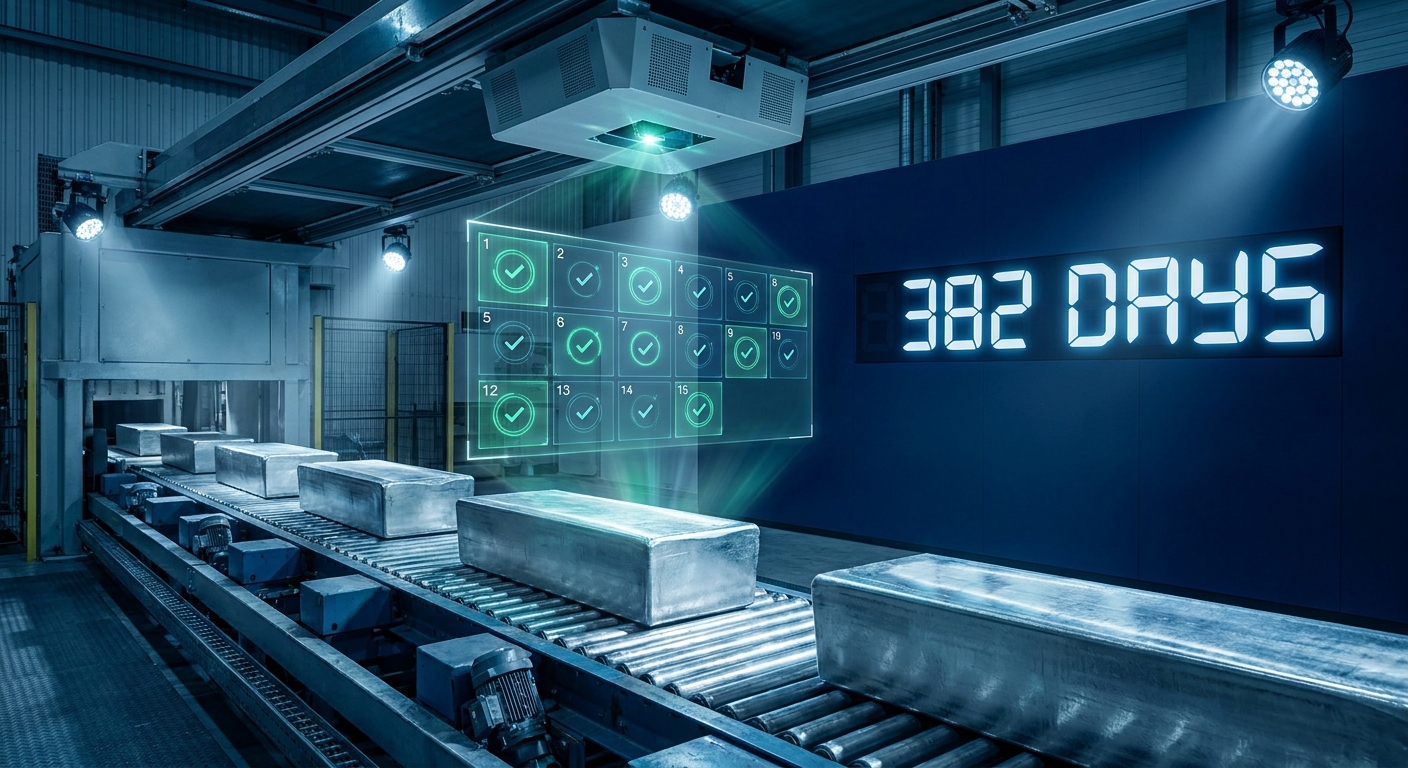
382 days remain until the CBAM transitional period ends. Your checklist starts now.
References & Sources
External Sources
- [1]IPCC AR6 WGIII Chapter 11 – Industry emissions identity and policy interventions
IPCC Working Group III contribution to the Sixth Assessment Report details the emissions identity for industry, including material stock intensity, energy per unit of material inputs, and emissions per unit of energy—core factors that determine CBAM embedded emissions calculations.
- [2]Hydro Integrated Annual Report 2024 – CBAM and carbon cost pass-through
Hydro's 2024 annual report discusses the commercial implications of CBAM for aluminium exporters, including the transition from informational to financial CBAM declarations in 2026 and the role of actual emissions data in avoiding default premiums.
- [4]EPA Status and Trends Report on U.S. Energy Attribute Tracking Systems
U.S. EPA report on energy attribute certificates (RECs) and tracking systems, relevant for CBAM Scope 2 electricity emissions calculations when non-EU exporters use renewable energy and need to demonstrate emission factor traceability.
Related Content
- [3]How a €12M Procurement Team Avoided €2.1M in CBAM Default Premiums
A European manufacturer transformed tier-2 supplier data capture in 11 months, securing primary emissions data for 73% of spend and avoiding €2.1M in CBAM default penalties.
- [5]Document-first ingestion – How raw documents become audit-grade evidence
Emission3's document ingestion pipeline extracts line-item emissions data from invoices, BoMs, and utility bills, auto-assembling structured evidence packs with full lineage for CBAM verification.
- [6]How Emission3 handles CBAM for non-EU exporters
Emission3's CBAM solution covers installation-level data capture, precursor tracking, verification-ready exports, and population completeness reporting—designed for non-EU exporters facing the 2026 cliff.
- [7]CBAM 2026: Why 47% of EU Importers Will Pay Default Premiums
Analysis showing that nearly half of EU importers lack installation-level data from non-EU suppliers, triggering sectoral defaults 2-5x real emissions and eroding supplier competitiveness.
- [8]382 Days Until CBAM Declarations Become Mandatory: Your 2026 Compliance Timeline
The CBAM transitional period ends December 31, 2025. Non-EU exporters have 382 days to secure installation-level data or face sectoral defaults 2-5x real emissions.
- [9]Book your onboarding call with Emission3
Every Emission3 customer starts with a personal onboarding call—no self-serve signups. We scope your installations, identify data gaps, and build a compliance timeline for CBAM 2026.