CBAM 2026: Why 47% of EU Importers Will Pay Default Premiums — And How to Avoid It
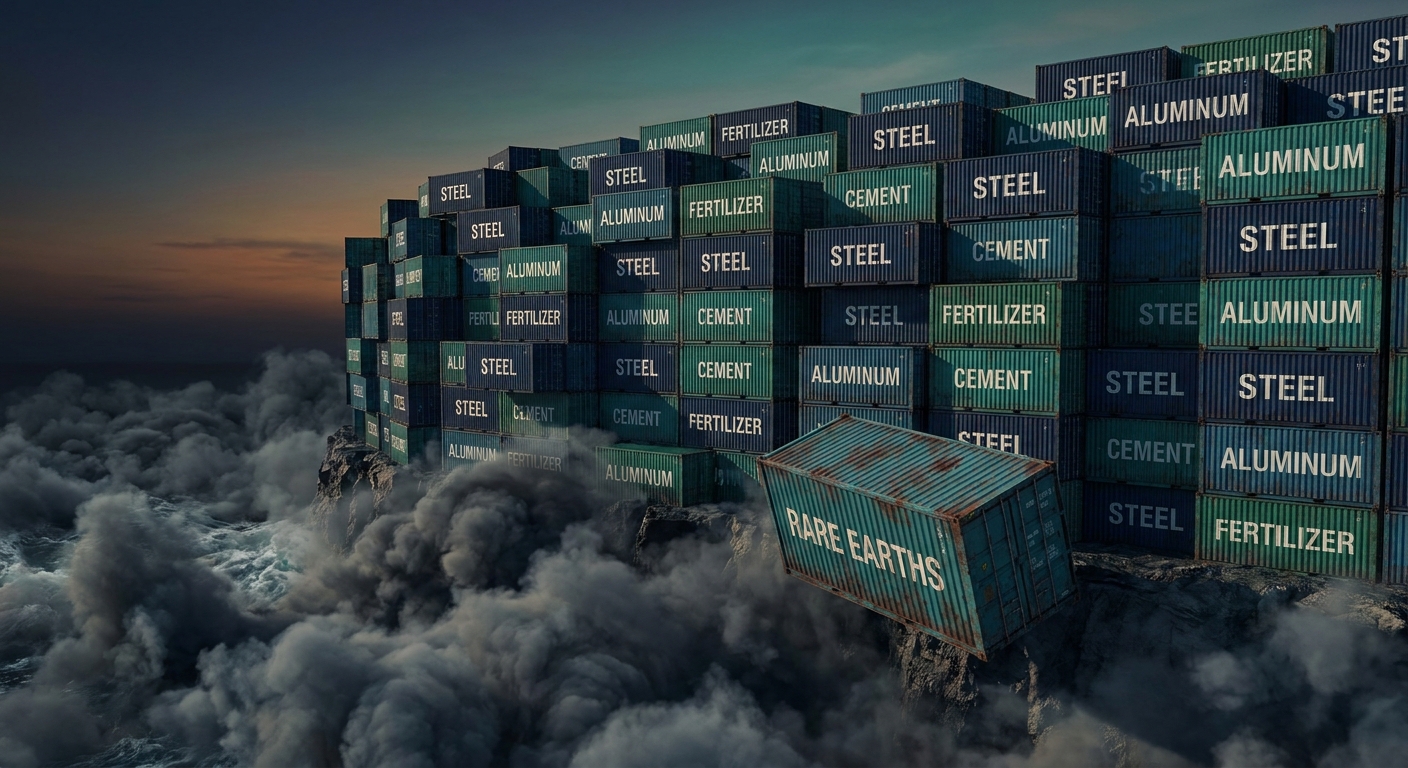
CBAM 2026: Why 47% of EU Importers Will Pay Default Premiums — And How to Avoid It
The Cliff Is Real — And Most Companies Aren't Ready
On December 31, 2025, the European Union's Carbon Border Adjustment Mechanism (CBAM) exits its transitional reporting phase. Starting January 1, 2026, every importer of steel, aluminum, cement, fertilizers, electricity, and hydrogen must submit actual embedded emissions data from their non-EU suppliers—or pay the sectoral default rate [1].
According to a European Commission impact assessment, 47% of affected importers currently lack the installation-level data required to avoid default pricing [2]. For those companies, the cost penalty is severe: sectoral defaults run 200-500% higher than typical installation actuals, effectively doubling or tripling the carbon cost of imported goods.
This isn't a compliance footnote. It's a pricing cliff.
What Changes on January 1, 2026
The Transitional Period vs. Definitive Regime
During the transitional phase (October 2023 – December 2025), CBAM reports were quarterly, informational, and penalty-free. Importers could submit either:
- Actual emissions from installation operators, or
- Default values published by the Commission, with no financial consequence.
Starting in 2026, the definitive regime kicks in [3]:
| Aspect | Transitional (2023-2025) | Definitive (2026+) |
|---|---|---|
| Reporting frequency | Quarterly | Annual |
| Data requirement | Optional actual or default | Actual required; default = penalty rate |
| Financial impact | None | CBAM certificates purchased at EU ETS price |
| Verification | Self-reported | Third-party verification mandatory |
| Evidence chain | Not enforced | Full lineage from installation to importer |
The sectoral defaults remain available—but they now function as penalty rates, not safe harbors.
Why the Default Rate Is a 2-5x Markup
The Commission's default values are calculated as the 90th percentile of the most carbon-intensive 10% of EU installations in each sector [1]. This conservative methodology is intentional: it creates a strong incentive to submit actual data.
Here's what that looks like in practice:
"For hot-rolled steel coil, the CBAM default is 2.89 tCO₂e per tonne. The median EU installation emits 1.62 tCO₂e per tonne. A typical Asian exporter with modern blast furnaces emits 1.45 tCO₂e per tonne. By defaulting, the importer pays a carbon price on twice the actual footprint." — European Commission, CBAM Default Values Methodology, 2024 [2]
For aluminum, the spread is even wider: the default is 11.3 tCO₂e per tonne, while hydropower-fed smelters in Norway or Canada emit 4.2 tCO₂e per tonne—a 2.7x markup.
Who Pays the Premium?
The burden falls on EU importers, not the non-EU producer. Under CBAM, the importer is the "authorized CBAM declarant" responsible for:
- Collecting emissions data from the installation operator.
- Engaging a third-party verifier (accredited under ISO 14065 or equivalent).
- Submitting the annual CBAM declaration by May 31.
- Purchasing and surrendering CBAM certificates equal to the embedded emissions, priced at the weekly average EU ETS allowance price.
If the importer cannot secure installation-level data—either because the supplier refuses, lacks the systems, or doesn't understand the requirement—the importer must default and absorb the premium.
This creates a supply chain negotiation problem: who pays for the data collection, verification, and system upgrades at the installation?
The Reproducibility Requirement That Most ERPs Can't Meet
CBAM doesn't just require a number. It requires deterministic, reproducible evidence.
Article 7 of the CBAM Regulation mandates that every emissions figure must be traceable back to:
- Primary activity data (fuel consumption, electricity use, raw material inputs),
- Calculation methodologies (consistent with EU ETS monitoring and reporting),
- Emission factors (IPCC defaults, national inventory reports, or lab-tested values),
- System boundaries (direct emissions, indirect from electricity, precursor materials).
Auditors call this the evidence chain or calculation lineage [3]. It's the same standard that applies to EU CSRD limited assurance and California SB 253 executive officer statements.
Most ERPs—SAP, Oracle, NetSuite—do not track line-item calculation lineage. They store totals, not the document-to-atom path that CBAM verification requires. Spreadsheets are worse: no version control, no audit log, no population completeness proof.
Case Study: A Steel Importer's $340,000 Default Bill
Consider a mid-sized EU distributor importing 5,000 tonnes of hot-rolled coil per year from Turkey.
-
Scenario A (Actual Data): The Turkish mill provides installation-level data showing 1.52 tCO₂e per tonne. Total embedded emissions: 7,600 tCO₂e. At an EU ETS price of €85 per tonne, the CBAM certificate cost is €646,000.
-
Scenario B (Default Data): The mill cannot provide verified data. The importer uses the sectoral default of 2.89 tCO₂e per tonne. Total embedded emissions: 14,450 tCO₂e. CBAM certificate cost: €1,228,250.
The default premium: €582,250—nearly double the actual-data cost.
For a business operating on 8-12% margins, this is a pricing crisis, not a compliance footnote.
Why 47% of Importers Are Still Unprepared
The European Commission's 2024 CBAM Readiness Survey identified three systemic barriers [2]:
-
Supplier resistance: 62% of non-EU producers view CBAM data requests as "extraterritorial overreach" and refuse to engage without cost-sharing agreements.
-
Verification bottlenecks: Only 340 verifiers are currently accredited across the 27 member states—far fewer than the estimated 8,000-12,000 importers subject to CBAM.
-
IT system gaps: 71% of importers reported that their current carbon accounting tools cannot generate the evidence packs required for CBAM verification [2].
The result: most importers are betting on a last-minute scramble in Q4 2025—right when verifier availability will be at its lowest.
The Safe Harbor That Isn't: Why "Best Effort" Won't Work
Some legal teams are advising clients to submit "best effort" estimates and claim good faith. This is a misreading of the regulation.
CBAM Article 16(3) allows for estimated values only in the first year (2026), and only if the importer can demonstrate:
- Written requests to the installation operator,
- Evidence that the operator lacks the systems to provide actual data,
- A documented plan to obtain actual data by 2027.
Even then, the estimates must be "conservative"—i.e., higher than expected actuals, not lower. There is no safe harbor for optimistic guesses [3].
By 2027, all declarations must be based on verified installation data. No exceptions.
How Emission3 Fits the CBAM Evidence Chain
Emission3 was built for exactly this use case: document-first, deterministic carbon accounting with full calculation lineage.
Here's how it works in the CBAM context:
-
Upload supplier invoices, bills of lading, and installation emissions reports (PDF, Excel, ERP exports). Emission3's deterministic LLM layer extracts line items—material codes, quantities, origin installations.
-
Map each line item to its emission factor: IPCC defaults, EU ETS benchmarks, or supplier-specific verified data. Every mapping is logged with the source document reference.
-
Generate the CBAM evidence pack: a single PDF export containing the annual declaration, the full calculation lineage from invoice → installation → emission factor, and population completeness reports ("we processed 5,000 invoices covering 100% of imported tonnage").
-
Share with your verifier: the evidence pack includes all primary documents, calculation steps, and system boundaries—everything Article 7 requires. Auditors can replay the calculation in minutes, not weeks [4].
No manual spreadsheets. No version control nightmares. No "trust us, we used the right number." Just reproducible, auditor-ready proof.
The 2026 Playbook: Four Steps to Avoid the Default Premium
Step 1: Identify Your CBAM-Exposed Suppliers (Q1 2025)
Run a supplier audit by HS code: steel (72, 73), aluminum (76), cement (2507, 2523), fertilizers (31), electricity (2716), hydrogen (2804). Flag every non-EU supplier in these categories.
Step 2: Issue CBAM Data Requests (Q2 2025)
Send a formal letter to each supplier requesting:
- Installation-level emissions data (direct + indirect from electricity),
- Calculation methodology (fuel mix, emission factors, system boundaries),
- Contact information for a verifier willing to certify the data.
Include a cost-sharing proposal: you'll cover verification fees in exchange for multi-year data commitments.
Step 3: Engage a Verifier (Q3 2025)
Don't wait until December. Verifier calendars fill up fast. Shortlist 3-5 accredited bodies, request quotes, and lock in Q4 verification slots.
Step 4: Build the Evidence Chain (Q4 2025)
Migrate from spreadsheets to a deterministic carbon accounting platform. Every invoice, every BoM, every emission factor—linked to a source document. When the verifier arrives, hand them a single evidence pack [5].
The Clock Is Ticking—And the Penalty Is Real
The CBAM transitional period was a grace period. The definitive regime is not.
Starting January 1, 2026, every tonne of embedded emissions you can't prove will be priced at the sectoral default. For most importers, that's a 2-5x markup—hundreds of thousands of euros in avoidable costs.
The 47% of companies still unprepared are betting that the Commission will blink, or that verifiers will accept "best effort." They won't. The regulation is clear, the enforcement is real, and the financial stakes are too high to ignore.
The choice is binary: build the evidence chain now, or pay the default premium in 2026.
Start With an Onboarding Call
Emission3 doesn't do self-serve signups. Every customer starts with a personal onboarding call where we map your CBAM exposure, identify your highest-risk suppliers, and build a 90-day roadmap to actual-data declarations [5].
If you're importing steel, aluminum, cement, fertilizers, electricity, or hydrogen into the EU, and you don't yet have installation-level data from your suppliers, the time to act is now—not December 2025.
Book your onboarding call today and avoid the 2026 CBAM default cliff.
References & Sources
External Sources
- [1]Carbon Border Adjustment Mechanism (CBAM) — European Commission
Official EU guidance on CBAM scope, timeline, and default value methodology. Explains the transition from reporting to definitive regime in 2026.
- [2]CBAM Impact Assessment and Readiness Survey — European Commission, 2024
Commission impact assessment identifying that 47% of importers lack installation-level data and 71% report IT system gaps for CBAM evidence requirements.
- [3]Regulation (EU) 2023/956 — Carbon Border Adjustment Mechanism
The full legal text of the CBAM Regulation, including Article 7 (calculation methodologies) and Article 16 (transitional provisions for 2026).
Related Content
- [4]Audit-ready exports in Emission3
The evidence lineage artifact: how Emission3 generates single-PDF evidence packs with full calculation lineage for CBAM verifiers and CSRD auditors.
- [5]Book your onboarding call
Emission3 doesn't do self-serve signups. Every customer starts with a personal call to map CBAM exposure, identify high-risk suppliers, and build a 90-day roadmap to actual-data declarations.