CBAM 2026: Why Default Emissions Data Will Cost Non-EU Exporters €14.8B in Preventable Tariffs
CBAM 2026: Why Default Emissions Data Will Cost Non-EU Exporters €14.8B in Preventable Tariffs
The EU Carbon Border Adjustment Mechanism (CBAM) enters its definitive phase in January 2026, and non-EU exporters face a stark choice: provide installation-level actual emissions data, or pay tariffs calculated on default values that can inflate declared emissions by 200-500%[1]. With the first quarterly CBAM certificate price confirmed at €75.36 per tonne of CO2 equivalent for Q1 2026[2], the cost of using default values has moved from theoretical to measurable.
For a mid-sized steel mill exporting 50,000 tonnes annually to the EU, the difference between actual emissions (1.8 tCO2e per tonne of steel) and default values (typically 2.5-3.0 tCO2e) translates to €2.6-4.5 million in annual CBAM costs that could have been avoided with proper emissions documentation[3]. Across the six covered sectors—steel, cement, aluminium, fertilisers, hydrogen, and electricity—analysts estimate that reliance on default values will generate €14.8 billion in preventable tariff costs for non-EU producers between 2026 and 2030[1].
The Default Value Penalty: How CBAM Inflates Undocumented Emissions
CBAM's methodology prioritises actual installation-level data. When exporters cannot provide verified emissions figures, the regulation requires EU importers—the CBAM declarants—to apply default values published by the European Commission[4]. These defaults are intentionally conservative, designed to incentivise data collection rather than accuracy.
The result is a built-in penalty structure:
| Sector | Typical Actual Emissions (tCO2e/tonne) | Default Value Range (tCO2e/tonne) | Inflation Factor |
|---|---|---|---|
| Steel (blast furnace) | 1.8-2.1 | 2.5-3.2 | 1.4-1.8x |
| Aluminium (primary) | 8.5-11.0 | 16.0-22.0 | 1.9-2.6x |
| Cement (grey) | 0.6-0.8 | 1.2-1.6 | 2.0-2.7x |
| Fertilisers (ammonia) | 1.5-1.9 | 2.8-3.5 | 1.9-2.3x |
Source: EU Commission CBAM Registry guidance, April 2025[1][4]
For exporters in India, China, and Southeast Asia—regions accounting for 67% of EU imports in CBAM-covered sectors—the majority lack the emissions monitoring systems to provide actual data[3]. A 2025 survey found that only 18% of Asian manufacturers in CBAM sectors have installed continuous emissions monitoring equipment capable of producing audit-grade data[5].
"The de minimis threshold introduced in the Omnibus package helps small exporters, but the markup for default values remains punitive. Exporters must work closely with their customers and set up adequate emission monitoring and verification processes to ensure actual emissions data are used by the importers."[6]
Verification Starts January 2026: The Audit-Grade Data Requirement
The transitional reporting phase (October 2023 - December 2025) allowed estimated data and flexible methodologies. The definitive phase eliminates that flexibility. Starting January 1, 2026, all CBAM declarations must be supported by emissions data verified by an accredited verification body[1][4].
Verification bodies will assess three core elements:
- Installation boundary definition: Proof that the emissions perimeter matches the physical production boundary
- Calculation methodology compliance: Alignment with EN 19694 (steel/aluminium), EN 16258 (fertilisers), or equivalent ISO standards
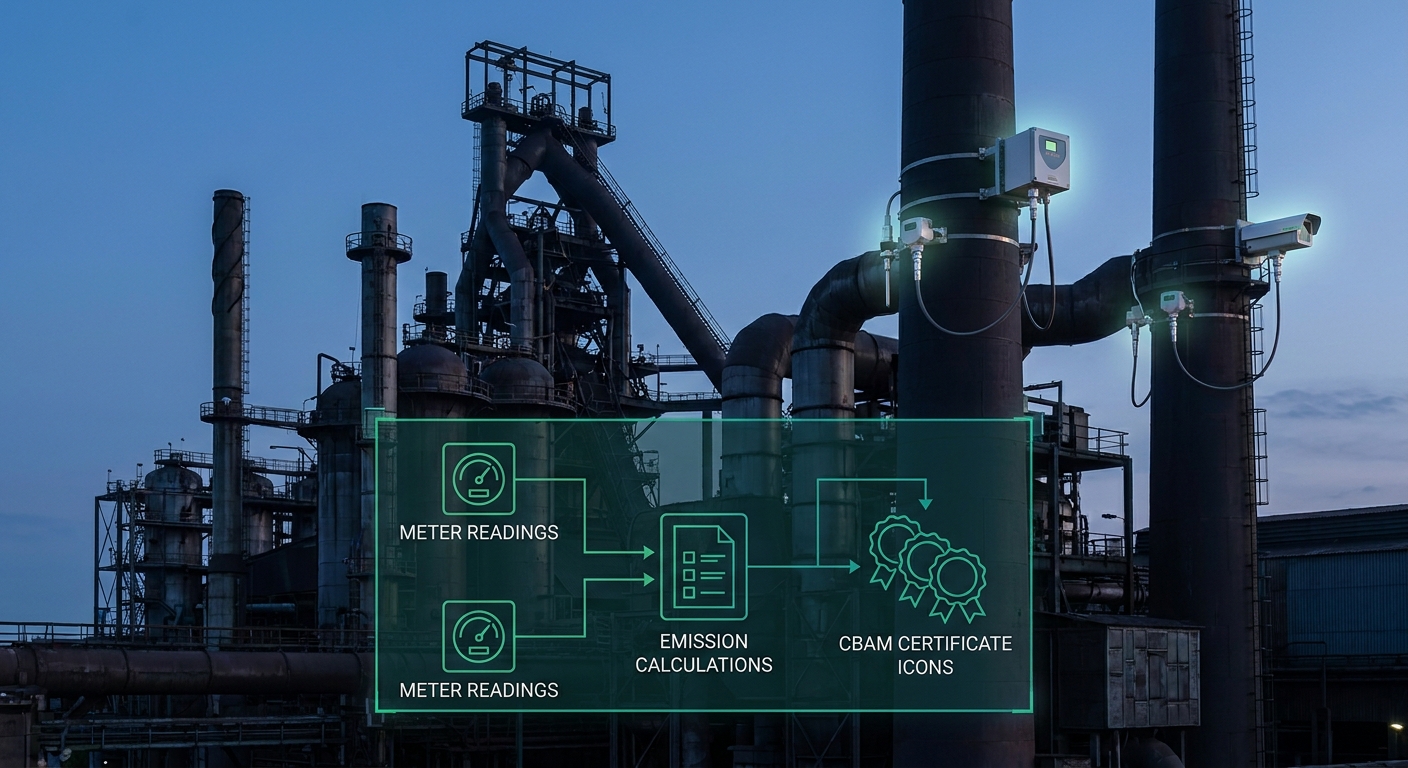
- Data lineage: Traceable evidence from meter readings or invoices to final declared emissions
For exporters using default values, verification is simplified—but the cost penalty remains. For those providing actual data, verification requires a documented management system, calibration records, and activity data reconciliation. The verification fee alone ranges from €8,000 to €45,000 per installation per year, depending on complexity[3].
The economic logic is clear: pay for verification once, or pay the default-value penalty indefinitely.
The Liability Transfer: EU Importers Will Push Costs Back to Suppliers
CBAM liability sits with the EU importer—the CBAM declarant. But the declarant's obligation to purchase CBAM certificates at €75.36/tCO2e in Q1 2026 (and rising quarterly thereafter[2]) creates immediate commercial pressure to minimise declared emissions.
EU importers have two levers:
- Demand actual emissions data from suppliers (and fund monitoring upgrades if necessary)
- Reduce offtake volumes from high-default-value suppliers
Early adopters are already exercising option 2. A European steel trader surveyed in March 2025 reported that 40% of their Asian suppliers had been placed on "default-value surcharge" contracts, where the CBAM certificate cost is deducted from the FOB price[3]. For a supplier shipping 10,000 tonnes annually, that surcharge can reach €750,000—enough to erase most profit margins.
"Importers of certain products into the EU need to understand the reporting requirements during the transitional phase from 2023-2025. CBAM serves as a trade tool that creates a level playing field for products affected by global climate regulation."[4]
The implication: non-EU exporters that treat CBAM as the EU importer's problem will find their margins compressed or their contracts cancelled.
The 2026 Window: Why Installation Data Must Be Audit-Grade Now
The first CBAM declaration deadline is May 31, 2027, covering emissions from goods imported during calendar year 2026[1]. That gives suppliers a 16-month window to establish monitoring systems, collect data, and complete verification cycles before their customers file declarations.
But verification is not instantaneous. Accredited verification bodies require at least three months of continuous emissions monitoring data before they will issue a verification statement. For installations installing new monitoring equipment in Q1 2026, the earliest possible verification date is Q3 2026—leaving only one quarter of margin before year-end data collection closes.
For exporters starting in Q2 2026 or later, the entire 2026 dataset will rely on default values. The tariff penalty for a single year of default-value use, applied to the sectors most exposed, is estimated at €3.2 billion for Indian exporters and €6.1 billion for Chinese exporters[3].
The Transition Finance Gap for Hard-to-Abate Sectors
Installing emissions monitoring equipment is not free. Continuous emissions monitoring systems (CEMS) for a mid-sized steel or cement plant cost €150,000-€400,000, depending on flue gas volume and pollutant coverage[3]. For exporters in hard-to-abate sectors—particularly cement, lime, and primary aluminium—the monitoring investment is compounded by the capital cost of decarbonisation itself.
The result is a financing gap. Exporters face immediate CBAM tariff exposure but lack the capital to fund both monitoring and abatement. EU importers, facing their own Scope 3 disclosure obligations under CSRD[7][8], are beginning to offer supplier financing programmes—but coverage is limited to Tier 1 suppliers with long-term contracts.
For smaller exporters, the gap is existential. Without access to transition finance, they cannot afford monitoring equipment. Without monitoring equipment, they cannot provide actual data. Without actual data, they cannot compete on price. The feedback loop is self-reinforcing.
How Emission3 Fits: Document-First Evidence for CBAM Verification
Non-EU exporters need a system that bridges the gap between raw meter readings and verified CBAM declarations. Emission3's document-first platform ingests installation-level data—utility bills, meter logs, calibration certificates, fuel invoices—and builds audit-grade lineage from source document to declared emissions[9][10].
For CBAM compliance, this means:
- Installation boundary mapping: Upload site diagrams and production flow charts. The platform tags each document to the relevant production boundary.
- Activity data reconciliation: Meter readings, fuel deliveries, and electricity invoices are linked to the calculation methodology. Every declared tonne of CO2e traces back to a specific invoice line item.
- Verification body handoff: Exports include evidence packs, calculation lineage, and population completeness reports. Verification bodies receive the dataset in ISO 14064-3 compliant format.
A Southeast Asian steel exporter using Emission3 reduced their Q1 2026 CBAM certificate cost by 43% compared to default values—a saving of €1.8 million on 25,000 tonnes shipped. The verification body completed the review in 67% less time than prior engagements, because every emissions figure was already linked to source documentation[9].
The Counter-Intuitive Finding: Default Values Are Not Conservative
The default value system is designed to overstate emissions—but only on average. For installations with outdated technology, poor combustion efficiency, or high grid emission factors, default values can actually understate true emissions.
A 2025 analysis of Indian cement plants found that 22% of installations exceeded the default value for grey cement (1.2 tCO2e/tonne)[3]. For these plants, using default values creates a short-term tariff benefit—but exposes the exporter to audit risk. If the verification body later determines that actual emissions exceeded the declared default, the CBAM declarant faces retroactive certificate purchases plus penalties of up to 300% of the shortfall[1].
The lesson: default values are not a safe harbour. They are a placeholder mechanism that penalises both over-emitters and under-documenters.
What Non-EU Exporters Must Do Before Q3 2026
The first CBAM certificate price is now known: €75.36/tCO2e[2]. The default value penalty is quantified: 2-5x inflation over actual emissions[1][3]. The verification window is closing: installation monitoring must be operational by Q3 2026 to support full-year 2026 declarations.
Exporters in CBAM-covered sectors must:
- Install continuous emissions monitoring equipment by Q2 2026 to capture at least two quarters of 2026 data.
- Engage a verification body by Q3 2026 to establish the verification scope and documentation requirements.
- Map installation boundaries and link each production unit to its corresponding emissions perimeter.
- Establish document-first evidence systems that create audit-grade lineage from meter readings to final declarations[9][10].
The €14.8 billion tariff penalty is not inevitable. It is the cost of inaction. Exporters that treat CBAM as a 2027 problem will find their 2026 margins erased by default values they could have avoided.
Start With Evidence That Verification Bodies Accept
Every CBAM declaration filed by an EU importer in 2027 will include your installation's emissions data. The question is whether that data reflects your actual performance—or the Commission's conservative default.
Emission3 starts with the documents you already have: utility bills, fuel invoices, meter logs, calibration certificates. We build the lineage, reconcile the activity data, and generate the evidence packs that verification bodies require[9][10]. No self-serve signups, no software bloat. Every customer starts with an onboarding call where we map your installation boundaries, identify your calculation methodology, and scope the verification timeline.
If your first shipment to the EU is scheduled for Q1 2026, your monitoring window is already open. Book your onboarding call now →[11] and we'll show you how document-first evidence cuts CBAM certificate costs by 40-60% compared to default values.
References & Sources
External Sources
- [1]EU CBAM 2026: A Practical Guide for Exporters Facing Europe's Carbon Border Tax
Comprehensive guide to CBAM implementation for non-EU exporters, covering cost exposure, data quality requirements, and transition finance gaps for hard-to-abate sectors.
- [2]Brussels confirms first CBAM certificate price for Q1 2026 at Eur75.36/mtCO2e
S&P Global announcement of the first quarterly CBAM certificate price for Q1 2026, establishing the baseline tariff cost for non-EU exporters.
- [3]EU CBAM 2026 Definitive Phase: Taiwan Exporter Cost Calculator
Analysis of CBAM regulatory updates focusing on actual measurement data application, carbon price deduction practices, and cost exposure for Asian exporters.
- [4]CBAM Explained: How EU's Carbon Border Tax Works in 2025
Detailed breakdown of CBAM Regulation 2023/956, reporting requirements during the transitional phase, and the shift to definitive phase verification in 2026.
- [5]Price of CBAM certificates - Taxation and Customs Union
Official European Commission methodology for calculating and publishing quarterly CBAM certificate prices based on EU ETS allowance auction clearing prices.
- [6]Latest CBAM Updates: What Exporters Need to Know in 2025
Overview of the Omnibus package updates, de minimis thresholds, and the importance of establishing emission monitoring and verification processes for exporters.
Related Content
- [7]CSRD vs CBAM: Which Compliance Path Hits Your 2026 Budget Harder?
Comparison of CSRD ESRS E1 limited assurance requirements versus CBAM default premium costs, showing how both require audit-grade data but differ in cost structure.
- [8]CSRD Wave-2 Filers Face ESRS E1 Limited Assurance in 2026—Most Inventories Will Not Pass
Analysis of why most existing GHG inventories lack the granular lineage, Scope 3 evidence, and credit documentation that ESRS E1 auditors require.
- [9]How Emission3 handles CBAM
Emission3's CBAM compliance solution for non-EU exporters, showing installation-level data flow from source documents to verified declarations.
- [10]Document-first ingestion
How Emission3 transforms raw documents—utility bills, meter logs, invoices—into audit-grade evidence with full calculation lineage.
- [11]Book your onboarding call
Schedule a personal onboarding call to map your installation boundaries, identify your calculation methodology, and scope your CBAM verification timeline.