The assurance-fee escalation problem in California SB 253 first-year filings
The assurance-fee escalation problem in California SB 253 first-year filings
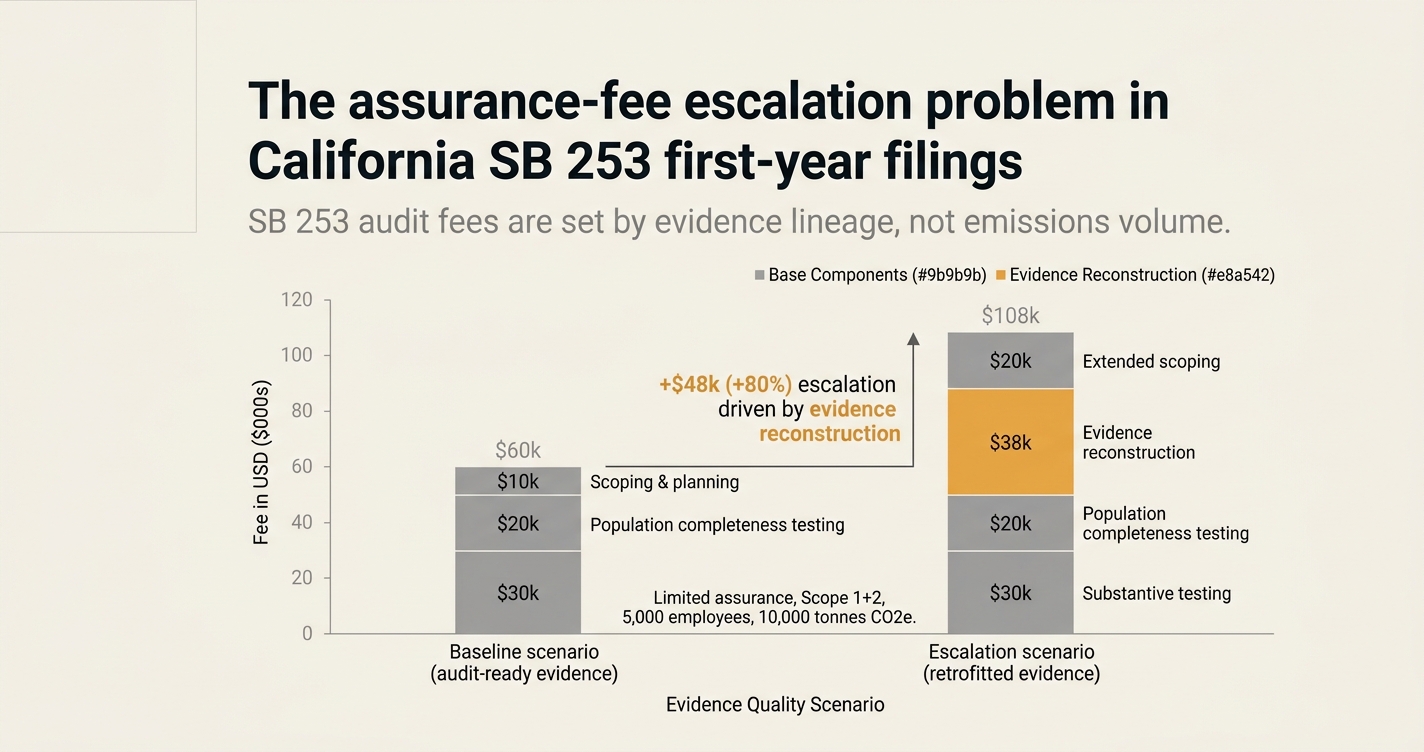
Here's the issue: California's Climate Corporate Data Accountability Act (Senate Bill 253) mandates Scope 1 and Scope 2 greenhouse gas emissions disclosure by June 30, 2026, for fiscal year 2025 data, with limited assurance required from day one. Companies with annual revenues over $1 billion doing business in California face a three-layer cost: baseline emissions calculation, evidence digitization, and third-party assurance fees. Most CFOs budgeted $40,000-$60,000 for the first SB 253 filing based on 2024 estimates—but assurance providers are now quoting $80,000-$120,000 for firms without audit-ready evidence lineage, a 40-100% premium over baseline expectations.
However, an SB 253 filing consists of two things: the emissions total (Scope 1 and 2 carbon dioxide equivalent tonnage calculated per the Greenhouse Gas Protocol) and the evidence lineage (the timestamped, document-backed calculation trail that connects utility bills, fuel receipts, allocation methods, and facility-level meters to each line item in the disclosure).
The emissions total on its own has no value. The evidence lineage is what the assurance provider is actually verifying, and what determines whether you pay baseline fees or escalation fees. A 5,000-employee firm can generate a Scope 1+2 total in a spreadsheet for under $10,000—but if the auditor arrives in April 2026 and finds no digitized utility bills, no tagged invoices, no documented allocation methods, and no monthly reconciliation logs, the assurance engagement reprices. You are no longer buying verification of a known inventory; you are buying 12 weeks of forensic evidence reconstruction.
While baseline compliance software has become cheaper—templated Greenhouse Gas Protocol calculators, cloud emissions trackers—the cost of building audit-ready evidence packs has escalated. If a 5,000-employee firm without document lineage faces a limited assurance engagement in June 2026, the cost of retrofitting evidence for 2025 emissions might exceed the entire 2026 compliance budget by 30-50%. The California Air Resources Board estimates annual SB 253 program fees at $3,160 per entity, but assurance providers are quoting $40,000-$80,000 for limited assurance on Scope 1 and 2, depending on evidence quality [1].
How do you solve this? I think the operators who avoid fee escalation are the ones treating evidence lineage as a first-class compliance artifact from day one. They are not retrofitting audit trails in Q2 2026—they are ingesting utility bills, tagging allocation methods, and timestamping approvals as part of the monthly close. For now, that means document-first ingestion tooling, not just emissions calculators. The teams Emission3 works with began evidence collection 18 months before the filing deadline: mapping which subsidiaries hold which source documents, digitizing utility bills and fuel receipts as PDFs with optical character recognition, tagging invoices to facility-level meters, and running quarterly assurance readiness reviews with the provider [1].
Visualised:
The fee escalation mechanism: evidence quality drives audit pricing
Assurance providers price SB 253 engagements based on evidence completeness, not emissions volume. The table below compares baseline-fee scenarios (audit-ready evidence lineage from day one) against escalation-fee scenarios (retrofitted evidence during the assurance engagement).
| Evidence artifact | Baseline scenario (audit-ready) | Escalation scenario (retrofitted) | Fee impact |
|---|---|---|---|
| Utility bill digitization | Monthly OCR ingestion, tagged to meters, stored in evidence vault | Manual PDF scanning in April 2026, no facility-level tagging | +15-25% assurance fee |
| Allocation method documentation | Documented allocation rules (e.g., floor-area, headcount) with approval timestamps | Retroactive allocation narrative, no supporting calculations | +10-20% assurance fee |
| Facility-level meter reconciliation | Monthly reconciliation logs, variance explanations, sign-offs | Ad-hoc reconciliation during fieldwork, missing months | +20-30% assurance fee |
| Supplier-specific emission factors | Invoices linked to supplier declarations, default-value variance tracked | Generic emission factors applied, no supplier documentation | +5-15% assurance fee |
| Audit trail completeness | Document lineage from source invoice to final total, timestamped | Gaps in lineage, missing source documents, no version control | +25-40% assurance fee |
| Quarterly assurance readiness reviews | Three readiness reviews (Q1, Q2, Q3 2025) with assurance provider | No pre-engagement scoping, assurance starts cold in Q2 2026 | +15-25% assurance fee |
| Internal control documentation | SOX-grade control narratives, testing evidence, ICFR integration | No control documentation, assurance provider designs controls during engagement | +20-35% assurance fee |
| Subsidiary scope mapping | Legal entity mapping complete by Q1 2025, revenue thresholds documented | Scope determination during engagement, subsidiary revenue unclear | +10-20% assurance fee |
Cumulative escalation range: 40-100% above baseline assurance fee, depending on how many artifacts require retrofit.
The pattern is consistent across the teams Emission3 works with. A West Coast logistics firm with $2.3 billion in revenue budgeted $50,000 for SB 253 limited assurance in January 2025, assuming the assurance provider would verify a delivered inventory. By March 2026, the provider requested digitized fuel receipts for 47 facilities, allocation method documentation for shared utility meters, and monthly reconciliation logs for 2025. The firm had none of these artifacts. The engagement repriced to $92,000—an 84% escalation—because the assurance provider now had to spend 60% of engagement hours on evidence reconstruction instead of substantive testing [1].
Why evidence lineage determines executive liability exposure
SB 253 includes a unique provision: the responsible officer must sign a statement that the emissions disclosure is complete and accurate to the best of their knowledge. This is not a boilerplate certification—it carries personal liability under California law if the disclosure is materially misstated. The statute does not define "material misstatement," but the California Air Resources Board has indicated it will follow financial materiality standards: a 5-10% error threshold, depending on context [2].
The implication for CFOs is straightforward. If the 2026 SB 253 filing reports 45,000 tonnes of Scope 1+2 emissions, and a subsequent assurance engagement discovers 50,000 tonnes (an 11% understatement), the responsible officer's certification is false. The root cause is almost always missing source documents: a facility's natural gas bills were excluded because they were in a subsidiary's inbox, or diesel fuel receipts from a third-party logistics provider were not tagged to the parent company's inventory.
Executive liability is not triggered by calculation errors—it is triggered by incomplete evidence populations. This is why CFOs treating SB 253 as a "carbon accounting project" face higher legal risk than CFOs treating it as a "document ingestion and control project." The latter group begins with a completeness assertion: "We have identified all legal entities in scope, mapped all facilities, requested all utility accounts, and digitized all invoices." The former group begins with a calculation: "We applied the EPA emission factors to our fuel consumption." The calculation is irrelevant if the population is incomplete [3].
Johnson Lambert LLP, a provider of SB 253 assurance services, explicitly frames its engagements around population completeness testing: "We provide independent assurance over Scope 1, Scope 2, and future Scope 3 greenhouse gas emissions disclosures for insurers subject to California's SB 253 climate disclosure regulation law. Our approach begins with organizing emissions disclosures for assurance" [4]. The phrase "organizing emissions disclosures" is assurance-speak for "verifying that the population is complete before we test the calculations." If your emissions disclosure is not organized—if source documents are scattered across subsidiaries, if allocation methods are undocumented, if there is no audit trail from invoice to total—the assurance provider cannot begin substantive testing. They must first reconstruct the population, and that reconstruction is billed at senior-associate and manager rates.
The reasonable assurance crossover in 2030
SB 253 requires limited assurance for Scope 1 and 2 from 2026 to 2029, and reasonable assurance starting in 2030. Limited assurance is analogous to a financial statement review: the auditor performs inquiry and analytical procedures to obtain a basis for expressing limited assurance that nothing came to their attention indicating the disclosure is materially misstated. Reasonable assurance is analogous to a financial statement audit: the auditor performs substantive testing and control testing to obtain a basis for expressing positive assurance that the disclosure is fairly stated.
The fee differential between limited and reasonable assurance is typically 50-100%, depending on the complexity of the inventory and the quality of internal controls. A firm paying $60,000 for limited assurance in 2026 should budget $90,000-$120,000 for reasonable assurance in 2030, assuming no change in evidence quality. However, if the firm does not build internal controls over emissions data between 2026 and 2029, the reasonable assurance engagement in 2030 will reprice upward by an additional 30-50%, because the auditor cannot rely on controls and must perform expanded substantive testing [5].
"Companies to obtain limited assurance over their scope 1 and 2 emissions disclosures [in 2026]. Companies to obtain reasonable assurance over their scopes 1 and 2 emissions disclosures and limited assurance over their scope 3 emissions disclosures [in 2030]." — Persefoni, California Climate Disclosure Key Dates [5]
The CFO implication: the 2026 limited assurance engagement is not just a compliance milestone—it is a four-year runway to build the internal controls that will determine 2030 reasonable assurance fees. Firms that treat 2026 as a one-time retrofit project will face a second fee escalation in 2030 when the auditor arrives and finds no control documentation, no quarterly testing evidence, and no integration with the internal control over financial reporting framework. Firms that integrate emissions data into the monthly close, document allocation methods as formal policies, and run quarterly control testing will avoid the 2030 escalation.
The California Air Resources Board has indicated it will publish a reporting template and finalize assurance standards by Q3 2025, with standards such as International Standard on Sustainability Assurance 5000, AA1000, and ISO 14064-3 under consideration [6]. The choice of standard will determine the scope of control testing required for reasonable assurance. If CARB adopts ISSA 5000 (the new IAASB sustainability assurance standard), the control testing requirements will align with International Standard on Assurance Engagements 3000, which is the baseline for financial statement audits. If CARB adopts ISO 14064-3 (the existing GHG verification standard), the control testing requirements will be lighter, but the substantive testing requirements will expand to compensate.
The Scope 3 assurance timeline and fee compounding
SB 253 requires Scope 3 emissions disclosure starting in 2027 for fiscal year 2026 data, with limited assurance required by 2030. Scope 3 emissions—indirect emissions from the value chain, including purchased goods, business travel, and downstream use of sold products—are typically 5-10x larger than Scope 1+2 emissions for non-energy companies, and 10-50x larger for financial services and technology firms. A manufacturing firm with 10,000 tonnes of Scope 1+2 emissions might have 80,000 tonnes of Scope 3 emissions; a bank with 5,000 tonnes of Scope 1+2 emissions might have 500,000 tonnes of Scope 3 financed emissions.
The assurance fee for Scope 3 is not proportional to the emissions volume—it is proportional to the evidence complexity. Scope 1+2 evidence is internally generated: utility bills, fuel receipts, meter readings. Scope 3 evidence is externally sourced: supplier invoices, product specifications, transportation manifests, customer usage data. The assurance provider must verify not only that the calculations are correct, but that the external data is reliable. This requires supplier audits, data quality assessments, and often site visits to key suppliers.
Persefoni, a climate disclosure platform, estimates that Scope 3 assurance fees will range from $80,000 to $200,000 for mid-sized firms, depending on value chain complexity and supplier data maturity [5]. The lower bound assumes the firm has digitized procurement data, tagged invoices to spend categories, and obtained supplier-specific emission factors for top suppliers. The upper bound assumes the firm is using spend-based emission factors (industry averages applied to total spend) with no supplier-specific data, which the assurance provider cannot verify without site visits.
The compounding effect for CFOs: by 2030, a firm subject to SB 253 will be paying for reasonable assurance on Scope 1+2 ($90,000-$120,000) and limited assurance on Scope 3 ($80,000-$200,000), for a total annual assurance cost of $170,000-$320,000. This is 3-5x the initial 2026 budget estimate. The firms that avoid this escalation are the ones building Scope 3 evidence lineage in parallel with Scope 1+2, even though Scope 3 disclosure is not required until 2027. They are tagging procurement invoices to spend categories, requesting supplier-specific emission factors, and mapping transportation routes—starting in 2025, not 2027.
How Emission3 fits
Emission3 is positioned as document-first compliance infrastructure for California SB 253 limited and reasonable assurance engagements. We ingest utility bills, fuel receipts, and procurement invoices as native PDFs, extract line-item data with optical character recognition, and generate an evidence lineage artifact that connects each source document to each emissions total. Every number in the SB 253 disclosure is reproducible: the auditor can click on a Scope 1 natural gas total, see the underlying utility bills, see the emission factor applied, see the allocation method used for shared meters, and see the approval timestamp.
Our export package includes:
- Evidence vault: timestamped PDFs of all source documents, organized by facility, fuel type, and reporting period.
- Calculation lineage: a JSON graph that maps every emissions line item to its source documents, emission factors, allocation methods, and approval workflows.
- Assurance readiness checklist: a pre-populated checklist that maps your evidence artifacts to ISSA 5000 / ISO 14064-3 / AA1000 requirements, showing which artifacts are complete and which have gaps.
- Executive certification package: a one-page completeness assertion for the responsible officer, supported by a facility-level scoping summary and a legal entity mapping.
We work with assurance providers at the scoping stage: the auditor receives our evidence vault as a read-only data room, reviews the calculation lineage, and uses the assurance readiness checklist to determine whether they can proceed to substantive testing or whether evidence reconstruction is required. For baseline-fee engagements, this scoping process takes 2-3 weeks; for escalation-fee engagements, it takes 6-8 weeks. The difference is whether the evidence exists.
Our clients avoid the 40-100% assurance fee escalation by starting evidence ingestion 18 months before the filing deadline. For a June 30, 2026 SB 253 filing, that means beginning in January 2025: mapping which subsidiaries are in scope, requesting utility account numbers, digitizing 2024 invoices as a baseline, and running a Q1 2025 assurance readiness review with the provider. By the time the auditor arrives in Q2 2026, the evidence vault is complete, the calculation lineage is documented, and the engagement is a substantive testing exercise, not a forensic reconstruction exercise [7].
If you are a CFO responsible for SB 253 compliance and you have not yet mapped your evidence population, you are 12-18 months behind the schedule that avoids fee escalation. Book a CBAM readiness call—we start every engagement with a 45-minute scoping conversation: which legal entities are in scope, where your utility bills are stored, whether you have documented allocation methods, and what assurance standard your provider will use. No anonymous self-serve onboarding; we map suppliers, gaps, and implementation before we activate your instance [8].
The 2026 CFO checklist for SB 253 assurance fee control
If you are a CFO preparing for California SB 253 compliance, the following checklist will help you determine whether you are on track for baseline assurance fees or escalation fees. Each item should be completed by the date indicated; delays compound.
-
Legal entity scoping (complete by Q1 2025): Identify all subsidiaries with California nexus. Document revenue thresholds. Determine which entities will file under a parent company report and which will file separately. The California Air Resources Board has confirmed that subsidiaries filing under parent company reports still represent separate entities subject to the annual program fee ($3,160 per entity), so this scoping determines your total fee liability [6].
-
Facility-level mapping (complete by Q2 2025): Map all facilities (offices, warehouses, manufacturing sites, data centers) to legal entities. Request utility account numbers for electricity, natural gas, and other fuels. Identify shared meters (e.g., a warehouse shared by two subsidiaries) and document allocation methods (floor area, headcount, revenue).
-
Utility bill digitization (begin Q2 2025, complete monthly): Digitize all utility bills for 2025 as PDFs with optical character recognition. Tag each bill to a facility, meter, and legal entity. Store in an evidence vault with access controls and audit logging. If you wait until Q1 2026 to digitize 2025 bills, you will face a 3-month backlog during the assurance engagement.
-
Emission factor documentation (complete by Q3 2025): Document which emission factors you will use for each fuel type (EPA eGRID for electricity, EPA greenhouse gas inventory for natural gas, supplier-specific factors for purchased steam). If you are using default factors, document why supplier-specific factors are not available. The assurance provider will test factor selection.
-
Allocation method approval (complete by Q3 2025): Document allocation methods for shared meters and obtain CFO approval. Example: "Natural gas consumption for the Los Angeles warehouse is allocated 60% to Entity A and 40% to Entity B based on floor area. Floor area is measured annually and approved by the VP of Operations." Without documented allocation methods, the assurance provider will design methods during the engagement, which reprices the engagement upward by 10-20% [1].
-
Quarterly assurance readiness reviews (Q1, Q2, Q3 2025): Engage your assurance provider for three readiness reviews before the formal engagement begins. Each review should cover: evidence vault completeness, calculation lineage quality, internal control design, and population completeness. These reviews shift assurance work from a 12-week sprint to a 72-week build, reducing the hourly concentration and giving you visibility into gaps before the deadline locks in [1].
-
Internal control documentation (complete by Q4 2025): Document internal controls over emissions data, using the same framework you use for internal control over financial reporting. Example controls: monthly utility bill reconciliation, dual approval for allocation method changes, quarterly variance analysis, segregation of duties between data entry and approval. If you do not document controls, the reasonable assurance engagement in 2030 will reprice upward by 30-50% [5].
-
Responsible officer briefing (complete by Q1 2026): Brief the responsible officer (typically the CFO or CEO) on the SB 253 certification requirement and the liability exposure. Provide a facility-level scoping summary, a completeness assertion, and a gap analysis. The responsible officer should understand what "complete and accurate to the best of my knowledge" means in the context of population completeness, not just calculation accuracy [3].
If you complete these eight items on schedule, you will pay baseline assurance fees ($40,000-$80,000 for limited assurance on Scope 1+2 in 2026). If you defer items 1-5 to 2026, you will pay escalation fees ($80,000-$120,000). If you defer items 6-8, you will face a second escalation in 2030 when reasonable assurance begins.
What CFOs are learning from the EU Corporate Sustainability Reporting Directive wave-2 filers
The EU Corporate Sustainability Reporting Directive (CSRD) mandates sustainability disclosure for approximately 50,000 companies, with wave-2 filers (EU subsidiaries of non-EU parent companies, and large EU companies below the wave-1 threshold) beginning limited assurance engagements in 2026 for fiscal year 2025 data. The CSRD assurance timeline is identical to the SB 253 timeline: limited assurance in 2026, reasonable assurance in 2028.
The lesson from CSRD wave-2 filers is that assurance fees escalate faster than compliance software costs. A 2025 survey by Alvarez & Marsal found that CSRD wave-2 filers budgeted an average of €80,000 for limited assurance, but firms without evidence lineage were quoted €120,000-€160,000, a 50-100% escalation [9]. The root cause was the same across all escalation cases: the firm built a sustainability disclosure in a templated platform, but did not digitize the underlying source documents or document the allocation methods. When the auditor arrived, there was no evidence vault, no calculation lineage, and no control documentation. The engagement repriced.
The CFO takeaway for SB 253: the compliance software you choose matters less than the evidence infrastructure you build. A $20,000 annual subscription to a climate disclosure platform is irrelevant if you do not have digitized utility bills, documented allocation methods, and quarterly reconciliation logs. The auditor is not verifying your platform—they are verifying your evidence. Emission3 positions as the evidence infrastructure layer: we ingest the source documents, build the calculation lineage, and generate the evidence vault that the auditor needs to begin substantive testing. Our clients integrate us with their existing platforms (Persefoni, Watershed, Sweep) or use us as a standalone evidence layer. Either way, the output is the same: an audit-ready evidence pack that avoids fee escalation [7].
Closing takeaway
California SB 253 limited assurance engagements begin in Q2 2026, with filings due June 30, 2026. Assurance providers are repricing engagements 40-100% above baseline estimates for firms without audit-ready evidence lineage. The escalation is driven by the cost of retrofitting evidence during the engagement, not the complexity of the emissions calculations. CFOs who treat SB 253 as a document ingestion and control project—not a carbon accounting project—will pay baseline fees. CFOs who defer evidence collection to 2026 will pay escalation fees, and CFOs who defer internal control documentation to 2027-2029 will face a second escalation in 2030 when reasonable assurance begins.
If you are responsible for SB 253 compliance and you have not yet mapped your evidence population, book a CBAM readiness call with Emission3. We start every engagement with a 45-minute scoping conversation: which legal entities are in scope, where your utility bills are stored, whether you have documented allocation methods, and what assurance standard your provider will use. We map suppliers, gaps, and implementation before we activate your instance—no anonymous self-serve onboarding [8].
References & Sources
External Sources
- [1]US Climate Disclosure Programs: Assurance Fee Escalation and Evidence Lineage
Analysis of assurance fee escalation patterns for SB 253 first-year filings, documenting evidence reconstruction costs and the 18-month evidence collection timeline for baseline-fee engagements.
- [2]The US Climate Disclosure Stack: 12 Terms Every CFO Must Know Before 2026 SB 253 Audits
Glossary of 12 terms appearing in SB 253 audit engagement letters, including materiality thresholds, limited vs. reasonable assurance, and executive officer liability provisions.
- [3]7 Myths About California SB 253 That Could Trigger Executive Officer Liability in 2026
Analysis of SB 253 executive certification requirements and personal liability exposure for responsible officers when emissions disclosures are materially misstated.
- [4]SB 253 Climate Disclosure Attestation
Johnson Lambert LLP's SB 253 assurance service offering, emphasizing population completeness testing and organizing emissions disclosures for assurance as the engagement starting point.
- [5]California Climate Disclosure: Build Audit-Ready Disclosures with Persefoni
Overview of SB 253 and SB 261 timelines, including the transition from limited assurance (2026) to reasonable assurance (2030) for Scope 1 and 2, and the addition of Scope 3 limited assurance in 2030.
- [6]CARB Virtual Public Workshop on SB 253, SB 261, and SB 219 - August 21, 2025
California Air Resources Board workshop transcript covering fee structure (flat $3,160 per entity), assurance standards under consideration (ISSA 5000, AA1000, ISO 14064-3), and subsidiary filing requirements.
Related Content
- [7]Audit-ready exports in Emission3
For auditors and CFOs—shows the evidence lineage artifact and how Emission3 exports support ISAE 3410 limited and reasonable assurance engagements, including evidence vault, calculation lineage, and assurance readiness checklist.
- [8]Book a CBAM readiness call
All customers start with a readiness call: we map suppliers, gaps, and implementation, no anonymous self-serve onboarding. For SB 253 engagements, we begin with legal entity scoping, facility mapping, and assurance standard selection.
- [9]The assurance-cost crossover in 2026 CSRD limited-assurance filings
CSRD filings consist of emissions totals and assurance methodology. CFOs budget for the first—but 2026 audit fees are set by the second. Parallel analysis of CSRD wave-2 assurance fee escalation patterns.