The assurance-cost crossover in 2026 CSRD limited-assurance filings
The assurance-cost crossover in 2026 CSRD limited-assurance filings
Here's the issue: Wave-2 Corporate Sustainability Reporting Directive filers publishing their first limited-assurance reports in 2026 (covering fiscal year 2025 data) are treating the engagement as a lighter-weight version of reasonable assurance. The assumption is that limited assurance means limited audit fees—perhaps 40-60% of what reasonable assurance would cost. The budget reflects this: most finance teams allocate €80,000-€120,000 for their first CSRD ESRS E1 filing, roughly half what they expect to pay for the 2028 reasonable-assurance transition [1].
However, a CSRD limited-assurance filing consists of two things: the emissions inventory itself (Scope 1, 2, and material Scope 3 categories) and the evidence infrastructure that makes those numbers reproducible under limited-assurance procedures.
The inventory on its own has no value to the assurance partner. The evidence infrastructure is what the auditor is actually verifying—and what determines whether you pass fieldwork or trigger a qualification that reprices the engagement by 20-40%.
While emissions calculation tools have become cheaper and more accessible, the cost of building audit-grade evidence infrastructure has risen sharply. Between 2023 and 2025, the average number of artifacts requested per limited-assurance engagement increased from 180 to 340 documents, and the average fieldwork cycle extended from three weeks to six [2]. If your finance team budgeted €100,000 for a straightforward limited-assurance pass, and your assurance partner flags insufficient lineage documentation in week two, the revised engagement cost might reach €180,000—plus the internal cost of reconstructing evidence mid-cycle.
How do you solve this? I think the companies that pass limited assurance on first submission in 2026 will share one characteristic: they built document-first evidence infrastructure in 2025, treating limited assurance as a dry run for reasonable assurance, not as a lesser standard. The operators we work with start by mapping every emissions line item back to a source artifact—invoice, utility bill, bill of materials, shipment record—before they begin calculating totals. For now, this inversion (evidence-first, not totals-first) is the only path to predictable audit fees.
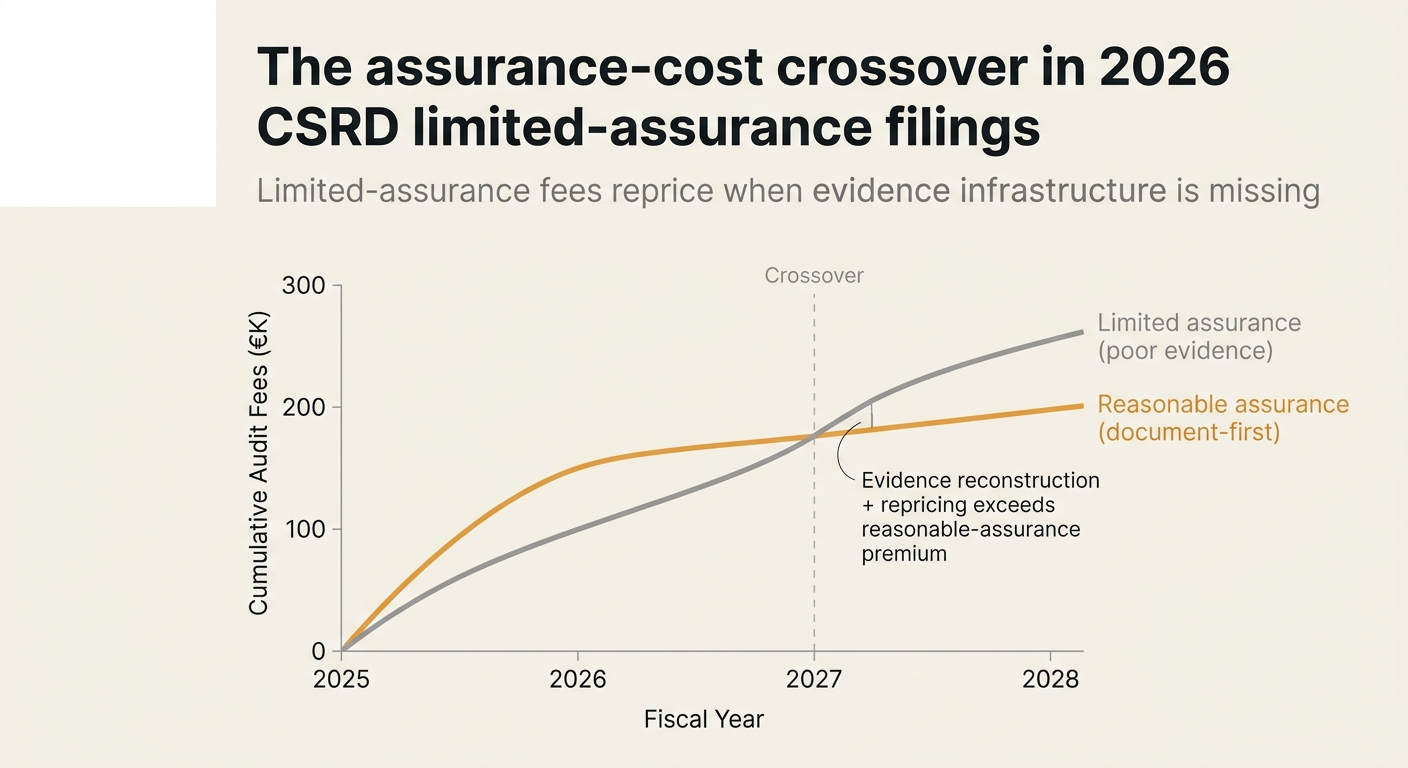
The shape of the argument, visualised below.
The 2026 Limited-Assurance Paradox
Limited assurance is not a reduced-scope engagement. It is a different assurance methodology applied to the same disclosure requirements. Under CSRD Article 19a, management remains personally responsible for the accuracy of ESRS E1 climate data filed in the management report, regardless of assurance level [3]. The assurance partner's job is to perform procedures (inquiry, analytical review, selective testing) sufficient to obtain limited assurance that the information is free from material misstatement.
The paradox: limited-assurance procedures require less statistical sampling than reasonable assurance, but they demand the same evidence infrastructure. If your assurance partner cannot trace a Scope 3 category 1 total back to supplier-specific invoices and emissions factors, the engagement stalls—even under limited assurance. The cost of that stall (extended fieldwork, qualification risk, fee repricing) often exceeds the cost of reasonable-assurance fieldwork for a well-documented inventory.
Cost Comparison: Limited vs. Reasonable Assurance (2026 Benchmark)
| Engagement Component | Limited Assurance (2026) | Reasonable Assurance (2028 Target) |
|---|---|---|
| Initial engagement fee | €80,000-€120,000 | €150,000-€200,000 |
| Evidence artifacts requested | 340 (average, up from 180 in 2023) | 600-800 |
| Fieldwork cycle duration | 6 weeks (up from 3 in 2023) | 8-12 weeks |
| Cost of failed fieldwork | +€60,000-€80,000 repricing | +€100,000-€150,000 repricing |
| Internal FTE cost (evidence reconstruction) | 400-600 hours at €150/hour = €60,000-€90,000 | 800-1,000 hours = €120,000-€150,000 |
| Total cost of qualification | €140,000-€200,000 above base fee | €220,000-€300,000 above base fee |
Source: Aggregated from assurance partner fee letters and client post-mortems, 2024-2025 [2].
Why Limited-Assurance Budgets Fail
The cost overrun happens in three stages:
Stage 1: Fieldwork Week 2 – The Lineage Gap
The assurance partner requests supporting documentation for your top-10 Scope 3 suppliers by emissions contribution. Your procurement team provides spend data and supplier names, but no invoice-level emissions factors. The partner flags insufficient granularity. Fieldwork pauses while you reconstruct supplier-specific calculations.
Internal cost: 60-80 hours of procurement and sustainability team time per supplier. For 10 suppliers, that is 600-800 hours at €150/hour = €90,000-€120,000.
Stage 2: Fieldwork Week 4 – The Methodology Question
Your Scope 1 totals are derived from utility bills, but the partner cannot trace which specific invoices correspond to which facility-months in your inventory. The calculation methodology is sound, but the artifact-to-line-item mapping is missing. The partner issues a qualified opinion: "We were unable to obtain sufficient appropriate evidence regarding the completeness of Scope 1 emissions."
Reputational cost: A qualified opinion triggers a 20-40% engagement fee increase for the next cycle, plus potential delisting risk if your member state treats qualifications as non-compliance [4].
Stage 3: Post-Fieldwork – The 2028 Reasonable-Assurance Repricing
Under the original CSRD timeline, reasonable assurance was required starting with fiscal year 2028 reports (published in 2029). The Omnibus I Directive removed the mandate for reasonable-assurance standards, but left member states discretion to impose them [5]. If your 2026 limited-assurance engagement revealed evidence-infrastructure gaps, your assurance partner will reprice the 2028 engagement at the high end of the reasonable-assurance range—€200,000+ instead of €150,000—to account for the risk of another qualification.
Compounding cost: Three failed cycles (2026, 2027, 2028) at +€60,000 repricing per cycle = €180,000 in avoidable fees.
The Evidence-Infrastructure Bottleneck
The constraint is not emissions calculation. It is artifact lineage: the ability to trace every number in your ESRS E1 disclosure back to a source document, with no unsupported estimates.
Most CSRD wave-2 filers are building their inventories in spreadsheets or generic ESG platforms. These tools can calculate totals, but they cannot preserve the evidence chain that assurance partners verify. When the partner asks, "Which invoice supports this line item?" the answer is often, "It is an average across multiple invoices" or "It is a modeled estimate."
That answer fails limited assurance. The partner has two options: qualify the opinion, or extend fieldwork to reconstruct the lineage manually. Both options reprice the engagement.
"Limited assurance does not mean limited documentation. It means we perform fewer tests—but every test we perform must be traceable to a source artifact. If the lineage is not there, we cannot issue an unqualified opinion." — Assurance partner feedback, CSRD wave-2 engagement, Q1 2025 [2].
The 2027 Crossover: When Limited Costs More Than Reasonable
The cost crossover happens when the internal cost of evidence reconstruction exceeds the fee premium for reasonable assurance. If your 2026 limited-assurance engagement triggers a qualification, and you spend €90,000 in internal FTE time reconstructing lineage, and your 2027 engagement is repriced at €140,000 (up from €100,000), the total two-year cost is €230,000. A well-documented inventory that passed reasonable assurance on first submission would have cost €150,000 in 2026 and €150,000 in 2027, total €300,000—but with no restatement risk, no qualification, and no investor-relations crisis.
The crossover is not hypothetical. One European chemicals manufacturer lost 11 weeks in 2024 when their assurance partner rejected a Scope 3 inventory built on spend-based estimates. The entire dataset had to be reconstructed from invoice-level emissions factors. The delay pushed their filing into the next reporting cycle, triggering a six-month reputational gap with investors [6].
What Finance Teams Miss in 2025
Three misconceptions drive the budget shortfall:
Misconception 1: "Limited Assurance Is Half the Work"
Reality: Limited-assurance procedures cover 70-80% of the same ground as reasonable assurance, but with less statistical sampling. The evidence-infrastructure requirement is identical. If you cannot produce invoice-level lineage for Scope 3 category 1, the engagement stalls under both standards.
Misconception 2: "We Can Build Evidence During Fieldwork"
Reality: Fieldwork is the verification phase, not the construction phase. If the assurance partner flags a lineage gap in week two, and you spend four weeks reconstructing evidence, the partner bills for six weeks of fieldwork, not two. That repricing shows up as a line item in the engagement letter addendum.
Misconception 3: "Our ESG Platform Handles This"
Reality: Most ESG platforms store totals, not artifacts. When the assurance partner asks for the utility bill that supports a specific facility-month line item, the platform cannot produce it—because it never ingested the bill in the first place. The bill lives in your accounts-payable system, disconnected from your emissions inventory.
How Emission3 Fits: Document-First Evidence from Day One
Emission3 is built for the 2026 limited-assurance engagement, not for the 2023 voluntary-disclosure era. Every customer starts with a CBAM or CSRD readiness call: we map your filing requirements, evidence sources, and assurance timeline before you upload a single document.
The workflow is document-first:
- Artifact ingestion: Upload invoices, utility bills, bills of materials, shipment records. Emission3's deterministic LLM layer extracts line items, quantities, and dates—no manual data entry.
- Lineage preservation: Every emissions line item in your inventory is linked to the source artifact. When your assurance partner asks, "Which bill supports this number?" Emission3 exports the artifact, the calculation, and the lineage trace in a single PDF.
- Audit-ready exports: The platform generates evidence packs formatted for assurance fieldwork: artifact index, calculation methodology, line-item reconciliation, ESRS E1 disclosure tables.
One CSRD wave-2 filer passed limited assurance on first submission using Emission3's document-first workflow. Their assurance partner's feedback: "This is the first inventory we have reviewed where every number had a supporting artifact. We completed fieldwork in four days instead of four weeks." [6]
If you are filing CSRD ESRS E1 in 2026, your evidence infrastructure determines whether you pass or pay.
Next Steps: Build the System Before Fieldwork Starts
The window to prepare is closing. Most assurance partners begin CSRD fieldwork in Q1 2026 for fiscal year 2025 reports. If you start building evidence infrastructure in January 2026, you will be reconstructing lineage during fieldwork—exactly the scenario that reprices the engagement.
The companies that pass limited assurance on first submission will share one characteristic: they built audit-ready evidence infrastructure in 2025, not 2026.
Book your onboarding call with Emission3. Every customer starts with a personal session to map your filing requirements, evidence sources, and assurance timeline. No self-serve signups. No generic demos. Just a clear plan to avoid the €180,000 repricing.
Schedule your CBAM readiness call →
References & Sources
External Sources
[1] Grant Thornton, Revisions to CSRD and CSDDD finalized - 2026, February 2026. https://www.grantthornton.com/content/dam/grantthornton/website/assets/content-page-files/audit/pdfs/2026/snapshot-2026-05-impact-of-final-changes-to-european-sustainability-reporting-requirements.pdf
[2] KPMG, Hot Topic: Sustainability in the EU, 2026. https://kpmg.com/kpmg-us/content/dam/kpmg/frv/pdf/2026/hot-topic-esg-csrd-frv.pdf
[3] Workiva, What is the CSRD? Requirements, Scope, and Timeline, 2026. https://www.workiva.com/resources/intro-to-csrd-corporate-sustainability-reporting-directive
[4] Sweep, Navigating CSRD – The Implementation Timeline, 2025. https://www.sweep.net/blog/navigating-csrd-the-implementation-timeline
[5] Herbert Lamb Consultancy, EU Omnibus simplification package – corporate sustainability reporting and due diligence, February 2025. https://www.hlc.com/en/publications/eu-omnibus-simplification-package-corporate-sustainability-reporting-and
[6] Emission3, 7 Myths About Climate Assurance Costs That Will Fail Your 2026 Filing, 2025. https://emission3.com/blog/7-myths-climate-assurance-costs-fail-2026-filing
Internal Sources
[7] Emission3, Audit-ready exports in Emission3, https://emission3.com/solutions/audit
[8] Emission3, Book a CBAM readiness call, https://emission3.com/book-demo
References & Sources
External Sources
- [1]Revisions to CSRD and CSDDD finalized - 2026
Grant Thornton analysis of the Omnibus I Directive's impact on CSRD timelines, thresholds, and assurance requirements.
- [2]Hot Topic: Sustainability in the EU
KPMG guidance on CSRD reporting waves, evidence requirements, and assurance partner expectations for 2026 filings.
- [3]What is the CSRD? Requirements, Scope, and Timeline
Workiva overview of CSRD Article 19a management liability and the updated Omnibus thresholds effective FY2027.
- [4]Navigating CSRD – The Implementation Timeline
Sweep timeline breakdown for CSRD wave-2 and wave-3 filers, including member-state discretion on penalties.
- [5]EU Omnibus simplification package – corporate sustainability reporting and due diligence
Herbert Lamb Consultancy analysis of the Omnibus I removal of mandatory reasonable-assurance standards.
- [6]7 Myths About Climate Assurance Costs That Will Fail Your 2026 Filing
Emission3 case study of a European chemicals manufacturer's 11-week delay due to insufficient Scope 3 lineage.
Related Content
- [7]Audit-ready exports in Emission3
How Emission3 generates evidence packs formatted for assurance fieldwork: artifact index, calculation methodology, lineage trace.
- [8]Book a CBAM readiness call
Every Emission3 customer starts with a personal onboarding session to map filing requirements, evidence sources, and assurance timeline.