The assurance-escalation gap in California SB 253 limited-to-reasonable assurance transition for CFO finance teams
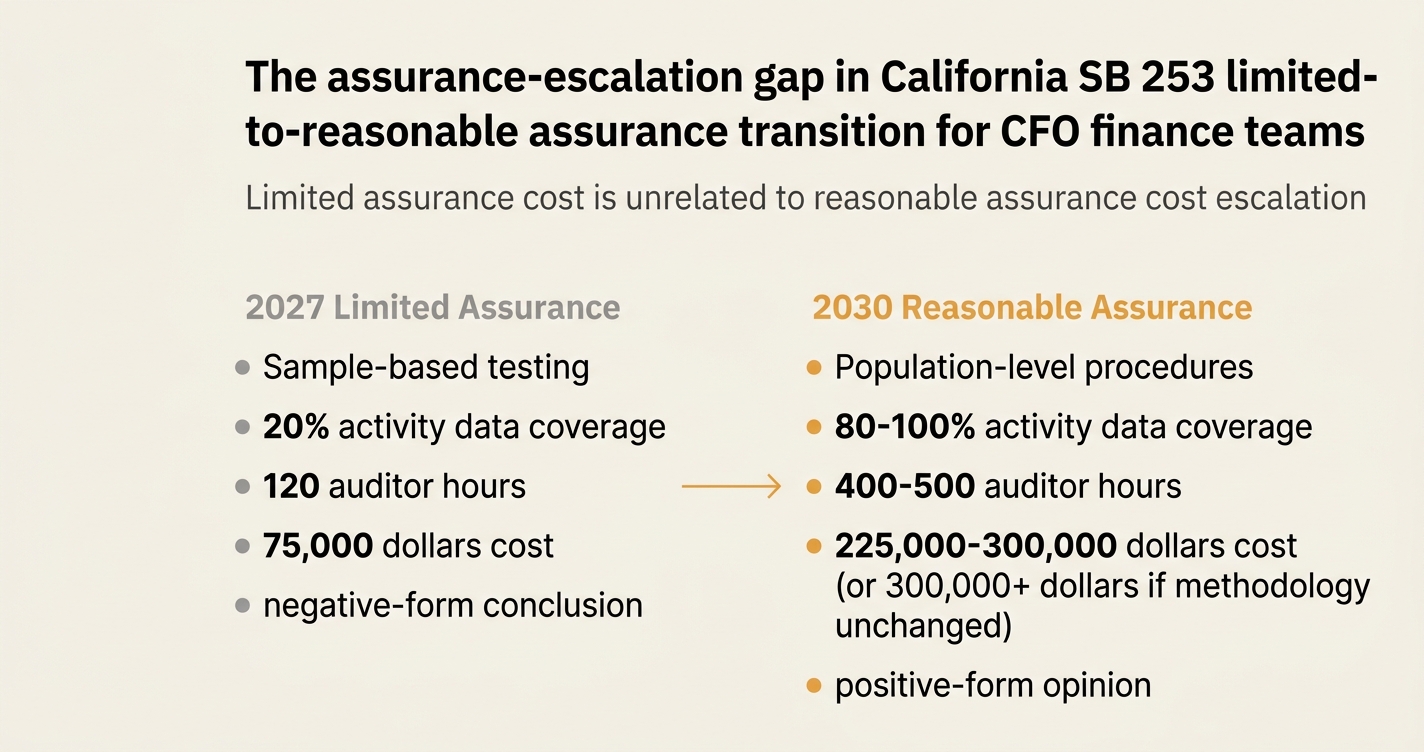
The assurance-escalation gap in California SB 253 limited-to-reasonable assurance transition for CFO finance teams
Here's the issue: California Senate Bill 253, the Climate Corporate Data Accountability Act, requires companies with over one billion dollars in revenue doing business in California to disclose Scope 1 and Scope 2 greenhouse gas emissions annually starting in 2026. Limited assurance becomes mandatory in 2027, upgrading to reasonable assurance in 2030. CFOs are budgeting for the limited assurance engagement—audit fees estimated at 50,000 to 150,000 dollars depending on organizational complexity—but the cost structure they are planning against is incomplete.
However, SB 253 assurance consists of two things: the limited assurance engagement for Scope 1 and Scope 2 emissions in 2027 through 2029, and the reasonable assurance escalation from 2030 onward.
The limited assurance engagement on its own has no predictive value for 2030 audit fees. The reasonable assurance escalation is what the auditor is actually pricing for. Limited assurance under ISAE 3410 or AA1000AS v3 involves sample-based testing and negative-form conclusions—the auditor states nothing has come to their attention indicating material misstatement. Reasonable assurance requires population-level substantive procedures and positive-form opinions—the auditor must affirmatively state that emissions are fairly presented in all material respects. The procedural gap between the two is not incremental. It is categorical.
While limited assurance has become the floor for 2027, reasonable assurance has become the ceiling that determines 2030 costs. If your organization reports 150,000 tonnes CO2e Scope 1 and Scope 2 combined, and your limited assurance provider samples 20 percent of activity data in 2027, your reasonable assurance provider in 2030 will test 80 to 100 percent of the same population. If your 2027 limited engagement costs 75,000 dollars and requires 120 auditor hours, your 2030 reasonable engagement might cost 225,000 to 300,000 dollars and require 400 to 500 hours—assuming your evidence infrastructure and calculation methodology remain unchanged. If they do not remain unchanged, if the auditor must re-baseline methodology or reconstruct evidence lineage, the cost escalation can exceed 400 percent.
How do you solve this? I think the answer depends on whether your organization treats the 2026 and 2027 filings as compliance checkboxes or as infrastructure buildout. The CFOs we work with who are getting ahead of the escalation are using the 2026 grace period—California Air Resources Board has exercised enforcement discretion and is not requiring assurance for the first Scope 1 and Scope 2 submission due August 10, 2026—to lock in calculation methodology, evidence workflows, and quantification documentation that will survive the transition to reasonable assurance. They are not optimizing for 2027 limited assurance cost. They are optimizing for 2030 reasonable assurance cost, which is three to four times larger and cannot be managed retroactively.
Visualised:
The 90-day CFO playbook for SB 253 assurance-ready infrastructure
This checklist is organized as 30-day, 60-day, and 90-day action blocks. Each step includes the action, the owner, and the evidence artifact produced. The objective is to complete the infrastructure buildout before your 2027 limited assurance engagement begins, so that the methodology, evidence base, and quantification documentation you deliver to your auditor in 2027 are identical in structure to what your auditor will require for reasonable assurance in 2030.
Days 1-30: Evidence baseline and methodology lock
Step 1: Commission a readiness assessment scoped to reasonable assurance requirements, not limited assurance minimums
✅ Done when: You have a written gap analysis comparing your current emissions quantification workflow against ISAE 3410 reasonable assurance substantive procedure requirements, including population completeness criteria, evidence sufficiency thresholds, and calculation reproducibility standards.
Owner: CFO or VP Finance, outsourced to assurance-readiness advisor or Big Four assurance practice.
Evidence artifact: Readiness assessment report with itemized gap list, prioritized by impact on 2030 reasonable assurance scope and cost.
Step 2: Map every emissions source to a primary evidence document and a fallback evidence document
✅ Done when: Every line item in your Scope 1 and Scope 2 inventory—stationary combustion, mobile combustion, fugitive emissions, purchased electricity—has a named primary evidence source (utility bill, fuel purchase invoice, odometer log, refrigerant service record) and a named fallback if the primary is unavailable (bank statement, supplier attestation, operations log). No defaults, no placeholders.
Owner: Controller or Director of Financial Planning and Analysis, coordinated with facilities management and procurement.
Evidence artifact: Evidence matrix in spreadsheet or database format, one row per emissions source, columns for primary evidence type, fallback evidence type, document retention owner, and current availability status.
Step 3: Select a single calculation methodology and lock the version number
✅ Done when: You have documented the specific version of the quantification standard you are using—GHG Protocol Corporate Accounting and Reporting Standard (2004 or 2015 amendment), ISO 14064-1:2018, or other—and you have documented the emission factor source and version for every activity type. California Air Resources Board references the GHG Protocol Corporate Standard and provides California-specific emission factors through the California GHG Inventory.[1]
Owner: Sustainability Director or ESG Program Manager, reviewed by CFO.
Evidence artifact: Methodology statement document, maximum three pages, listing standard version, boundary definition, consolidation approach (operational control, financial control, or equity share), and emission factor sources with retrieval dates.
Step 4: Quantify Scope 2 using both location-based and market-based methods, even if you only report one
✅ Done when: You have calculated Scope 2 emissions under both methods, documented the difference, and stored both outputs. SB 253 does not prescribe a single Scope 2 method, but CARB has indicated it expects disclosure of the method used and, where applicable, the alternative method result.[2] Reasonable assurance in 2030 will test whether your chosen method is consistently applied.
Owner: Sustainability Director, coordinated with energy procurement team.
Evidence artifact: Scope 2 calculation workbook with separate tabs for location-based (grid average factors) and market-based (contractual instruments, renewable energy certificates, power purchase agreements), including a variance explanation if the two methods differ by more than 10 percent.
Step 5: Establish a document retention schedule aligned with assurance evidence requirements, not general records retention
✅ Done when: Your organization has a written policy requiring retention of all primary and fallback evidence documents for SB 253-relevant emissions sources for a minimum of five years, with monthly or quarterly snapshots for dynamic data sources (utility portals, fuel card transaction logs). Standard corporate records retention schedules—typically three years for non-financial documents—are insufficient for reasonable assurance. Auditors conducting reasonable assurance in 2030 will re-perform 2027 and 2028 calculations as part of trend analysis.
Owner: General Counsel or Chief Compliance Officer, coordinated with IT and facilities management.
Evidence artifact: Document retention policy addendum specific to SB 253 evidence, distributed to all document owners, with quarterly compliance reporting to CFO.
Days 31-60: Quantification infrastructure and internal controls
Step 6: Build a calculation workbook with cell-level lineage from raw input to final emission total
✅ Done when: Every cell in your emissions calculation spreadsheet or database that contributes to a final reported number has a traceable path back to a raw data input and a documented transformation (unit conversion, emission factor application, allocation ratio). No manual overrides without logged justification. Reasonable assurance requires the auditor to re-perform calculations; if your calculation logic is embedded in undocumented Excel macros or proprietary software black boxes, the auditor will re-build it from scratch at your expense.
Owner: FP&A Analyst or Sustainability Analyst, reviewed by Controller.
Evidence artifact: Calculation workbook with embedded commentary, formula audit trail, and version control log. Alternatively, a database schema document showing table relationships, transformation logic, and output queries.
Step 7: Implement a three-person segregation of duties for data collection, calculation, and review
✅ Done when: No single individual collects raw data, performs emission calculations, and reviews the final inventory. This is a SOX-grade control structure. For limited assurance, auditors accept management review as sufficient. For reasonable assurance, auditors test whether the review is independent and whether the reviewer has the technical competence to identify calculation errors.
Owner: CFO, formalized in internal control documentation.
Evidence artifact: Roles and responsibilities matrix for SB 253 emissions reporting, including names, titles, and sign-off checkpoints. Integrated into your organization's Sarbanes-Oxley Section 404 internal control framework if applicable.
Step 8: Conduct a dry-run limited assurance engagement using your 2025 fiscal year data
✅ Done when: You have engaged an independent assurance provider—eligible under California Air Resources Board proposed standards, including AA1000AS v3, ISAE 3410, AICPA AT-C Section 210, or ISO 14064-3:2019[3]—to perform a limited assurance review of your 2025 Scope 1 and Scope 2 inventory before the August 10, 2026 filing deadline. The objective is not to obtain an assurance report for filing (CARB is not requiring assurance in 2026) but to identify evidence gaps, calculation inconsistencies, and methodology ambiguities that would escalate cost in 2027 and 2030.
Owner: CFO, coordinated with Sustainability Director.
Evidence artifact: Management letter from assurance provider listing findings, risk-rated by severity, with estimated cost impact if findings are not remediated before 2027 limited assurance or 2030 reasonable assurance.
Step 9: Establish a quarterly emissions close process parallel to financial close
✅ Done when: Your organization calculates Scope 1 and Scope 2 emissions on a quarterly basis using the same evidence collection and calculation methodology that will support annual reporting. This allows you to identify data gaps, anomalies, and methodological inconsistencies four times per year instead of once. It also produces a quarterly emissions trend that auditors will use for analytical procedures—unexplained quarter-over-quarter variance is a red flag for reasonable assurance.
Owner: Controller, coordinated with Sustainability Director.
Evidence artifact: Quarterly emissions close checklist mirroring financial close checklist, including data collection cutoff dates, calculation review sign-offs, and variance analysis templates.
Step 10: Document uncertainty and quantification limitations for every material emissions source
✅ Done when: For each emissions source contributing more than 5 percent of total Scope 1 and Scope 2 emissions, you have documented the quantification approach (direct measurement, mass balance, engineering estimate, emission factor application), the uncertainty range (typically expressed as a percentage or confidence interval), and any known limitations (missing data, estimation assumptions, allocation methodology). SB 253 does not currently require uncertainty quantification in the disclosure, but CARB's proposed regulations include a requirement for transparency documentation starting in 2027.[4] Reasonable assurance auditors will test whether reported emissions reflect the best available data and whether limitations are adequately disclosed.
Owner: Sustainability Director, reviewed by external technical consultant if in-house expertise is limited.
Evidence artifact: Uncertainty register, one entry per material emissions source, with quantification approach, uncertainty range, and limitation description. Updated annually.
Days 61-90: Vendor alignment and fee negotiation
Step 11: Pre-qualify your 2027 limited assurance provider and your 2030 reasonable assurance provider, even if they are the same firm
✅ Done when: You have issued a request for proposal to at least three assurance providers eligible under CARB standards, specifying that the engagement scope includes limited assurance for 2027, 2028, and 2029, and reasonable assurance for 2030 onward. The RFP must include your current emissions inventory structure, your evidence matrix, your calculation methodology, and your internal control documentation. Providers should quote multi-year fee schedules with explicit pricing for the limited-to-reasonable transition. Fee escalation from 2029 to 2030 should not exceed 150 percent if your infrastructure is assurance-ready.[5]
Owner: CFO or VP Finance, supported by procurement.
Evidence artifact: Comparative fee analysis showing 2027-2030 total cost of assurance per provider, normalized to cost per tonne CO2e assured. Providers charging materially different rates for the same scope are either mispricing the transition risk or pricing in infrastructure remediation that you have not budgeted.
Step 12: Negotiate a fixed-fee or capped-fee structure for the limited-to-reasonable transition
✅ Done when: Your assurance provider agreement includes a fee cap or a fixed fee for the 2030 reasonable assurance engagement, contingent on your organization maintaining the methodology, evidence base, and calculation infrastructure documented in the 2027 engagement. Variable-fee structures—billed hourly with no cap—transfer the cost risk of infrastructure deficiencies to you. If your provider will not commit to a fee cap, it signals they expect material remediation work between 2029 and 2030.
Owner: CFO.
Evidence artifact: Assurance provider contract with fee schedule appendix, including escalation triggers (e.g., methodology change, boundary expansion, restatement) and de-escalation provisions (e.g., infrastructure improvements reducing sample size or testing scope).
Step 13: Align your SB 253 inventory boundary with your financial reporting boundary to minimize consolidation complexity
✅ Done when: The entities included in your SB 253 Scope 1 and Scope 2 inventory match the entities included in your consolidated financial statements, using the same consolidation approach (operational control, financial control, or equity share). Boundary misalignment is a common driver of assurance cost escalation. If your financial statements consolidate 50 entities but your emissions inventory consolidates 48, auditors will test whether the exclusion is methodologically justified or an error. If it is an error, the 2027 inventory must be restated, and the 2030 reasonable assurance scope expands to cover restatement risk.
Owner: Controller, coordinated with Sustainability Director.
Evidence artifact: Boundary alignment matrix comparing financial reporting consolidation scope to emissions inventory consolidation scope, with explanations for any differences.
Step 14: Establish a response protocol for CARB inquiries and audit requests
✅ Done when: Your organization has a written protocol designating the individual responsible for responding to California Air Resources Board information requests, audit notices, or compliance inquiries related to SB 253. The protocol must include response timelines (CARB has indicated entities will have 30 days to respond to data requests), document retrieval procedures, and legal review checkpoints. SB 253 authorizes penalties up to 500,000 dollars per year for non-compliance, and CARB has indicated it may conduct internal audits of assurance and reporting activities.[6]
Owner: General Counsel, coordinated with CFO and Sustainability Director.
Evidence artifact: CARB response protocol document, integrated into your organization's regulatory compliance framework, with annual training for designated responders.
Step 15: Model the cost impact of Scope 3 assurance escalation from 2030 onward
✅ Done when: Even though SB 253 Scope 3 reporting does not begin until 2027 and Scope 3 assurance is not required until 2030 (and CARB will decide separately in 2027 whether Scope 3 assurance will be mandatory), you have modeled the incremental audit cost if Scope 3 reasonable assurance becomes required. For most organizations, Scope 3 emissions are 5 to 20 times larger than Scope 1 and Scope 2 combined. If your Scope 1 and Scope 2 reasonable assurance costs 250,000 dollars in 2030, and your Scope 3 emissions are 10 times larger, your Scope 3 reasonable assurance could cost 1 to 1.5 million dollars depending on category complexity and supplier data availability. CFOs who model this cost in 2026 can begin supplier engagement, data collection, and category-level infrastructure buildout while the regulatory pathway is still being defined.
Owner: CFO, coordinated with Sustainability Director and procurement.
Evidence artifact: Scope 3 assurance cost model showing estimated audit fees per category (purchased goods and services, capital goods, upstream transportation, business travel, employee commuting, downstream transportation, end-of-life treatment), with sensitivity analysis for supplier data availability (primary data, supplier-specific data, industry average data, spend-based estimates).
How Emission3 fits
Emission3 is productized CBAM implementation backed by compliance infrastructure, but the same document-first, deterministic architecture that supports CBAM actual-emissions filing for non-EU exporters supports SB 253 assurance-ready reporting for California filers. The platform ingests utility bills, fuel invoices, and facility-level operational data, calculates emissions with cell-level lineage from raw input to final total, and exports evidence packs structured for auditor review. Every number is reproducible. Every calculation step is documented. Every evidence document is retained with retrieval metadata.
For CFOs managing the SB 253 limited-to-reasonable assurance transition, Emission3 eliminates the infrastructure gap that drives 2030 cost escalation. The methodology you lock in 2026, the evidence base you build in 2027, and the calculation workbook you deliver to your limited assurance provider in 2028 are identical in structure to what your reasonable assurance provider will test in 2030. The cost escalation is the escalation in auditor procedures—not the escalation in remediation work.
CFOs working with Emission3 are completing the 90-day playbook above in 60 days, because the evidence matrix, calculation lineage, and uncertainty documentation are system outputs, not manual deliverables. If your 2027 limited assurance provider quotes 120 auditor hours and your 2030 reasonable assurance provider quotes 400 auditor hours, the incremental cost is the incremental testing scope—not the cost of rebuilding your quantification infrastructure under audit pressure.
Start the readiness conversation
The August 10, 2026 Scope 1 and Scope 2 filing deadline is eight months away. The 2027 limited assurance engagement begins in March or April 2027 at the latest.[7] The methodology decisions you make in the next 90 days determine your 2030 reasonable assurance cost. If you are a CFO or finance leader at a company with over one billion dollars in revenue doing business in California, book a CBAM readiness call with Emission3. We will map your current evidence infrastructure against reasonable assurance requirements, identify the gaps that would escalate 2030 audit fees, and scope a 60- to 90-day implementation that locks in your assurance-ready workflow before your 2027 engagement begins. All customers start with a readiness call—we map suppliers, gaps, and implementation, no anonymous self-serve onboarding.[8]
References & Sources
External Sources
- [1]Updated Guidance on Compliance with California's Climate Disclosure Laws - Proskauer Rose LLP
CARB compliance timeline updates for SB 253 and SB 261, including August 10, 2026 deadline for Scope 1 and 2 reporting and fee estimates.
- [2]California SB 253 Climate Disclosure Requirements - Schellman
Detailed breakdown of SB 253 Scope 2 methodology requirements and CARB's expectation for transparent quantification documentation starting in 2027.
- [3]SB 253 Compliance Roadmap - Terrascope
CARB's February 2026 rulemaking approval and accepted assurance standards including AA1000AS v3, ISAE 3410, AICPA AT-C Section 210, and ISO 14064-3:2019.
- [4]CARB's Climate Disclosure Checklist - GSI Environmental
CARB disclosure checklist for SB 261 and SB 253, including transparency requirements for quantification methodology and uncertainty documentation.
- [5]California SB 253 and SB 261 Compliance Guide - Environ Energy
Phased assurance requirements for SB 253, including limited assurance timeline for Scope 1 and 2 in 2027-2029 and reasonable assurance starting 2030.
- [6]A guide to California's climate disclosure rules - Watershed
SB 253 enforcement timeline, penalties up to $500,000 per year for non-compliance, and CARB's stated intention to conduct internal audit activities.
- [7]Assurance for California's SB 253 - SustainCERT
Assurance engagement timing requirements for SB 253, including the March-April 2027 start date for limited assurance and the surge in market demand for qualified providers.
Related Content
- [8]Book a CBAM readiness call
All customers start with a readiness call: we map suppliers, gaps, and implementation, no anonymous self-serve onboarding.
- [9]Audit-ready exports in Emission3
For auditors and CFOs, shows the evidence lineage artifact Emission3 produces to support assurance-ready reporting workflows.
- [10]The assurance-cost escalation in California SB 253 limited-to-reasonable assurance transition for Scope 1 and Scope 2 emissions
SB 253 assurance consists of limited engagement and reasonable escalation. CFOs budget for limited—but 2030 audit fees are set by methodology decisions locked in 2026.