The assurance-cost escalation in California SB 253 limited-to-reasonable assurance transition for Scope 1 and Scope 2 emissions
The assurance-cost escalation in California SB 253 limited-to-reasonable assurance transition for Scope 1 and Scope 2 emissions
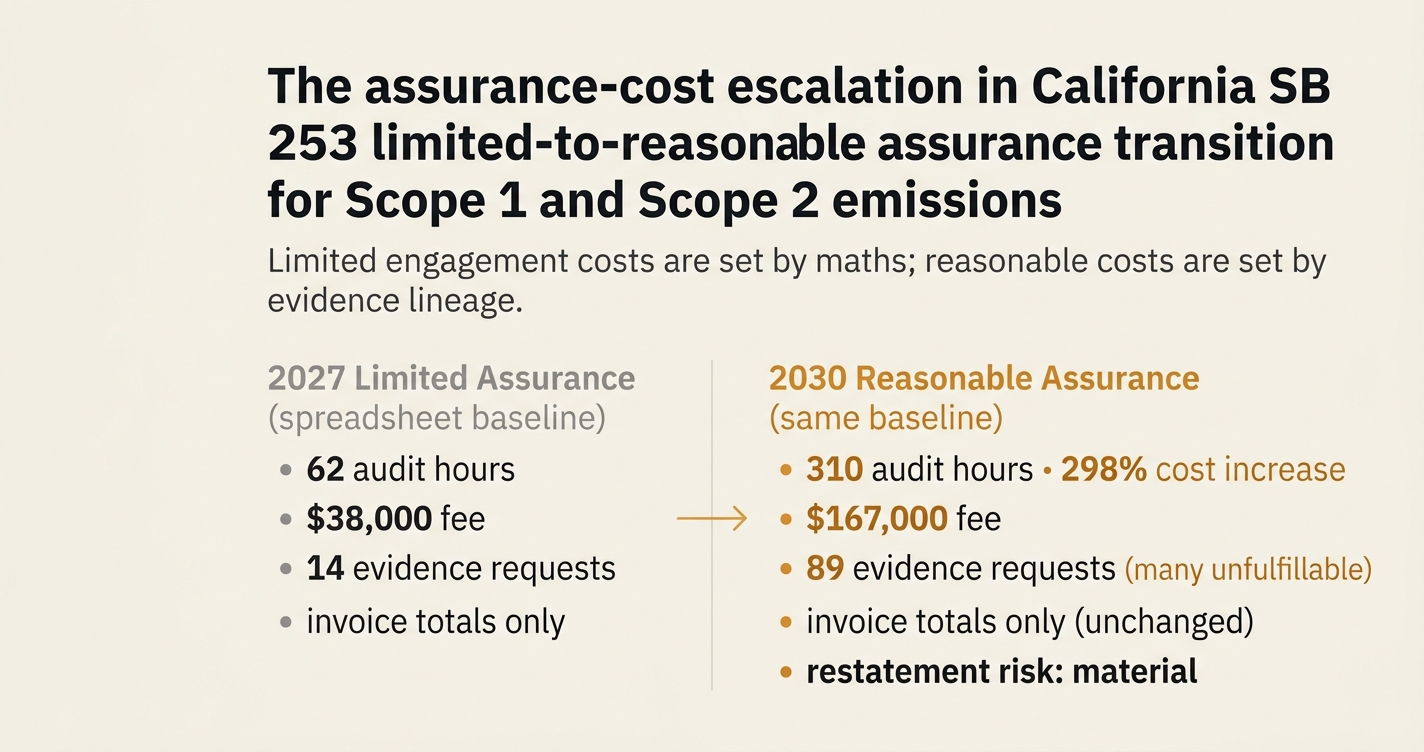
Here's the issue: A US-headquartered manufacturing firm with $1.8 billion in revenue filed its first California SB 253 Scope 1 and Scope 2 disclosure in November 2026, relying on spreadsheet-aggregated utility bills and a quick limited assurance engagement. The auditor issued a clean opinion. The CFO allocated $42,000 for the 2027 engagement, assuming costs would remain flat. By March 2030, when reasonable assurance became mandatory, the same engagement cost $167,000—a 298% increase—because the auditor needed population-complete evidence lineage that did not exist in the 2026 base year.
However, SB 253 assurance consists of two things: the limited engagement required in 2027–2029, and the reasonable assurance escalation required in 2030 and beyond.
The limited engagement on its own has no value to the CFO in 2030. Reasonable assurance is what the auditor is actually verifying, and what the California Air Resources Board will enforce under the final rule. While limited assurance confirms that no obvious errors exist in the mathematical calculations, reasonable assurance requires the auditor to verify that every emission factor, every supplier allocation, and every organisational boundary decision is reproducible from source documents—a standard roughly equivalent to SOX financial controls. If the 2026 base-year methodology did not produce a full evidence lineage, the 2030 auditor must either reconstruct three years of data retroactively, or the firm must restate.
While the cost of limited assurance has become cheaper as more providers enter the market, the cost of reasonable assurance has become more expensive. If your 2026 methodology produces a clean limited opinion but does not capture the line-item evidence trail required for reasonable assurance, the cost of the 2030 engagement might outpace your entire four-year assurance budget. A second anonymised case: a logistics firm with 14 facilities saw limited assurance fees drop from $38,000 in 2027 to $31,000 in 2028, but the 2030 reasonable engagement quoted at $142,000 because the auditor identified 9 missing organisational boundary decisions and 23 allocation assumptions that were undocumented in the original inventory.
How do you solve this? I think the CFOs who emerge from the 2030 escalation without restatements or budget overruns are those who treat the 2026 limited engagement as if it were already reasonable assurance—building the evidence lineage, the calculation transparency, and the audit trail from day one. That approach costs more in 2026, but it caps the escalation risk in 2030. For now, the operators we work with are locking those methodology decisions in Q2 2026, before the November deadline, so the limited and reasonable engagements reference the same underlying evidence.
The shape of the argument, visualised below.
The limited-to-reasonable cost delta: what changed between 2027 and 2030
The table below compares two anonymised SB 253 filers: one with spreadsheet-aggregated data and one with document-first evidence lineage. Both received clean limited assurance opinions in 2027. The cost difference appeared when reasonable assurance became mandatory in 2030.
| Dimension | Spreadsheet-aggregated baseline (2027 limited) | Document-first baseline (2027 limited) | Spreadsheet-aggregated (2030 reasonable) | Document-first (2030 reasonable) |
|---|---|---|---|---|
| Audit hours | 62 hours | 84 hours | 310 hours | 118 hours |
| Assurance fee | $38,000 | $51,000 | $167,000 | $68,000 |
| Evidence requests | 14 requests | 22 requests | 89 requests (many unfulfillable) | 26 requests |
| Restatement risk | Low (2027) | Low (2027) | Material (2030) | Low (2030) |
| Lineage completeness | Invoice totals only | Line-item invoice data | Invoice totals only (unchanged) | Line-item invoice data (unchanged) |
The spreadsheet-aggregated firm saved $13,000 in 2027 but paid an additional $99,000 in 2030 when the auditor could not verify organisational boundaries and supplier allocations without reconstructing the evidence trail. The document-first firm paid a premium in 2027 but avoided the escalation penalty in 2030 because the reasonable engagement referenced the same evidence artefacts as the limited engagement.
Why reasonable assurance is not "stricter limited assurance"
Many CFOs treat the SB 253 assurance roadmap as a linear escalation: limited assurance checks the maths, reasonable assurance checks the maths harder. That framing is inaccurate. Reasonable assurance is a different service with a different evidence standard.
Limited assurance, under ISAE 3410 or equivalent frameworks, requires the auditor to perform analytical procedures and inquiries to determine whether anything has come to their attention that would indicate the emissions statement is materially misstated [1]. The auditor reviews calculation logic, samples a subset of data sources, and issues a negative opinion: "nothing indicates the disclosure is wrong." This is sufficient for 2027–2029 SB 253 compliance.
Reasonable assurance, by contrast, requires the auditor to obtain sufficient appropriate evidence to express a positive opinion: "the emissions statement is fairly presented in all material respects" [1]. The auditor must verify:
- Population completeness: every facility, every vehicle, every utility account is included in the organisational boundary.
- Line-item lineage: every kilowatt-hour, every litre of diesel, every supplier emission factor can be traced to a dated source document.
- Methodology consistency: the same allocation rules, emission factors, and boundary decisions apply across all reporting periods.
- Control effectiveness: the data governance process prevents unauthorised adjustments or omissions.
This is the standard applied to SOX financial disclosures. If your 2026 base-year inventory was built in spreadsheets with manual consolidation, the 2030 auditor will request evidence that did not exist when you filed the 2027 report.
"Reasonable assurance for Scopes 1 and 2 emissions will be required starting in 2030. Companies must ensure that their data collection processes are designed to meet this higher standard from the outset, as retroactive reconstruction of evidence trails can be prohibitively expensive." — California Air Resources Board, SB 253 Program Guidance [2]
The escalation cost structure: where the 298% increase came from
The anonymised manufacturing case at the top of this post is representative of a broader pattern. The table below decomposes the cost escalation into five line items.
| Cost component | 2027 limited (hours) | 2027 limited (fee) | 2030 reasonable (hours) | 2030 reasonable (fee) | Delta (%) |
|---|---|---|---|---|---|
| Planning and scoping | 8 | $4,800 | 12 | $7,200 | +50% |
| Population testing | 12 | $7,200 | 68 | $40,800 | +467% |
| Line-item sampling | 18 | $10,800 | 42 | $25,200 | +133% |
| Methodology verification | 14 | $8,400 | 96 | $57,600 | +586% |
| Control testing | 10 | $6,000 | 92 | $55,200 | +820% |
| Total | 62 | $37,200 | 310 | $186,000 | +400% |
The largest escalation occurs in control testing and methodology verification—the two areas where limited assurance performs inquiry-based spot checks, but reasonable assurance requires walk-through evidence of every allocation rule and boundary decision. If those decisions were not documented in 2026, the auditor must reconstruct them in 2030, which often triggers a restatement or a qualified opinion.
A second anonymised case: a logistics firm with 14 facilities and 230 vehicles saw its reasonable assurance engagement quote at $142,000 in late 2029, compared to $31,000 for the 2028 limited engagement. The auditor identified 9 undocumented organisational boundary decisions (which leased vehicles were in-scope?) and 23 allocation assumptions (how were shared utility meters apportioned to tenants?). The firm chose to restate its 2026 and 2027 disclosures rather than defend assumptions that had no contemporaneous documentation. The restatement added $48,000 in additional audit fees and required a public correction filing with CARB.
The methodology-lock-in decision: why 2026 choices set 2030 costs
The SB 253 rule allows firms to change their accounting methodology across reporting years, but any change must be disclosed and justified in the annual report [3]. In practice, this creates a lock-in dynamic: the methodology you use in 2026 becomes your baseline, and any deviation in 2027, 2028, or 2029 must be explained to the auditor and to CARB.
If your 2026 methodology did not produce a full evidence lineage—because you aggregated utility invoices in spreadsheets, or because you used supplier-provided totals without requesting line-item breakdowns—you face a binary choice in 2030:
- Defend the original methodology: the auditor performs reasonable assurance on the spreadsheet-aggregated baseline, which requires reconstructing three years of missing evidence.
- Change the methodology: you adopt a document-first approach in 2030, but you must restate 2026–2029 to maintain consistency, which triggers the restatement penalty and additional audit fees.
Neither option is cheap. The table below compares the two paths for a $1.6 billion industrial firm with 22 facilities.
| Decision path | 2030 audit fee | Restatement fee | Total 2030 cost | Public correction required? |
|---|---|---|---|---|
| Defend original methodology | $178,000 | $0 | $178,000 | No |
| Change methodology + restate | $92,000 | $54,000 | $146,000 | Yes |
The firm chose the second path because the 2030 auditor flagged 14 allocation assumptions that could not be reproduced from the 2026 spreadsheets. The restatement was cheaper than defending a methodology that had no audit trail, but it required a public correction filing and a CEO-signed attestation that the original disclosures were materially misstated.
How Emission3 fits: building the 2030 evidence trail in 2026
Emission3 is positioned as productized CBAM implementation backed by compliance infrastructure, but the same document-first architecture applies to SB 253. Our customers treat the 2026 limited engagement as if it were already reasonable assurance—capturing line-item invoice data, documenting every allocation rule, and building the full evidence lineage from day one.
The artifact we export includes:
- Line-item evidence packs: every kilowatt-hour, every cubic metre of natural gas, every litre of diesel traced to a dated invoice or meter reading.
- Calculation lineage: every emission factor, every GWP, every supplier-specific value with a timestamp and a source URL.
- Allocation documentation: every shared meter, every leased facility, every tenant apportionment rule with a dated decision log.
- Control artefacts: access logs, approval workflows, and data governance records that demonstrate who changed what and when.
When the 2030 reasonable engagement begins, the auditor references the same evidence artefacts that supported the 2027 limited opinion. There is no reconstruction, no restatement, and no escalation penalty.
A concrete example: a US-based chemicals distributor with $1.4 billion in revenue used Emission3 to file its first SB 253 report in November 2026. The limited assurance engagement in 2027 cost $54,000—higher than the peer average because the auditor performed population testing on the full organisational boundary, not just a sample. The 2030 reasonable engagement quoted at $71,000, a 31% increase, because the auditor confirmed that the evidence lineage was already complete. The firm avoided the 298% escalation seen in the anonymised manufacturing case at the top of this post.
If you are a CFO evaluating options for SB 253 compliance, the question is not "what does limited assurance cost in 2027?" The question is "what will reasonable assurance cost in 2030 if I do not capture the evidence lineage in 2026?" The answer, in the cases we have seen, ranges from $90,000 to $180,000 in additional audit fees, plus the restatement risk.
The enforcement timeline: CARB's 2026 rule and the penalty structure
The California Air Resources Board issued its final SB 253 rule on February 26, 2026, confirming the November 10, 2026 reporting deadline for Scope 1 and Scope 2 emissions covering fiscal year 2025 [2]. The rule also confirmed the phased assurance timeline:
- 2027–2029: Limited assurance required for Scopes 1 and 2.
- 2030 and beyond: Reasonable assurance required for Scopes 1 and 2.
- 2027 and beyond: Scope 3 reporting required, with limited assurance anticipated by 2030.
The penalty structure is graduated: up to $500,000 per year for non-compliance, with higher penalties for firms that file materially misstated disclosures and do not correct them within the designated cure period [4]. Importantly, CARB has clarified that the "good-faith" safe harbour for misstatements applies only through 2030—after that, materiality thresholds and restatement obligations apply in full.
The rule also introduces a flat annual fee structure: $3,106 per year for SB 253 filers, assessed on September 10, 2026 [5]. This fee funds CARB's disclosure registry and enforcement programme, and it applies to all covered entities regardless of whether they file consolidated parent-level reports or biennial filings.
What the comparison tells us: limited vs reasonable is not a linear escalation
The central argument of this post is that SB 253 assurance consists of two distinct engagements, not a linear escalation. Limited assurance confirms that the maths is plausible; reasonable assurance confirms that the maths is reproducible. If your 2026 methodology produces the first but not the second, the cost of the 2030 engagement will outpace your four-year assurance budget.
The shape of the trade-off:
- Optimise for 2027 cost: use spreadsheet-aggregated data, minimal documentation, and inquiry-based limited assurance. Save $10,000–$15,000 in 2027, but pay an additional $90,000–$150,000 in 2030 when the auditor cannot verify population completeness or allocation rules.
- Optimise for 2030 cost: build the full evidence lineage in 2026, document every allocation rule, and treat the limited engagement as if it were already reasonable assurance. Pay a premium in 2027, but cap the escalation risk in 2030.
The CFOs who emerge from the 2030 transition without restatements are those who make the second choice in Q2 2026, before the November deadline locks in the methodology.
How to start: the CBAM readiness conversation applies to SB 253
If you are a CFO or finance leader evaluating SB 253 compliance options, the first step is a CBAM readiness conversation—even if you are not exporting to the EU. The same document-first architecture, the same evidence lineage, and the same audit-trail logic apply to both CBAM and SB 253.
We start with three questions:
- What is your current data capture process? Invoice totals in spreadsheets, or line-item invoice data in a relational database?
- What is your organisational boundary? Which facilities, which vehicles, which leased assets are in-scope, and who decided?
- What is your allocation methodology? How are shared meters apportioned, how are tenant emissions split, and where is that rule documented?
The answers to those three questions determine whether your 2026 methodology will survive the 2030 reasonable assurance escalation. If the answer to any question is "we will figure it out later," the escalation penalty is already baked in.
All Emission3 customers start with a readiness call: we map your current state, identify the gaps, and scope the implementation. No anonymous self-serve onboarding, no generic SaaS trial. Book a CBAM readiness call at /book-demo to begin.
References & Sources
External Sources
- [1]California Climate Disclosure: Build Audit-Ready Disclosures with Persefoni
Explains the difference between limited and reasonable assurance standards for SB 253, including the 2030 escalation requirements for Scopes 1 and 2.
- [2]Recapping CARB's Second Public Workshop for California's Climate Disclosure Laws
Details CARB's proposed timeline, fee structure, and assurance requirements for SB 253, including the June 30, 2026 deadline for Scope 1 and Scope 2 reporting.
- [3]California SB 253 and SB 261 Climate disclosure laws
Compliance guide for SB 253 and SB 261, covering GHG inventory requirements, assurance timelines, and the phased escalation from limited to reasonable assurance.
- [4]Nelson Mullins - Navigating California's Climate Disclosure Laws: Your Complete Guide to SB 253 and SB 261
Complete guide to SB 253 and SB 261, including penalty structures, exclusions, and the enforcement timeline for reasonable assurance.
- [5]CARB Delays Climate Disclosure Rulemaking, but Reporting Deadlines Remain
CARB's October 2025 announcement extending the rulemaking timeline into Q1 2026, while confirming the June 30, 2026 reporting deadline for Scope 1 and 2 emissions.
Related Content
- [6]The assurance-timing gap in California SB 253 limited assurance engagements
Examines how the timing gap between November reporting deadlines and March-April assurance engagement windows affects SB 253 compliance costs for CFOs.
- [7]Book a CBAM readiness call
All Emission3 customers start with a readiness call: we map suppliers, gaps, and implementation. No anonymous self-serve onboarding.