The actual-versus-default myth in 2026 CBAM filings for EU importers
The actual-versus-default myth in 2026 CBAM filings for EU importers
Here's the issue: non-EU exporters face a straightforward choice in their Carbon Border Adjustment Mechanism filings—report actual installation-level emissions using verified utility bills and production records, or accept default values from the EU's transitional registry. Default values appear simpler: no supplier engagement, no document collection, no data gaps. For many exporters, defaults look like the path of least resistance through the first year of mandatory CBAM reporting.
However, a CBAM filing consists of two things: the embedded emissions figure that determines certificate obligation, and the evidence package that supports it.
The embedded emissions figure on its own has no value to the importer. The evidence package—the installation boundary, the calculation methodology, the utility bills, the production volumes, the emission factor lineage—is what the CBAM declarant is actually paying for when they purchase certificates. Default values eliminate the evidence requirement, but they do so by applying a markup. The EU's default methodology systematically inflates emissions by 20–40% above typical actual installation values for steel, aluminium, and cement, creating a direct cost penalty in certificate purchases.
While supplier engagement has become cheaper through digitalisation and third-party platforms, the certificate cost penalty for using defaults has become more expensive. If a Turkish steel exporter ships 10,000 tonnes of hot-rolled coil to Germany with embedded emissions of 1.8 tCO2e per tonne actual but 2.3 tCO2e per tonne default, the certificate cost difference at €80 per tonne is €400,000 annually. For the German importer, that penalty flows directly to their cost of goods sold, regardless of whether the exporter chose defaults to avoid a €50,000 data collection exercise.
How do you solve this? I think the non-EU exporters who cut CBAM costs in 2026 will be those who treated actual installation data as a commercial negotiation point with their EU customers, not a compliance formality. The operators we work with are building installation-level inventories now—Q1 2026—because the first transitional filing window opens in July, and retrofitting primary data after a default-value submission requires methodology changes that trigger restatement obligations under both CBAM and ESRS E1. For now, the lowest-cost path through CBAM is the one that collects actual data before the first filing, not after.
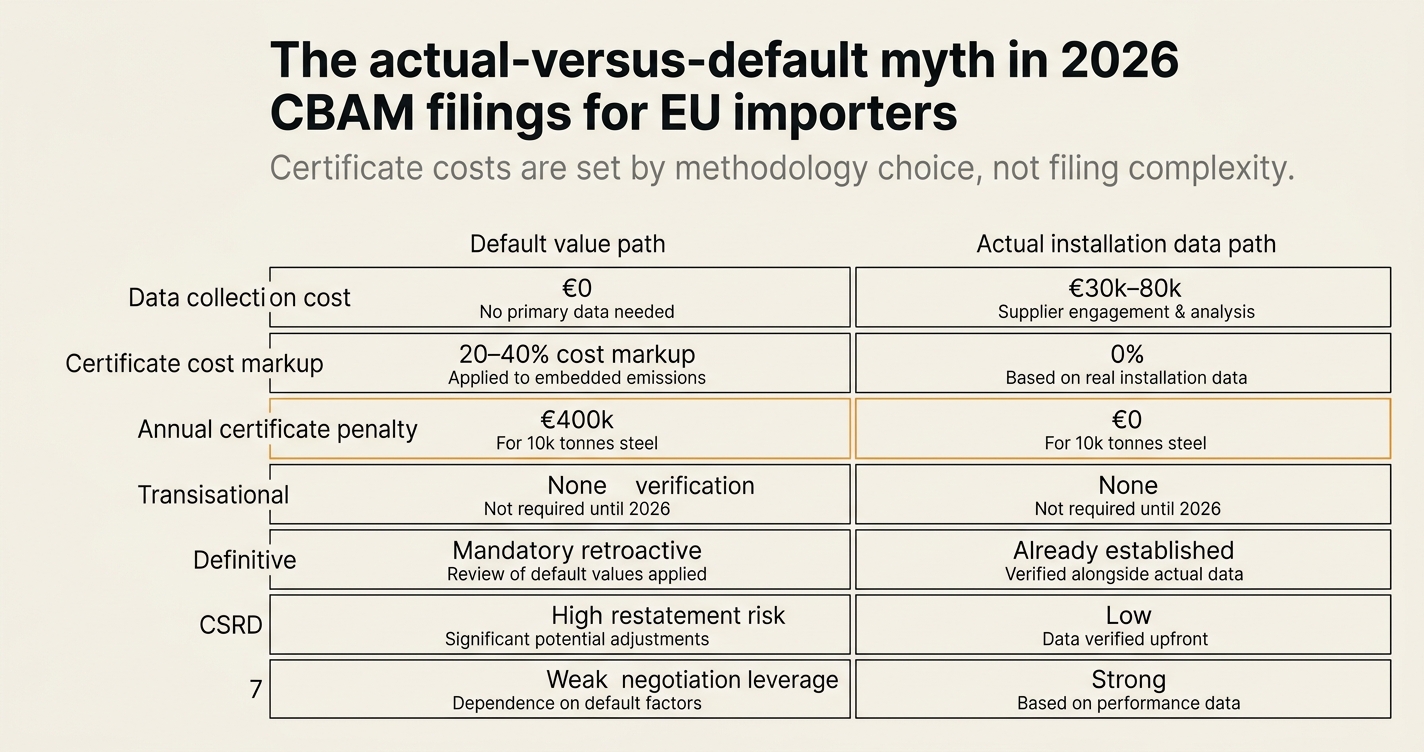
The shape of the argument, visualised below.
Myth 1: Default values simplify CBAM compliance for exporters
Reality: Default values eliminate data collection but replace it with a 20–40% emissions markup that flows directly to the EU importer's certificate cost. The European Commission's Implementing Regulation (EU) 2023/1773 specifies that default values "shall be representative of the emission intensity of the least efficient 10% of the Union producers" for each CBAM good category.[1] For Turkish steel exporters, this means a default value of approximately 2.3 tCO2e per tonne of hot-rolled coil, compared to a typical electric arc furnace actual value of 1.6–1.8 tCO2e per tonne. At a carbon price of €80 per tonne, the certificate cost penalty is €40–56 per tonne of steel shipped. Over a 10,000-tonne annual contract, that penalty compounds to €400,000–560,000, a cost the importer will increasingly negotiate back to the exporter as CBAM matures beyond the transitional phase.
Myth 2: Actual installation data requires complex third-party verification before first filing
Reality: The transitional phase (2026–2027) accepts installation-level data without mandatory independent verification, provided the methodology follows the EU's default calculation methods and emissions are traceable to source documents (utility bills, fuel invoices, production logs).[2] Independent verification becomes mandatory only when the definitive CBAM regime begins on 1 January 2026, at which point the regulation requires accredited verifiers to certify embedded emissions before certificate surrender. Exporters who wait until 2026 to begin primary data collection will face a compressed timeline: they must establish a documented methodology, collect 12 months of activity data, and complete third-party verification within a single calendar year to avoid default-value penalties in their first definitive filing. The operators who are ready in 2026 are those building installation inventories now, in the transitional window, when methodology errors are still correctable without certificate penalties.
Myth 3: EU importers can absorb certificate costs without passing them back to exporters
Reality: CBAM certificates are purchased by the EU importer (the "CBAM declarant") but priced by the exporter's embedded emissions. As the mechanism matures, commercial contracts are shifting certificate costs upstream. In practice, German steel importers are already renegotiating 2026 supply agreements to include CBAM cost pass-through clauses: if the exporter chooses default values, the resulting certificate markup becomes a price adjustment. For a 5,000-tonne quarterly shipment of aluminium ingots at 8 tCO2e per tonne actual versus 11 tCO2e per tonne default, the certificate cost difference at €75 per tonne is €1.125 million annually. That cost does not disappear—it flows to the party who chose the methodology. EU importers with multiple non-EU suppliers are treating actual installation data as a supplier selection criterion, not a compliance nicety.
Myth 4: Scope 3 Category 1 emissions for EU importers equal CBAM embedded emissions
Reality: CBAM embedded emissions and Scope 3 Category 1 emissions measure overlapping but not identical boundaries. CBAM covers direct emissions (Scope 1) and indirect emissions from electricity consumption (Scope 2) within the installation boundary where the CBAM good is produced, plus precursor materials (e.g., iron ore pellets for steel, alumina for aluminium) where specified.[1] Scope 3 Category 1 under the GHG Protocol includes all upstream emissions in the value chain: extraction, processing, transportation, and distribution of purchased goods. For a German automotive manufacturer importing Turkish steel, CBAM captures the steelmaker's Scope 1 and 2 emissions; Scope 3 Category 1 also includes the iron ore mine, the coking coal supply chain, and the shipping emissions from port to factory. ESRS E1 under the Corporate Sustainability Reporting Directive (CSRD) requires both: CBAM-aligned installation-level data for the goods themselves, and GHG Protocol-compliant Scope 3 totals across all 15 categories.[3] A common error is assuming CBAM compliance satisfies Scope 3 disclosure—it satisfies part of Category 1, nothing more.
Myth 5: Switching from default values to actual data mid-cycle has no reporting consequences
Reality: Changing from default to actual values between CBAM filings constitutes a methodology change that may trigger restatement obligations under ESRS 1, the cross-cutting standard governing CSRD disclosures. ESRS 1 paragraph 126 states that an undertaking must provide restated comparative figures when it has "redefined or replaced a metric or target" or "identified new information regarding estimated figures from the preceding period."[4] For an EU importer reporting under CSRD, a 2026 CBAM filing using default values followed by a 2027 filing using actual installation data creates a discontinuity: the 2026 base year must be restated to reflect the new methodology, or the 2027 trend is not comparable. This is not theoretical—under limited assurance, which begins for large EU companies' Wave 2 CSRD filings in 2026, auditors will test whether year-on-year emissions changes are due to operational improvements or methodological drift. Switching mid-cycle creates the second problem.
Myth 6: Primary data from suppliers automatically qualifies as installation-level data for CBAM
Reality: "Primary data" in GHG Protocol terminology means supplier-specific information, which can range from a supplier's own calculated emissions estimate (activity-based or spend-based) to installation-level measurements traceable to utility meters and production logs. CBAM requires the latter: emissions must be calculated using "actual emissions determined on the basis of primary data from the production process of the goods."[2] A supplier who provides a facility-average emissions factor (e.g., "2.1 tCO2e per tonne of aluminium") is giving primary data by Scope 3 standards but not necessarily installation-level data by CBAM standards unless that figure is supported by metered electricity consumption, fuel invoices, and production volumes for the specific installation where the CBAM good was produced. This distinction matters in verification: CBAM accredited verifiers are required to trace emissions to source documents, not accept supplier attestations. Exporters who collect supplier data without document-level evidence will fail verification in the definitive phase, even if the data is technically "primary."
Myth 7: CBAM readiness can be solved with carbon accounting software alone
Reality: CBAM compliance consists of two problems: emissions calculation and evidence lineage. Carbon accounting platforms solve the first by applying emission factors to activity data; they rarely solve the second. The EU's CBAM transitional registry requires the declarant to submit not only the embedded emissions figure but also the calculation methodology, the production process description, the emission factor sources, and (from 2026) the installation's geographic coordinates and operating permit reference.[1] For a Polish cement importer receiving clinker from Serbia, the submission must include the Serbian installation's electricity grid factor (location-based), the fuel mix (coal, natural gas, waste-derived fuel), the clinker-to-cement ratio, and the source documents for each input. Generic SaaS platforms that output emissions totals without document-first data ingestion leave the evidence gap unaddressed. The tools that work in 2026 are those that treat CBAM as a document assembly problem with a calculation layer, not the reverse.
Summary: Actual versus default—the cost structure
| Decision point | Default value path | Actual installation data path |
|---|---|---|
| Data collection cost | €0 (no supplier engagement) | €30,000–80,000 (utility bills, production logs, methodology documentation) |
| Certificate cost markup | 20–40% above actual emissions | 0% markup (actual emissions) |
| Annual certificate cost penalty (10,000 tonnes steel, 2.3 vs 1.8 tCO2e, €80/tonne) | €400,000 | €0 |
| Verification requirement (transitional phase) | None | None (methodology must follow EU defaults) |
| Verification requirement (definitive phase, 2026+) | Mandatory (must then collect primary data retroactively) | Mandatory (methodology already established) |
| CSRD restatement risk | High (methodology switch between years) | Low (consistent methodology from base year) |
| Supplier negotiation leverage | Weak (importer bears penalty) | Strong (exporter demonstrates lower cost) |
"Default values shall be representative of the emission intensity of the least efficient 10% of the Union producers." — Commission Implementing Regulation (EU) 2023/1773, Article 7(2)[1]
How Emission3 fits
Emission3 is built for the actual-installation-data path. We treat CBAM as a document-first problem: import utility bills, fuel invoices, and production logs; extract installation-level activity data with a deterministic LLM layer; apply EU-compliant emission factors with full lineage; and export submission-ready CBAM reports with evidence packs that survive verification. The output is not a CSV of emissions totals—it is a structured evidence package that maps every reported tonne back to the source document, the calculation step, and the regulatory reference.
Our CBAM workflow is designed for non-EU exporters and EU importers working together. Upload the installation's Q1 utility bills in January; we extract metered electricity consumption, apply the national grid factor, and document the calculation. Upload Q2 fuel invoices in April; we identify the fuel type (natural gas, coal, biomass), apply the relevant emission factors from Annex VIII of the CBAM Implementing Regulation, and show the lineage. By June, before the first transitional filing window closes in July, you have a complete installation inventory traceable to source documents, not a default-value penalty.
We start every customer relationship with a CBAM readiness conversation: map the suppliers, identify the gaps in primary data coverage, and define the implementation timeline. No anonymous self-serve onboarding, no generic questionnaires. The work is productised—document ingestion, calculation, evidence lineage, and submission outputs are standardised—but the scoping conversation is specific to your supplier base, your goods categories, and your importer's CSRD obligations. If you are an EU importer negotiating CBAM costs with Turkish steel suppliers or a Serbian cement exporter facing default-value penalties, this is the conversation.
Start with a CBAM readiness call
If you are an EU importer sourcing steel, aluminium, cement, fertiliser, or electricity from non-EU suppliers, or a non-EU exporter facing default-value markups in your 2026 filings, the cost of inaction is measurable: it is the certificate penalty multiplied by annual shipment volumes. The cost of action is a three-month document collection exercise that establishes installation-level data before the first definitive filing window.
We help exporters and EU importers become CBAM-ready in weeks, using the compliance infrastructure we already built. Book a CBAM readiness call: we will map your suppliers, quantify the certificate cost gap between actual and default values, and outline the implementation path.[5] The operators who are ready in 2026 are those who started in Q1. If you are starting in Q2, you still have time—but the window is closing.
[1] European Commission Implementing Regulation (EU) 2023/1773 specifies that default values "shall be representative of the emission intensity of the least efficient 10% of the Union producers" for each CBAM good category, creating a systematic markup over typical actual installation emissions.
[2] The GHG Protocol underwent a significant update process in 2025–2026, with the Scope 3 Standard receiving its first refresh since 2011 and the Scope 2 guidance consultation closing January 31, 2026, tightening expectations on data quality and supplier-specific evidence.
[3] ESRS E1 under CSRD requires disclosure of Scope 1, Scope 2 (both location-based and market-based), and Scope 3 emissions split by significant category, with limited assurance beginning for Wave 2 filings in 2026 and reasonable assurance required by 2028.
[4] ESRS 1 paragraph 126 requires restated comparative figures when an undertaking has "redefined or replaced a metric or target" or "identified new information regarding estimated figures from the preceding period," a provision that catches methodology switches between default and actual CBAM data.
[5] Book a CBAM readiness call with Emission3 to map suppliers, quantify the certificate cost gap between actual and default values, and define the implementation timeline before the first definitive CBAM filing window.
[6] Emission3's reporting and filings product generates CSRD, CBAM, and California SB 253 disclosures with full document lineage, designed for limited-to-reasonable assurance transitions.
[7] The default-value penalty in 2026 CBAM filings for non-EU steel exporters explores how certificate cost is set by the markup between actual and default emissions, a commercial negotiation point with EU importers.
[8] ESRS E1 Climate change reporting requires GHG emissions calculated using the GHG Protocol, with organisational boundaries defined by financial control, operational control, or equity share approaches as of the 2026 standard revisions.
References & Sources
External Sources
- [1]Commission Implementing Regulation (EU) 2023/1773 — CBAM default values and calculation methodology
Specifies that CBAM default values shall represent the emission intensity of the least efficient 10% of EU producers, creating a systematic markup over actual installation emissions for non-EU exporters who do not submit primary data.
- [2]GHG Protocol Updates 2026: Scope 2 & Scope 3 Accounting Guide
Details the 2025–2026 GHG Protocol update process, including the first Scope 3 refresh since 2011 and tightened expectations on supplier-specific data quality, with a second Scope 2 consultation expected mid-2026 and final standards by late 2027.
- [3]ESRS E1 Climate change — Greenhouse gas emissions metrics and disclosure requirements
ESRS E1 requires separate disclosure of Scope 1, Scope 2 (location-based and market-based), and Scope 3 emissions by significant category, with limited assurance beginning for Wave 2 CSRD filings in 2026 and reasonable assurance required by 2028.
- [4]ESRS (2026) — revised standards and restatement obligations under ESRS 1
ESRS 1 paragraph 126 requires restated comparative figures when an undertaking has redefined or replaced a metric, a provision that applies when switching CBAM methodology from default values to actual installation data between reporting periods.
- [8]ESRS E1: Understanding the Climate Reporting Standard in the CSRD
ESRS E1 requires GHG emissions calculated using the GHG Protocol, with organisational boundaries defined by financial control, operational control, or equity share approaches as clarified in the 2026 standard revisions.
Related Content
- [5]Book a CBAM readiness call
All customers start with a readiness call: we map suppliers, quantify the certificate cost gap between actual and default values, and define the implementation timeline. No anonymous self-serve onboarding.
- [6]Reporting & filings — CBAM, CSRD, and SB 253 submission outputs
Generate CBAM transitional and definitive filings, CSRD ESRS E1 disclosures, and California SB 253 reports with full document lineage and evidence packs that survive limited-to-reasonable assurance.
- [7]The default-value penalty in 2026 CBAM filings for non-EU steel exporters
CBAM filings consist of actual emissions and default values. Exporters assume defaults avoid data collection—but 2026 certificate cost is set by the markup, a commercial negotiation point with EU importers.