The default-value penalty in 2026 CBAM filings for non-EU steel exporters
The default-value penalty in 2026 CBAM filings for non-EU steel exporters
Here's the issue: non-EU steel exporters shipping to the European Union in 2026 face a choice between documenting actual installation-level emissions or allowing their EU importer to rely on default values published by the European Commission. At first glance, defaults look convenient—no monitoring plan, no verification audit, no capital outlay for metering infrastructure. But the apparent administrative savings mask a structural cost penalty that compounds every quarter.
However, a Carbon Border Adjustment Mechanism filing consists of two things: the embedded emissions figure itself, and the data provenance that determines whether a markup applies. Exporters budget for the first—the tonne-by-tonne carbon intensity—but the second is what sets the actual certificate cost per tonne shipped.
The emissions figure on its own has no value to the EU buyer. The data provenance—whether the number comes from verified actuals or conservative country-level defaults—is what the CBAM declarant is actually paying for. Verified actuals eliminate the markup entirely. Default values carry a 10% markup in 2026, rising to 20% in 2027 and 30% from 2028 onward [1].
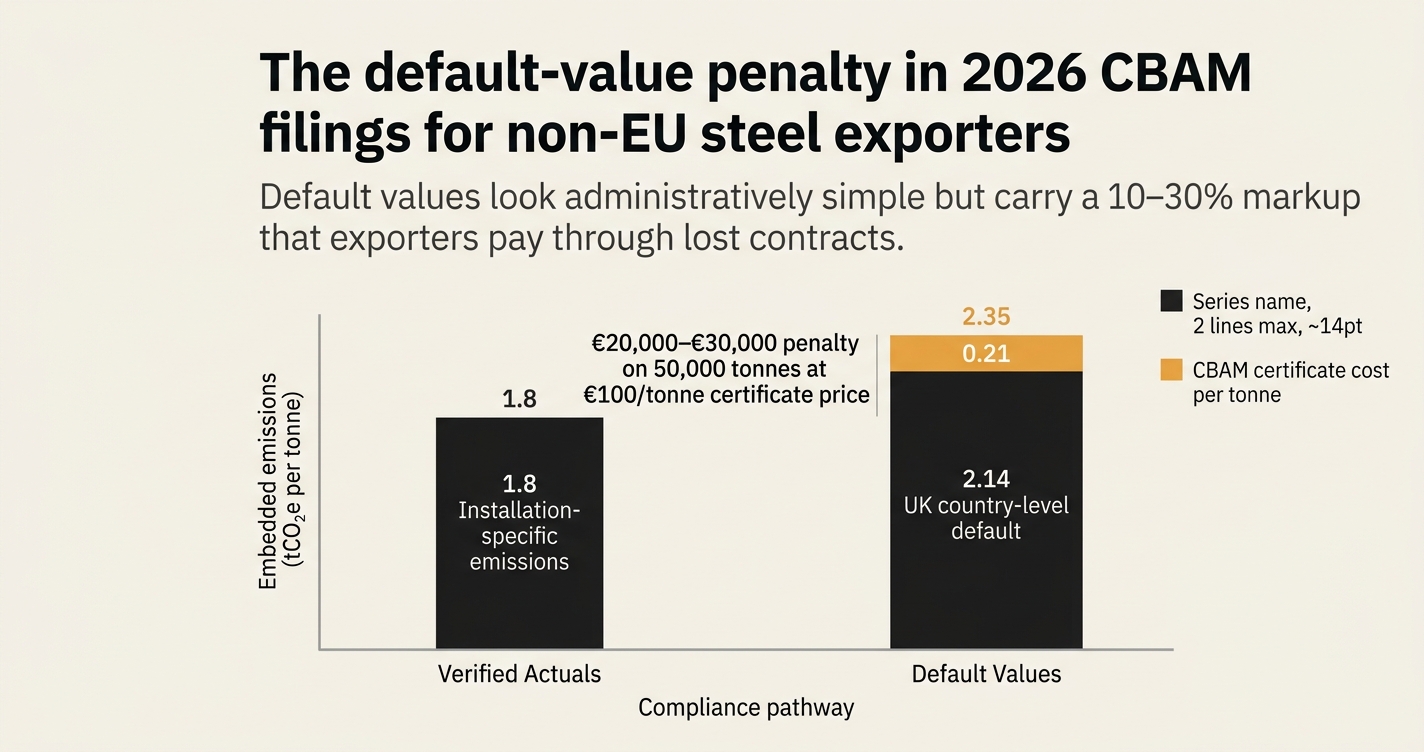
While the cost of collecting actual data has become more visible—monitoring plans, quarterly documentation, third-party verification—the cost of relying on defaults has become more expensive in absolute terms. If a UK steel exporter ships 50,000 tonnes of basic oxygen furnace steel to the EU in 2026, the difference between verified actuals (approximately 1.8 tCO₂e per tonne) and UK default values (2.14 tCO₂e per tonne, plus 10% markup) could add €20,000–€30,000 to the importer's CBAM liability at a €100 per tonne certificate price [2]. That cost does not stay with the importer—it flows back to the exporter as a pricing adjustment or a lost contract.
How do you solve this? I think the operators who will retain EU market access in 2027 and beyond are those who treat 2026 as a documentation build-out year, not a reporting deferral year. The verification infrastructure is only now coming online—accredited CBAM verifiers are not expected to operate at scale before September 2026—but the emissions monitoring must start immediately. For now, exporters who document installation-level production records, fuel consumption, and electricity metering throughout 2026 can undergo pre-verification before the first annual declaration is due on 30 September 2027, positioning themselves to avoid the default-value markup from day one of the definitive regime.
The shape of the argument, visualised below.
The two paths: actual emissions vs default values
Every non-EU steel exporter shipping CBAM-covered goods to the European Union must choose between two compliance paths. The table below compares them across cost, data requirements, verification burden, importer preference, and long-term viability.
| Criterion | Verified Actual Emissions | Default Values |
|---|---|---|
| Certificate cost per tonne (2026) | Based on installation-specific intensity, no markup | Country-level default + 10% markup [1] |
| Certificate cost per tonne (2028+) | Based on installation-specific intensity, no markup | Country-level default + 30% markup [1] |
| Data collection burden | Continuous: monitoring plan, quarterly documentation, meter calibration certificates | None: EU Commission publishes values by country and production route |
| Verification requirement | Mandatory third-party verification by accredited verifier, first audit covers calendar year 2026 [3] | No verification required |
| Importer preference | Strongly preferred: eliminates markup, reduces CBAM liability, improves contract pricing | Tolerated in 2026, increasingly expensive thereafter |
| Operational transparency | High: reveals process inefficiencies, supports decarbonisation roadmap [8] | None: no visibility into actual installation performance |
| Competitive positioning | Locks in price advantage vs competitors using defaults | Cedes pricing power to EU buyers, who will source from lower-cost suppliers |
| Long-term viability | Sustainable: markup-free structure survives ETS price increases | Unsustainable: 30% markup from 2028 makes high-volume exports uncompetitive |
Scoring the two paths against exporter success criteria
The decision matrix below scores each path against five criteria that determine whether a non-EU steel exporter retains EU market share in 2027 and beyond.
1. Certificate cost per tonne shipped
Verified actuals: 9/10. Installation-specific data typically shows 15–30% lower emissions than country-level defaults for modern producers. A UK blast furnace-basic oxygen furnace (BF-BOF) route exporter reporting 1.8 tCO₂e per tonne of crude steel pays certificates on that figure. The UK default is 2.14 tCO₂e per tonne, plus 10% markup in 2026, yielding 2.35 tCO₂e—a 30% cost difference [2].
Default values: 3/10. The markup is the structural problem. Even if the country-level default happens to match the installation's actual intensity, the 10–30% markup inflates the liability. For high-volume exporters, the cumulative penalty across 50,000 or 100,000 tonnes shipped becomes a six-figure line item that EU buyers will not absorb.
2. EU buyer contract renewal likelihood
Verified actuals: 10/10. EU importers are CBAM declarants—they are legally liable for purchasing and surrendering certificates. An exporter who provides verified actual emissions data reduces the importer's certificate cost, removes regulatory uncertainty, and demonstrates supply chain maturity. Contracts renew because the total landed cost (product price + CBAM liability) remains competitive.
Default values: 4/10. In 2026, some EU buyers will tolerate defaults because verification capacity is still ramping up. By 2027, when accredited verifiers are operating at scale and the markup rises to 20%, buyers will source from suppliers who can document actuals. The exporter who relies on defaults in 2026 trains their buyer to evaluate alternatives.
3. Data collection and verification cost
Verified actuals: 6/10. The up-front cost is real. Exporters must implement a monitoring plan that tracks emissions at installation level, allocate emissions to production processes, and attribute emissions to individual goods [7]. Verification audits—including on-site installation reviews—add professional fees and internal coordination overhead. However, the data infrastructure built in 2026 serves every subsequent reporting cycle, and the marginal cost per tonne declines as production volume scales.
Default values: 8/10. No data collection cost, no verification fees, no internal staff time spent on documentation. The administrative simplicity is the entire value proposition. But simplicity is not the same as affordability when the markup penalty exceeds the avoided data collection cost.
4. Operational insight and decarbonisation planning
Verified actuals: 9/10. Monitoring installation-level emissions provides visibility into process inefficiencies that would otherwise remain hidden. An Indian steel mill tracking electricity consumption per tonne of output can identify furnace inefficiencies, optimise production scheduling, and justify capital investment in lower-emission technology. The CBAM compliance engine becomes a continuous improvement input [8].
Default values: 2/10. No operational feedback, no process-level insight, no data foundation for decarbonisation planning. The exporter knows their country-level average emissions, which is useful for benchmarking but cannot guide installation-specific investments.
5. Regulatory durability through 2030
Verified actuals: 10/10. The verified-actuals pathway is the compliance structure the European Union designed for the long term. The markup on defaults is not a transitional incentive—it is permanent policy architecture intended to push all exporters toward installation-level monitoring. Exporters who build verification-ready data systems in 2026 are positioned for every subsequent tightening of CBAM rules.
Default values: 3/10. The 30% markup from 2028 onward makes default values financially nonviable for any exporter shipping material volume. Worse, the European Commission has revised default benchmarks downward in late 2025, which raises CBAM exposure for most products [3]. An exporter who defers data collection in 2026 will face both higher certificate costs and a steeper learning curve when they eventually must implement monitoring.
The verdict: verified actuals win on every dimension that matters after 2026
For non-EU steel exporters, the choice between actual emissions data and default values is not a trade-off between accuracy and convenience. It is a trade-off between a one-time data infrastructure investment and a permanent, escalating cost penalty that EU buyers will not absorb.
The math is unambiguous. A Turkish steel exporter shipping 100,000 tonnes per year to the EU at a certificate price of €100 per tonne faces a €200,000–€300,000 annual markup penalty if they rely on defaults in 2026, rising to €600,000–€900,000 by 2028 [1]. The cost of implementing a monitoring plan, quarterly documentation, and third-party verification is a fraction of that penalty—and it is a one-time cost that scales efficiently across future reporting cycles.
The timing constraint is equally clear. Accredited CBAM verifiers are not expected to be operating at scale before September 2026, and verification of an installation's 2026 emissions cannot be completed before the first annual declaration is due on 30 September 2027 [2]. Exporters who start monitoring now can undergo pre-verification in late 2026 or early 2027, ensuring their data is audit-ready when the first declaration cycle opens. Exporters who defer until mid-2026 will default to conservative country-level values for the entire 2026 reporting year, locking in the markup for twelve months of shipments.
The competitive dynamic is the final consideration. EU buyers are not indifferent between suppliers who provide verified actuals and suppliers who rely on defaults. The CBAM declarant—the EU importer—pays the certificate cost, and they will source from the supplier whose total landed cost (product price + CBAM liability) is lowest. An Indian steel exporter competing with a Turkish exporter for the same EU buyer will lose the contract if their reliance on defaults adds 20–30% to the buyer's certificate cost, even if their quoted steel price is slightly lower.
"Default benchmarks are set by country, production route of the goods and CN code. The default value benchmarks are lower than earlier drafts, raising CBAM exposure for most products covered by CBAM." [3]
The structural message from the European Commission is unambiguous: defaults are a fallback for 2026, not a viable long-term strategy. The markup is a policy lever designed to make actual data collection financially rational. Exporters who treat 2026 as a documentation build-out year—rather than a reporting deferral year—will retain EU market access. Exporters who rely on defaults will cede contracts to competitors who invested in verification infrastructure.
How Emission3 fits
Emission3 is built for non-EU exporters who need to document installation-level embedded emissions at the line-item level, not aggregate totals. Our document-first ingestion layer turns invoices, bills of materials, utility bills, and production logs into audit-grade evidence packs that CBAM verifiers can review without additional translation or reformatting.
The deterministic LLM layer extracts emissions-relevant data—fuel type, electricity consumption, production process allocation—and links every number to the source document that justifies it. That linkage is what verifiers require: not a spreadsheet with embedded emissions per tonne, but a reproducible calculation with full lineage from raw measurement to reported figure.
Our CBAM-specific output layer generates the data structures EU importers need to file declarations: installation-level emissions by production process, precursor emissions attribution, and CN-code-level embedded emissions totals. The evidence pack exports as a PDF that includes source documents, calculation lineage, and verification-ready documentation in the format accredited verifiers expect.
For a UK steel exporter shipping 50,000 tonnes per year to the EU, the difference between verified actuals and default values is €20,000–€30,000 in CBAM certificate cost in 2026 alone [2]. Emission3's implementation is scoped to close that gap in weeks, not quarters, using the compliance infrastructure we already built for California SB 253 limited-to-reasonable assurance transitions and EU CSRD ESRS E1 disclosure.
Start with a CBAM readiness conversation
If you are a non-EU steel, aluminium, cement, or fertilizer exporter facing CBAM obligations in 2026, the first step is not software evaluation—it is a readiness conversation. We map your supplier data landscape, identify the gaps between what you have and what verifiers require, and scope an implementation that positions you to file with verified actuals in the first declaration cycle.
Every Emission3 customer starts with a workflow-review call. We do not offer anonymous self-serve onboarding because CBAM compliance is installation-specific, and the data infrastructure you need depends on your production route, your existing metering systems, and your EU buyers' declaration timelines. Book a CBAM readiness call at /book-demo [5], and we will walk through your 2026 monitoring plan, verification timing, and the documentation your importer needs to avoid the default-value markup.
References & Sources
External Sources
- [1]EU CBAM 2026: How to calculate your liability
Explains the markup structure on default values: 10% in 2026, 20% in 2027, 30% from 2028 onward, and the financial exposure for exporters relying on country-level defaults.
- [2]EU CBAM for Steel Exports: Track Embedded Carbon & Ensure Compliance
Provides worked examples of CBAM certificate cost for UK steel exporters comparing verified actuals (1.8 tCO₂e per tonne) to UK defaults (2.14 tCO₂e per tonne) and the financial impact on 50,000 tonne shipments.
- [3]CBAM | Your Guide to the EU Carbon Border Adjustment Mechanism
Details the revised default benchmark values published in late 2025, verification requirements for actual data, and the timing of the first verification cycle covering calendar year 2026.
- [4]EU CBAM Emissions Data: Monitoring, Reporting & Verification
Describes the monitoring, reporting, and verification standards for actual emissions data under CBAM, including the top-down approach from installation-level monitoring to goods-specific embedded emissions.
- [7]How the EU's New Default Emissions Values Under CBAM Impact US Exporters
Explains the requirement for producers to monitor emissions at each installation, allocate emissions to production processes, and attribute emissions to individual goods to avoid default values.
- [8]CBAM Verification: Carbon Border Adjustment Mechanism
Discusses how reporting actual emissions provides operational visibility, identifies inefficiencies, and drives decarbonisation opportunities that improve productivity and cost efficiency.
Related Content
- [5]Book a CBAM readiness call
All Emission3 customers start with a readiness call: we map suppliers, gaps, and implementation. No anonymous self-serve onboarding.
- [6]How Emission3 handles CBAM
Specific to CBAM exporters, shows the installation-data flow from raw documents to registry-ready declarations with full audit lineage.