The verification-timing gap in 2026 CBAM actual-emissions filing for non-EU installations
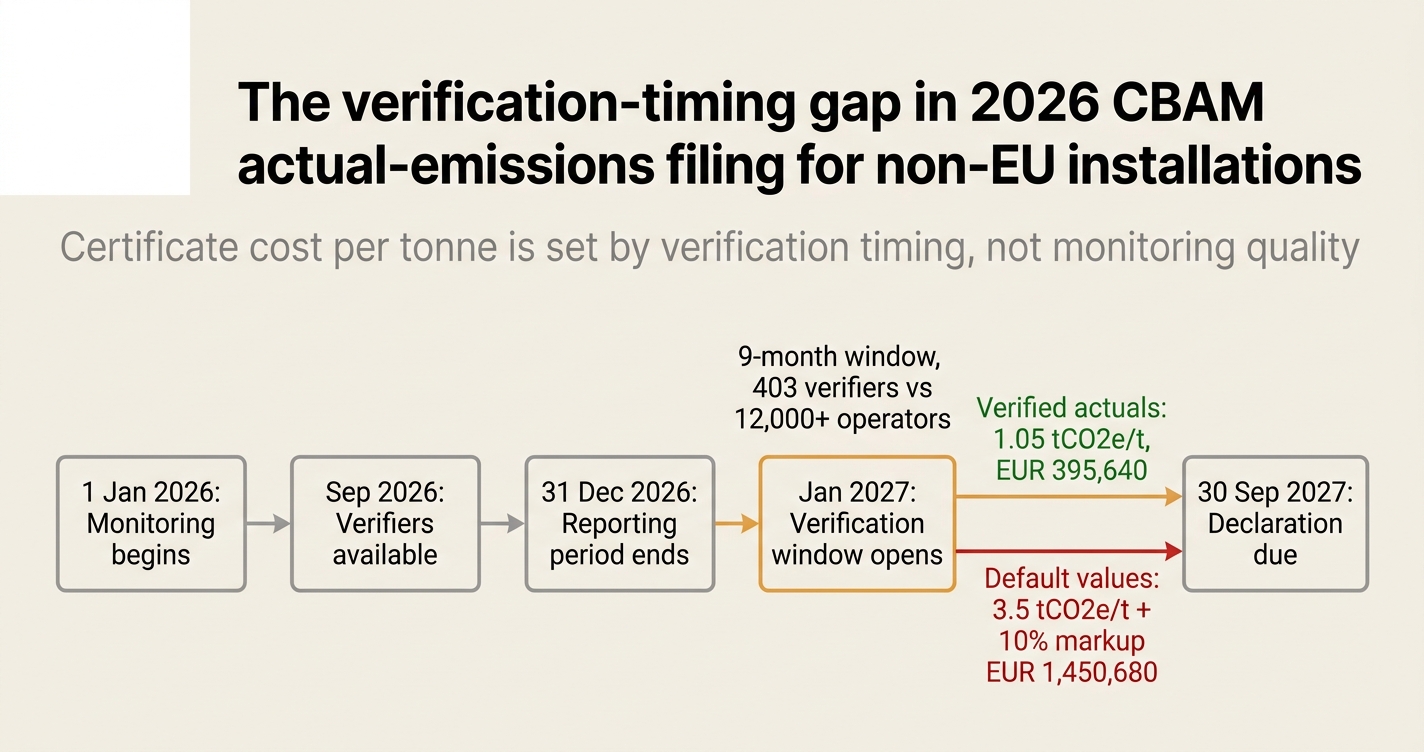
The verification-timing gap in 2026 CBAM actual-emissions filing for non-EU installations
Here's the issue: non-EU exporters entering the Carbon Border Adjustment Mechanism definitive period in 2026 face a scheduling problem that directly inflates their EU buyers' certificate costs. Accredited CBAM verifiers are not expected to be operating before around September 2026, and verification of an installation's actual 2026 emissions cannot be completed before the first annual CBAM declaration is due on 30 September 2027.[1] Most exporters assume that beginning emissions monitoring in January 2026 puts them on track for verified actual values in their buyers' first declarations—but the verification infrastructure timeline makes that assumption incorrect.
However, CBAM filing consists of two things: verification timing and default-value exposure. Verification timing is the window between the end of the reporting period (31 December 2026) and the declaration deadline (30 September 2027). Default-value exposure is the financial penalty applied when verified actual data is unavailable: a 10% markup on certificate cost in 2026, rising to 20% in 2027 and 30% from 2028 onward, per Implementing Regulation (EU) 2025/2621.[2]
Verification timing on its own has no value. Default-value exposure is what the EU importer is actually paying for. If an exporter misses the verification window—or if verification capacity is unavailable in their region—the importer must fall back to default values, which overstate emissions for most modern producers and carry the markup penalty. While the exporter may have monitored emissions perfectly, the buyer's certificate cost is determined by whether a verification report exists by the declaration deadline.
While verification readiness has become more accessible—national accreditation bodies began CBAM accreditation in April 2026, and accredited verifiers can register in the CBAM Registry from September 2026—verification capacity has become more scarce. Only 403 accredited verifiers are registered in the Union Registry as of early 2026, against 4,100 CBAM declarants authorized and nearly 12,000 economic operators awaiting authorization.[3] If an exporter sources from multiple installations or operates in a region with limited verifier coverage, the cost of securing timely verification might outpace the savings from avoiding default values—especially if the exporter's actual emissions are only marginally below the country default.
How do you solve this? I think the operators we work with start by quantifying the default-value penalty in their buyers' declarations, then work backward to determine whether verification capacity exists in their region before the 2027 deadline. For installations where actual emissions are 20-30% below the country default, the certificate-cost delta justifies early verifier engagement—ideally in Q1-Q2 2026 to conduct gap assessments and approve monitoring plans before the year-end rush.[4] For installations closer to the default benchmark, the cost-benefit calculation tilts toward accepting the 10% markup in 2026 and targeting verified actuals for 2027, when verification capacity is expected to stabilize.
The shape of the argument, visualised below.
The statutory verification timeline
Article 8 of the CBAM Regulation requires that actual emissions used in a CBAM declaration must be verified by a verifier accredited by an EU national accreditation body. Verification is done per installation and includes a site visit. The verifier issues one verification report per installation that the producer can share with its buyers.[5] Verification reports for 2026 can be issued in an electronic EU template from January 2027 via the CBAM Registry—but only after the calendar year is complete.
For an exporter shipping goods in 2026, this creates a hard timeline:
| Milestone | Date | Constraint |
|---|---|---|
| Emissions monitoring begins | 1 January 2026 | Installation must follow approved monitoring plan per IR 2025/2547 |
| Accredited verifiers available | September 2026 | National accreditation bodies began CBAM accreditation April 2026; verifiers register from September[1] |
| Reporting period ends | 31 December 2026 | Full calendar year of data required for 2026 declaration |
| Verification window opens | January 2027 | Verifiers can issue reports via CBAM Registry[5] |
| First annual declaration due | 30 September 2027 | EU importer must submit declaration with either verified actuals or default values[2] |
The gap is visible: verification for 2026 emissions cannot begin until January 2027, leaving a nine-month window to complete site visits, evidence testing, corrective actions, and final opinion before the September deadline. For installations in regions with limited verifier capacity—India, Turkey, North Africa, Southeast Asia—this window is effectively shorter, because verifiers with accreditation from EU bodies may not have local presence or may be fully booked.
"It is also worth being realistic about timing for the first declaration cycle. Accredited CBAM verifiers are not expected to be operating before around September 2026, and verification of an installation's actual 2026 emissions cannot be completed before the first annual CBAM declaration is due on 30 September 2027. Exporters should start monitoring and documenting emissions now so they are ready as verification capacity comes online—but should plan their 2026/27 financial exposure on the assumption that default values may still apply for at least this first cycle."[1]
The default-value penalty
When verified actual data is unavailable, the EU declarant must use the Commission's default values set in Implementing Regulation (EU) 2025/2621, as corrected by Implementing Regulation (EU) 2026/1740.[2] Default values are not installation-specific—they represent country-level average intensity for a given production route. A UK steel mill running efficient blast furnace-basic oxygen furnace (BF-BOF) processes will almost certainly have lower actual embedded emissions than the default assigned to UK steel production as a whole.
Default values carry two penalties:
- Overstated emissions: Default values are set at country-level average intensity. For most modern installations, actual emissions are 20-40% below the default, depending on the production route and energy mix.
- Financial markup: Under IR 2025/2621, importers using default values pay a markup on top of the certificate cost: 10% in 2026, rising to 20% in 2027, and 30% from 2028 onward. Verified actual data eliminates the markup entirely.[2]
Consider a 10,000-tonne shipment of blast furnace steel from a high-emitting country. Using default values at 3.5 tCO2e per tonne and an EUA price of EUR 80, the CBAM cost is EUR 1.7 million in 2026 before the markup. The same tonnage with verified actual data at 1.9 tCO2e per tonne reduces the base cost to under EUR 450,000.[6] The delta is EUR 1.25 million—but only if the exporter can secure verification by September 2027.
For installations where actual emissions are close to the country default—say, within 10-15%—the certificate-cost savings may not justify the cost and complexity of verification in the first cycle, especially if verifier capacity is constrained. The 10% markup in 2026 might be less expensive than expedited verification fees or the risk of a failed verification opinion.
The verifier capacity constraint
The verification bottleneck is not regulatory—it is operational. As of early 2026, only 403 accredited verifiers are registered in the Union Registry, against 4,100 CBAM declarants authorized and nearly 12,000 economic operators with pending applications.[3] Each declarant may source goods from multiple installations abroad, so the actual number of installations requiring verification is significantly higher.
Verification is not a desktop review. The verifier must:
- Conduct a site visit to the installation.
- Review the monitoring plan for compliance with IR 2025/2547.
- Test activity data, emission factors, and calculation methodology.
- Assess precursor emissions (if applicable) and production route allocations.
- Issue corrective actions for any material misstatements or non-conformities.
- Deliver a final verification opinion and report.[4]
Typical verification duration is 4-8 weeks, depending on installation complexity, data quality, number of production processes, and the verifier's workload.[4] For installations with weak meter controls, missing precursor data, or unsupported emission factors, the timeline extends further as corrective actions must be completed before the verifier can issue a positive opinion.
Verifiers cannot issue a positive statement if material misstatements remain uncorrected. The installation must address identified issues, conduct corrective actions, and undergo re-verification—all within the nine-month window between January and September 2027.[4] For exporters in India, Turkey, or Southeast Asia, where local verifier presence is limited, this constraint is binding.
The cost-benefit calculation
The decision to pursue verified actual values in 2026 is not binary—it is a cost-benefit trade-off that depends on the gap between actual and default emissions, the availability of local verifier capacity, and the exporter's ability to deliver CBAM-compliant data.
A worked example: UK steel exporter, BF-BOF route, 5,000 tonnes shipped in 2026.
| Scenario | Embedded emissions (tCO2e/t) | Total emissions (tCO2e) | Gross certificate cost (EUR 75.36/tCO2e) | Default markup | Adjusted cost |
|---|---|---|---|---|---|
| Default values | 3.5 (country average) | 17,500 | EUR 1,318,800 | 10% (EUR 131,880) | EUR 1,450,680 |
| Actual values (verified) | 1.05 (installation-specific) | 5,250 | EUR 395,640 | None | EUR 395,640 |
| Delta | -2.45 tCO2e/t | -12,250 tCO2e | -EUR 923,160 | -EUR 131,880 | -EUR 1,055,040 |
The certificate-cost savings are EUR 1.05 million—but only if the exporter can secure verification by September 2027. If verification capacity is unavailable, or if the installation's monitoring plan is rejected by the verifier in Q2 2027, the exporter loses the window, and the buyer pays the default-value cost.
For installations where actual emissions are closer to the default—say, 3.0 tCO2e/t against a 3.5 default—the delta shrinks to EUR 377,000 before the markup. If verification fees are EUR 20,000-40,000 and the exporter faces expedited timeline pressure, the cost-benefit calculation may favor accepting the 10% markup in 2026 and targeting verified actuals for 2027, when verifier capacity is expected to stabilize.
The 2026 readiness checklist
Exporters pursuing verified actual values for the 2026 reporting period should begin verifier engagement in Q1-Q2 2026, before the year-end rush. The checklist:
- Quantify the default-value penalty: Calculate the certificate cost for your buyers using country default values, then recalculate using estimated actual emissions. The delta is your maximum verification budget.
- Engage verifiers early: Contact accredited verifiers in Q1-Q2 2026 to conduct gap assessments, approve your monitoring plan, and establish reporting processes. Verifiers with local presence in your region book out quickly.
- Define system boundaries: Confirm which production processes, precursor emissions, and energy inputs are included in your installation's embedded emissions calculation. Missing precursor data is a common verification failure.[7]
- Establish meter controls: Ensure all activity data (fuel consumption, electricity use, raw material inputs) is metered, recorded, and traceable. Weak meter controls are a red flag for verifiers.[7]
- Document emission factors: Source emission factors from credible references (IPCC, national inventories, equipment specifications) and document the rationale for each factor used. Unsupported factors are non-compliant.[7]
- Plan for corrective actions: Budget time for corrective actions if the verifier identifies material misstatements. Re-verification can add 2-4 weeks to the timeline.[4]
- Register in the O3CI portal: The Operator Communication Interface (O3CI) is part of the CBAM Registry and enables you to provide emissions data directly to your EU buyers, with verification status displayed in the portal. Registration is voluntary but reduces manual data entry and transmission errors.[5]
How Emission3 fits
Emission3 is built for exporters preparing verified actual values in 2026. We ingest raw documents—utility bills, fuel invoices, bills of materials, production logs—and convert them into line-item evidence that meets CBAM monitoring requirements per IR 2025/2547. Every calculation is deterministic: embedded emissions totals trace back to source documents, with full lineage for verifier review.
Our CBAM workflow includes:
- Document ingestion: utility bills, fuel invoices, BoMs, production logs → line-item evidence.
- Monitoring plan alignment: system boundaries, production routes, precursor allocations configured to match your approved plan.
- Emission factor documentation: every factor is sourced from credible references (IPCC, national inventories, equipment specs) and linked to the calculation.
- Verification evidence packs: for each installation, we export a full evidence pack—activity data, emission factors, calculation lineage, and supporting documents—that the verifier can audit without reprocessing.
- Registry-ready outputs: emissions data formatted for O3CI portal submission or direct transmission to EU buyers.[8]
We work with non-EU exporters who need installation-level data that survives verification, not estimates. If your actual emissions are materially below your country default and you want to avoid the markup penalty, we can map your suppliers, identify gaps, and build the evidence base in Q1-Q2 2026—before the verification window opens.
Book a CBAM readiness call
If you are a non-EU exporter shipping goods subject to CBAM in 2026, the verification-timing gap is binding. Default values carry a 10% markup in 2026, rising to 20% in 2027 and 30% from 2028 onward. The delta between default and actual emissions is your maximum verification budget—but only if you can secure verifier capacity before the September 2027 deadline.
All Emission3 customers start with a CBAM readiness call. We map your installations, quantify the default-value penalty, and determine whether verified actuals are achievable in the 2026 cycle. If you need installation-level data that meets IR 2025/2547 and survives verification, book a call: /book-demo.[9]
[1] EU CBAM 2026: How to calculate your liability
[2] CBAM for US Exporters: EU Carbon Border Rules in 2026
[3] Guest Post: Whose CBAM is it anyway? Of Default Values and Accreditation
[4] EU CBAM Verifiers: Complete Guide and Checklist for Indian Exporters (2026 Ready)
[5] DEHSt - CBAM Definitive Regime from 2026
[6] CBAM | Your Guide to the EU Carbon Border Adjustment Mechanism
[7] CBAM Actual Values: Preparing Compliant Data and Obtaining Verification
References & Sources
External Sources
- [1]EU CBAM 2026: How to calculate your liability
Analysis of verification timing constraints for the 2026 reporting cycle, explaining why default values may still apply for the first declaration despite monitoring readiness.
- [2]CBAM for US Exporters: EU Carbon Border Rules in 2026
Breakdown of default values, verification requirements, and the financial markup applied when verified actual data is unavailable.
- [3]Guest Post: Whose CBAM is it anyway? Of Default Values and Accreditation
Data on the verifier capacity constraint: 403 accredited verifiers registered against 4,100 CBAM declarants and 12,000 pending operator applications.
- [4]EU CBAM Verifiers: Complete Guide and Checklist for Indian Exporters (2026 Ready)
Practical guidance on verification duration, engagement timing, corrective actions, and readiness checklist for exporters.
- [5]DEHSt - CBAM Definitive Regime from 2026
Official guidance on verification requirements, including the O3CI portal for operator data submission and verification report issuance timeline.
- [6]CBAM | Your Guide to the EU Carbon Border Adjustment Mechanism
Worked example of CBAM cost scenarios comparing default values versus verified actual emissions for a 10,000-tonne steel shipment.
- [7]CBAM Actual Values: Preparing Compliant Data and Obtaining Verification
Webinar breakdown of common verification pitfalls: missing precursor data, weak meter controls, unsupported emission factors, and how to prepare CBAM-compliant data.
Related Content
- [8]How Emission3 handles CBAM
Specific to CBAM exporters, shows the installation-data flow from raw documents to verification evidence packs and registry-ready outputs.
- [9]Book a CBAM readiness call
All customers start with a readiness call: we map suppliers, gaps, and implementation, no anonymous self-serve onboarding.