The verification-timing bottleneck in 2026 CBAM filings for non-EU exporters
The verification-timing bottleneck in 2026 CBAM filings for non-EU exporters
Here's the issue: Non-EU exporters shipping steel, aluminium, cement, fertilizers, hydrogen, or electricity into the European Union after 1 January 2026 face a choice between reporting actual embedded emissions or accepting default values. Default values inflate declared emissions by 2-5x versus actual installation performance, and under Implementing Regulation (EU) 2025/2621, importers using defaults pay a markup: 10% in 2026, rising to 20% in 2027, and 30% from 2028 onward.[1] The financial incentive to report actual values appears straightforward—verified installation data eliminates the markup and reduces certificate cost per tonne shipped. Most exporters assume the bottleneck is collecting emissions data.
However, CBAM filings consist of two things: installation-level emissions data and third-party verification of that data.
Installation-level data on its own has no value. Verification by an accredited verifier is what the CBAM declarant—the EU importer—is actually permitted to submit. Under Article 8(3) of Regulation (EU) 2023/956, embedded emissions calculated from actual values must be verified by an accredited verifier using the verification principles in Annex VI. Commission Implementing Regulation (EU) 2025/2546 requires a physical site visit in the first year an installation is subject to verification, and verifier registration in the CBAM Registry opened on 1 September 2026.[2] Without a completed verification report, the EU importer cannot use the actual data, regardless of its quality.
While installation monitoring has become more accessible—thanks to metering infrastructure, utility bill aggregation, and process emission factors published in Implementing Regulation (EU) 2025/2547—verification capacity has become the binding constraint. Accredited CBAM verifiers are not expected to be operating at scale before around September 2026, and verification of an installation's actual 2026 emissions cannot be completed before the first annual CBAM declaration is due on 30 September 2027.[3] If thousands of installations across third countries require on-site audits by a limited pool of verifiers within a nine-month window, the probability that a given exporter secures a verification slot for 2026 imports is low. Default values apply if the verification report is unavailable, even if the installation has a complete monitoring plan and accurate emissions records.
How do you solve this? I think the answer for 2026 is twofold: exporters should begin monitoring and documenting emissions now—collecting utility bills, production logs, and precursor material invoices—so the data is ready when verifier capacity comes online. But they should also plan their 2026-27 financial exposure on the assumption that default values may still apply for at least the first cycle, particularly for downstream products like fasteners where emissions from precursor materials spread across multiple companies in different countries must all be verified.[4] Pre-verification in 2026, where feasible, can de-risk 2027 filing timelines, but relying exclusively on actual data for 2026 imports carries execution risk.
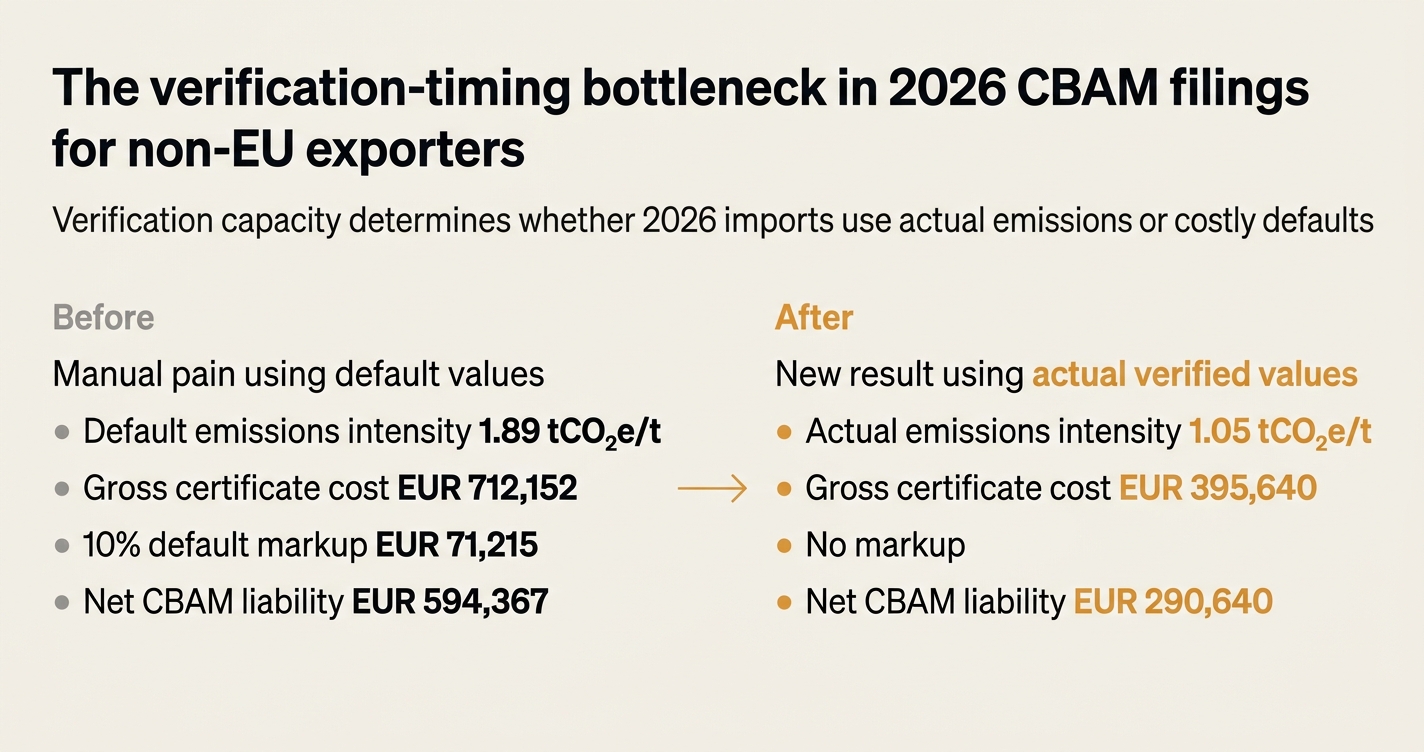
The shape of the argument, visualised below.
The 2026 verification window
The CBAM Regulation establishes a compressed timeline for the first compliance cycle:
| Milestone | Date | Implication |
|---|---|---|
| CBAM definitive regime begins | 1 January 2026 | Emissions from this date forward are subject to CBAM certificate purchase obligations. |
| Verifier registration opens | 1 September 2026 | National accreditation bodies in EU Member States begin registering verifiers accredited under EN ISO/IEC 17029:2019. |
| Calendar year 2026 emissions monitoring concludes | 31 December 2026 | Installations must have collected a full year of data according to their monitoring plan. |
| Verification reports for 2026 emissions issued | January–September 2027 | Verifiers conduct on-site audits, assess monitoring plans, and issue reports. |
| First annual CBAM declaration due | 31 May 2027 | EU importers submit declarations for goods imported in 2026, supported by verification reports if using actual values. |
The European Commission published the verification standards in Implementing Regulation (EU) 2025/2546 in late 2025, leaving fewer than nine months for the global verifier market to scale from zero to sufficient capacity to audit thousands of production installations across steel, aluminium, cement, fertilizers, hydrogen, and electricity sectors worldwide. The European Fastener Distributor Association notes that "a limited number of auditors will have to conduct on-site inspections of thousands upon thousands of companies worldwide that manufacture CBAM-relevant goods within nine months," creating a bottleneck that "cannot realistically be assumed" to clear in time for verified actual values to support 2026 import declarations.[5]
The default-value markup in numbers
Default values carry two financial penalties. First, they overstate emissions for most modern producers—default values are set at country-level average intensity, not installation-level performance. A UK steel mill running efficient processes will almost certainly have lower actual embedded emissions than the default assigned to UK steel production as a whole.[6] Second, they trigger the markup under Article 9 of Regulation (EU) 2023/956.
"Under Implementing Regulation (EU) 2025/2621, importers using default values pay a markup on top of the certificate cost: 10% in 2026, rising to 20% in 2027, and 30% from 2028 onward. Verified actual data eliminates the markup entirely."[7]
Consider a worked example from eco-shaper: a UK steel exporter ships 5,000 tonnes of basic oxygen furnace (BOF) steel to the EU in 2026. The default embedded emissions intensity for UK BOF steel is 1.89 tCO₂e per tonne. The installation's actual emissions intensity, measured via a monitoring plan compliant with Implementing Regulation (EU) 2025/2547, is 1.05 tCO₂e per tonne. The CBAM certificate price is EUR 75.36 per tonne CO₂e, and the UK Emissions Trading System (ETS) carbon cost is EUR 20 per tonne.
Using default values
| Step | Calculation | Result |
|---|---|---|
| Embedded emissions | 5,000t × 1.89 tCO₂e/t | 9,450 tCO₂e |
| Gross certificate cost | 9,450 × EUR 75.36 | EUR 712,152 |
| Default markup (10% in 2026) | EUR 712,152 × 10% | EUR 71,215 added |
| Adjusted gross cost | EUR 712,152 + EUR 71,215 | EUR 783,367 |
| UK ETS carbon cost deduction | 9,450 × EUR 20 | EUR 189,000 deducted |
| Net CBAM liability | EUR 783,367 - EUR 189,000 | EUR 594,367 |
Using actual values
| Step | Calculation | Result |
|---|---|---|
| Embedded emissions | 5,000t × 1.05 tCO₂e/t | 5,250 tCO₂e |
| Gross certificate cost | 5,250 × EUR 75.36 | EUR 395,640 |
| No default markup | No surcharge applies | EUR 395,640 |
| UK ETS carbon cost deduction | 5,250 × EUR 20 | EUR 105,000 deducted |
| Net CBAM liability | EUR 395,640 - EUR 105,000 | EUR 290,640 |
The difference is EUR 303,727 for a single 5,000-tonne shipment—a 104% cost premium for using defaults. The markup accounts for EUR 71,215 of that delta, but the larger driver is the 1.8x emissions intensity gap between default and actual values. The exporter's financial incentive to secure verification is clear. The operational question is whether a verifier slot will be available in 2027 to audit 2026 emissions before the 31 May 2027 filing deadline.
The precursor-emission verification chain
CBAM embedded emissions are calculated using a top-down approach: emissions are monitored at installation level, attributed to production processes, and then converted to specific embedded emissions for the goods produced.[8] For primary steel, aluminium, or cement, this means the exporter's installation is the single point of verification. For downstream products—fasteners, bolts, screws, or other fabricated goods—the verification chain extends upstream through every precursor material.
Implementing Regulation (EU) 2025/2547 requires that emissions from precursor materials be included in the embedded emissions calculation. If a fastener manufacturer in Türkiye uses steel rod from a supplier in India, the embedded emissions of the Indian steel rod—including its own precursor emissions from iron ore pellets, coke, and electricity—must be verified. If the Indian steel supplier has no monitoring plan, or if no verifier completes an on-site audit of the Indian installation by September 2027, the Turkish fastener manufacturer must use the default value for Indian steel. That default value will be higher than the actual emissions of an efficient Indian mill, and it will carry the 10% markup in 2026.
The complexity multiplies with each tier in the supply chain. A bolt requires steel rod, which requires hot-rolled coil, which requires crude steel, which requires iron ore pellets and coke. Each step requires a separate monitoring plan, a separate verification, and a separate verifier slot. The European Fastener Distributor Association observes that "emissions from production processes that are far removed from the production processes of raw materials and spread across different companies in different countries will have to be verified," and "as things stand at present, it is highly unlikely that verified actual emission values will be available for imports in 2026" given the cascading verification dependency.[9]
The verifier accreditation pathway
Accredited CBAM verifiers must meet the requirements in Commission Delegated Regulation (EU) 2025/2551 and be accredited by the national accreditation body of an EU Member State against EN ISO/IEC 17029:2019, the standard for validation and verification bodies.[10] Accreditation is not automatic—verifiers must demonstrate technical competence in GHG emissions monitoring, sector-specific knowledge (steel, aluminium, cement, fertilizers, hydrogen, or electricity), and the ability to conduct on-site audits in third countries. The German Emissions Trading Authority (DEHSt) notes that verifier registration opened on 1 September 2026, with the first verifiers expected to complete accreditation by late 2026.[11]
Once accredited, verifiers must conduct a physical site visit of the non-EU installation in the first year the installation is subject to verification. Subsequent years allow limited flexibility—virtual site visits or waivers—provided strict conditions are met, including completion of a prior physical site visit and a verifier risk assessment demonstrating that reliability would not be compromised.[12] For 2026 emissions, physical site visits are mandatory, full stop. If a verifier cannot schedule an on-site audit of a Turkish steel mill or an Indian cement plant before September 2027, the installation's 2026 emissions remain unverified, and the EU importer uses default values.
The pre-verification option
Carbonchain, a supply-chain emissions data platform, recommends that installations undergo pre-verification in 2026: "It is recommended that installations undergo pre-verification in 2026."[13] Pre-verification is not a formal regulatory concept—Implementing Regulation (EU) 2025/2546 defines only one verification pathway, applicable from 2026 onward—but the term describes a pragmatic dry run: the installation engages a verifier, implements a monitoring plan, collects data for a subset of 2026 (e.g., Q1 and Q2), and receives feedback on whether the monitoring plan and data quality would pass a full audit. Pre-verification does not produce a report usable in the 2027 CBAM declaration, but it de-risks the 2027 verification by surfacing gaps early.
For exporters with high-volume shipments to the EU—5,000+ tonnes per year of steel, 10,000+ tonnes of cement, or continuous electricity exports—pre-verification in 2026 is a hedge against the 2027 verifier bottleneck. If the installation identifies missing utility bills, incomplete production logs, or precursor emissions data that cannot be traced to source documents, those gaps can be closed in real time, rather than discovered in August 2027 when it is too late to adjust. The cost of pre-verification is a verifier's day rate (typically EUR 1,500–3,000 per day) for a scoping visit and methodology review, a fraction of the EUR 300,000+ cost delta in the worked example above.
The 2026 emissions monitoring checklist
Whether an exporter pursues pre-verification or plans for full verification in 2027, the same data infrastructure is required. Implementing Regulation (EU) 2025/2547 prescribes calculation-based or measurement-based methodologies for direct and indirect emissions:
- Installation-level emissions: The operator monitors all CO₂ emissions from fossil fuel combustion, process emissions (e.g., calcination in cement, reduction in steel), and indirect emissions from consumed electricity. For aluminium, perfluorocarbon (PFC) emissions from anode effects are included. For fertilizers, nitrous oxide (N₂O) emissions from ammonia oxidation are included.
- Activity data: Monthly fuel consumption (natural gas, coal, coke, diesel) from utility bills or metering logs. Monthly electricity consumption from utility bills, with grid emission factors from Annex IV of Implementing Regulation (EU) 2025/2547 if actual supplier-specific data is unavailable.
- Emission factors: For calculation-based methods, emission factors from Annex I of Implementing Regulation (EU) 2025/2547 (e.g., 56.1 tCO₂/TJ for natural gas, 94.6 tCO₂/TJ for anthracite coal). For measurement-based methods, continuous emissions monitoring system (CEMS) data calibrated to EN 14181.
- Production logs: Monthly production volumes for each CBAM good produced (e.g., crude steel output in tonnes, clinker output in tonnes, ammonia output in tonnes). Attribution of emissions to production processes and conversion to specific embedded emissions per tonne of output.
- Precursor materials: Invoices, bills of material, and emissions declarations from upstream suppliers for all precursor materials used in production (e.g., hot-rolled coil invoices for a fastener manufacturer, iron ore pellet invoices for a steel mill). If precursor suppliers provide actual emissions data, that data must also be verified. If not, default values apply.
The monitoring plan must be documented in a format compatible with the CBAM Registry's Operator Communication Interface (O3CI). The O3CI portal is part of the CBAM Registry and enables operators in third countries to provide CBAM declarants with emissions and company data directly. Registration in O3CI is voluntary but reduces manual data entry and transmission errors.[14]
The 2027 enforcement question
The European Commission has not yet published guidance on how it will enforce CBAM obligations when verified actual data is unavailable. The CBAM Regulation is explicit that importers must surrender CBAM certificates corresponding to the embedded emissions of imported goods, but it does not specify whether importers will face penalties if they are unable to secure verification reports due to verifier unavailability rather than non-compliance. The International Carbon Action Partnership notes that "early 2026: The Commission will adopt the implementing act establishing the methodology for deducting carbon prices effectively paid in third countries under CBAM," suggesting that enforcement details will continue to evolve in 2026.[15]
One plausible scenario: the Commission grants a transitional period for 2026 imports, accepting default values without the markup if the importer can demonstrate that the installation had a compliant monitoring plan and attempted to secure verification but no verifier slot was available. Another scenario: the Commission enforces the markup strictly, treating verifier unavailability as the importer's problem. The exporter's supplier contract with the EU importer should address this risk explicitly—if the importer pays the default-value markup due to verification delays, does the exporter reimburse the markup, or does the importer absorb the cost?
How Emission3 fits
Emission3 is designed for the non-EU exporter who knows that actual emissions data is the only path to lower CBAM certificate costs, but who needs to convert raw documents—utility bills, production logs, precursor invoices—into verification-ready evidence before a verifier arrives. The platform ingests monthly utility bills and production logs, maps them to installation-level emissions, and generates the monitoring plan and emissions report in the format required by Implementing Regulation (EU) 2025/2547. Every calculation is reproducible, with a full lineage from source document to filing.
For 2026 monitoring, Emission3 exports include:
- A quarterly emissions report for submission to EU importers, updated on a rolling 12-month basis.
- A pre-verification evidence pack with document lineage, emission factors, and production attribution, ready for a verifier's scoping visit.
- An O3CI-compatible data package for direct upload to the CBAM Registry.
The workflow starts with a CBAM readiness call, where we map your supplier relationships, identify precursor emissions dependencies, and scope the monitoring plan. If you are shipping 5,000+ tonnes per year to the EU and want to use actual values in 2027, but the verifier bottleneck makes 2026 implementation uncertain, this is the conversation to have now. Learn more at /solutions/cbam.
What to do in 2026
If you are a non-EU exporter with CBAM-relevant goods shipped to the EU in 2026, the tactical sequence is:
- Start monitoring now. Collect utility bills, fuel receipts, and production logs monthly, even if verification is not scheduled until 2027. The 31 May 2027 declaration deadline requires a full calendar year of 2026 data. Gaps discovered in July 2027 cannot be filled retroactively.
- Engage a verifier early. Contact verifiers accredited under Delegated Regulation (EU) 2025/2551 and request a slot for a 2027 on-site audit. If verifiers are fully booked, ask to be added to a waitlist. Pre-verification in late 2026, if available, is a hedge against 2027 capacity constraints.
- Map precursor emissions. If your goods include precursor materials (e.g., steel rod, hot-rolled coil, cement clinker), contact upstream suppliers and confirm whether they have monitoring plans and verification capacity. If not, default values will apply to the precursor component.
- Negotiate supplier contracts. Clarify with EU importers whether the exporter or the importer bears the cost of the default-value markup if verification is unavailable. This is a commercial question, not a regulatory one, and the answer varies by contract.
- Budget for both scenarios. Model the CBAM certificate cost using both actual values (assuming verification succeeds) and default values (assuming it does not). The delta is your maximum downside exposure.
The verification-timing bottleneck is not a data problem. It is a capacity problem, and capacity does not scale instantly. The exporters who secure verifier slots in 2027 will be the exporters who started building the monitoring infrastructure in 2026, documented every utility bill and production log, and had evidence packs ready when verifiers came online. The exporters who wait until 2027 will use default values and pay the markup, regardless of their actual emissions performance.
If you are ready to map your 2026 monitoring plan and understand what verifiers will ask for when they arrive, the next step is a CBAM readiness call. We will walk through your production process, identify where the data lives today, and scope the evidence infrastructure you need before the first verifier site visit. Book a CBAM readiness call here.
References & Sources
External Sources
- [1]EU CBAM 2026: How to calculate your liability
Detailed explanation of default value markups (10% in 2026, 20% in 2027, 30% from 2028) and worked example comparing default versus actual emissions for UK steel exporter.
- [2]CBAM Default Values 2026: Country Values, Mark-ups and Costs
Commission third-party verification requirements, EN ISO/IEC 17029:2019 accreditation, physical site visit mandate in first year, and verifier registration opening 1 September 2026.
- [3]EU CBAM 2026: How to calculate your liability
Timeline analysis showing accredited CBAM verifiers not expected operating at scale before September 2026, and verification of 2026 emissions cannot be completed before 30 September 2027 declaration deadline.
- [4]CBAM cost calculation in 2026
European Fastener Distributor Association analysis of downstream product verification challenges, noting that emissions from precursor materials spread across multiple companies in different countries must all be verified.
- [5]CBAM cost calculation in 2026
EFDA assessment that a limited number of auditors conducting on-site inspections of thousands of companies worldwide within nine months creates a bottleneck that cannot realistically clear for 2026 imports.
- [6]EU CBAM 2026: How to calculate your liability
Explanation that default values overstate emissions because they are set at country-level average intensity, not installation-level performance, with UK steel mill example.
- [7]EU CBAM 2026: How to calculate your liability
Quote on Implementing Regulation (EU) 2025/2621 markup structure: 10% in 2026, 20% in 2027, 30% from 2028, with verified actual data eliminating markup entirely.
- [8]EU CBAM Emissions Data: Monitoring, Reporting & Verification
Top-down calculation approach: emissions monitored at installation level, attributed to production processes, converted to specific embedded emissions for goods produced, per IR 2025/2547.
- [9]CBAM cost calculation in 2026
EFDA observation on downstream products: emissions from production processes far removed from raw materials, spread across different companies in different countries, highly unlikely verified actual values available for 2026 imports.
- [10]CBAM Default Values 2026: Country Values, Mark-ups and Costs
Delegated Regulation (EU) 2025/2551 requirements for verifier accreditation by national accreditation bodies under EN ISO/IEC 17029:2019.
- [11]DEHSt - CBAM Definitive Regime from 2026
German Emissions Trading Authority confirmation that verifier registration in CBAM Registry opened 1 September 2026, with first verifiers expected late 2026.
- [12]A Guide to the EU CBAM
Verification Regulation detail on site visits: physical site visit mandatory starting 2026, subsequent years allow virtual visits or waivers under strict conditions including prior physical visit and verifier risk assessment.
- [13]CBAM | Your Guide to the EU Carbon Border Adjustment Mechanism
Carbonchain recommendation that installations undergo pre-verification in 2026 to de-risk 2027 filing timelines.
- [14]DEHSt - CBAM Definitive Regime from 2026
O3CI portal as part of CBAM registry enabling operators in third countries to provide emissions and company data directly, reducing manual data entry and transmission errors, voluntary registration.
- [15]EU CBAM enters compliance phase and outlines path ahead
International Carbon Action Partnership noting Commission will adopt implementing act in early 2026 establishing methodology for deducting carbon prices effectively paid in third countries.
Related Content
- [16]How Emission3 handles CBAM
Specific to CBAM exporters, shows the installation-data flow from utility bills to verification-ready evidence packs.
- [17]Book a CBAM readiness call
All customers start with a readiness call: we map suppliers, gaps, and implementation, no anonymous self-serve onboarding.