The verification timeline bottleneck in 2026 CBAM filings
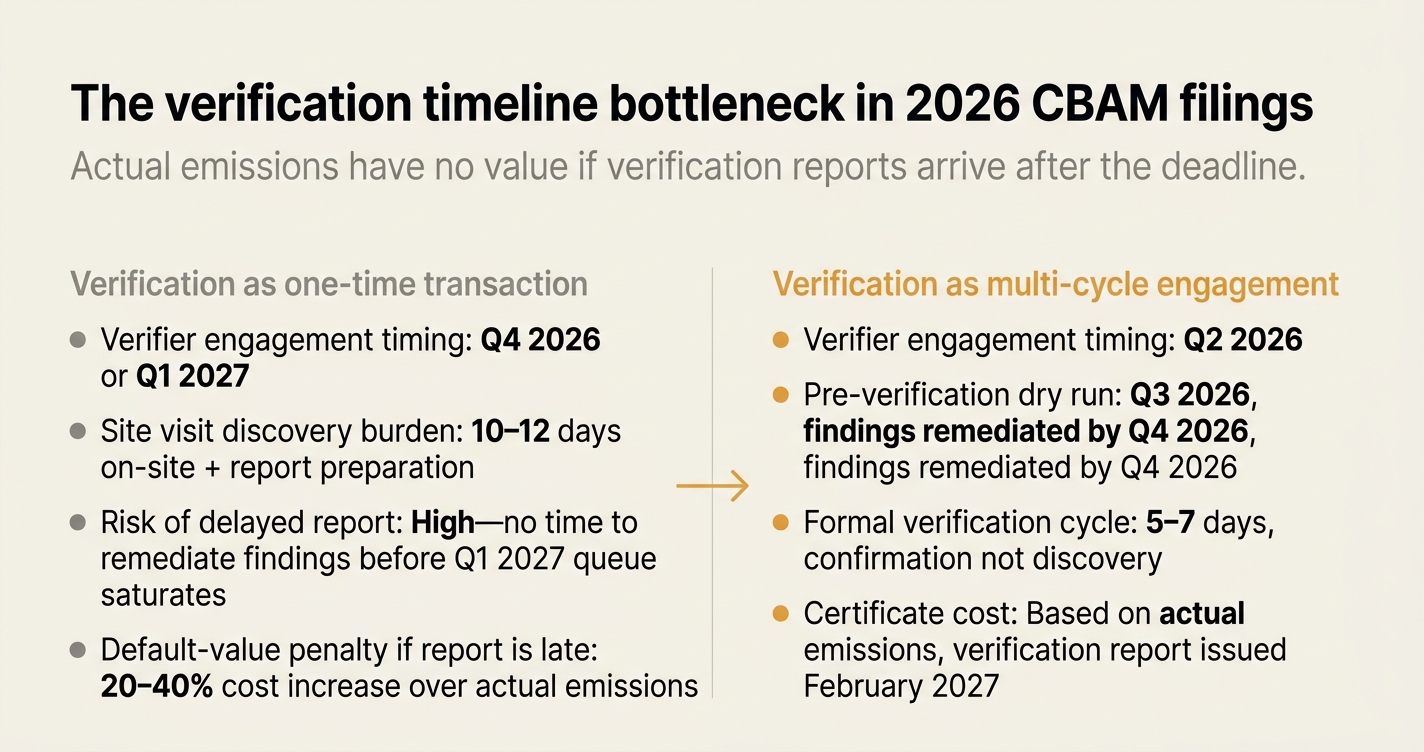
The verification timeline bottleneck in 2026 CBAM filings
Here's the issue: a non-EU steel exporter ships 10,000 tonnes of hot-rolled coil to Hamburg in March 2026. The importer must declare embedded emissions by September 2027. The exporter has installation-level production data, utility bills, and a monitoring plan. Everything looks audit-ready. But the verification body cannot issue a report until calendar year 2026 closes, and the on-site visit cannot happen until Q1 2027 at the earliest. If the verification queue runs long, the importer defaults to benchmark values—inflating the CBAM certificate cost by 20–30% over actual emissions.
However, a 2026 CBAM filing consists of two things: the embedded emissions calculation, and the verification timeline that makes those emissions eligible for declaration.
The embedded emissions calculation on its own has no value. The verification timeline is what the EU registry is actually enforcing. If the verifier cannot complete the on-site visit and issue the report before the September 2027 deadline, the actual emissions data becomes inadmissible, and the importer is forced onto default values—regardless of how accurate the underlying calculation is.
While actual emissions monitoring has become more accessible, verification capacity has become more constrained. If every exporter to the EU requires a physical site visit in Q1 2027, and accredited verifiers cannot be registered until after September 2026, the queue for calendar-year 2026 verifications might exceed available capacity by a factor of three to five. The result: importers who budgeted for actual values pay the default-value penalty because the verification report arrived too late.
How do you solve this? I think the operators we work with are treating 2026 as a pre-verification dry run. They're engaging accredited verifiers in mid-2026 to conduct a preliminary site visit before the formal 2026 calendar-year close, so the final verification in Q1 2027 becomes a confirmation cycle rather than a discovery cycle. For now, the operators who avoid the default-value penalty are the ones who moved the verification relationship forward by six months.
Visualized:
The shape of the verification bottleneck
The EU's verification requirements for 2026 create a structural mismatch between data availability and verification capacity. Embedded emissions for calendar year 2026 cannot be finalized until December 31, 2026. Accredited verifiers cannot be registered in the CBAM infrastructure until after September 2026. Physical on-site visits are mandatory for 2026, and the verification report must be issued before the importer's September 2027 declaration deadline. This creates a nine-month window in which every non-EU installation exporting CBAM-covered goods must undergo verification.
The mechanics of the bottleneck are documented in the draft technical implementing regulation circulating in the EU steel market in early 2025[1]. Benjamin Steven, writing on LinkedIn in December 2025, notes: "Some fear this will create an unsustainable demand for accredited verifiers in early 2027 to visit and verify emissions for calendar year 2026, and could see importers pushed onto default values if verifications cannot be completed in time."[2]
The materiality threshold for 2026 verifications is 5% of total embedded emissions per CN code[3]. For a mid-sized steel installation shipping 50,000 tonnes annually across three product categories, this means the verifier must assess at least 15 source data points, conduct physical inventory checks, and reconcile utility meter readings against production logs. A single site visit typically requires 2–3 days on-site plus 5–7 days of report preparation. If the verifier is working through a queue of 40–60 installations in Q1 2027, the calendar math does not close.
✅ The 12-step verification readiness checklist for 2026
This checklist is sequenced to move verification relationships forward by six months, so the formal 2026 calendar-year verification becomes a confirmation cycle rather than a discovery cycle. Each step includes the action, the internal owner, and the evidence artifact produced.
Step 1: Identify CBAM-covered CN codes and annual tonnage by destination
Owner: Export compliance manager
Done when: A spreadsheet lists every 8-digit CN code shipped to the EU in 2025, with tonnage and destination country.
Evidence artifact: CN code × tonnage × destination matrix.
Step 2: Map production processes to CN codes
Owner: Production planning
Done when: Each CN code is linked to the specific production route (e.g., blast furnace → basic oxygen furnace → hot rolling for CN 7208 39 10).
Evidence artifact: Production route flowchart per CN code.
Step 3: Inventory emission sources by production process
Owner: HSE / environmental manager
Done when: A complete list of direct emissions (fuel combustion, process emissions) and indirect emissions (electricity, heat) per production process.
Evidence artifact: Emission source inventory table.
Step 4: Assign monitoring points to emission sources
Owner: Operations / instrumentation team
Done when: Each emission source has a named meter, sensor, or manual sampling protocol, with calibration records.
Evidence artifact: Monitoring point register.
Step 5: Draft a CBAM monitoring plan
Owner: Environmental reporting lead
Done when: A written plan that maps installation boundaries, production processes, emission sources, monitoring methods, and data retention protocols.
Evidence artifact: CBAM monitoring plan document (20–40 pages).
Step 6: Engage an accredited verifier for pre-verification
Owner: CFO / external audit relationship manager
Done when: A verifier accredited under ISO 14065 (or equivalent) has been contracted for a preliminary site visit in Q3 2026.
Evidence artifact: Signed engagement letter with pre-verification scope.
Step 7: Conduct the pre-verification site visit
Owner: Verifier + on-site operations team
Done when: The verifier has physically inspected monitoring equipment, reviewed calibration logs, and interviewed process engineers.
Evidence artifact: Pre-verification findings memo.
Step 8: Remediate pre-verification findings
Owner: Environmental reporting lead
Done when: All material non-conformities identified in the pre-verification have been corrected (e.g., missing calibration certificates, incomplete source inventory).
Evidence artifact: Remediation action log.
Step 9: Monitor actual emissions through calendar year 2026
Owner: Operations / environmental data team
Done when: Monthly emissions totals per production process, with source documents (utility bills, fuel invoices, meter readings) archived.
Evidence artifact: Monthly emissions workbook.
Step 10: Close the 2026 calendar year and finalize embedded emissions
Owner: Environmental reporting lead
Done when: Total embedded emissions per CN code, with production tonnes and specific emissions intensity (tCO₂e per tonne of product).
Evidence artifact: 2026 embedded emissions summary table.
Step 11: Schedule the formal verification site visit
Owner: Verifier + on-site coordination team
Done when: The verifier has confirmed a site visit date in January or February 2027, before the Q1 queue saturates.
Evidence artifact: Site visit confirmation email.
Step 12: Receive the verification report
Owner: CFO / external audit relationship manager
Done when: The verifier issues a compliant verification report in the EU electronic template, with an unqualified opinion on the 2026 embedded emissions.
Evidence artifact: Verification report (uploaded to CBAM Registry or transmitted to importer).
Verification timeline constraints in the 2025 implementing regulations
The December 22, 2025 implementing regulation (IR 2025/2546) defines verification requirements for the definitive phase starting January 1, 2026[4]. Physical site visits are mandatory for 2026. From 2027, the verifier may replace the physical visit with a virtual visit or waive the visit entirely—but only after visiting the installation at least once in 2026, and only if data credibility is not compromised. Physical visits must occur at least every two years.
The verification report must be transmitted via the CBAM Registry (if the operator is registered) or by other means (if not registered)[5]. Verification reports for 2026 can be issued in the electronic EU template from January 2027 via the CBAM Registry. This means the earliest possible issuance date for a compliant 2026 verification report is January 1, 2027, and the latest acceptable date is early September 2027 to allow the importer time to prepare the declaration.
The Bipartisan Policy Center, writing in December 2025, observes: "Even importers that have sufficient emissions data for each step of their good's manufacturing process are likely to be inhibited by the verification timeline. Actual emissions data must be verified via an in-person site visit to each facility that manufactures a component of the CBAM-covered good. What's more, verification of each facility in the supply chain must take place in the same order that the good is manufactured. Since facilities cannot calculate their 2026 emissions until year's end and importers must submit their 2026 CBAM data by September 2027, long verification queues seem likely."[6]
The default-value fallback and the 20–30% penalty
If the verification report is not available by the September 2027 deadline, the importer must use default values. Default values are country- and product-specific average emissions intensities, with a markup: 10% in 2026, 20% in 2027, 30% in 2028 and beyond[7]. For a US hot-rolled coil exporter with actual emissions of 1.8 tCO₂e per tonne, the US default value might be 2.3 tCO₂e per tonne plus the 10% markup, yielding a declared intensity of 2.53 tCO₂e per tonne—a 40% increase over actual.
Carbon Chain notes: "From 2026, relying on defaults instead of verified actuals will significantly increase your CBAM cost exposure. The Commission revised default benchmarks downward in late 2025, which actually raises CBAM exposure for most products."[8] The downward revision means the default values are more conservative than earlier drafts, but still systematically higher than installation-level actuals for efficient producers.
The financial consequence: if the EU ETS carbon price averages €80 per tonne in 2026, and the importer declares 2.53 tCO₂e per tonne instead of 1.8 tCO₂e per tonne, the additional CBAM certificate cost is (2.53 − 1.8) × €80 = €58.40 per tonne of product. For a 10,000-tonne shipment, this is €584,000 in avoidable costs—driven entirely by the verification timeline, not the underlying emissions performance.
How Emission3 fits
Emission3 positions the pre-verification cycle as a first-class workflow, not an afterthought. When a non-EU exporter books a CBAM readiness call, we map:
- CN codes and production routes: Which goods are CBAM-covered, which production processes feed each CN code, and where the installation boundaries are drawn.
- Emission source inventory: Which direct and indirect sources must be monitored, and whether current metering infrastructure meets CBAM granularity requirements.
- Monitoring plan gaps: What the verifier will ask for in the pre-verification site visit, and which evidence artifacts are missing or incomplete.
- Verification relationship timing: When to engage the verifier (target: Q2 2026), when to schedule the pre-verification visit (target: Q3 2026), and when to remediate findings (target: Q4 2026).
Emission3's document-first ingestion model means utility bills, fuel invoices, and production logs are captured as source evidence, not summary tables. When the verifier conducts the pre-verification visit, they see a line-item lineage from meter reading to monthly emissions total to specific embedded emissions per CN code. This reduces the on-site discovery burden and shortens the formal 2026 verification cycle from 10–12 days to 5–7 days.
For operators who missed the Q2 2026 engagement window, Emission3 provides a fallback: we run the monitoring plan and emissions calculation in parallel with the formal verification in Q1 2027, so the verifier receives a complete data package on day one of the site visit. This does not eliminate the queue risk, but it removes data preparation as a source of delay.
The pre-verification dry run as the 2026 default posture
The operators who avoid the default-value penalty in 2026 are the ones who treated the verification relationship as a multi-cycle engagement, not a one-time transaction. The pre-verification site visit in Q3 2026 serves three functions:
- Calibration check: The verifier confirms that monitoring equipment is properly calibrated and that calibration records are complete.
- Methodology confirmation: The verifier reviews the allocation of installation-level emissions to production processes, and the attribution of process emissions to individual CN codes.
- Evidence artifact audit: The verifier samples source documents (utility bills, fuel invoices, meter logs) to confirm that the data retention protocol meets CBAM requirements.
If the pre-verification identifies a material non-conformity (e.g., a missing emission source, an incomplete calibration log, or an incorrect allocation method), the operator has three months to remediate before calendar year 2026 closes. This is the difference between an unqualified opinion in February 2027 and a qualified opinion (or delayed report) in April 2027.
For exporters who have not yet engaged a verifier, the calendar is already tight. A mid-2026 engagement leaves enough time for a Q3 pre-verification and a Q4 remediation cycle. A Q4 2026 engagement leaves no time for a dry run, and pushes all discovery risk into the formal Q1 2027 verification.
Next step: book a CBAM readiness call
If you're a non-EU exporter shipping CBAM-covered goods in 2026, the verification timeline is the constraint that sets your certificate cost. Book a CBAM readiness call with Emission3 to map your CN codes, production routes, emission sources, and verification relationship timing. We'll identify the gaps that would delay your 2026 verification, and scope the pre-verification cycle to move the discovery burden forward by six months[9].
All Emission3 customers start with a readiness call: we map suppliers, gaps, and implementation, no anonymous self-serve onboarding. The readiness conversation is a workflow design session, not a demo.
References & Sources
External Sources
- [1]EU steel market sees CBAM draft circulation, importers face uncertainty
Benjamin Steven discusses the draft technical implementing regulation for CBAM verification requirements, noting the structural mismatch between calendar year emissions and verification capacity in Q1 2027.
- [2]EU steel market sees CBAM draft circulation, importers face uncertainty
Benjamin Steven on the unsustainable demand for accredited verifiers in early 2027 and the risk of importers being pushed onto default values if verifications cannot be completed in time.
- [3]CBAM: A guide to Carbon Border Adjustment Mechanism
OneClickLCA on the 5% materiality threshold for total embedded emissions and total specific embedded free allocation per CN code in the definitive phase verification requirements.
- [4]CBAM reporting requirements & Compliance Guide for 2026
Clean Carbon overview of the December 22, 2025 implementing regulation (IR 2025/2546) defining physical site visit requirements for 2026 and the conditions under which virtual visits or waivers are permitted from 2027.
- [5]EU CBAM Emissions Data: Monitoring, Reporting & Verification
CO2-IQ on how verification reports can be transmitted to the operator via the CBAM Registry or by other means, and the availability of the electronic EU template from January 2027.
- [6]High CBAM Default Values Underscore the Need for U.S. Data
Bipartisan Policy Center analysis of the verification timeline constraint: facilities cannot calculate 2026 emissions until year-end, and importers must submit 2026 CBAM data by September 2027, creating long verification queues.
- [7]How the EU's New Default Emissions Values Under CBAM Impact US Exporters
O'Melveny & Myers on the markup applied to default values: 10% in 2026, 20% in 2027, 30% in 2028 and beyond, and the need for actual emissions monitoring and third-party verification to avoid these penalties.
- [8]CBAM | Your Guide to the EU Carbon Border Adjustment Mechanism
Carbon Chain on the December 2025 revision of default benchmarks downward, which paradoxically raises CBAM exposure for most products by making the default values more conservative than earlier drafts.
Related Content
- [9]Book a CBAM readiness call
All Emission3 customers start with a readiness call: we map suppliers, gaps, and implementation, no anonymous self-serve onboarding. The readiness conversation is a workflow design session, not a demo.
- [10]How Emission3 handles CBAM
Specific to CBAM exporters, shows the installation-data flow from utility bills and production logs to line-item evidence and verification-ready reporting.